Archives for category: Frames of mind
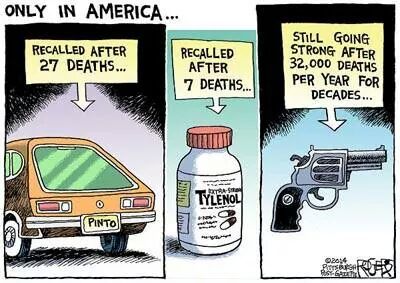
There is a small difference between the first two and the last one.
The car and the pills where supposed to be safe while the guns have been purposefully designed to be deadly.
Just as ‘beauty is in the eye of the beholder’, guns are dangerous only if used inappropriately while a badly designed car or some tainted pills are dangerous no matter what!

Boy… do I see it coming?
Yes!
So what?!?
Like the man just said, it’s our duty as human beings to act as such.

And here is the other side of the story:

Just found this in my inbox:

A little boy was waiting for his mother to come out of the grocery store.
As he waited, he was approached by a man who asked, “good morning young
man, can you tell me where the Post Office is?”

The little boy replied, “Sure! Just go straight down this street a coupla
blocks and turn to your right.”

The man thanked the boy kindly and said, “I’m the new pastor in town.  I’d
like for you to come to church on Sunday…I’ll show you how to get to
Heaven.”

The little boy replied with a chuckle.  “You’re bullshitting me, right?
……You don’t even know the way to the Post Office!”

A tour bus stops at a waterfall. Some of the tourists mill around while a woman takes “the opportunity to go freshen up and change clothes. When she reboarded the bus, the rest of the passengers didn’t realize it was her. Instead, they became alarmed that she’d gone missing.
The driver waits for a an hour before alerting the police and then a search party is organized. The coast guard joins in and the whole thing goes on for hours.
Meanwhile ‘the missing person’ was actually helping the search efforts. At some point she figured out it was her that everybody was looking for and informs the police.

Simon Brew, the writer of this article, has a very pertinent piece of advice: “It’s always worth properly counting the number of people on a tour bus. No matter what they happen to be wearing.”

OK, that makes a lot of sense.

Still… what I find extremely interesting about this entire development is that the people on the bus, not the driver, had noticed that a person is missing but no one had observed that a ‘new’ one had come aboard…
How much time had those people spent together before this had happened?

OK, the picture I used above was shot in a commuter train – where passengers just want to get to their destinations – but in a tourist coach people tend to regain their seats after a short stop and to remember their neighbors.
So how come those vacationers did notice that somebody didn’t come back but didn’t observe the stranger?

Deutsche Bank is sitting on more than $75 Trillion in derivatives bets — an amount that is twenty times greater than German GDP.

Both the next 3D printer and Deutsche Bank derivatives portfolio were designed by us, the human people.
When are we going to get our act together?

“We research and develop groundbreaking, cost-effective robotic technology with which we can 3D-print beautiful, functional objects in almost any form,” wrote MX3D on the project Web page. “The ultimate test? Printing an intricate, ornate metal bridge for a special location to show what our robots and software, engineers, craftsmen and designers can do.”

And why do we need the pope to remind us that the Earth is the only home we’ve got?


“Scientists weary after years of often vicious opposition by doubters of their climate-change findings see this year as crucial to the planet’s future because of a religious document expected from Pope Francis on Thursday. The rare encyclical, or teaching letter, expected to promote climate action as a moral imperative could do more to slow global warming than international negotiations this year to limit greenhouse gas emissions, scientists say.”

Oh, I forgot. Right now we are still under ‘the spell’, we have somehow convinced ourselves that having money, loads of it, trumps every thing else.

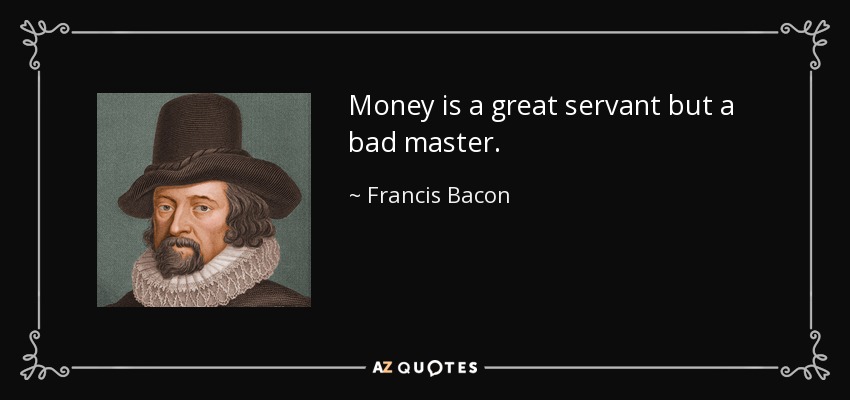
We’ll get over it, sooner or later. Francis Bacon has already warned us, all we need is to remember.

Or, even better, we can ask ourselves:

What is money, instrument or goal?

“An Amnesty International report reveals what the human rights group calls the ‘devastating impact’ of Ireland’s ban on abortion”

The same report asks us to take action and “urge” the Taoiseah (the prime minister of Ireland) to:

The troublesome amendment reads like this: “The State acknowledges the right to life of the unborn and, with due regard to the equal right to life of the mother, guarantees in its laws to respect, and, as far as practicable, by its laws to defend and vindicate that right.

On one side it make a lot of sense. What could be the difference between the life of the mother and that of the unborn and how could somebody choose between these two?

On the other side it unveils an ugly truth: “The State…”…

What we have here is a blatant example of an organized crowd – “the State” – imposing it’s will on a minority of it’s members in a matter that, in reality, doesn’t affect anything else but the feelings of the crowd. Besides the entire life of the mother, of course.

The point I’m trying to make is that we cannot equate the life of an unborn, specially so if the fetus is less than three month old, with that of its mother.
It makes a lot of sense to recognize the life of a self contained human being – once that it was born – and a lot less to impose as a sacrosanct value that of the life of a fetus that cannot survive, under any circumstances, outside the womb of its mother.
A child that has already survived its birth or a sick person can be successfully taken care of by the community. Same thing is not at all valid for an unborn fetus that is less than three months old.

So when discussing the relationship between the life of a mother and that of her unborn child we have two situations. When the fetus is too small to survive outside the womb it practically belongs to the mother and she should be the one who decides about it.
Only after the fetus has reached the stage from which it could survive a miscarriage we enter the realm described by the 8Th Amendment. Only from that moment on the life of the child becomes equivalent to that of the mother and only from that moment on the pregnancy should be terminated only if the life of the mother is in immediate danger, as specified by the current Irish legislation.

That was how an old friend of mine – thanks Oache – was treating anyone who complained too much.
And there were plenty reasons to complain about during Ceausescu’s communist rule over Romania.

Five minutes ago I found this in my inbox:

A  young couple moves into a new  neighborhood.
The next morning while they are  eating breakfast,
The young woman sees her  neighbor hanging the wash  outside.
“That  laundry is not very clean,” she said.
“She  doesn’t know how to wash correctly.
Perhaps  she needs better laundry  soap.”
Her  husband looked on, but remained  silent.

Every time her neighbor would  hang her wash to dry,
The young woman would  make the same comments.

About one month  later, the woman was surprised to see a
Nice  clean wash on the line and said to her  husband:
“Look, she has learned how to  wash correctly.
I wonder who taught her  this.”
The husband said, “I got up early  this morning and
Cleaned our  windows.”

And so it is with life.   What we see when watching others
Depends on  the purity of the window through which we  look.
 

I’d go even further than that.
The way we perceive what’s going on around us depends heavily on the ‘filter’ each of us chooses to use when trying to make some sense of this world.
Catalin Zamfir, a Romanian sociologist with a keen interest in the decision making process, has studied how individuals try to assuage the feeling of acute/constant uncertainty experienced by each of them during the constant (social) encounters that constitute ‘daily life’. In one of his early books, unfortunately not yet translated in English, he explains that ‘ideology’ is not only a blue print for future action but also, and maybe even more important, the lens/filter through which we perceive what is going on around us. An interface that translates ‘reality’ into ideas that make sense for each of us.
The interesting thing about ‘ideology’ is that it isn’t fixed. Each of us can choose from whatever is available in his time or even ‘write’ his own.
Granted, the process of selection/rewriting incurs costs/risks. Some obvious, like adopting a contrarian stance, and others very well hidden in plain view, like the dangers that arise from indiscriminately following a herd.
And this is exactly why we should strive to keep our windows/ideological eyes as clean as possible.

‘Democracy’ comes from ‘demos’, the Greek word for ‘people’.
Basically a democratic society is  a social arrangement where the people is in charge. Through representatives, as in most cases, or even directly – the Swiss organize referendums whenever they have something really important to decide.

‘Republic’ comes from Latin. ‘Res publica’ means ‘public matters (=issues)’ so a republic can be seen as a social arrangement where everything is out in the open.

Would it make any sense for the public to know everything that is going on if they don’t have any say in the matter? Could democracy work if people are kept in the dark?

So.
In communism the state (in fact the rulers) decide everything – who does what and who gets what.
In socialism there is not much difference from the previous state. (I can vouch for both propositions, I’ve lived under both regimes)
‘Anarchy’ means no rules. If you happen to have two cows you need to defend them constantly, by your own, against anyone who covets them. Remember, anarchy means ‘no rules’ whatsoever. You cannot cherry-pick. I like this rule (property rights are fundamental for me) so this one stays in place while the the rules that I don’t like will be discarded.
As in ‘I won’t respect but the rules I like and I’ll hold everybody else to respect mine’.
That would be an absolutely one sided anarchy. If you’d be able to enforce such an arrangement it would be perceived by everybody else as the most authoritarian regime ever and Stalin would be jealous of your accomplishments.
As I said before ‘democracy’ means people having their say about how things are settled in a that particular society. If people respect each-other you have real democracy. If people band together to decide, against the will of the owner, about the fate of those fabled two cows we can no longer speak about true democracy. That would be ‘mob rule’, just another form of ‘anarchy/authoritarianism’. One ‘organized’ by a ruler who is a callous spin doctor skilled enough in his trade to make a considerable portion of the population follow him, usually against their better interests.

I was just speaking about the mutual respect that exists among the members of a truly democratic society…. I have a distinct feeling that those who promote this meme think of themselves as being ‘the true democrats’… I’m not a religious person myself, not in the classic sense of the word anyway. But I won’t ever think of a religious person as being ‘ignorant’ based solely on his creed and I’ll never refer to him using such a word, regardless of his level of education. One of the reasons being that if I ‘indulge’ in such a barbarism he’ll never listen to me again.
Why should he? To get some more abuse from me?

Now lets get this straight.
Mutual respect is absolutely essential for democracy.
There can be no such thing as mutual respect among individuals whose goals are mutually exclusive.
This meme actually doesn’t make much sense. No matter how well armed the lamb is, a determined wolf would eventually sink its fangs in the lamb’s sweet flesh so a rational lamb would do his best to shoot the wolf at the first opportunity. What kind of democracy are we speaking about here?

Most governments don’t get this. You can stretch it only that far. At some point, no matter how authoritarian the regime, people will take to the street.
This doesn’t mean that democracy will automatically be installed after a public uprising, far from it. The Arab Spring is only the latest example.
It only means that people have it in themselves to try to improve their lot. If they find a way to do this together then the sky’s the limit.
And this is a fact. Only the democratic America successfully landed a man on the Moon. The Soviet Union was the first to start this game but wasn’t able to keep up.

Yeah? And what are bragging about here?
About not finding a candidate to suit your wishes AND not doing anything about this situation?
How about running yourself? Or at least going there and annulling your ballot…
If you do not vote at all the political establishment will consider that you are either content with what is going on or so despondent as to not care anymore. So why should they even consider your plight? In which direction should they change their behavior in order to suit your needs if you don’t express them when you have the chance?

Really? Is he indeed unable to make distinction between democracy and mob rule?
‘Democracy in and of itself is not necessarily a good thing’…
I’m afraid he didn’t get the gist of it!
Real (=functional, stable over long periods of time) democracy IS good while mob rule IS bad. Period.

So, any chance for this cute fellow to have nailed it?
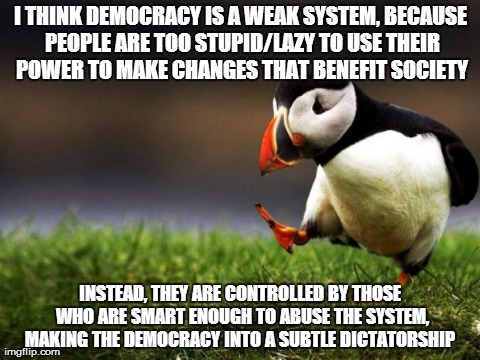
Close but there is space for improvement so I’ll try to rephrase this.
A democratic system invariable becomes weak/unstable if the general public becomes complacent and the power is grabbed by short-sighted but arrogant and callous spin doctors who, by eviscerating the true nature of democracy, transform the concept into an empty shell. This way the democratic process becomes a beauty pageant and an erstwhile democracy becomes a subtle dictatorship.

The strangest part of all this is that exactly those who should have known better – the professional politicians and some members of the academia – are the first to fall into the trap.

 

“Hope is a mistake. If you can’t fix what’s broken, you’ll go insane.” This muddled piece of dialogue grunted out by Max (Tom Hardy) is a pretty spot on summation of my thoughts on Mad Max: Furious Road. The fact that this film has somehow slipped into the consciousness of the masses, winning the heart of critics and blowing the minds of audiences, is an anomaly to me. With a staggering 98% approval rating on Rotten Tomatoes, I’m still questioning if I happened to miss something or not. I had hoped this would be the heart-thumping action film that others promised. I wanted to bawl over in joy becoming lost in a ridiculous, yet intelligent world created by director George Miller and his fellow screenwriters Brendan McCarthy and Nico Lathouris. But alas, Max was right. Hope is a mistake.” (The Cinephiliac)

OK, so is there anything to be gleaned out from here?

Firstly, hope is a mistake only if not followed through.
Yes, people might get mad if not able to fix what’s broken.
But there are alternatives.
Like next time fail better.
This way even if you don’t succeed at least you end up trying. Way better than locked up in a loony bin, specially so if the cell itself is of your own making.

Secondly, the 98% approval rate on Rotten Tomatoes bears a very clear message.
The audience is fed up. Basically with everything.

I just hope people will find a way to vent their grievances before they flare up and that the powers that be pay attention before the things go too far down the Fury Road.

Activists dismantle Ukraine’s biggest monument to Lenin at a rally in the eastern city of Kharkiv on Sept. 28, 2014. Photo: Igor Chekachkov/Associated Press

Wall Street Journal reports that Ukrainian people are somewhat baffled by  a new law banning the use of Soviet (and Nazi) symbols.

“While few outside Crimea and the rebel strongholds of eastern Ukraine want to join Russia, not all Ukrainians are ready to repudiate a joint history that remains dear to many across generations.

“I wanted to tell my child that there was ‘Uncle Lenin,’ and at one point Mama took part in a big celebration in Kiev” in honor of the first Soviet leader, said 37-year-old Svetlana Arshavina, who lives in this suburb northwest of the capital.

“Now what will I tell her? That they took Uncle Lenin and smashed him to pieces?” she asked.”

Isn’t it rather strange that the nephews of those who survived the 1921 Famine still harbor any respect for the likes of Lenin?

http://www.wsj.com/articles/ukraine-tries-adapting-to-life-without-lenin-1432324644
https://www.icrc.org/eng/resources/documents/article/other/5rfhjy.htmhttp://www.globalsecurity.org/military/world/russia/famine-1919.htm