Archives for category: effective communication

“The purpose of Halacha is to disturb. To disturb a world that cannot wake up from its slumber because it thinks that it is right.”
Rabbi Dr. Nathan Lopes Cardozo

What is currently known as the ‘North Atlantic Civilization’ is a construction whose blue prints have been initiated in the Middle East, on the Banks of Jordan.

The Jews, those who had started the process and one of the very few peoples/cultures who have survived since that era, have reached a very interesting stage in their development.
Rabbi Dr. Nathan Lopes Cardozo discusses, in a series of articles, some very important ‘contemporary issues’.
For those of you who are unfamiliar with the context:
“The word “halakhah” is usually translated as “Jewish Law,” although a more literal (and more appropriate) translation might be “the path that one walks.” The word is derived from the Hebrew root Hei-Lamed-Kaf, meaning to go, to walk or to travel.”
Yigal Amir had killed Yitzhak Rabin in an attempt to halt the Oslo Peace process and
Baruch Goldstein had killed 29 and wounded 125 in “the Muslim prayer hall at the Tomb of the Patriarchs in Hebron.

When reading Dr. Cardozo’s considerations please engage yourself in a mental experiment. Try to identify at least one aspect of those mentioned here that doesn’t fit the rest of the North Atlantic cultural space.
I encourage you to use the links and read Dr. Cardozo’s articles in full. I have selected some of his words trying to suggest something, there is a lot more to be learned there.

“One of the greatest tragedies of Judaism in modern times is that certain halachic authorities, as well as people like Yigal Amir and Baruch Goldstein, forgot to study the first book of the Torah. They have become so dedicated to the letter of the law that they have done the inconceivable and have caused the degradation of Halacha.”

http://www.cardozoacademy.org/thoughts-to-ponder/the-desecration-of-halacha/

“It is for this reason that Halacha has always developed on the basis of case law, and not because of overall well-worked-out ideologies. It is sui generis. Much depends on circumstances, the kind of person we are dealing with, local customs, human feelings, and sometimes trivialities. God, as Abraham Joshua Heschel explains, is concerned with everydayness. It is the common deed—with all of its often trivial and contradictory dimensions— that claims His attention. People do not come before God as actors in a play that has been planned down to the minutest detail. If they did, they would be robots and life would be a farce.”

http://www.cardozoacademy.org/thoughts-to-ponder/chaos-theory-halacha-part-1-3/

“Not only do we see a considerable amount of chaotic halachic literature, published by numerous authorities, which seems to lack consistency and order, but we may even find contradictions in the various writings of one halachist. This doesn’t mean that the writer lacks a particular line of thought and some basic principles; it just means that within these norms almost everything is an open market.

I believe this is the reason why the Conservative movement, with all its good intentions and great scholarship, was unable to grasp the imagination of many halachic authorities. It is not the lack of knowledge, but rather the over-systematization that is responsible for this. Once there is too much of a unified weltanschauung and agenda, Halacha loses its vitality. The multitude of attitudes, worldviews, chaotic thinking and sometime wild ideas, through which the greatest halachic authorities freely expressed their opinions, is what kept the Orthodox halachic world alive. In some sense, and even almost paradoxically, Orthodox Halacha is less fundamentalist than Halacha in other movements within Judaism.

None of this should surprise anyone. When looking into the Talmud, which is the very source of Halacha, we find a range of opinions so wide, and often radical, that it is almost impossible to find any sense of order. There’s a reason why the Talmud is compared to a sea in which storms create unpredictable waves and turbulence. The revealed beauty of this natural phenomenon is what attracts people to gaze at the sea for hours on end. It reflects their inner world, which thrives only in the presence of tension, paradox and chaos.”

http://www.cardozoacademy.org/thoughts-to-ponder/chaos-theory-halacha-part-2-3/

“In my opinion, Halacha is in need of more “chaos.” It must allow for many ways to live a halachic life unbound by too many restrictions of conformity and codification. It must make room for autonomy on the part of individuals, to choose their own way once they have undertaken to observe the foundations of Halacha. Acceptance of minority opinions will have to become a real option, and some rabbinical laws must be relaxed so that a more living Judaism will emerge. While some people need more structure than others, in this day and age we must create halachic options that the codes such as the Mishneh Torah of Maimonides and the Shulchan Aruch of Rabbi Yosef Karo do not provide.

Surely those who prefer to live by the strict rules of the codes should continue to do so. For some, these rules are actually a necessity – even a religious obligation – since this may be the only way they can experience God. But they should never become an obstacle to those who are unable to adhere to them. Labeling these new approaches “non-Orthodox,” or “heresy,” is entirely missing the point.

I wish to be clear: I am not advocating Reform or Conservative Judaism which, as I stated earlier, have paradoxically become overly structured and agenda-driven. They lack sufficient “chaos” to make them vigorous.

While there is great beauty in attending synagogue three times a day to pray, we clearly see that much of it has become mechanic – going through the motions, but no religious experience. Yes, it’s better than not being involved in any prayer at all, but the price we pay is increasing by leaps and bounds. It is pushing many away. Codification is the best way to strangle Judaism. By now, Orthodox Judaism has been over-codified and is on its way to becoming more and more irrelevant.

I believe that one of Halacha’s main functions is to protest against a world that is becoming ever more complacent, self-indulgent, insensitive, and egocentric. Many people are unhappy and apathetic. They no longer live a really inspiring life, even though they are surrounded by luxuries, which no one would have even dreamed of only one generation ago.

The purpose of Halacha is to disturb. To disturb a world that cannot wake up from its slumber because it thinks that it is right. The great tragedy is that the halachic community itself has been overcome by exactly those obstacles against which the Halacha has protested and for which it was created. Halachic living has become the victim of Halacha. The religious community has succumbed to the daily grind of halachic living while being disconnected from the spirit of Halacha, which often clashes with halachic conformity for the sake of conformity. Many religious people convince themselves that they are religious because they are “frum.” They are conformists, not because they are religious but because they are often self-pleasers, or are pleasing the communities in which they live.

Large numbers of religious Jews live in self-assurance and ease. The same is true of the secular community. Both live in contentment. But as Rabbi Dr. Louis Jacobs notes: “Who wants a life of contentment? Religion throughout the ages has been used to comfort the troubled. We should now use it to trouble the comfortable…” ”

http://www.cardozoacademy.org/thoughts-to-ponder/chaos-theory-halacha-part-3-3/

“It is as irrational to reject all conspiracy theories as it is to accept them.”

Nassim Nicholas Taleb

Conspiracy theories are similar to religious superstitions.
They offer comfort to the emotionally insecure and create a meeting ground for the like minded.

Unlike full grown religions they lack a proper structure but that doesn’t mean their main ideas are not used for propaganda purposes, just as all religious dogmas have been. And still are….

Another difference between conspiracy theories and religions is that while both have been produced by human minds some of the conspiracy theories had been proven true while the most that can be said about religions is that they had been useful …

But what is a conspiracy theory and what does Utopia have to do with anything?

“Conspiracy theories as a general category are not necessarily wrong. In fact as the cases of Watergate and the Iran-Contra affair illustrate, small groups of powerful individuals do occasionally seek to affect the course of history, and with some non-trivial degree of success. Moreover, the available, competing explanations—both official and otherwise—occasionally represent dueling conspiracy theories, as we will see in the case of the Oklahoma City bombing…[but] there is no a priori method for distinguishing warranted conspiracy theories (say, those explaining Watergate) from those which are unwarranted (say, theories about extraterrestrials abducting humans).” (Brian Keely, Of Conspiracy Theories)

According to this definition a conspiracy theory is a ‘shape-shifter’. The notion covers both the true and the bogus ones while it can be used both ‘admiratively’ and disparagingly.
Again, just as it happens with religion, the mind set of those who consider each of them is of paramount importance.

Meanwhile ‘Utopia’ is, yet again, another creation of the human mind.
While religions and conspiracy theories are shared mental constructions that try to explain something which already exists Utopia is a shared mental construction which describes the ‘ideal’ state of  something that already exists and is perceived by those who experience it as being ‘perfectible’.

The link between all these being that the only two roads that lead to Utopia are, of course, ‘religion’ and ‘conspiracy theories’.

Am I being too harsh?

Utopia, “an imagined place or state of things in which everything is perfect“, is a word coined by Sir Thomas More “for his 1516 book Utopia, describing a fictional island society in the Atlantic Ocean.“. It “comes from the Greek: οὐ (“not”) and τόπος (“place”) and means “no-place“, and strictly describes any non-existent society ‘described in considerable detail’.”

Now why would a reasonable person attempt to reach a ‘no-place’ unless conned into it by a ‘conspiration’? No matter how desirable that ‘place’ might be…

The way I see it this is yet another argument that rationality is not at all the perfect ‘balancing’ tool some of us believe it to be. In fact we are not ‘rational’ at all but ‘rationalizers’. Since it is impossible to gather and analyze all pertinent information before making a decision we try to convince ourselves, and others, that the decision we are about to make (or have already taken) is the right one. In order to do that we marshal all arguments we can find that confirm our hypothesis and we (honestly?) try to water-down those who are contrary to our views.

Until our coveted utopia becomes a real-life dystopia…

“There are known knowns. These are things we know that we know. There are known unknowns. That is to say, there are things that we know we don’t know. But there are also unknown unknowns. There are things we don’t know we don’t know.”

Donald Rumsfeld (b.1932)

“Of all things the measure is man, of the things that are, that [or “how”] they are, and of things that are not, that [or “how”] they are not.”

Protagoras of Abdera (c.485 – 415 BCE)

“Making (political) decisions requires judgement and skill. It should, Plato urges, be left to the experts.”

Plato (c.425 – 348/347 BCE, ‘translated’ by Johnatan Wolff in
An Introduction to Political Philosophy, 2006)

“The Prime Mover causes the movement of other things, not as an efficient cause, but as a final cause. In other words, it does not start off the movement by giving it some kind of push, but it is the purpose, or end, or the teleology, of the movement. This is important for Aristotle, because he thought that an effective cause, giving a push, would be affected itself by the act of pushing. Aristotle believed the prime mover causes things to move by attraction in much the same way that a saucer of milk attracts a cat. The milk attracts the cat but cannot be said to be changed in the process! “

Aristotle (384 – 322 BCE)

“Give me a place to stand and I’ll move the Earth”

Archimedes (c.287 – 212 BCE)

“For every action there is an equal and opposite re-action”

Sir Isaac Newton (1642 – 1727)

“As many more individuals of each species are born than can possibly survive; and as, consequently, there is a frequently recurring struggle for existence, it follows that any being, if it vary however slightly in any manner profitable to itself, under the complex and sometimes varying conditions of life, will have a better chance of surviving, and thus be naturally selected. From the strong principle of inheritance, any selected variety will tend to propagate its new and modified form”

Charles Darwin (1809 – 1882)

“The Communists, therefore, are on the one hand, practically, the most advanced and resolute section of the working-class parties of every country, that section which pushes forward all others; on the other hand, theoretically, they have over the great mass of the proletariat the advantage of clearly understanding the line of march, the conditions, and the ultimate general results of the proletarian movement.

The theoretical conclusions of the Communists are in no way based on ideas or principles that have been invented, or discovered, by this or that would-be universal reformer.
They merely express, in general terms, actual relations springing from an existing class struggle, from a historical movement going on under our very eyes.”
Karl Marx (1818 – 1883)

“Einstein deduced that there is no fixed frame of reference in the universe. Everything is moving relative to everything else….
… space has three dimensions, and the fourth dimension is time.
Space-time can be thought as a grid or fabric. The presence of mass distorts space-time.”

Albert Einstein (1879 – 1955)

“”Heidegger’s analysis of Plato attempts to show that a transformation occurs in the nature of truth in Plato’s philosophy, as a consequence of which Being is subordinated to the correct perception of beings. This subordination, Heidegger maintains, characterizes the history of Western philosophy as metaphysics.
The allegory of the cave is, for Heidegger, an illustration of the nature and process of paideia. At each level of ascent — within the cave to the light, and out of the cave to the sun — the individual experiences a painful blinding. Each stage requires an adjustment and transformation in vision. This transformation in vision expresses the turning of the soul from what is disclosed in one region to what is disclosed within another. This is paideia, according to Heidegger. The relationship of paideia, in this new sense, to alétheia is not apparent because, as Heidegger sees it, we have not only misunderstood the nature of education but, more importantly, have misconceived the nature of alétheia by conceiving it as “truth.” If paideia is a transition from one abode to another, affected by the soul’s receptivity to what is disclosed within each region, then alétheia is disclosure itself: “At first truth meant what was wrested from a concealment. Truth, then, is just such a perpetual wresting-away in this manner of uncovering.
Heidegger indicates that what “truth” means is not so much a correspondence as it is a disclosure.”

Martin Heidegger (1889-1976)

The depth of the uncertainty principle is realized when we ask the question; is our knowledge of reality unlimited? The answer is no, because the uncertainty principle states that there is a built-in uncertainty, indeterminacy, unpredictability to Nature.

Werner Heisenberg (1901 – 1976)

“Contrary to the tenets of classical economics, Simon maintained that individuals do not seek to maximise their benefit from a particular course of action (since they cannot assimilate and digest all the information that would be needed to do such a thing). Not only can they not get access to all the information required, but even if they could, their minds would be unable to process it properly. The human mind necessarily restricts itself. It is, as Simon put it, bounded by “cognitive limits”.

Herbert Simon (1916-2001)

‘Evolution is not as much about the survival of the fittest as it is about the demise of the unfit’

Ernst Mayr, (1904 – 2005, What Evolution Is)

“We human beings can reflect on ourselves, on what we do as well as on what we do not do, on what we imagine and on what we do not imagine, that is, we are self-conscious beings. Yet, how do we do this has been, and still is a mystery for many philosophers, scientists, and mystics that reflect on the matter. So, the search for an explanation continues, with some people hoping to Þnd some unique entity, different from what we connote or intend to connote as we speak of our self, that by itself may provide us (that which we are without it?) with this ability. Others look for some property of the operation of our brain that realises in us the ability that we call our self-consciousness. The old dilemma entailed in these and other different attitudes can be stated as follows: Is our operation as self-conscious beings a property of our brain, the gift of some external agent, or does it consist in some particular manner of our operation as organisms in our interactions?”

Humberto Maturana (b. 1928)

” “Consider a turkey that is fed every day,” Taleb writes. “Every single feeding will firm up the bird’s belief that it is the general rule of life to be fed every day by friendly members of the human race ‘looking out for its best interests,’ as a politician would say.

“On the afternoon of the Wednesday before Thanksgiving, something unexpected will happen to the turkey. It will incur a revision of belief.” “

Nassim Nicholas Taleb (b. 1960)

It seems rather obvious that humankind has ‘consistently’ oscillated between two opposing views on things.

Some of us are convinced that the (whole) truth can be achieved (and that ‘they’ had already done that) while others have reasons to believe that while ‘individual efforts’ are indeed the source of everything that exists, the final results of those efforts are always being shaped/conditioned/reacted to by the medium where they are exerted and by those who bear the consequences.

Coming back to Rumsfeld’s words it seems that the most important (dangerous?) category is, contrary to our first impression, the (presumptive) ‘known – known’.
We cannot do anything about the unknown-unknowns, except for preparing ourselves in a ‘general manner’, and we can always ‘dig up’ something fresh about the known-unknowns but it seems that nothing can convince us that what we consider to be the known-known is but a thin layer of ice floating on a very deep lake.

So the real question that awaits our response is ‘What are we going to do, now that so many have told us what’s been going on?’

Quite a lot of things are currently going on on our Earth.
Many of them have a planetary importance and some of them make it into the news bulletins.
The manner in which they are selected by the editors speaks volumes about our, collective, mind set.

So let’s see what BBC, one of the most important news outlets, deemed as being important enough to make the cut this early morning – September 8, 2016.

news

US elections, Technology, A peek into how the Chinese Government manages its country, A little ‘human touch’ – an Australian family caving in to mental illness, A short but heated discussion about ‘ugly buildings’

An so on…

The Middle East Crises is buried somewhere in “More World News” but still only two clicks away from the main page while if you want to find out more about the “Worst SE Asia Haze for 20 Years” you have to specifically search for it despite BBC itself wondering, only three short days ago: “Could air pollution cause brain damage?”

OK, but what about those ‘damned phones’?

So don’t you find it rather strange that ‘Apple’s new IPhone ditches headphone socket‘ makes it to the ‘first page’?


Abraham Maslow, the initiator of ‘humanistic psychology’, has been described as being “concerned with questions such as, “Why don’t more people self-actualize if their basic needs are met?” and basically why don’t people try to reach their full potential.”

“To over simplify the matter somewhat it is as if Freud supplied to us the sick half of psychology and we must now fill it out with the healthy half. Perhaps this health psychology will give us more possibility for controlling and improving our lives and for making ourselves better people. Perhaps this will be more fruitful than asking “how to get unsick”. (A. Maslow, Toward a Psychology of Being,)

In a sense Maslow follows in the footsteps of J.J. Rousseau.

“Although, in this state [civil society], he deprives himself of some advantages which he got from nature, he gains in return others so great, his faculties are so stimulated and developed, his ideas so extended, his feelings so ennobled, and his whole soul so uplifted, that, did not the abuses of this new condition often degrade him below that which he left, he would be bound to bless continually the happy moment which took him from it for ever, and, instead of a stupid and unimaginative animal, made him an intelligent being and a man” (J.J. Rousseau, The Social Contract)

In more than one sense.

Both consider that society presents its members with almost endless opportunities for self em-betterment, both wonder how come so few make good use of those opportunities and both have been accused of things they have never done.

Rousseau has been falsely accused of being the father of the ‘Noble Sauvage’ – and the quote above proves his complete innocence, ‘stupid and unimaginative animals’ can be mistaken for ‘noble savages’ only by those ‘abused’ by their ‘new condition’ – while Maslow’s detractors – who have failed to scientifically validate all aspects of ‘the hierarchy of needs’ – are questioning the scientific nature of Maslow’s ideas instead of reconsidering their own positions. (The truth being that Maslow had stated upfront that “I yield to the temptation to present it (his notion of a ‘Psychology of Health’, which includes the concept of ‘self-actualization’) publicly even before it is checked and confirmed, and before it can be called reliable scientific knowledge“)

Unfortunately it is rather obvious that while Maslow has successfully detailed what it takes for an individual to ‘ripen’ into the situation of being able to ‘reconsider its own self’, he failed to reach as far as Rousseau was able to. While the latter deplored the fact that ‘the abuses of his new condition often degrade him below that which he left’ the first blindly entertained the notion that self-actualization is necessarily a positive process.

I’ll use only two examples to illustrate my theory, even if by doing so I’m presenting myself as a target for the ‘science-nazi’.
First take a glance at those who founded/were involved in running LTCM. All of them had very respectable careers behind them at that moment. Why did they feel the need to get involved in such a risky business? For those of you unfamiliar with the financial world LTCM was a hedge fund which had to be bailed out in 1998 after losing $4.6 billion, a huge amount of money for those times.
Then tell me what drove Bernard Madoff, an already very successful ‘operator’ in the financial market  to transform the wealth management branch of his company into a huge Ponzi scheme that eventually lost some $18 billion of actual money ($65  billion if the fabricated gains are added to the total)? Not to mention the fact that he involved his family into the daily operation of his company, leading to his brother being sentenced to 10 years in prison and one of his sons committing suicide… – the other one died of lymphoma a few years after Madoff had been incarcerated.

Could it be that this ‘self-actualization’ business depends on two things, the character of the individual involved and the kind of interaction that exists between him and the community of which he is a member? Meaning that if the ties are weak the character of the individual becomes the dominant factor?

And since nobody’s perfect…

“It is not power that corrupts but fear. Fear of losing power corrupts those who wield it and fear of the scourge of power corrupts those who are subject to it.” (Aung San Suu Kyi, Freedom from Fear)

But also

All governments suffer a recurring problem: Power attracts pathological personalities. It is not that power corrupts but that it is magnetic to the corruptible.” Frank Herbert, Chapterhouse: Dune

I’ll end up saying that it’s not the governments that have a ‘recurring problem’ but the peoples themselves. By definition governments come and go, it’s the peoples that stay behind and must suffer the consequences of ‘self-actualizations’ went wrong.

row your boat

While discussing with a FB friend the last video posted by Price Ea – you can watch it by clicking on the picture above – something hit me.

We were exchanging ideas about how much control each of us has over his own life when I realized that our very insistence on using precisely this term is what causes a lot of trouble.

The notion of control divides the world in two.
The controller and the controlled.

And since we are social animals, things become very quickly very complicated.

Being ‘animals’ means we that we have ‘animalic’ needs. Air to breathe, water to drink, food to eat, shelter from the elements… The first floors of Maslow’s pyramid, as you surely remember.
Being ‘social animals’ means that we not only depend on having access to enough physical space and resources but also on the cooperation of the people who happen to be in our vicinity.

The control hypothesis ‘leads’ us into a competition for both space and authority above those around us.
Our world becomes divided into what ever space we already control and the rest. Meaning the (yet) uncontrolled areas from where it is very possible that a challenger might spring up anytime so that the controller must somehow extent his control over those areas as well, as soon as possible.
Our neighbors become divided into our ‘slaves’ and our direct competitors. Who have to be, sooner or later, subdued into slaves – lest they do the same thing unto us.

In conclusion, the ‘control hypothesis’ sees the world as a constantly busy battlefield where each of the dwellers is in constant conflict with everybody else.

Luckily, even the most perfunctory  glance down the history teaches us that human success is more about cooperation than about conflict.

Only the conspiracy theorists believe that most wars are started by business people trying to sell their wares to the warring parties. The reasonable business people know that while a certain amount of tension is good for their business – tension sells guns, among other things – an actual war exhausts both parties and destroys solvent demand.
While it is possible that some callous business people or political actors might try to foment war, for various reasons, that doesn’t mean they are behaving reasonably.

Which brings us to the alternate hypothesis.

How about we replace the concept of ‘control’ with the idea of ‘autonomy’?

How about we give up the ‘tiresome’ notion of control and replace it with the peaceful concept of cooperation?

Since we have already figured out that we depend on both those around us and on whatever resources we can identify, how about we enroll the cooperation of as many of the like minded that surround us as possible and search together for those resources?
Instead of each of us simultaneously trying to run faster than everybody else and to hold back as many as possible – the true meaning of generalized conflict?

Which brings me to the notion of ‘autonomy’.
Being autonomous means being engaged in a special kind of relationship. It means being part of a flexible structure. One that is strong enough to resist but flexible enough to allow a variable amount of leeway for each of its components.
The very concept of autonomy recognizes the mutual dependency that exists between the autonomous members of the said structure and also the fact that the very strength of the structure comes from each of the members being able to solve problems on his own.

Autonomously, that is.
Drawing resources from the structure, sometimes enrolling the negotiated cooperation of some other members but, on the whole, most of the problems get to be resolved ‘under the radar’. To the great benefit of the entire structure.
The vast majority of the structure not even noticing the huge numbers of situations that get solved this way.

Compare this situation to the one described in the first scenario, the one where everybody fights, openly or covertly, with every body else and tell me what you prefer.

“Control” or “Autonomy”?

An all out incessant war for ultimate control or a continuous process of negotiation?


quote-we-learn-from-history-that-we-learn-nothing-from-history-george-bernard-shaw-52-49-23

Funny, isn’t it?

Or yet another reminder that constantly cracking jokes about everything and everybody is not exactly the best thing to do… Let’s compare the relative importance of the British Empire during Shaw’s coming of age – the period when he developed his habit of cracking jokes about everything, no matter how serious the subject, with the fact that Scotland is seriously planning a second independence referendum.

Or let me remind you of another Brit who enjoys cracking annoying jokes:

3727584669

Not funny anymore?

OK, let me try another tack.

What if

caaf122f196e61ec72335fd6ee6b0981

Could it be that the problem resides with us?

That this is basically a matter of what we do with whatever (history) has been passed to us by our forefathers? That what has been passed to us does have its own importance but that we can’t do very much about it?
History can only be rewritten but never changed…
We, on the other hand, can and should learn to deal with the dynamics of this world.


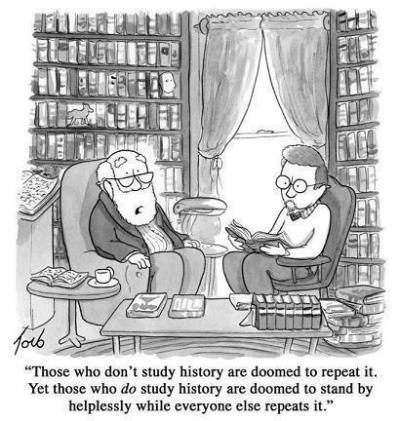
learning_from_history

How come ‘those who do study history are doomed to stand by helplessly while everyone else repeats it’?

Could it be that some of the ‘students of history’ are doing something wrong?
Misunderstand the very lessons they try to impose on the others?

Cracking annoying jokes about the matters at hand instead of honestly helping others to reach intellectual autonomy and then respectfully allowing them to develop their own interpretations of things?


I hear a lot of people discussing about the need to choose ‘the lesser evil’.

Otherwise the ‘greater evil will prevail’ they warn us.

I’m afraid that those who fall into this trap actually validate the idea that ‘evil is acceptable’.
Every time this subject comes up I keep remembering the joke about an older man asking a young lady:
‘Would you sleep with me if I gave you a million bucks?’.
‘Well, I’m not that kind of girl… but you know, that’s an awful lot of money… I could help my old parents… I could go back to school… OK…”
‘But what if I gave you $100?’
‘I told you I’m not a hooker!’
‘That’s already been settled. All that’s left for us to do now is to negotiate the price.’
Same thing with ‘choosing the lesser evil’. Once you’ve  accepted that evil is inevitable … you’re sure to get some. And keep getting it until you quit playing their game.
That doesn’t mean we schould quit voting all together. It would send the wrong message. Even if you don’t go to the voting booth because you are disgusted by the available options the ‘analysts’ interpret your stance as ‘they’re so despondent that they don’t care anymore about their own fate. They they don’t have enough energy left in them to protest so no need to change anything. Or, maybe, things might be allowed to become even a little worse. For them, of course.’
What we need to do is vote what we really like, even if that candidate doesn’t stand the slightest chance. This way the intention of the voter is absolutely clear – ‘I want exactly this’.
If there is no acceptable option, we can always check the ‘non of the above’ box – if available – or take the necessary steps to annul your vote – the specifics depend on local rules and regulations. Again, this sends a rather clear message. ‘I refuse to play into your hands and accept that evil is inevitable’.

takes-a-village-quote

I’ve spent the first 30 years of my life under communist rule.

One of their many ‘mantras’ was: ‘Children are the future of mankind’.

Communist rule had brought about so much happiness in Romania that people had stopped making children.
Concerned about the future the communists had decreed that from then on abortion was to be considered a crime – after it was freely available until that time,  October 1, 1966.
As a consequence more than 10 000 women died after botched abortion attempts – all other methods for birth control had been banned also.
Add to those deaths the individuals, mostly youngsters, killed while attempting to flee communism by sneaking across the borders.

But there was one good thing that communist rule had brought to the people. Not that much because the communists really cared about the fate of the individuals but because they needed skilled laborers in order to put their plans into practice.

Schooling was free.
You could learn as much as you wanted without having to pay a dime.
One had to pass some exams, positions were limited for higher education, but if you were smart enough and diligent enough you could go really high. Specially in the area that is currently known as ‘STEM’. ‘Humanities’ were somewhat off limits, because one could get ‘funny’ ideas when delving too deep in that area but STEM was OK.

Fast forward to our days.

Half of my University mates – I have a MSc in Mechanical Engineering – have emigrated right after Ceausescu was toppled while political power in Romania has fallen under the constant grip of a small coterie which doesn’t really care about what’s going on and/or has not enough intellectual flexibility to understand that we are currently running towards a dead end.

In the end the ‘good’ thing has proved to be a poisoned apple. By tuning the schooling system towards their own goals the communists had created many generations of  superb engineers – who were welcomed by the ‘greedy capitalists’ – but also had completely discouraged independent thinking – the kind needed to breed honest politicians and effective public figures, if you can accept those concepts as anything more than empty words.

Gazing over the borders I became even more despondent.

Forget, for a minute, about child pornography, sweat-shops and so on. These are absolutely horrible but we might console ourselves with the thought that those who are involved in them are either mentally disturbed or blinded by greed.

But something like this?

rape threats

Supposedly a feminist writer is followed by either like-minded people or opponents of her ideas only both categories belong to the wider category of ‘intellectuals’ – people concerned with ideas, human rights, philosophical thinking, etc., etc….
In this context to threat a mother that you are planning to rape her child is way above anything that was imaginable until this moment.
It’s as if being able of sophisticated thinking is no longer one of the venues towards becoming a better person – by simply being able to understand how much pain is produced by evil or careless behaviour.

Then I came across the meme at the top of my post.

I must confess that I don’t like her. For various reasons that do not fit here. Enough to say that while watching the DNC 2016 I had the distinct impression of being transported back in time to one of the congresses organized by the Romanian Communist Party.
Because of my dislike of her I had the tendency to believe that she had actually wrote that.

trust-but-verify-quote-2

So I did that.

false

“While it’s true that Hillary Clinton published a book in 1996 called It Takes a Village: And Other Lessons Children Teach Us, it does not include the above-displayed quote, and Clinton (a parent herself) has not said at any point that she believes that children should be raised by the state with parents taking a secondary role.


OK, some of you will tell me that Snopes is leaning towards the left and that you cannot always trust its findings.

I can agree with that. Sometimes you should not believe your own eyes, let alone what you read over the Internet.

But my argument still stands.
What has happened to us?
Why are we so willing to involve even our children in our political lies? It doesn’t matter here who lied – Snopes or those who ‘cooked’ this meme…

What are politics for if not for securing a future for our children?

What kind of future can be build on lies?
On this kind of lies and on this kind of threats…

When are we going to understand that the state which side-lines the parents is a fascist one – fascism and communism are close authoritarian cousins, that no one can survive for long outside a community and that the community, as a whole and each of its members, fare better if all its members have a real chance to develop their potential?

Education and health care should not be treated as ‘individual rights’.
It is obvious to the naked eye that societies who take good care of their members while simultaneously respect their freedom fare better than those who let their members fend for themselves without helping them train for today’s job market and without extending them any safety net.
We keep saying that we need better skilled individuals and do nothing about it. We keep saying that in a free market there are risks that have to be taken yet we step back when a risk taker who happened to have failed, honestly, asks for our help.

OK, I understand. The communists dissuaded their children from studying ‘humanities’. Simply because they might have started to ask the very same questions that I’m asking today.

But what happened to the rest of the world?

Who is thinking about the future, beyond planning for future cash-flows (extremely unreliable in the first place), anyway?

The scientists act on the assumption that their efforts to un-peel the  ‘onion’ will eventually bear fruit and that ‘the truth’ will eventually be found crouching behind the proverbial ‘last skin’.

The artists keep torturing their souls hoping that theirs will be the one blessed with enough sensitivity to feel the ‘ultimate’ experience and with enough talent to be able to communicate it to the rest of us.

The mystics keep entertaining the proverbially faithful ‘grain of hope’ that their soul will be blessed by their Maker with some ‘insider’ knowledge and with enough stamina to make the revelation known to the rest of the flock.

Meanwhile the rest of us, the ‘regulars’, keep altering the ‘onion’ – otherwise known as ‘The Reality’, sometimes beyond recognition.

Let me elaborate.

As of now it seems that there are a hard core reality – the one feverishly pursued by all those mentioned at the start of my post, a multitude of partial images of what that reality looks to each of us – the ones made up by each of us when trying to make sense of our perceptions about the (hard core) reality, usually without being aware that what we look at is a window dressing composed of the numerous patches pinned by by each of us on the original while acting according to what each if us perceived to be (the image of) the ‘reality’.

And it’s exactly this overgrowth that constantly changes the object of perception at which each each of us stares continuously and tries not only to understand it but alto to adapt to it. Constantly forgetting that our efforts not only adapt us to the (perceived) reality but also alter the reality itself, not only the image we perceive of it.

But hold on. I haven’t mentioned the really interesting part yet.
All of the above constitute the ‘innocent’ side of the whole thing. The natural process that would take place if all of us would act ‘up-front’.

In reality some of us have ‘ulterior’ motives.
Some of us consider that their understanding of the world is not only better than that of everybody else but also that they are entitled to act based on that understanding. Without asking permission from and sometimes even against the wishes of those who will bear the brunt of the consequences brought forth by those actions.

That’s why the ‘patches’ pinned by these callous people fit a lot less to the real reality than those attached by the honest ones among us.

And that’s the catch.
The ‘distance’ between the reality of a fact and our perception/action about it produces a certain ‘energy’. If the distance is small the energy corresponding to it is manageable. People can adjust to it and absorb its consequences.
But sometimes the distance is larger than what can be comfortably absorbed and this leads to the formation of social scars. And if successive ‘distanced’ patches are applied without enough healing time in between, then, eventually, wide ‘gaps’ will have to be dealt with.

And since ‘wide’ produces a lot of ‘energy’ and ‘a lot of energy’ leads to massive upheavals…