

Imagine now that Reagan, or his speech writer, would have used a single different word …
It isn’t that people are ignorant, it’s just that they know so much that isn’t so.
Imagine now that Reagan, or his speech writer, would have used a single different word …
It isn’t that people are ignorant, it’s just that they know so much that isn’t so.
From the airlift which kept the flame of liberty alight in West Berlin to “Trump’s decision (to stop supplying arms to Kurdish fighters in Syria) appeared to catch both the Pentagon and the U.S. State Department off guard. Officials at both agencies, who would normally be informed of changes in U.S. policy toward arming the Syrian Kurds, said they were unaware of any changes. The officials spoke on condition of anonymity. It was unclear whether the Trump administration notified the Kurds of the move before telling the Turks. Nor was it how much significance the change would have on the ground, considering the fight against Islamic State is almost over.”

What happened to “Ich bin ein Berliner”?!?
I’m afraid that too many people continue to not understand what’s ‘the big issue between the free world’ and the authoritarianism which still encroaches it. They should indeed ‘go to Berlin’!
From a friend’s FB wall:
“African proverb:
Every morning in Africa, a gazelle wakes up.
It knows it must run faster than the fastest lion or it will be killed.
Every morning a lion wakes up.
It knows it must outrun the slowest gazelle or it will starve to death.
It doesn’t matter weather you are a lion or a gazelle.
When the sun comes up, you better start running.”
(from The World Is Flat, by Thomas L. Friedman)
It seems that the modern world is gradually becoming more and more ‘African’.
We’re so busy running ourselves out that we’re failing to remember the essential.
That we’re people.
Neither gazelle nor lion!
And that most of us have long ago left the jungle and now live in cities!
How about ‘taking five‘ from our incessant quest for trinkets and use the time to remember “togetherness”?
As in “communion”?
In the civilized world, ‘Dog eat dog’ was supposed to be an exception, not an everyday occurrence…
PS.
After reading this, my son pointed out that lions are the only cats which hunt cooperatively on a constant basis.
Could this be the reason for which they are seen as the royals of the animal world?

“Federal lawmakers on Wednesday released samples of 3,000 Facebook ads purchased by Russian operatives during the 2016 presidential campaign. The ads conveyed the wide range of influence Russian-linked groups tried to enact on Americans…”
Let’s zoom out in order to gain some perspective over all this.
Fake news are defined by Oxford Learner’s Dictionaries as “false reports of events, written and read on websites“.
The way I see it, “fake news” have a lot in common with counterfeit currency.
In more ways than one!
First of all, most money in current use is ‘fiat money’.
We are dealing with either printed pieces of paper or otherwise useless pieces of metal.
We ‘trust’ them for trading purposes simply because we are convinced that the institution which stand behind them – Central Banks, free(ish) markets and law enforcement, will do what they are meant to do. We trust that the Central Banks will not print too many of those pieces of paper, that the free(ish) markets will set a reasonable price to everything and that the police will manage to weed out (most of) those who try to circulate fake money.
Not even a return to ‘real’ money – a.k.a. gold, wouldn’t insulate us from crooks. Gold coins can be, and had been, tampered with in so many ways. Human greed is a very powerful motivator but not necessarily a good mentor.
Which brings us to the reason for why fake money came to be.
Simply because some ‘industrious’ people ‘make’ them and some other, equally greedy, people knowingly distribute them.
In conclusion, we wouldn’t have to deal with fake money if money wasn’t essential for an efficient free market and we would have a lot less of it if greed were not such a widespread attitude. And no, a cash-less economy would not solve the problem. A printing press is no longer essential for faking money. Hacking skills have become a good enough substitute.
Let’s translate this rationale to (fake) news.
We need to know what’s going on around us so we’ve developed an equivalent to the financial system. The mass media.
Which has a more or less equivalent set of ‘guardians’.
The ‘printers’ are responsible for the equivalence between their ‘product’ and the reality it represents while the market (readers, that is) is responsible for ‘setting the price’.
Of course, there are also differences.
‘Law enforcement’ has indeed a role to play in the news industry but its scope is a lot narrower than in the first case. And rightfully so. The ‘information’ market needs to be a lot more ‘flexible’ than the one dealing in ‘economic goods’. There’s a lot to discuss on this subject, I’ll leave it here.
There’s also no Central Bank to ‘tug at the sleeves’ of those who ‘jump the shark’.
As a consequence of these two differences, the ‘counterfeiters’ have an easier life and the consumers/victims a far greater responsibility for what’s going on. Simply because the consumers/potential victims cannot rely on any third party to do their job. To sniff out the ‘bad thing’.
But what if ‘it’s the thief who plays the victim’?
That very much depends on who the ‘thief’ is!
Let’s go back in time for a short while.
First to the American Revolutionary War. During which the British attempted to crash the American economy by injecting in it enough counterfeit money to cause hyperinflation. “No economy, no more war.” The British did manage to produce and distribute a huge amount of fake money yet the outcome was not the intended one. “Even when at one point the amount of counterfeit currency in circulation may have exceed the amount of legitimate currency, the economy hung on by its eye teeth and never fully collapsed.”
One and a half centuries later, the British had found themselves at the receiving end of the same game. “…during World War II the Nazis almost destroyed the credibility of the British pound sterling by producing near-perfect forgeries, The Telegraph reports. By the end of the war the forgeries were so rife that Bank of England notes would not be accepted by any neutral country on the Continent “except at a very large discount…”.
Hitler was even less successful than the British had been but the inflicted injuries were huge nonetheless.
Now, would Hitler have attempted this on his own, without the British establishing a precedent?
We’ll never know… Sufficient to say that the US has also used fake money, obviously fake this time. For propaganda reasons and not as an attempt to ‘crash the economies’ of the countries they were fighting.
To close the circle, we must ask ourselves how successful would Putin’s trolls have been if Trump wouldn’t have beaten so hard the ‘birther’ drum…
Seriously now, propaganda is a very efficient weapon. Maybe more efficient than guns.
But, and in total contrast with a gun, propaganda is useless against really determined people.
“Sticks and stones may break my bones but names can never hurt me” is true. But only as long as those being called names are in the right state of mind. As soon as they start feeling hurt, all hell comes loose.
If you think of it, Trump’s birther campaign, fake as it was – he had admitted that much, eventually, was a very successful ‘fake news campaign’. It had established Donald Trump as shrewd media manipulator.
Unfortunately, it had an even worse outcome. It had very much helped those who wanted the American public split into warring parties.
And who are now pushing these parties further and further apart.
PS. While researching for this post, I found out that “fake news” has been declared ‘word of the year’ for 2017. A fitting development… last year’s ‘champion’ was “post truth”…
What next? Doublethink?
Plato, without actually saying so, was planning to ‘kill’ it.
A society run by his king-priests would have been ‘perfect’. Hence in no need of improvement. Not exactly dead but how would you describe something that doesn’t change in time? Anything but alive, right? And since ‘no change’ means ‘no history’…
Four centuries later, Jesus Christ had warned us about the ‘Final Countdown‘. Last Judgement, sorry. But what difference does it make? Final… Last…
Fast forward to the XIXth century, when Karl Marx was breathing new life into Plato’s ideas.
“The Communists, therefore, are on the one hand, practically, the most advanced and resolute section of the working-class parties of every country, that section which pushes forward all others; on the other hand, theoretically, they have over the great mass of the proletariat the advantage of clearly understanding the line of march, the conditions, and the ultimate general results of the proletarian movement.” (Karl Marx et al, Manifesto of the Communist Party),
Which very able and extremely wise communists were supposed to solve all past, present and future problems through a very simple measure. Abolition of private property and of the state needed to protect such property.
And since not everybody was yet ready to receive ‘the good news’, the communists were given a free hand to use revolutionary force in order to accomplish what they had to do.
To finally bring order to the World. To end history, that is.
Am I thick headed or the difference between Marx’s and Plato’s words is small enough to be insignificant?
A short century later, another optimist announced that ‘now, after the communist gulag had finally imploded, liberal democracy – a system flexible enough to absorb/solve any input/problem – will take over the entire planet. And, of course, bring over “The End of History” “.
Three decades later things are going on, as if nothing had happened.
There are still plenty rulers who behave as if “L’etat c’est moi” was coined yesterday and, even more sadly, too many people who look up to them.
The end of history has been postponed. Indefinitely.
Language is the tool we use when we consciously transmit, receive or glean information.
While the ‘transmitting&receiving’ part is rather simple, ‘consciously and ‘glean’ might need some explaining.
You’ve all heard about ‘body language’.
Actors use it consciously to convey emotion and sometimes even meaning while profilers use it to glean information unconsciously distributed by their marks.
Artists use specific ‘modes of expression’ – language, actually – to convey emotion/subliminal meaning to sometimes unsuspecting audiences.
Skillful ‘communicators’ have learned how to chisel a message – using most common words, printed or spoken – to obtain ‘maximum impact’.
By now I’m sure you’ve already gleaned what I meant by “‘consciously’ and ‘glean'”.
Contrary to popular belief, only one half of those ‘immersed’ in communication need to be conscious of what is going on in order for language to be in use.
Actors can influence their audience without the audience being privy to acting tools.
All of us freely distribute a lot of information about ourselves – through walking, eating, manner of speaking, etc., etc. – which can be ‘deciphered’ with ease by those knowledgeable in this trade.
All of us are inundated by all kinds of advertisement – commercial, political, religious, you name it – but very few of us are aware of the full picture which is being played for us.
In a sense, those of us who can sense anything are like any device connected to the internet.
‘If it’s connected, it can be hacked‘.
But nothing’s as bad as it seems.
Devices can be plugged off or fire-walled while we can stop watching crap.
And, of course, we can put our brains to work, in earnest, before buying into anything which is hurled towards us.
The current “Me too” campaign – long overdue, should be an eye opener.
Pointing out the perpetrators is a good start and we have a long way to go.
If we want to significantly reduce sexual harassment we need to examine ourselves, men and women, in a mirror.
How many times, as men and women, have we heard other men bragging about their sexual exploits, and said nothing?
How many times have we learned about other men using their rank/position to sexually impose themselves upon women, our colleagues, and did nothing?
And these were the easy ones…
Who raised and educated the present generation of sexual predators? Their mothers and fathers? Their teachers and neighbors? Who had put together the ‘sex sells’ culture which currently permeates everything?
How many women had voted for the ‘American Pussy Grabber’, despite the fact that he had proudly bragged about the whole thing? Why so many women, including ‘his’ wife, agreed that receiving oral sex in the Oval Office was something completely different from ‘having sex with that woman’?
How many women, including actresses, have used their charms to snare their bosses/business partners? And got away with it?
Why is it that in most countries the legislation which punishes the ‘working girls’ does not incriminate their clients?


OK, let me wrap my head around this.
So Corker doesn’t have enough guts to run for re-election without Trump’s blessing but has enough to openly tweet his mind about what’s going on in the White House?!?
A reality show run by the supposedly most powerful man on Earth?
Who’s about to transform the “Great” America into the biggest laughing stock of the world?
Am I the only one wondering whether any of these can be described as “adult” behavior?
There’s a glimmer of hope though.
401K is way bigger than 65K. And big enough to rise above 65K+57K+62K… I know, adding this numbers up doesn’t make much sense – there is a strong possibility that many individual readers may have liked more than one of these tweets, but still…
For some people the fog may have started to rise.
The fog generated by the fake news manipulated by the ‘Great Deal Maker’, that is.
Compare the comments which accompany those tweets.

OK, I’m willing to admit that the past gives us a strong indication about what may happen in the future. Hence it might be a very good prophet!
The best?… that would depend on how each of us interprets the notion.
The notion of prophecy, of course.
And since the best( ?!?, 😉 ) way to understand an action is to figure out the motivation behind it…
Let me start with the beginning.
What is a prophecy?
In fact there are two kinds of prophecies. Of promises, actually.
‘Don’t do that or you’ll have to face the consequences’ and ‘if you’ll do such and such, your reward will be this’.
Only very few of the prophets have been using such a clear language. Most of them have preferred to use a much more convoluted manner of expression.
Quite understandably.
First of all, because these were ‘second hand’ promises.
They were not uttered directly by the promising agent but by a more or less ‘self appointed press secretary’. Who had no sure way of knowing whether he had at least a working understanding of the message he was supposed to deliver to his peers, whether they were going/able to understand/accept the message in it’s entirety nor whether they were going/able/willing to abide to all its intricacies.
Secondly, and this is applicable specially to the ‘don’t do it’ kind of prophecy, let’s examine what may happen if/when people do heed to a professed prophecy.
I’ll consider the ‘positive’ case first.
If people do ‘the right thing’, and the reward promptly arrives, they think/feel ‘it is rightfully theirs’, no question asked. The prophet is seldom remembered. And in the rare cases when people do remember they’ve been foretold, the extended thanks rise very rarely above ‘lip service’ level.
If people think they have done ‘the right thing’ but are unaware they have ‘trespassed’, one way or another, they expect ‘their’ reward. Which, usually in this situation, never comes.
Who’s more likely to shoulder the blame? Remember that the people are not aware of not having fulfilled their bidding!
The prophet?
You nailed it!
And there’s a strong possibility that he might get nailed himself!
Let’s examine the ‘negative’ case now.
The one where the prophecy is ‘don’t do that, or else!’
People might choose to heed to the warning. Hence no punishment. Again, the prophet is usually forgotten along the way. Mainly because the bad things he kept speaking about never came through/true. Or even worse, he may be laughed at. But he’s happy. He has helped his people avoid experiencing a bad thing.
Or people might choose to ignore the warning. Hence experience the punishment.
Or, even worse, the people might try to ‘do the right thing’ and fail. For what ever reason. Who would be the most likely to be held responsible by the masses, or blamed by the politicians? For making an incomplete, or mistaken, prophecy…
An even stranger situation develops when the ‘judge’ decides to give ‘his’ people another chance. And postpones the (well deserved?!?) punishment. Is it possible that the people might decide to ignore altogether the prophecy, completely misinterpreting both the prophecy and the misericordia displayed by the judge?
Quite annoying for the prophet, right?
Boring?
You might consider that I didn’t consider all possibilities… for instance that when the reward comes without (in spite?) all demands having (not) been fulfilled. The prophet becomes a laughing stock, right?
Anyway, the whole thing was intentionally meant to be somewhat boring.
This way your attention wasn’t mesmerized and you had a fighting chance to figure out my real point.
Go back up and glance at Byron. He looks back but his body faces the future.
We are the ones called to presently transform the past into the future.
Glancing back tells us where we come from and what we have at our disposal.
Yet we have only one option. To go forward.
To survive and, maybe, to prosper.
Yes, we have a lot of carry-on luggage.
But it’s up to us to use that luggage as a resource or to trundle it along as a burden.
Another prophecy…
do as the Romans do.
According to UrbanDictionary.com, “it has become shortened so often, some people don’t get it anymore. It’s an analogy making use of the strict rule of the ancient Roman empire”
Wikipedia mentions that it’s “a proverb attributed to Saint Ambrose”, meaning “that it is advisable to follow the conventions of the area in which you are residing or visiting.”
OK, seems sensible to follow the rules, specially when their are enforced vigorously. Furthermore, why rock the boat – specially when visiting a place? Or shortly after you’ve just moved in?
How about after becoming familiar with the local mores?
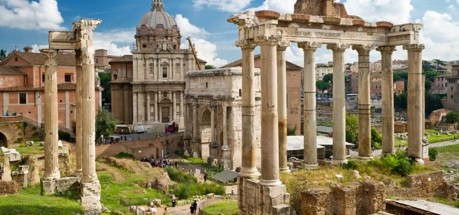
Could there be anything more behind these words?
The proverb dates from an era when Rome was the center of the world. Of the Mediterranean world, anyway…
Could it also mean ‘do as the Romans do and you’ll share into the benefits enjoyed by the rest of them’? In line with ‘don’t rock the boat, lest the others will throw you out’?
In other words, the proverb suggests that ‘herding is good for you’.
Which is true. Most of the time, anyway.
Specially when you know when to bail out…
In this context I must remind you that mighty Rome ended up being sacked by a succession of rogue thieves… some of them hired by the emperors to guard the borders because the Roman citizens had became too ‘adept’ at ‘panem et circenses’ to bother anymore with bearing arms…
It seems that not all things done by the Romans were actually worth doing.
How about exercising our brains instead of sheepishly following the herd?
No need to insult the others, ‘rock the boat’ or anything else dramatic.
Just honestly give them the reasons for your dissent.
If they are wise – and you are right, of course, they’ll come your way.
If not… you should either follow the rules… or change the herd.

