Archives for category: democracy

It depends on the meanings we attach to these two concepts.

Yanis Varoufakis, Greece’s ex finance minister, is convinced that ‘Capitalism will eat democracy – unless we speak up.

Since he has some experience in this matter I’ll follow his line of thinking – for a while.

His point being that you can have successful capitalism in undemocratic societies – like Singapore and China – and that effective power has slowly shifted from the political sphere of the society to the economic one – which is undemocratic by definition.

Can’t say he’s entirely wrong, can we?

But we can say he’s somewhat confused…
So, he mentions Lee Kuan Yew’s Singapore and China as capitalistic success stories and then says that  the political sphere is gradually falling  under the yoke of the economic one… Well, last time I looked, in China the state was still in full control of everything that moved and the state was firmly in the hands of the politicians. Same thing was happenning during Yew’s tenure as Singapore’s good willed dictator.

Unfortunately there is some truth in his words when we look at what’s going on on the both sides of the Atlantic and that’s why I’m going to examine whether we have the same kind of capitalism in both situations.

By Google-ing the word I got two definitions for the concept.

The first definition that was offered by the search engine came from Oxford Dictionaries, “An economic and political system in which a country’s trade and industry are controlled by private owners for profit, rather than by the state” and the second one came from Merriam Webster: capitalism is “an economic system characterized by private or corporate ownership of capital goods, by investments that are determined by private decision, and by prices, production, and the distribution of goods that are determined mainly by competition in a free market“.

Putting them together we have private ownership, private decision, free market and profit as a goal.

Are these enough to describe a reasonably well functioning economic system?
I’m afraid not.

Let me give you some examples.
The French state has a controlling interest in Renault and the land of Bavaria quite a sizeable one in VW. Renault is in good shape and VW was too, until very recently. So private ownership is not an absolute necessity.
In the US we had quite an interesting situation. Two out of the three big car manufacturers  had to be bailed out by the state. All three were privately owned so we must look somewhere else: the Ford family still has a powerful word in the management of the single one which didn’t had to be bailed out. In Europe the best run auto company seems to be BMW – again controlled by a single family, the Quandt’s. It seems that it helps a lot if those who call the shots have a long time interest in the well being of the company versus the situation in which the top management has (short time) profit as the single/obsessive target.
Coming back to Renault and VW, they can be compared to Singapore, China and, maybe, Spain. Singapore was able to develop a ‘capitalistic’ economy despite it being an authoritarian society simply because Lee Kuan Yew was a very special kind of ‘dictator’ – one that not only cared sincerely for the greater good of his people but also didn’t loose his head during his long stage at the helm. A similar thing happened in Spain – Franco was the sole dictator who had made preparations for a democratic evolution after his demise, while China had to wait for another good-willed dictator to grab the power – Deng Xiao Ping – before it could steer towards the present course. No other authoritarian regimes but these two have ever managed to replicate this feat – we still have to wait a little before pronouncing Vietnam as the third, and very few other publicly owned companies fare so good as Renault does.

So, we have rather strong evidence suggesting that ‘skin in the game‘ trumps blind insistence on short time profit and that a free, democratic, society offers greater chances for economic development than a authoritarian one. In fact the politicians that need periodic confirmation from the people they govern do have some skin in the game while the authoritarians are in a position that is somehow equivalent to that of the CEO’s of the huge corporations whose stock owners are so disspersed that practically don’t count much – the members of the board practically slap each-other on the back and are able to do practically what they want with the companies. Look what happened at GM, Chrysler and, for example, ENRON.

But how free should be that society in order for capitalism to thrive?

Could it be so free that a guy could come from the street and claim your house as being his own? No?

So we need a free but orderly society. One where private property changes hands only when its owner says so – or has previously entered into a contract which stipulates that in certain conditions that transfer has to take place.

Meaning that in order to have a functioning capitalist society we need not only private ownership but also private owners who have enough trust in each other to start making business together.

You see, the feudal lords of the Dark Ages did have a lot of private property but capitalism couldn’t take hold in earnest as long as the (absolute) monarch could strip a man of his property and give it to somebody else. They couldn’t enter into (longish time) contracts because the era was dominated by huge uncertainties regarding various aspects of the social and economic life.

In fact it is exactly this well tempered freedom that is the crux of functional capitalism. Enough freedom so that everybody could feel confident that he is his own master but tempered by rules enforced in a pwerfully enough manner to give everybody sufficient trust that most contracts will be executed faithfully.

In this sense for capitalism to work properly we need to have a market that is free in more dimensions that one.

It has to be free from political intrusion in the sense that the government should leave it alone as a rule of thumb but also that the same government should keep it free from becoming cornered by a single group of interests.
In fact there is no difference from a market that is run by a governmental agency or by a monopolistic corporation – no matter if the latter is private. As soon as decision making becomes concentrated in too few hands mistakes starts happening. And their effect accumulate until the system finally collapse. Or is dismantled by some ‘exasperated’ more powerful agency – as Standard Oil and  ‘Ma Bell’ were dismantled by the US government. Which, by doing so, created the premises for  the huge development of those two respective markets – oil and communications.

Only this freedom of the markets can seldom be preserved by an authoritarian regime. Yew’s Singapore and contemporary China are exceptions, not the rule. Most authoritarian regimes cannot resist temptation and start meddling in the economic life of their countries. By doing so, they introduce a lot of ‘noise’ into the system. Eventually, this noise drowns the useful signals and ‘blinds’ the decision makers.

Same thing happens – and here Varoufakis has a valid point – when economic agents become so powerful that they can dominate the policy makers. The politicians can no longer preserve a balanced stance towards the economy and give in to ‘special interests’. This way the markets loose their freedom, with all the malign consequences that come with this situation. Among them, the lack of trust that slowly creeps in the souls of those who have to do business in the no longer free markets. Which lack of trust is very bad for all those involved.

And another thing about which Varoufakis is absolutely right. A lot of money are not being moved through the ‘front doors’. Not that they are not invested at all but because they are kept somewhat hidden they do not contribute as much to the well being of the world economy as they could/should.

2.1 $ trillion have been accumulated, as of  October 2015, in off shore accounts by the top 500 American companies in order to avoid taxes and
Between $21 an $32 trillion have been hiding in 2012 in various offshore jurisdictions.

Why is that? Simply because those who are called to decide about these money do not ‘trust’ that by bringing these money home and by investing them there, after paying the taxes, will be able to generate profits equivalent to those produced by leaving them off shore?

So what should we do? Tell them ‘democratically’, by electing somebody who is crazy enough to implement such a measure, to bring them home? Or even  confiscate them, one way or another?

I’m afraid that here I part again ways with Mr. Varoufakis. And with Aristotle: the way I see it democracy is not ‘the constitution in which the free and the poor, being in majority, control government‘. That would be ‘mob rule’.
A truly democratic process starts before the vote. When every stakeholder can make its point known to those who are going to cast a ballot so they’ll be able to do that having a reasonably clear understanding about what’s going on.

Frankly I’d rather rephrase Varoufakis’ message. ‘Corporatism has a tendency to disembowel democracy and transform it into ‘mob rule’ – the situation where the poor are no longer that free simply because they are convinced through ‘unholy’ methods to vote one way or another.

What can be done? Explain, loud and clear, that if jobs disappear the same thing will happen with the aggregate demand?
Explain that by giving their workers as little money as they can in reality the results are way worse than if the wages were as high as the companies could afford?
Ford didn’t give his workers more money because he loved them but simply because he had understood that in the long run he would be better off himself by doing this, you know!

Read the comments to any article that deals with the European Community and you’ll certainly find something to this tune:
“This is the end of the EU”

That might happen anytime, of course, but I’d still like very much to know why so many contemplate this possibility with so much glee? And I’m not talking here about those who think they have something to gain from a weaker Europe. Putin, for instance. Or Erdogan.

Why so many ordinary Europeans are so angry towards the very idea of a closely knit European Union?

How about reading the entire history of this continent as a long story of individuals striving hard to become more and more autonomous?

Some would say that Europe was about individuals becoming free, and I can agree with that. Only that freedom had strings attached.

“My freedom stops where your freedom begins”.

Meaning that none of us is really free unless each of us respects the liberty of all the others. That our individual liberties depend on each-other. Well, that’s the definition of autonomy, not that of ‘absolute freedom’ but let’s not be bogged down by words.

In fact what helped Europe become what it is today is an unique combination of ever growing individual freedom made possible by an ever stricter respect for the rule of law.

This was not at all a smooth process.

From time to time some individuals garnered a lot of liberty for themselves precisely by depriving all other of theirs and sometime even succeeded in writing this into law. For instance, until 1848 it was still lawful to own slaves in France.

Another type of ‘garnered’ freedom is what happens in a dictatorship. The dictator and his henchmen are freer than the rest of the people, but none of them as free as the people living in a truly free country. And Europe had witnessed a considerable number of dictatorships.

Which all eventually failed.

But something lingered in the collective memory of the Europeans. Their disdain for being told what to do. Their mistrust for rules imposed from above, for regulations that did not have the opportunity to become evident, through the passage of enough time, for those called to follow them.

This is why the ‘enthusiasm’ with which “l’aquis communautaire” was peddled by the Brussels bureaucrats to the new entrants has been met with such reticence.
This is why the measures being practically imposed by the more powerful members of the Union to the rest of the gathering are met with such scorn.

Very little real consideration is being given to the manner in which these measures are adopted and then communicated ‘from above’  and, simultaneously, very little attention is paid, by those called to put them in practice, to what their real effect would be – if they’d be applied in earnest.

And, unfortunately, there is no real shortage of callous political mavericks who eagerly try, and sometimes succeed, to capitalize on these misgivings.

As if we didn’t know any better.


Modern England was shaped by a bunch of ‘French immigrants’ led by William II of Normandy. In the following centuries England and France fought each-other bitterly, in one instance for more than 100 years. Yet they ended up being best buddies, close enough to have fought, and won, two World Wars.

France and Germany started as the two wings of the Carolingian Empire. After it was divided in 835, France was the first to become a national state and, for a while, was Europe’s hegemon of sorts. During that period the French culture had influenced heavily the life of the entire German area. Take a walk through the Sanssouci palace in Potsdam and the Schonbrunn in Wien if you need any confirmation.
But none of this stopped a considerable number of French and German leaders from marshaling numerous armies that fought each-other bitterly, for various reasons.

In fact one could say that Europe itself was forged during those battles.

In this context, the Peace of Westphalia – that ended a 30 years long war, can be considered the seed of what we have now: a system of sovereign states that interact according to a set of practices that have been enshrined into international law.

But it seems that one war was not enough for the rulers that happened to gain precedence in both French and German speaking areas of Europe. So others followed. Culminating with the two World Wars that have involved almost the entire planet.

And what do we have now?
An European Union that has been built precisely in the spirit of the Franco-German Elysee Treaty signed in 1963?

So, could we say that Europe is the success story of so many nations, speaking different languages and having various cultural traditions, who have finally learned to live in peace?
Who have finally learned to silence the war-mongering among them?

Who have finally realized that they are “better off together than apart” and that what it takes for this to happen is “Mutual respect, no love, …but a considerable amount of curiosity“?

Then how come we are not able to extend that wisdom, that literally soaked in blood body of  knowledge, to cover the current events?
How can we not find in ourselves an effective way to help the so many people who are literally dying outside our closing gates?

Why is it that so many of us still pay any attention to those who teach us to ‘circle the wagons’ and to ‘leave behind those who didn’t make it’?

This tactic seldom worked, if ever.

trump torture

As a young adult I understood that there was no real difference between Hitler and Stalin. It didn’t matter that one of them was considered to come from the left while the other was depicted (by the communists but not exclusively) as a paragon of the right. Both of them had in common the absolute disrespect for everybody else. Each of them was convinced that only their opinions mattered and that all others were absolute morons.

That was when I started to have an inkling about what ‘the elders’ wanted to convey to us, green-horns bucking under the communist rule – which was crippling Romania at that time, when whispering:

‘there isn’t much difference between USSR and America. Their leaders want to rule as much of the world as they can grab while the ordinary people, in both countries, don’t have a clue about what’s going on’.

As I’ve become older I’ve started to figure out that the real difference between various activism-s has nothing to do with the ‘hue’ displayed on their banners. All that counts is the intensity of the sentiment that fuels them and the manner in which the activists relate to the other participants in the game.

At first glance the very notion of ‘conservative activist’ would be an oxymoron, given the fact that (most of the) conservatives define themselves as defenders of the existing order.
Who simply react, within the boundaries of the law and using the tenets of the Constitution, to whatever follies the progressive ‘liberal activists’ are trying to bring upon our heads:

“Like the American people I have watched this process for a number of years, and I fear this empathy standards is another step down the road to a liberal activist, results-oriented and relativistic world where — laws lose their fixed meaning, unelected judges set policy; Americans are seen as members of separate groups rather than simply Americans, and where the constitutional limits on government power are ignored when politicians want to buy out private companies… Call it empathy, call it prejudice, but whatever it is, it is not law. In truth, it is more akin to politics. And politics has no place in the courtroom.” (Senator Jeff Sessions (R-AL), speaking at Sonia Sotomayor’s confirmation hearings)

As usual, practice trumps theory. Regardless of whatever the theory says – and some of the pundits pretend, everybody has an agenda and everybody who has an agenda is actually an activist.

Now that we’ve successfully climbed down to the practical level let’s see what’s the real meaning of Trump backing down from his trumped up stance on torture:

trump defending torture

Hey, wait a minute! So he actually said that ‘we should go tougher than waterboarding’ and he still has such a strong following among the ‘law abiding defenders of the Constitution’?

Well, I’m afraid things are more complicated than that.
Here’s what he says about those who trust him:

trump shooting people

“The people, my people, are so smart…
And you know what else? they say about my people? the polls?
They say I have the most loyal people! Did you ever see that?
Where I could stand in the middle of Fifth Avenue and shoot somebody and I wouldn’t lose any voters.”

Well, if this isn’t ‘activism’ then I don’t know what else is.

But what kind of activism is it?
I’m not asking about where it should be placed in the political spectrum! I’m just wondering how are his proponents, Trump’s people, going to relate with their fellow citizens?
Or with the rest of the world…

And what’s the true meaning of the conservative activists coming out of the closet and assuming such an active stance? So active, in fact, that – as I said before – it is now way outside the realms of typical conservative behavior.

The explanation – as I see it – has little to do with Trump itself and everything with the present situation of the American society as a whole.

First things first.
Trump is nothing but an opportunistic bug, the real problem being how come the American Conservatives have not seen him for what he is and have not thrown him out yet.
I’ll concentrate on this from now on.

The American Conservatives, and not only those ‘loyal’ to Trump, behave as if they have been under a two thronged siege.
‘ The liberals are destroying America from within, the enemies from the outside are growing stronger and stronger yet the American Political Establishment does nothing meaningful about any of these, not even the ‘entrenched’ conservative ‘figureheads’.’

This didn’t start yesterday.

“Whenever you get a group of people together who share certain basic assumptions, there’s a natural tendency for the group to gravitate toward the most uncompromising, extreme, strident, fundamentalist, hard-core positions. Social psychologists call this tendency group polarization. It happens on juries with some regularity. It explains why the Tea Party became so insane, so deeply out of touch with the needs and views of the average American voter. And it explains why the Bush Administration invaded Iraq without an exit strategy (they stopped inviting people who disagreed with their assumptions—people like Colin Powell—to the planning meetings).” (John Faithful Hamer, From Here (2016))

But because of the internet things have gotten even worse:

“These days, any simpleminded partisan with a political ax to grind can find an online community of like-minded whack-jobs who’ll be happy to provide him with plenty of ideological ammunition (e.g., bogus stats, pre-fab arguments, etc.).” John Faithful Hamer, From Here (2016)

“Worse” not because of the ease with which these communities can grow but because too many of the members of these communities tend to give in to the apparent comfort and safety of single-mindedness.

Arguments are no longer able to penetrate the boundaries of this kind of communities.
Walls are erected to keep the odd man out. Then defended fiercely.

And this is why any attempt to cross those walls, be it aggressively or even in good faith, is too often perceived as a mortal threat by those within.

This is the mechanism through which the likes of Hitler and Stalin have managed to dominate for so long their hapless followers, by convincing them that all outsiders, all aliens, are conspiring to destroy ‘Das Vaterland’.

Fortunately the Internet works both ways. It’s true that the members of those communities can chose not to read anything else but the ideas promoted by their insiders but, just as easily, any of them can find out everything that ‘the others’ have to say about the matter.

But what if things are not (yet) as bleak as some of the media venues present them to be?
Not that all the media wants to scare the shit out of us or that all of them are politically biased. No. This happens simply because all of them want to make better ratings and because very few of them understand that ‘he who saws the wind will reap the whirlwind’. (Well, some of them might actually do it on purpose and that’s exactly what activism means but my post is more about those who let themselves be sucked into the whirlwind than about the tempest sowers).

A very short search of the Internet produced two extremely interesting ‘snapshots’.
The first, that the CPAC straw poll placed Trump no higher than the third place, should not surprise us very much. After all most of the participants are either GOP officials or young wannabees and for them Trump is akin to a ragging bull.
The second, though, is rather mind boggling.

gallup, candidates popularity, february 2016

Gallup, daily tracking

Four out of the six still running candidates nomination are perceived more or less unfavorably by the American public?

So what is this? A contest for ‘the least un-liked presidential candidate’ title? (The answer to this question might also explain why Trump has backed down on torture. He figured out that that was too much, even for him. And for ‘his people’.)

We couldn’t blame this on ‘activism’, as such – the remaining two candidates are also ‘active’, but shouldn’t we be asking ourselves about what kind of activism deserves our encouragement?

In any way, shape or form?

Well, before answering this we must consider another issue.
What brought us to the present situation, where both sides of the Political Establishment – and not only in America – are acting as if they want to tear everything apart instead of doing their best to make it all work together?

Lincoln activism

“Abraham Lincoln represented the entire nation, and his most serious actions were aimed at improving the lives of the oppressed and the poor. Lincoln’s values and actions still rank as the greatest period of social activism in the United States. Lincoln’s goal was to create a more perfect union by extending dignity to all — to once and for all end a diabolical, brutal, and oppressive system in which humans were property, mere production instruments.

In other words, Lincoln’s policies were designed for all of the people, not the just the wealthy, the privileged, or vested-interested lobbies.”

Later Edit

‘Conservative activism’ hasn’t been invented yesterday.
Nor by Trump’s supporters!

https://www.everand.com/article/357205089/Surviving-Koch-Nancy-Mac-Lean-Wants-You-To-Ignore-Donald-Trump

https://independentaustralia.net/business/business-display/murdoch-propaganda-machine-catastrophic-for-democracy,18117

Mencken, democracy perfected

Just stumbled upon this meme.

It gave me the creeps.

If such an influential personality like H.L. Mencken had such a warped understanding of the democratic process what can we ask from the proverbial ‘regular guy’?

One question haunts me.
How come so many otherwise bright people fail to grasp the obvious fact that ‘democracy’ is what happens before the voting process?

Voting itself is nothing but logistics, arithmetic and honesty. A process more or less akin to a social survey, one through which the electoral commission determines ‘the will of the people’ at a certain moment. A ‘mechanical’ process that has nothing to do with the living thing encapsulated in the concept of democracy.

…’living thing encapsulated in the concept of democracy’…

Do you think I’m exaggerating?

Then let’s go back to the Agora (the meeting place where the ancient Greeks congregated to discuss the public matters at hand) and watch carefully what happened there before each issue was decided upon.

Everybody who wanted to say something about a subject of interest had the opportunity to make his voice heard.

Yes, that’s the real essence of the democratic process! That’s why the Founding Fathers insisted so much about ‘The Freedom of Expression’. That’s why ‘the right to speak up’ comes First, before all others!

You see, the right to vote has no real meaning if the voters are kept in the dark, if they didn’t had access to all the information available prior to the deciding moment.

People will make a choice regardless of how much information they have, at a given moment, about something, precisely because they think they know everything that is to be known about that something.

That’s why people privy to more information than the ‘general public’ have come to reach the conclusion that the ‘ordinary voter’ is stupid.

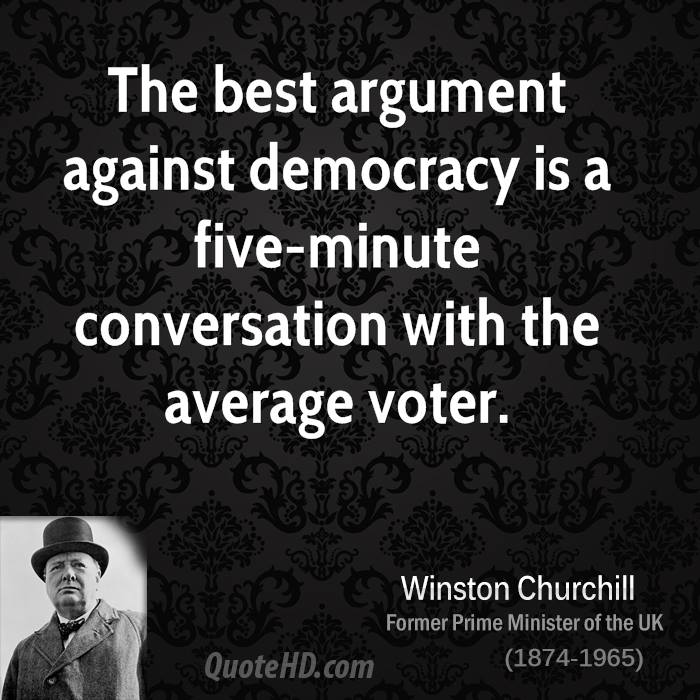
winston-churchill-government-quotes-the-best-argument-against

Because instead of putting everything on the table and letting ‘the people’ decide in earnest, for some time now some of the ‘pundits’ have been playing a dangerous game of  ‘hide and seek’.
One which has resulted in the profound distrust felt by ‘the people’ about the ‘political establishment’. And in the barely masked contempt displayed by the ‘political elite’ towards the rest of the society.

So, instead of having an open discussion about issues and an atmosphere of trust between the various segments  of the social organism we have to pry bits and pieces of information from those who guard it dearly and such mutual distrust that, if we’ll look around carefully, we’ll notice that we’ve been living, for some time now, way inside ‘paranoia land’.

Can we still pretend that our societies are governed in a democratic manner? That each of us tries to shed some light over his area of expertise and by doing so contributes to all of us avoiding as many of the ‘potholes’ as possible?

‘Cause this is the real essence of democracy.
Not finding the best possible solution to every problem but avoiding the known/foreseeable potholes.

No matter how many of us will study a problem we’ll never find the best solution. After five minutes some fresh information will come about and the erstwhile ‘best’ becomes ‘obsolete’.

Compare this situation to somebody stumbling in a pitfall waiting for all of us, coming  back to warn the rest and not one of us heeding to his cries…

1x59cvjb_mojtouxmkbihsq

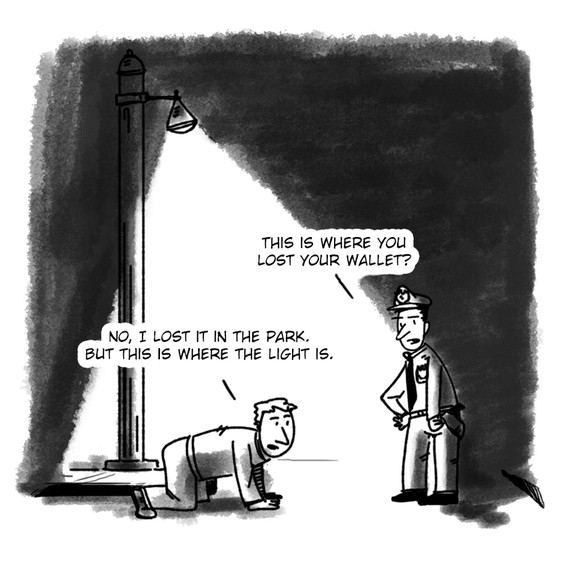
“When we’re trying to recreate an intellectual milieu, even one that’s relatively recent, we invariably discover that the vast majority of the sources we need to do such a thing have been swallowed up by oblivion and lost forever. Sometimes those that remain—e.g., Plato’s dialogues—remain because they were the best of the best, works of great importance. But this isn’t always (or even usually) the case. Sources often survive for largely accidental reasons. Regardless, the temptation to exaggerate the significance of what we have has proven irresistible for generations of intellectual historians. As the philosopher Aaron Haspel puts it in Everything (2015): “The parable of the drunk looking for his keys under the street lamp, where the light is better, explains vast swaths of intellectual history.” (John Faithful Hamer, Touch They’re Real in his blog Committing Sociology)

As always things are not as simple as they seem at the first glance – otherwise we wouldn’t have had a parable to start with, would we?

Basically the drunkard is doing the only reasonable thing available to him. Searching in the lightless park would be completely pointless but what if somebody else had lost a wallet in the lighted area?

Aaron Haspel is also right. Our intellectual history consists indeed of whatever cultural artifacts have been lucky enough to survive. Considered important enough by a sufficient number of people so they helped preserve it to the present day.
Or, evidently, both!

I’d like to direct your attention to ‘Considered important enough by a sufficient number of people’.
You see, the drunkard was looking under the street lamp because ‘This is where the light is’. He was reacting rather sensibly to a real situation.

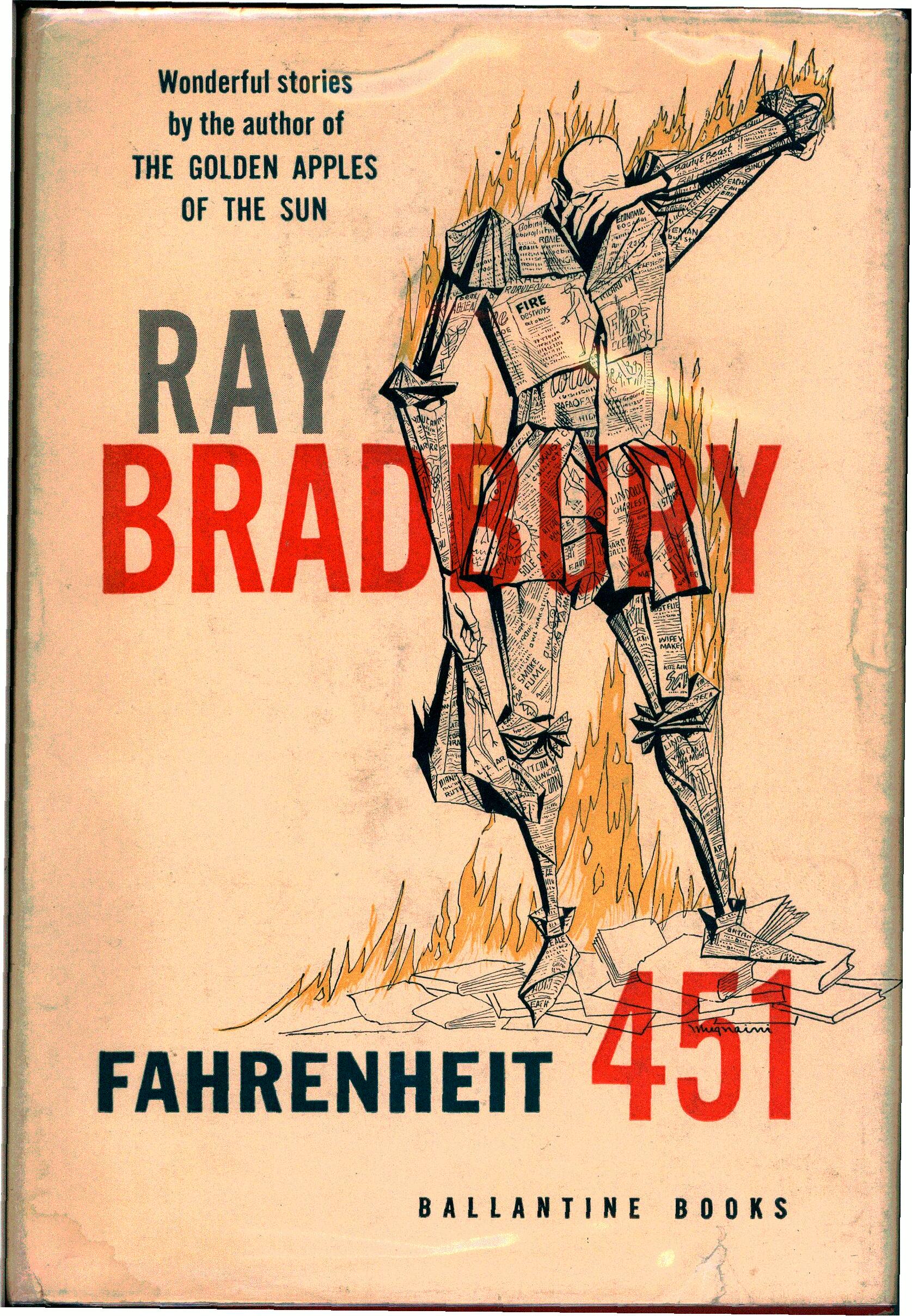
But what if the reality of something is not so easily ascertainable? What if it’s a ‘second degree’ reality, one that is constantly (re)created by human intercourse? Like people choosing which book to keep and which one to throw into a bonfire?

fahrenheit451

Or even a ‘third degree’ reality? One that is imagined by someone who tries to assess the wishes of somebody else?

“Politicians are fooled into thinking corporate welfare is important to voters because politicians spend an inordinate amount of time with the powerful people to whom corporate welfare is vitally important. That’s why every candidate who has tried to win Iowa has prostrated him or herself before ethanol.”

You certainly guessed it. This paragraph will be about the ‘fourth degree’ reality. The one we, the voters, bring upon ourselves at the ballot box. After having carefully considered each candidate and his or her programme. Or having voted with ‘that particular one’ just because  …

The point I’m trying to make here being that this ‘fourth degree reality’ is not at all ‘virtual’, in the manner the second and the third ones are. In fact this ‘fourth degree’ reality is exactly the one where we have to live. Where we are faced with the consequences of the choices we, ourselves, have made while bringing it about.

cruzmeme

“That was done by somebody named John Fugelsang, who somehow thinks he’s funny. At least he has the courage or naivete (you decide) to own up to such stupid overgeneralizing, of a company-line liberal sort that panders to a sycophantic gaggle of Cruz-hating left-wing foamers. [I’ve hosted the image locally in case the creator sees this essay and tries to delete it from his social media out of shame and embarrassment…sorry, man, too late–it’s on the record now!”

“The Candidate is a natural born citizen by virtue of being born in Canada/(Hawaii) to his mother who was a U.S. citizen at the time of his birth,” the board said, explaining Cruz/(Obama) met the criteria because he “did not have to take any steps or go through a naturalization process at some point after birth.”

Wow… That settles it… Both are indeed ‘natural born citizens’ so the only relevant thing here is the manner in which people relate to a ‘delicate’ subject.
Some tend to let themselves be driven by sentiment rather than reason while others change their minds according to their most immediate interest.

September 9, 2015, at a rally in Washington against the deal with Iran:

“Despite being rivals for the Republican presidential nomination, Cruz and Trump enjoy an unusually cozy relationship. Cruz, who invited Trump to the rally because he would bring the spotlight, praised the real estate mogul as “my friend” and the two men embraced on stage.”

“I hear it was checked out by every attorney and every which way and I understand Ted is in fine shape,” Trump told ABC News just before speaking at a Capitol Hill rally blasting the Iran nuclear deal.

Fast forward to January, 2015.

“Donald Trump doubled down on rival Ted Cruz’s citizenship Monday night, again questioning whether the Canadian-born Texas senator is eligible for the presidency.
“My new battle is with a gentleman named Ted Cruz,” the billionaire real-estate mogul said at a rally in Farmington, N.H. “The Canadian, the man from Canada.””

“But Trump has begun to raise an issue that could have deeper resonance. He criticized his principal GOP rival as trying to portray himself as “Mr. Robin Hood — he’s gonna protect you from the horrible Wall Street bankers,” when he took a loan from Goldman Sachs, his wife’s employer, for his Senate campaign, which he didn’t fully disclose.”

“Cruz noted that Trump in September said Cruz’s Canadian birth did not disqualify him for the White House since his mother was an American citizen. Now, he has changed his mind.
“Now since September, the Constitution hasn’t changed,” Cruz said, “but the poll numbers have.”
Trump acknowledged as much, saying that Cruz didn’t seem like a threat before, but now is neck-and-neck with him in the Iowa polls.”

perspective09

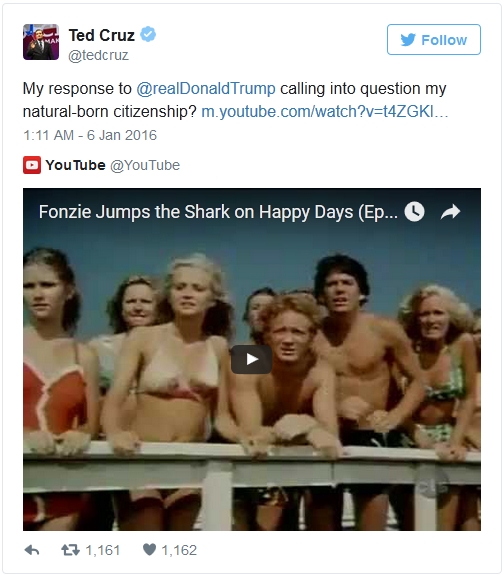
During this exchange Cruz brought back into the limelight an almost forgotten movie:
cruz jumping the shark

“That’s the scene that brought into our parlance the use of the term “jumping the shark” to signify that someone’s relevancy had reached it’s zenith and was in decline.”

Prophetic words?
For which one of them?

Anyway, my ‘democratic conundrum‘ is still unsolved.

Gov. John Kasich, maybe?

kasich, the underdog

I published yesterday a post on this subject. In Romanian.

Today I stumbled upon another article which uses almost the very same manipulative tools. In English this time.

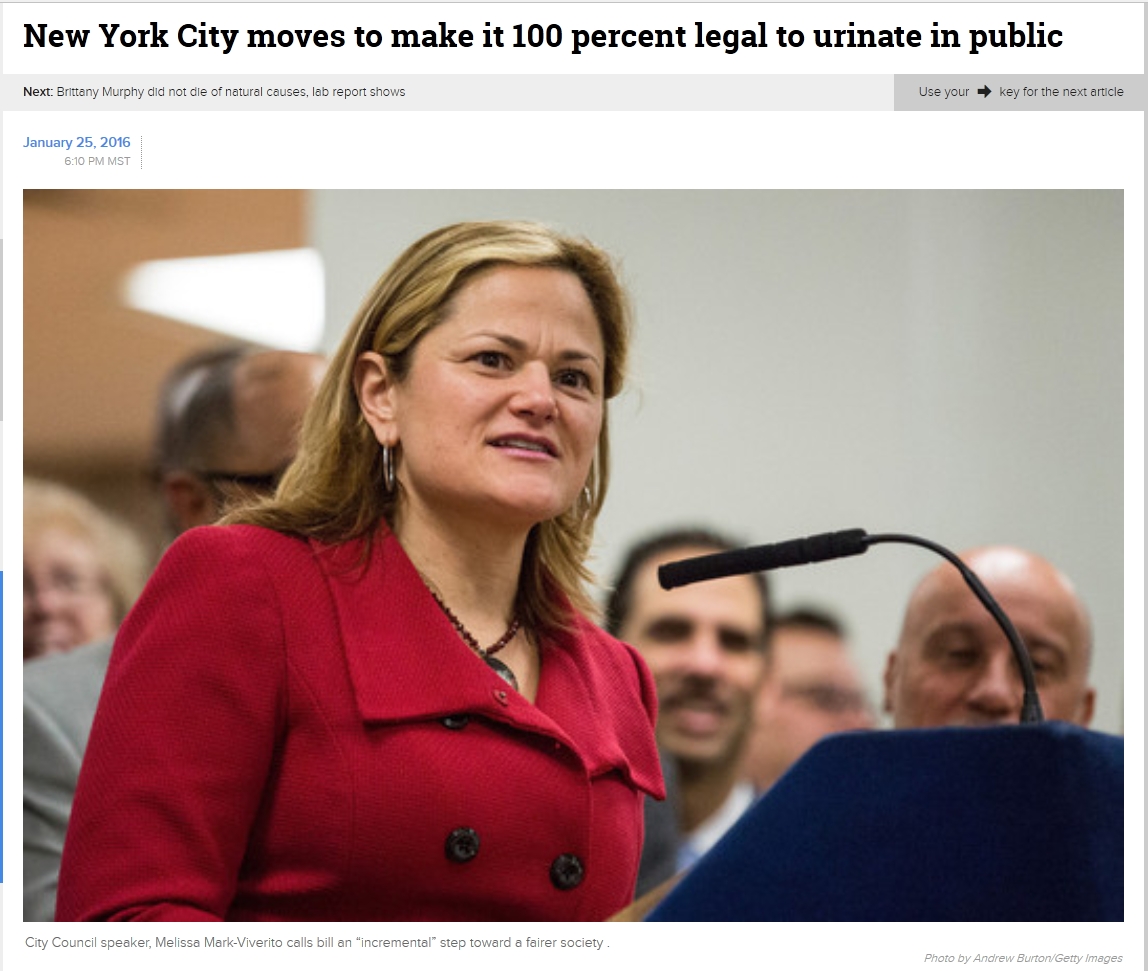
legal public urination

“Of all the things one could think of that New York City needs more of, public urination doesn’t immediately come to mind. But New York’s City Council, which is so far left it almost collides with the right, is about to make it happen thanks to it’s Speaker, a Puerto Rican nationalist who supports terrorists and rejects the Pledge of Allegiance.”

 Now can someone explain to me how can decriminalizing something be interpreted as an encouragement towards that something?
And what’s the use of making it a crime to urinate or to drink in public? A crime? Something that will be written into your rap sheet and follow you all your life?
Let’s imagine for a moment that you are a 19 year old who had one too many beers. And had to take a leak. A cop happens to be in the area. Now tell me what are the chances that he’ll look the other way if you’re white? And if you’re black?
Do you understand, at least now, what the ‘liberal official who sponsored this change’ meant by ‘helping the minorities reach their full potential’?
Who’s going to give a real chance to a ‘minority’ with a criminal record? Who has the time to check that his only crime was ‘public urination’? Or that he had a beer in front of his porch? Not exactly in front of his porch, because he used to live in a ‘public housing facility’ but you get the general idea…
Reality check no 1.
How about providing some places where people can relieve themselves? Porta-johns for instance? Or functional public rest-rooms in all New York subway stations?
Now I’m wondering what the author meant by “But New York’s City Council, which is so far left it almost collides with the right, is about to make it happen thanks to it’s Speaker, a Puerto Rican nationalist who supports terrorists and rejects the Pledge of Allegiance.“?
What has the Pledge of Allegiance have to do with anything? What’s the relevance of the Speaker’s ethnicity, beyond the fact that belonging to a minority increased her awareness of the way the minorities are treated by some of the law enforcement officers?
And how come a ‘supporter of terrorism’ has been elected Speaker in the first place?
What’s going on here?

don't pee in our pool

First things first. Click on the picture and read the article.
It is interesting enough, even if it doesn’t say anything you didn’t already know – or at least presumed. That if enough people pee in the pool, the mixture of uric acid and chlorine, which produces some nasty chemicals, could become ‘powerful’ enough to affect a susceptible person.
The really interesting part being the fact that the scientists who have studied the matter do not seem to agree on how dangerous it is and what exactly, if anything, should be done about it.

But do we really need a scientist to tell us that we simply shouldn’t pee in the pool?
Regardless of whether the issuing chemicals would be powerful enough to harm us or not?

Then why do we hide behind slogans like ‘Global Warming is the New Religion’ when we discuss the subject of carbon dioxide being spewed into the atmosphere by the tens of billions of tonnes each year?

OK, I can understand that some of us are not convinced by the data put forward by the ‘alarmists’, specially after some of the scientists studying the matter have changed tack and have become ‘skeptical’ about the whole thing.
“I would say that the global warming is basically a non-problem. Just leave it alone and it will take care of itself. It is almost very hard for me to understand why almost every government in Europe — except for Polish government — is worried about global warming. It must be politics.”

“So far we have left the world in better shape than when we arrived, and this will continue with one exception — we have to stop wasting huge, I mean huge amounts of money on global warming. We have to do that or that may take us backwards. People think that is sustainable but it is not sustainable.” Ivar Giaever, 1973 Nobel Prize for Physics, speaking in July 2015.

So. Cutting down the tropical jungle to make room for palm trees grown for their oil and burning during the last two centuries fossil fuels that have been accumulated during God only knows how many millennia is ‘sustainable’! Yeah, right.

Do you remember the smog that used to hang over Los Angeles until some of us wised up to the matter?

Is it a matter of politics?!?
And money?!?
And what’s new about that? Or is it that some of those who have to gain from us continuing to burn fossil fuels, indiscriminately, have not understood, yet, that we are all together in this? That the atmosphere is nothing but the huge ‘pool’ where we all live?
And breathe…

To me it doesn’t really matter what ‘science’ has to say about this. In fact ‘science’ cannot speak, it’s the scientists who speak on its behalf.
Now, since they don’t seem to agree on this subject we’d better realize that ‘This is too important a matter to be left to the scientists’ and remember the Hippocratic principle which teaches us ‘primum non nocere’: ‘Above all, do no harm!’

If ‘it’s a matter of politics’ how about us telling the politicians how we wanted it solved instead of letting them scheme on it?
And then let the business people take care of the money part?

One other thing and I’ll wrap it up.
I can already see my libertarian friends frowning:
‘He had jumped on the big government bandwagon’.
Not so fast.
In fact this is not a decision that should be made by the government, be it big or small.

We are the ones who should make up our minds about this matter.
We are the ones who should close the faucets, use more efficient cars, collect the trash selectively, etc, etc, etc… and maybe even walk a little.
We are the ones who should instruct the governments we have elected to use some of our tax money to finance some honest research into renewable power sources instead of allowing them to transform the whole issue into another ‘pork barrel bonanza’…

wumo567852b7e8fa87-46431296

not2bdemocracy

Enter a caption

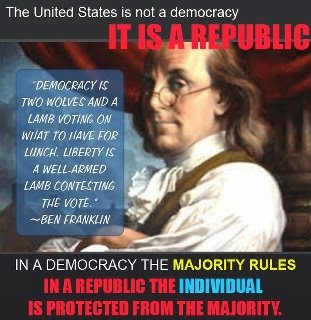
Our nation did not become great because our form of government was created as a socialist, communist, or any form of democracy; it was specifically created as a constitutional republic.

I’ve been trying for some time now to figure out the origin of this huge confusion.

Yesterday, during an exchange on this subject, a FB friend of mine used this link to prove her argument:

An Important Distinction: Democracy versus Republic


And there it was, laying in plain sight, THE explanation I was too blind to find it by myself.

It is important to keep in mind the difference between a Democracy and a Republic, as dissimilar forms of government.

Come again?!?

Since when democracy has become a “form” of government?
If you want to discuss about forms of government you have basically two: republican and monarchic. In a republic the head of state is changed from time to time, sometimes in a more or less democratic manner, while in a monarchy it is customary for that head of state to be replaced only after his death and by a person which has already been known for quite a while.

That was not what you had in mind? You meant what kind of interaction exists between the governed and the government?
‘Cause only in this realm we may speak about the difference between democracy – where the population has a say about its fate – and dictatorship – where the rulers don’t give a damn about the wishes of those who allow themselves to be ruled from above.

Don’t believe me?
Then please consider the British Empire. It is headed – nominally – by a monarch who has had no power for the last two hundred years or so and has NO – absolutely NO – constitution. Yet its democratic traditions can be traced down to the Magna Carta – a ‘compact’ signed in 1215 between the King (John of England) and his ‘free subjects’.

I used ‘ ‘ around ‘free subjects’ to highlight the fact that this is an oxymoron AND that the basic function of Magna Carta was to solve that oxymoron.
It actually doesn’t matter much what was written in that compact. The very fact that the King – erstwhile considered an almost divine person who until then had absolute power over his subjects and the land under his control – sat down at the same table with some of his erstwhile subjects and by his own signature conceded that they were “free” (‘all free men have a right to justice and a fair trial‘) signifies the dawn of a new kind of interaction between those at the no longer opposed ends of the society.

OK, things didn’t evolve smoothly. The Magna Carta wasn’t enforced in earnest until a lot later but still, the bird was out of the cage.

My point being that until we understand that the difference between ‘republic’ and ‘democracy’ is the same as the one between apples and oranges – and that we should stop comparing them – we are stuck.

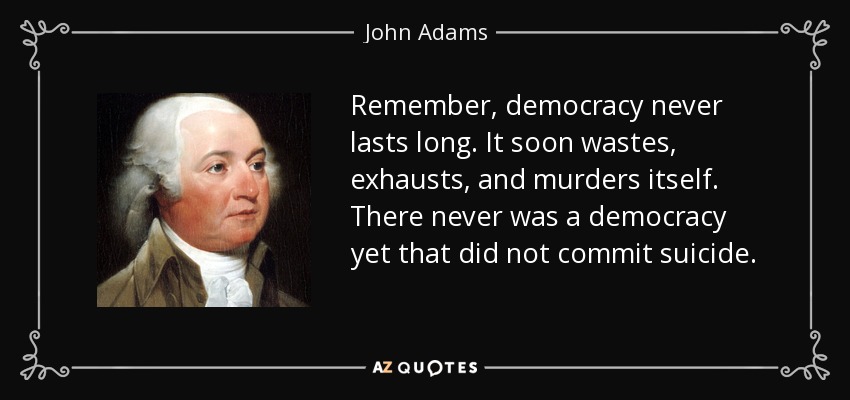
So, am I somewhat implying that John Adams was wrong?

quote-remember-democracy-never-lasts-long-it-soon-wastes-exhausts-and-murders-itself-there-john-adams-0-19-42

Not at all. All I’m saying is that he used a poetic license and that the quote is not only incomplete but also used in a misleading way.

“I do not say that democracy has been more pernicious on the whole, and in the long run, than monarchy or aristocracy. Democracy has never been and never can be so durable as aristocracy or monarchy; but while it lasts, it is more bloody than either. … Remember, democracy never lasts long. It soon wastes, exhausts, and murders itself. There never was a democracy yet that did not commit suicide. It is in vain to say that democracy is less vain, less proud, less selfish, less ambitious, or less avaricious than aristocracy or monarchy. It is not true, in fact, and nowhere appears in history. Those passions are the same in all men, under all forms of simple government, and when unchecked, produce the same effects of fraud, violence, and cruelty. When clear prospects are opened before vanity, pride, avarice, or ambition, for their easy gratification, it is hard for the most considerate philosophers and the most conscientious moralists to resist the temptation. Individuals have conquered themselves. Nations and large bodies of men, never.”

OK, he made the same confusion between ‘forms’ of government and social relationships between the people and those in power, only this is an understandable mistake. But, to his merit, he made it amply clear that it is the very “passions” of the people that “when unchecked, produce the same effects of fraud, violence, and cruelty”!

This is precisely the job that every constitution – not only the republican ones – is called to fulfill. Or a powerful enough tradition – please remember that the British ‘Empire’ has no constitution to this day.

Coming back to the notion of democracy I must add that it might not work properly, no matter how well written the constitution that presides over the process, unless the people who uses this form of collective decision making entertains the proper mental and moral attitude.
If the entire society isn’t permeated by enough mutual respect among its members then what Adams had warned us against is about to happen – regardless of any constitution. Or even under the cloak of the existing one.

You see, proper democracy works because it creates a frame where all those interested in the matter – all stake-holders – have the opportunity to express their grievances. This way the society is able to find out what doesn’t work properly and to take the appropriate measures.
But if there is not enough mutual respect going on around, things may become ugly, eventually. Just as Adams told us. When mutual respect weans out we stop caring about anything else but our own personae and ‘passions’ are no longer ‘checked’.
Society no longer acts like an organism and people become divided into smaller ‘mobs’ whose leaders fight each-other – sometimes under a democratic disguise – for followers.

That’s when democracy ceases to be a venue for a civilized debate about ideas and become an arena for the bloodiest sport of them all. Politician-ism.

That’s when some people start thinking like this.
democracy, bikes

Or even like this:
jbs_3

Let me tell you something.
I’ve been living under a republican regime for all my life. Only for the first 30 years that republic was a communist one. It even had a constitution – and at the first glance it wasn’t such a bad one. But believe me, you don’t want to experience that kind of republic.

What you really want is true democracy, the one where people respect each-other. It doesn’t matter if that happens in a republic or in a kingdom. It is enough that it works, and for that to happen it is enough for the people to ‘check their passions’.

And mind you!  Whenever 51% of the voters band together to confiscate the bikes that the others have acquired through honest means, that’s no longer democracy but mob rule. Something that could very easily degenerate into communism. That’s what you want to avoid, not bona fide democracy.