Archives for category: cooperation

epicycle-move

“Now, in this tortured model one sees that it is possible to have retrograde motion and varying brightness, since at times as viewed from the earth the planet can appear to move “backward” on the celestial sphere. Obviously, the distance of the planet from the Earth also varies with time, which leads to variations in brightness. Thus, the idea of uniform circular motion is saved (at least in some sense) by this scheme, and it allows a description of retrograde motion and varying planetary brightness.”

Rationality is a beautiful method of relating to the outside world.
It is one of the tools we used to get where we are now.

And, like all other tools, it has its limits.

The most ‘stricturing’ one being the fact that rationality is used by us, individual people.

We are deluding ourselves with the notion that we are rational, reasonable even, human beings. That given the same set of facts each of us is potentially able to find the same ‘truth of the matter’ and only those who are ill indented will reach a different conclusion.

Ptolemy’s epicycles are just a set of the innumerable proofs that we are nothing but skillful rationalizers, far away from the reasonable individuals we believe ourselves to be.

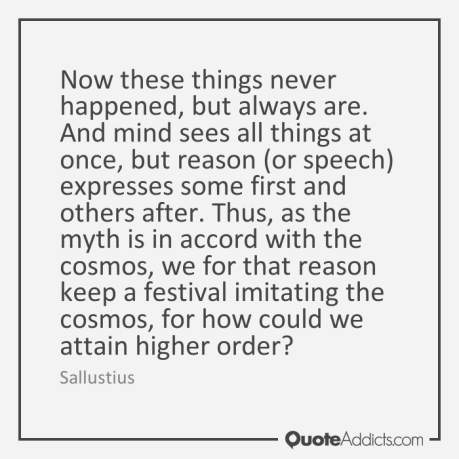
Sallustius to the rescue:

sallustius myths

The ‘things that never happened, but always are’ are the founding myths that keeps it all together for us. From the axioms on which we have built our mathematics to the religious beliefs we have forged while grooming ourselves into humans.

What happens is that not all of us have been groomed along the same myths, and even when that happened not all of us interpret a given myth in exactly the same way.

That’s why Ptolemy had invented the epicycles in his attempt to corral the planets around the Earth while Copernicus was able to propose a much simpler explanation.

Hence the notion of ‘rationalization’.
The most we can do is to honestly put together whatever facts we have at our disposal in our attempt to justify the conclusion we have already reached.
And then to respectfully accept respectfully offered reactions from those around us.

If you think of it, this is how ‘science’ works. Somebody has a hunch, gathers a lot of data, tries to fit them into the hypothesis he had started from and then submits a paper for his peers to review.
If the paper passes that scrutiny it is published – and submitted to even more criticism.
Eventually somebody else has another hunch, which includes, or even completely contradicts, the previous one…

They key words in all this being ‘honestly’ and ‘respectfully’.
Whenever we knowingly alter the facts (fake news, alternative facts,  autism causing vaccines, etc., etc…) to fit our narrative we end up in a huge mess.
Whenever we fail to respectfully examine the work of those around us and reject it before-hand we simply take a different route to the same huge mess.

WWI was the consequence of a stupid game of brinkmanship while the second one had started with a series of blatant lies. During both we had copiously murdered ourselves.

“There is a concept within Western democracies known as “loyal opposition.” It is based on the assumption that, while you may disagree with your opponent when it comes to goals, or even the means necessary to achieve those goals, you do not question your opponent’s basic patriotism or love of country.

My question for both of you: Are you willing to concede that your opponent is a patriotic American whose election does not pose an existential threat to our country?”


“Over at Emory University, political scientist Alan Abramowitz has established that Americans now line up politically according to what they hate, not what they like.

We are 50 years past Loving v. Virginia, the U.S. Supreme Court decision that overturned state bans on interracial marriage. But only three years ago, a Pew Research study found that 30 percent of hard-core conservatives would be “unhappy” if an immediate family member married a Democrat. And nearly a quarter of hard-core liberals felt the same about a family member who wedded a Republican.

We have talked and Twittered and Facebooked our way into this hole. And we will have to talk and Twitter and Facebook our way out of it.”

When your own rhetoric gives you license to commit mayhem. And worse
John Galloway, AJC.com

We’ve somehow trained ourselves to discriminate people into ‘thinkers’ and ‘doers’.

As if anybody has ever been able to do anything, anything at all, without first thinking about the matter at hand.

OK, we are still able to react in a more or less ‘reflexive’ manner – for instance most of us no longer ‘think about it in real time’ when walking or biking – but we do consider the matter before starting the ‘exercise’…

How about putting it a little differently? As in ‘talkers’ versus ‘doers’?

You see, people are ‘recognized’ by the manner in which they interact with what surrounds them.

If a guy is adept at growing food he will be recognized as a farmer. Whose intellectual prowess will be gauged by the quality of his vegetables. OK, he also needs some skills and just a little bit of luck but that’s another story.

If another guy is adept at speaking about things that happened in the past he will be recognized as a historian.

And considered to be  a ‘thinker’ while the farmer is always branded a doer…

Maybe because vegetables are easier to gauge than words?

There is indeed a difference between the manner in which those two generic guys think.
Most farmers, specially those who have been trained ‘on the job’, think ‘on the go’ – similar to what happens in our heads when walking or riding a bike, while all historians employ what is known as ‘discursive thinking’.
Farmers also employ ‘discursive thinking’ when consciously planning something or when explaining to someone which is he right way to harvest a certain crop but the entire ‘historic thinking’ consists of very well organized and carefully worded ideas.

You see, the main difference between those two guys is that the farmer’s main goal is to actually do something while the historian mainly needs to convince ‘his peers’.
This is why the farmer’s thinking is concerned almost exclusively with practical things while the historian needs to keep both aspects in balance. Facts are, or at least should be, important – all ‘historical stories’ should be based on facts, right? – but words are at least as important. Whenever the words had not been chosen right, the resulting story was not intelligible. The entire thinking process had been a waste of time.

This very difference also hides a huge danger.
Fake vegetables are way easier to spot than fake ideas, specially when they have been worded by a ‘skilled poet’.

We must give to each its due – agriculture was a huge step forward from hunting and gathering yet modern civilization depends very heavily on discursive thinking – but we must also exert extreme caution when judging the merits of a particular idea by the beauty of the words used to convey it.

Vegetables haven’t hurt anybody yet – as long as they had been grown properly, anyway – while most tragic things that had fallen on our heads had started as ideas. Worded well enough to convince…

People tend to treat it as if it was a ‘point’.
A theoretical concept that has been put on a table, studied from all angles, found desirable/unacceptable and which is now aggressively marketed by fervent apostles/rejected by ‘die-heart fundamentalists’.

I’m afraid it should rather be treated as a continuum.

People belonging to diverse cultures who freely decide to live together will, sooner rather than later, generate a meta-culture based mainly on intercultural mutual respect.
People belonging to diverse cultures who have to live together, without previously being asked whether they want this to happen or not, will, later rather than sooner, generate a meta-culture fusing together various cultural segments appropriated from the various cultures that were forced to coexist.
I am fascinated by the fact that both ‘extremes’ can happen simultaneously.
Individuals, usually unaware of what is going on, find ways of cooperating with members belonging to other cultures to impose/reject ‘cultural artifacts’ upon/coming from individuals belonging to other cultures.
The key of all this being a simple matter of ‘perception’.
We find it easier to cooperate with people belonging to cultures which we perceive as  ‘friendly’ and to treat with disdain those belonging to cultures which are different enough to be perceived as inferior. Hence ‘unfriendly’.

A system is nothing more and nothing less than a set of relatively stable interactions.
A system can be evaluated only from the outside.
A system exists only in the mind of the observer.

I’ll discuss these three affirmations from the bottom.

Even if the objects that compose the system exist ‘in the real world’, the system itself exists only in the minds of the observers – the person who had first identified the interactions and all those who agree with him.
To illustrate my point I’ll give you three examples.
–  A constellation is “a group of stars that forms a particular shape in the sky and has been given a name“. A long time ago, when those constellations had been named by our ancestors, people thought they were something totally different than what we think of them now. Yet they continue to exist as before and are identified using the same names.
– The Solar System. It works totally different today than it used to during Ptolemy’s time…
– The human body. Each of us temporarily inhabits one but we still don’t know exactly how it works or whether, in reality, it is but a small – and not even autonomous, part in a way larger system.

No system can be evaluated from the inside.
Apparently this is pure nonsense. I have just said that each of us inhabits a human body, which is a system by itself. Yeah, right. And when was the last time when you have fully understood how your body works? Or when any of us was able to do that… including here the doctors in the audience – exactly those people who do understand the meaning of “A physician who treats himself has a fool for a patient.” …
On the other hand, most of us – at least after a certain age and before dementia takes over – are ‘house trained’ and relatively polite. Because of our consciousness? Something that we hardly understand and sometimes think of as being somewhat separated from our ‘mortal’ body? Please remember, in this context, that some of us consider our souls as belonging to somebody else…

A system is nothing but a relatively stable set of interactions.
That have been either identified or established by us. The Solar System has been identified by us while the GPS (the Global Positioning System) was designed, and build from scratch, by us. Composed of materials found in the Solar System and obeying the same ‘laws’ as the rest of it but, nevertheless, something different. And to understand what I mean, please imagine for a moment that gravity would suddenly become a much weaker force. Big enough to keep the Earth together but not big enough to maintain Earth’s current orbit, at Earth’s current speed around the Sun. Nor big enough to keep the Sun together… Depending on how weaker the gravity would become the planets would scatter away while the Sun would become nothing more than a nebula… or, if the gravity would become reality small, it would be possible that the gases furiously escaping from the Sun would catch at least some of the planets from behind and melt them into a lot wider nebula….
Or, alternatively, imagine that the GPS satellites run out of power and no longer emit any radio signals. They would continue to orbit the Earth for a while but the GPS system would have been gone the minute when too few satellites would have remained active …

I checked my FB wall before ‘reloading’ ‘on the thickness of things’.

‘Zuckerberg’ made me an offer I couldn’t refuse:

“Your Memories on Facebook
Sarchis, we care about you and the memories you share here. We thought you’d like to look back on this post from 4 years ago.”

Wow, a robot – you know that FB is involved way over its head in AI, don’t you? – which cares about it’s client…

Anyway…

Here’s what I posted then:

“A Dog’s Life

An older, tired-looking dog wandered into my yard.

I could tell from his collar and well-fed belly that he had a home
and was well taken
care of.

He calmly came over to me, I gave him a few pats on his head. He
then followed me into my house, slowly walked down the hall, curled up in
the corner and fell asleep.

An hour later, he went to the door, and I let him out.

The next day he was back, greeted me in my yard, walked inside and
resumed his spot in the hall and again slept for about an hour.

This continued off and on for several weeks.

Curious I pinned a note to his collar: ‘I would like to find out who
the owner of this wonderful sweet dog is and ask if you are aware that
almost every afternoon your dog comes to my house for a nap.’

The next day he arrived for his nap, with a different note pinned to
his collar:

‘He lives in a home, with my non stop chatting and nagging wife,
he’s trying to catch up on his sleep ……

Can I come with him tomorrow ?

Thanks !”

Since I do not have any recollection about this I googled some of it in an attempt to find it’s origin.

“Disclaimer

Many of these articles were submitted by PetPlace.com dog lovers and the original source is unknown in terms of origin, author or copyright. It is not our intent to infringe on anyone’s copyright and if it is done, it is done unknowingly and we would be happy to remove the offending content. Just email us!.”

The same text has been published by tens and tens of sites.
Or maybe more? I just scrolled down on the search results page, didn’t count them…

It looks like things do have a certain thickness, don’t they?

That all things, at least those belonging to the real world, have a certain thickness… is a truism.

Yet so often we ignore this evidence and relate only to the appearance we are looking at.
At a given moment.
By chance, by design or by negligence.

Take for instance Marine le Pen’s ascension to the second tour in the French elections.
Quite a number of ‘pundits’ put the ‘blame’ for this squarely on ‘Bruxelles” shoulders. Including her and her followers. And, not at all surprisingly, Trump and Putin.

And not without reason!

After all the EU bureaucracy, headquartered in Bruxelles, is responsible for many of the consequences brought upon our heads by the very existence of what is currently known as the European Community.

what we gonna do

Click on the bloody picture, will ya!

First of all let me remind you what brought about the current edition of the ‘European Project.’

OK, it has been attempted before. By the Romans, by Charlemagne, by Napoleon, by Hitler… and don’t tell me that Putin wouldn’t love to be ‘crowned’ as The European Leader.

The problem is that all those attempts had started as individual initiatives and had happened to be ‘against the grain’. As in those who had to shoulder the burden for it didn’t see any benefit from it coming to life.

A small parenthesis. There is nothing ‘unnatural’ for strong willed individuals to try to widen their domination to the farthest possible corner. It had happened when and where ever geographical and historical conditions had allowed it.
The problem is that all imperia have eventually failed, usually in an abysmal manner. History is so full of examples that I won’t bother presenting any.

This edition of the European Project has started out of necessity.

At the end of WWII the continent was in a state of disarray.
The West was mired in self doubt and extremely tired while the East had experienced both the German occupation and the blessings of being liberated by the Soviets.

Understanding that Europe had to be helped, or else – it could have been, in a short while, overwhelmed by the Soviets, America had drafted the Marshall Plan.
For the sake of efficiency, the Americans had asked the Europeans to organize themselves at the receiving end. The Europeans responded by calling a Conference for European Economic Co-operation. It would be beyond the scope of this post to get into further details but this was the start of the Organisation for European Economic Co-operation which a short while later had set the stage for the European Coal and Steel Community – the precursor of the present-day European Community.

As we all know, the project has fulfilled its intended goals.

Europe has recovered nicely and the Soviet Union was contained.

‘But you haven’t mentioned, at all, the (professed?) reason for which the European Community was forged in the first place! To make sure that Europe will never again be drenched in blood as a consequence of war!’

Yes, this had indeed been the professed motive, “The European Union is set up with the aim of ending the frequent and bloody wars between neighbours, which culminated in the Second World War“.
It did its job, briliantly, only it was just a ‘marketing gimmick’. Ever since the Soviet Union had started to export, by force, its particular brand of (extremely authoritarian) socialism to the countries under its ‘sphere of influence’ it had become abundantly clear that the rest of Europe had only two alternatives. Stick together in order to be able to fend of the Soviets or be gobbled up piece by piece.
Fighting among themselves? In those conditions? Not even Stalin could have dreamed of something like that…

Why did America continued to help?
First of all, they were already heavily invested here. Just think of it. To save Europe from  the Nazis only to allow the Soviets to occupy it… doesn’t make much sense, does it?

Then why are so many trying to tear it apart now? From inside as well as from outside?

You don’t have to be a rocket scientist to understand Putin’s motives so I won’t waste any of your time on this.

It’s a little bit harder to understand the Americans who wish the European Project would fail. After all we are their most important trading partner AND their closest ideological neighbor. I used ‘neighbor’ on purpose, instead of ‘friend’.

Distant neighbor, I have to add…

You see, being protected by two oceans and by a very effective ‘nuclear umbrella’ may induce a certain feeling of coziness… just remember how long they had waited before intervening in WWI and WWII. Add to that the fact that people’s memories are very short and you’ll understand why the ordinary Americans do not care much for what is going on this side of the Atlantic.
Why are some of the American ‘plutocrats’ weary of the EU and rather friendly towards Putin? For the very same reason for which their peers had done business with Hitler, even after the start of the war…. Some of them might still be convinced that their corporations would be more profitable under an authoritarian regime than under a more democratic one. And since Putin makes the right noises…

And we have reached now the really tricky part.
Why on Earth are some people trying to tear apart the EU from the inside?!?

One might very well consider they, or at least some of them, constitute a post-Soviet fifth-column, meant to destabilize Europe and make it more susceptible to be influenced by Putin and his eventual heirs.

Since I cannot prove any of this, one way or the other, I’m going to use a different tack.

History teaches us that people commit mistakes for two reasons. Alone or in conjunction: Lack of adequate understanding of the matter and/or callousness.

Take your pick: Quisling, Petain, Lord Haw-Haw… but don’t forget Daladier, Chamberlain and also von Papen.

But there’s a catch.
No amount of stupidity and/or callousness on the part of any of the politicos may produce any damages unless the situation is ‘right’. Or ‘ripe’?!?

You see, all these jerks had been able to make their ultimately stupid moves simply  because the social yarn had already been messed up by a long line of political, and economic, blunders. From the French insistence that the Germans pay huge war reparations after WWI to, but not exclusively, the Fed mishandling rates during the ’20es and the 30es.

The current situation is nowhere near as bad as it was before WWII but does share with that a couple of converging points.

To be continued

“It is a very difficult decision for all parents because we live in a society that values profit over public health.”

“It’s more like listening to what other mothers were saying…
There was a … huge amount of evidence that it was harmful. Even if there weren’t ways that we could scientifically prove it, it was just talking from one mother to another.”

“Doctors do not do their own research, they are heavily brain-washed when they end school  with this idea that it is all good and then they do not question it much themselves”.

“A beautiful child went to have a vaccine and came back and a week later he had a tremendous fever, got very, very sick and now is autistic”

vaccine sceptic island

Well, the scope of this post goes way beyond the dispute between the vaxxers and the skeptics.

As a matter of fact, at face value all the four quotes I started with are spot on.

Most autistic children living in the so called civilized world have been immunized before having been diagnosed, both the doctors and the anti-vaxxers have been ‘brain-washed’ by their peers into holding to their current beliefs while very few of them have conducted any independent scientific research into the matter and yes, we do seem to live in a society which values profit over public health.

What next?

Ayn RAnd

Ayn Rand in 1957: her novels The Fountainhead and Atlas Shrugged earned her a cult-like following, dubbed the Collective. Photograph: New York Times Co./Getty Images


“But Rand’s philosophy of rugged, uncompromising individualism – of contempt for both the state and the lazy, conformist world of the corporate boardroom — now has a follower in the White House”

So.
The author tells us that Rand despises both (big) government and the ‘corporate boardroom’. He also tells us that the current American President shares the same convictions. I might agree about Trump despising ‘corporate boardrooms’ but I have a definite feeling about Trump having nothing against the notion of ‘big and powerful corporations’ (specially those he controls personally).
“Born Alisa Zinov’yevna Rosenbaum in 1905 in St Petersburg, Russia, she saw her father impoverished and her family driven to the brink of starvation by the Soviet revolution, an experience that forged her contempt for all notions of the collective good and, especially, for the state as a mechanism for ensuring equality.”
It looks like Ayn Rand hated (big) government simply because the Soviet one had failed to deliver what it had promised… And that she had lost confidence in the notion of ‘common good’ for the very same reason…
The problem is that trusting the Soviets, or any other authoritarian regime, is childish to start with…. well then, maybe we shouldn’t wonder about her reaction…
Further more, expecting the government, any of them, to ‘ensure equality’ is even worse! Governments are meant to ‘maintain order’, not to decide the outcome of the game…Regardless of what some of those who climb to power seem to believe!

As for rejecting the very notion of common good, that means rejecting capitalism itself.
“It is not from the benevolence of the butcher, the brewer, or the baker that we expect our dinner, but from their regard to their own self-interest. We address ourselves not to their humanity but to their self-love, and never talk to them of our own necessities, but of their advantages”
If each of those ‘professionals’ didn’t see their personal interest as being conjoint with the ‘common good’ each of them would have tried to double-cross the others. The baker would have tried to use the worst possible flour, the brewer to sell whatever stinking concoction while the butcher would have tried to pass rotten dogs as dry cured beef.

Oh, that’s what’s currently going on in our no longer free market?

Then maybe Rand was a prophet, after all….

“Put more baldly, the reason why Republicans and British Conservatives started giving each other copies of Atlas Shrugged in the 80s was that Rand seemed to grant intellectual heft to the prevailing ethos of the time. Her insistence on the “morality of rational self-interest” and “the virtue of selfishness” sounded like an upmarket version of the slogan, derived from Oliver Stone’s Wall Street, that defined the era: greed is good. Rand was Gordon Gekko with A-levels.”


“Talking about morality in a class about nationalism is sort of like talking about modesty in a swingers club or moderation in a crack house.”

John Faithful Hammer

Absolutely brilliant observation!

I haven’t tried swinging but I imagine that each of the participants does exert a certain form of ‘modestly’, otherwise they would be rapidly kicked out by the rest.
Similarly, no crack addict would survive even his first ‘session’ without being actually ‘moderate’.

As for ‘nationalism’… well, there is nothing wrong when people stick together in an attempt to lead a decent life, in close cooperation with the other nations.
Nationalism becomes dangerous, a.k.a. immoral, only when the people promoting it attempt to lead a (more) than decent life at the expense of all those who happen to live around them. The ‘funny’ part being, of course, the fact that this kind of nationalism invariably leads to tragedy. Mostly for those foolish enough to ‘swallow’ it, but not exclusively.

trump-epa-er-170328_31x13_1600

“”The president’s been very clear, he’s not going to pursue climate or environmental policies that put the American economy at risk,” said a senior Trump administration official Monday evening. Asked whether climate change poses its own long-term threat to the economy, the official said he was not familiar with research drawing such a conclusion.” (President Trump signs executive order rescinding Obama’s clean energy plans. abcNEWS, March 28, 2017)

“Republican Rep. Kevin Yoder of Kansas parted ways with his Republican colleagues on the issue. He said the privacy protections were “commonsense measures” that would have ensured internet users continue to have control over their personal information.

“We don’t want the government having access to our information without our consent, and the same goes for private business,” Yoder said”.

“The American Civil Liberties Union urged Trump to veto the resolution, appealing to his populist side.

“President Trump now has the opportunity to veto this resolution and show he is not just a president for CEOs but for all Americans,” said the ACLU’s Neema Singh Guliani.”

“”Lawmakers who voted in favor of this bill just sold out the American people to special interests,” said Rep. Jared Polis, D-Colo.” (House votes to block Obama-era online privacy rule, abcNEWS, March 28, 2017.)

“Supporters of the proposed constitutional changes say handing Erdogan sweeping new authority is the only way to achieve the stability that society craves and businesses need to thrive. But opponents say approving the referendum is an invitation to dictatorship, particularly since Erdogan, already the most dominant leader in eight decades, jailed or fired more than 100,000 perceived enemies after rogue army officers attempted a coup in July.

“Everybody on the street tracks the exchange rate on a daily basis and Erdogan wins support as long as Turkey can keep the lira stable,” said Wolfango Piccoli, the London-based co-president of Teneo Intelligence, a political risk advisory firm. “But the challenge here is the external backdrop. They can’t really predict what’s coming.” “ (Erdogan Races against the Dollar in Campaign for Unrivaled Power, Bloomberg.com, March 28, 2017.)

“So we now know that Khalid Masood, the 52-year-old Briton who carried out the Westminster attack in London, had a string of criminal convictions. His first was in 1983 for criminal damage and his last was in 2003 for a stabbing. He was also a convert to Islam. Neither fact should come as a surprise.

Attackers apparently inspired by Islamic extremist ideologies are, for all their righteous rage at others, rarely particularly puritanical in their personal lives. A man who earlier this month seized an automatic weapon from a police officer at Orly airport in Paris had traces of cocaine in his blood and a long criminal record, while the attacker who killed 86 in Nice last July had a history of heavy drinking, cannabis use and casual sex. Several key members of the network which killed 140 in Paris in November 2015 had been involved in drug and arms sales. Almost every high profile attack in Europe – and many in the UK – in recent years has involved someone convicted for petty or serious crime.

There has long been a link between criminality and Islamic radicalism. One of the men who killed the off-duty soldier Lee Rigby in 2013 in south-east London had served time as a young offender for his role in a crack ring. Richard Reid, who tried to detonate a bomb in his shoe on a transatlantic flight in 2001, was a juvenile delinquent.

The proportion of Islamic militants with criminal backgrounds has been rising over recent years. One reason is that Islamic State in Iraq and Syria (Isis), which established its new caliphate in 2014, offers adventure, camaraderie, violence, excitement, relative comfort, cash rewards and even sexual opportunity in a way which contrasts dramatically with the asceticism of previous militant groups like al-Qaeda.

A young man from Dortmund or Lyon or Sheffield could thus expect much that a gang back home offered but repackaged. Violence was no longer wrongdoing but resistance, and even redemption. The extremist’s selective teaching of religious texts encouraged former criminals to see themselves as washed of former sins by their commitment to jihad.

The one surprising fact about the London attacker is that most recruits were between 23 and 28 years old. Some were teenagers. There is no evidence that Masood, so much older, has been involved in criminal activity in recent years. Indeed, reports of his unstable, punchy, pub-going persona a decade or so ago are in stark contrast with neighbours’ description of his “devout” and “quiet” lifestyle recently.”  (Khalid Masood was a convert with a criminal past. So far, so familiar. The Guardian, March 25, 2017.)

“According to general data, the suicide wave began in 2015 in Russia, where local media reported about secret communities for teens that invited them to participate in a dangerous game. In each case, the players must complete 50 tasks, beginning with cutting a vein and using a blade to draw an image of a blue whale on their hand. Suicide is the last mandatory task and if not completed, the game creators threaten to “deal” with the player’s family.

One social media user shared the results after he courageously took part in a game.

“I became curious about how this works and why people commit suicide after 50 days. My friend and me created two fake accounts on VKontakte and were both reached by a person for each one of us. Different people were giving tasks every day. The first one was to ‘scribble’ a blue whale on our hand,” which the user said they did with the help of Photoshop, reported Tengrinews.kz.

“We had to choose either ‘to hang ourselves’ or ‘to jump’ on the 50th day. Death is the end of the game. I then replied that I was scared and received a link. The ‘404 not found’ message appeared after I followed the link. After 10 minutes he wrote ‘If you don’t end your life, I will kill your loved ones’ to me, wrote my address and apartment number and I realised how they do it,” he continued in his message.

He called upon others to spread the post in the hope of preventing possible tragedies. He is confident while many might have refused the final offer, the gamers know where the child lives once the link has been followed.” (Suicide games raising concerns in Kazahstan, The Astana Times, February 15. 2017.)

“Police today warned Devon parents to be on their guard against a sick social media challenge which encourages youngsters to cut themselves. At its most extreme, the so-called ‘Blue Whale’ challenge encourages teenage suicide.” (Devon police issue warning over new ‘suicide challenge’ being spread on social media. Devon live.com, March 13, 2017)

What we have here is piled up evidence that we, as a species, have been focusing too much, for already too long,  on short term goals. While setting aside, or simply ignoring, any possible consequences of our ‘binging’ habits.

We elect our leaders based on their promises that they will ‘fix’ everything. As if any of them ever did. Go back to the history book and show me a single authoritarian leader who didn’t disappoint his followers. And yet we still ‘invite’ them to lead us.

Furthermore, we allow them to convince us that our present actions cannot possibly harm us, or our children, in the future.
Madagascar, one of the poorest nations on Earth, is taking steps to ‘clean up their act’ (“eliminate defecation in the open air; a practice still rooted in the culture and in the Malagasy society“) while the President of the US believes that “The concept of global warming was created by and for the Chinese in order to make U.S. manufacturing non-competitive.” And acts according to his convictions.
Why?
Simple. People living in Madagascar have finally figured out, like many other people before them, that careful management of ‘human waste’ drastically reduces the incidence of diarrhea – which mainly affects the children.
What must happen for the American public to understand that we cannot burn, in two short centuries, the carbon accumulated in hundreds of millions of years without having to face any consequences?

During most of our history, most people have been mainly preoccupied with the welfare of their children. For a very reasonable motive. Having children at your bedside is the most efficient manner to ‘enjoy’ a decent death.

No more. Nowadays we buy life insurance to supplement our pensions and plan to hire ‘outside help’ to wipe our arses,  if and when the ‘time will come’.
And in order to get ‘enough’ money we, or at least some of us. are willing to transform even personal data into ‘merchandise’.

This very obsession with money is the reason for which we care more about the promised stability of the exchange rate than about the character, and past actions, of the person who makes the promise.

This is why we no longer keep in touch with our children. Not even with the under-aged ones who continue to live with us.
This is why some of them become ensnared in ‘challenges’ which ‘inspire’ them to commit suicide.
This is why some of them fall prey to fundamentalist preachers. Islamic, White Supremacist, you name it. Yet another ‘reason’ to commit suicide…

Now, after too many wretched souls have become ‘radicalized’ – some of them even without any outside intervention, and after so much innocent pain has been inflicted, time has come to ask ourselves ‘why is this “blue whale” lurking around in the room?’.
And ‘why haven’t we noticed it before?’.

blue whale