Archives for category: collective identity

The New York Times, from the other side of the Atlantic Ocean, has found out that Calin Popescu Tariceanu, currently the second most important political persona in Romania, as the Speaker of the Senate, is being investigated “for giving false testimony to aid suspects in a wider real estate graft case.

Prosecutors said Tariceanu made untrue statements under oath in April when he was called to testify in an investigation in which …

OK.
So he isn’t investigated for anything he might have done then but for something he had (not?!?) recently said about the whole thing, now.

“Tariceanu denied wrongdoing and fired back at magistrates, saying “we live in a republic of prosecutors based on the politics of dossiers and handcuffs”.”

At this point it is very important to remember that Mr. Tariceanu has been at the fore front of the Romanian political stage for the last 25 years – for instance he was the Prime Minister from 2004 to 2008, and to mention that he is only one amongst  the many Romanian politicians being criminally investigated who deplore the growing importance of the role recently assumed by the Romanian prosecutors.

I’m not going to discuss here the individual merits of each of the corruption cases that have been investigated recently. It is very possible that some of them were started, or closed, because ‘somebody’ had made specific ‘recommendations’. The prosecutors are human beings themselves.

But isn’t it rather strange that so many of the people who have actually honed the finest inner wheels of the contemporary Romanian state are now complaining about the way it works?

During the last 26 years this rather small group of people had countless opportunities to put things on the right track.
It seems that they didn’t succeed. For various reasons.
But it also seems that some of them, at least, had ‘ulterior motives’ for not succeeding.

Some of which are now being unearthed by the prosecutors.

The point being that we shouldn’t become mesmerized by the process.

Let the prosecutors do their job. Under close supervision, of course.
Learn the appropriate lessons.
“Do not steal” is important not so much because it is one of the Ten Commandments but because no society that has condoned theft on a large scale has ever thrived for long long enough to really enjoy the spoils.

Coming back to the Romanian political class – and to the people itself, everybody eventually gets to sleep in the bed each of us has prepared for itself.

If corruption wasn’t so widespread as it is today the prosecutors wouldn’t have been able to launch so many investigations.
If corruption wasn’t so widespread as it is today the ordinary people would have undoubtedly enjoyed a way better life. Maybe one close enough to the point where they wouldn’t have minded so much ‘a little’ corruption.

I have to end this by quoting Traian Basescu, the former President, also a very controversial figure:

“Corruption rests with two sides. I do not want to change responsibility, but it must be shared and assumed. A corrupt civil servant cannot be corrupt if they do not have a partner to put money into their hands, a ministry cannot pay by 50 percent more if there is not a consultant to sustain what the constructor says: ?Yes, we’ll raise the bill’. The ministry finds it impossible to act, because anyone wins in court if one also has the consultant’s advice that they should increase the public works price by 50 percent’, Basescu said at the launch of the Report on the Competitiveness of Romania, an event organised by the Romanian-based American Chamber of Commerce.

The President went on: ‘I believe we must, first and foremost, leave hypocrisy behind. The state alone cannot be corrupt, it has a partner, if there is corruption. The state alone cannot be non-performing, it has a partner. Let us together assume what we have to do. The easiest thing for the private sector to do is to criticise the state and the easiest thing for the state to do is to show indifference to the problems facing the business environment. I believe we are not in such a situation. We all want to have performance, to be competitive.”

Those of you who are interested in learning more about how we got here might start by reading this report by Oxford Business Group.

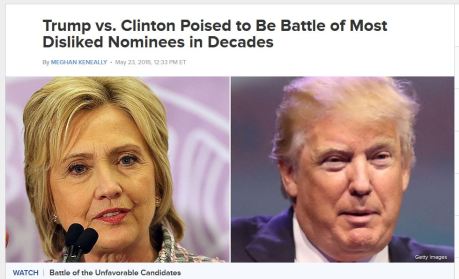
Clinton, trump, unpopular

Not so long ago I was asking myself “What’s going on there?“.

Now, that my nightmare is very close to becoming reality – both major American parties are about to nominate unpopular candidates for the 2016 presidential elections, I’m wondering about the current meaning attached to the very concept of ‘politics’.

For an impersonal and very theoretically minded observer ‘politics’ would seem to describe the job of those who make it possible for the rest of us to lead our lives in an orderly fashion.

I believe you are familiar with what a ‘super’ does. ‘Super’ as in ‘superintendent’ for a residential building.
“The super must be conversant with every mechanical and technical system in the building, work diplomatically to solve problems in the building, be responsive to residents and be able to work as a team member with the board and the managing agent.”
Not exactly ‘rocket science’ but a very important role. So important that when poorly played the whole thing might very quickly deteriorate beyond repair.

After all, ‘the government’ should do nothing more, and nothing else, but act as a nationwide ‘superintended’ while ‘politics’ should be nothing more, and nothing less, than what we, all the inhabitants of a country, do in order to make sure that the government, our government, does its job. Properly.
Especially when living in one of the so called ‘democratic countries’.

Then how come I’ve got a growing feeling that ‘politics’ have become just another set of means towards specific goals? Goals that are more often than not detrimental to the society, as a whole?

PS.
This is for those of you who are not familiar with how this site works.
By clicking on the pictures, or the highlighted text, you are automatically linked to the sources of the quoted material. Sometimes they might be interesting, to some of you.

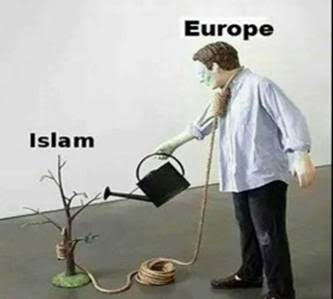
Islam Europe

I’ve just found this cartoon in my e-mail.
It was captioned: “The Winning cartoon in an organized competition.”

I instantly remembered some very wise words I’ve read long time ago:

Do not be deceived: God cannot be mocked. A man reaps what he sows.
Whoever sows to please their flesh, from the flesh will reap destruction; whoever sows to please the Spirit, from the Spirit will reap eternal life.
Let us not become weary in doing good, for at the proper time we will reap a harvest if we do not give up.
Therefore, as we have opportunity, let us do good to all people, especially to those who belong to the family of believers.”

“Beware! Whoever is cruel and hard on a non-Muslim minority, or curtails their rights, or burdens them with more than they can bear, or takes anything from them against their free will, I (Prophet Muhammad) will complain against that person on the Day of Judgment.”

All religious teachings, all of them, maintain that ‘a man reaps what he sows’. It doesn’t really matter if the ‘result’ will come as a sentence delivered by a divine judge or if it will be just another bead in the string representing the life story of an individual.
I, for one, don’t see much difference between ‘fate’ and ‘karma’.

Then how come we keep acting as if we’ve never been warned?

“In my two visits to Auschwitz, the Nazi concentration camp in Poland, I learned that holocausts and genocides do not occur in a vacuum. Rather, there is almost always a vicious campaign of incitement directed against the target group preceding them. What is troubling today, with the recent uptick in anti-Semitic and Islamophobic incidents worldwide, is that extremists and zealots are not the only ones inciting their followers. In a number of Arab countries, Muslim children are taught ideas that distort the true meaning of the Quran and hadith too.”

o-gay-prophet-570

Love, more powerful than hate.

This is probably the biggest bone of contention between the conventional sides of the political spectrum.

The conventional right claims that we’d be a lot happier with a considerably smaller government while the conventional left would, if left to its own devices, transform the government into a huge, and ‘smothering’, nanny.

Is there any reasonable way of determining the right size of the government or we should just try to reach a compromise between the warring factions?

I don’t think I’m smart enough to determine how big a government should be.
I also dislike the very concept of compromise – if I have to settle something I prefer to negotiate instead of compromising.
And that’s is why I’d rather approach this problem from another angle.

What KIND of government!

Let me take you on a short, and very condensed, historical ride.

Basically humankind has used, somewhat alternatively, two systems of running things.

Authoritarianism and democracy.

Specifics do not matter much. If decision making was centralized it was authoritarianism, if decisions were made by those directly affected by the results of those decisions being put in practice it was democracy.

What’s really important here is the fact that those two different manners of decision making generated different forms of government.

Authoritarian regimes employed ‘administrative’ (meaning ‘directorial’) forms of government while democracies were served by ‘referential’ forms of government.
And it was only natural that things happened this way.
Authoritarian regimes need nothing more than a ‘transmission belt’ to convey orders from the very top to the base of the social pyramid while democracies need a team of referees to keep the playing field level and nothing more than that.

Of course that I’m presenting a very simple sketch here. Things are more complicated than that.

And there are at least two main complications. ‘Human greed’ and ‘international relations’.

It doesn’t really matter if that greed is for money of for power. Whenever greedy individuals are allowed to enter the government and to cater for their ‘special needs’ things are headed south. And the only difference between this situation occurring in a democracy or under an authoritarian regime is that the latter has no natural defense against this kind of ‘mishaps’.

‘International relations’ play a less obvious role. The main job a government has to fulfill is to keep the state together. If a hypothetical state would exist in a vacuum – and have no neighbors, things would be a lot simpler. Since in the real world states do have neighbors the governments have to organize armies, secret services, engage in arms races…
Also in the real world states are very different. In size, for instance.

For all these reasons it’s very hard to ‘calculate’ the ‘proper’ size of a government.

Specially so without defining clearly what’s expected from that government.
An authoritarian regime would ask the government to preserve the privileges of those at the helm of the regime while a truly democratic minded people would expect their government to safeguard, using legitimate means, the independence of their country on the international level while simultaneously making sure that the individual members of that people enjoy enough personal autonomy so that their political regime remains democratic.

After those expectations are clearly formulated, the size of the government will simply be a consequence…


For how many times each of us has moaned, in true disbelief, ‘why is this happening to me?’. Or at all.

“I emerge from this conversation dumbfounded. I’ve seen this a million times before, but it still gets me every time.
I’m listening to a man tell a story. A woman he knows was in a devastating car accident; her life shattered in an instant. She now lives in a state of near-permanent pain; a paraplegic; many of her hopes stolen.
He tells of how she had been a mess before the accident, but that the tragedy had engendered positive changes in her life. That she was, as a result of this devastation, living a wonderful life.
And then he utters the words. The words that are responsible for nothing less than emotional, spiritual and psychological violence:
Everything happens for a reason
. That this was something that had to happen in order for her to grow.

That’s the kind of bullshit that destroys lives. And it is categorically untrue.”

In a sense the post that prodded me into writing this (Everything doesn’t happen for a reason by Tim J. Lawrence) is akin to a self supporting fallacy coupled with the kind of honest, well intended error all of us somehow feel is wrong at the very time we are doing it yet we cannot help ourselves to stop doing it.

So, why is all ‘this’ happening to us?

Basically there are three main stances on this.

The staunch believers are convinced that there is a grand scenario that ultimately decides our fates, down to every minute detail. You can find here, mingled together, religiously motivated people, convinced that ‘God’ has preordained their entire lives well before they were even born, rubbing elbows with the scientifically minded who are convinced that everything that  had ever happened went on according to an uninterrupted chain of causes and effects which can, only if we were able to find out how, be followed down to the root of all things. To even before the Big Bang?

The amoral ‘happenstancers’ believe that  ‘Lady Luck’ is blindly leading us down the path to exactly nowhere, hence ‘it’s up to each of us to make the best of it’. Sometimes up to callously disregarding everything else but their own whims.

The agnostics have figured out that while it is impossible to know/understand the ultimate cause for anything, from time to time it happens that each of us has a glimpse of understanding about something. And that however incomplete, that piece of understanding might  prove itself to be useful, even if temporarily.

Most of you have already noticed that the first two positions are at the very extreme ends of the spectrum and are held, in earnest, by relatively few people.
And that most of us – despite our professed affiliations, belong, in reality, to the third category.

Before proceeding any further I’m going to make a small detour here and note that ‘science’ itself was invented by Christian scholars trying to make sense of God’s ways. Hence no wonder that the ‘scientific minded’ cannot see eye to eye with the ‘believers’ – new converts are looking down in disdain to their old religion, and that both partake in the conviction that ‘there must be something behind what is readily visible’.

The link between all these three categories, between the first two who already have a strong conviction about things and us, the run of the mill people who are sometimes taken aghast by what is happening in our close vicinity, is that all humans need to make at least some sense of things before learning to live with them. And with their consequences.
And since no two normal people are alike there never was a one size fits all narrative able to cover, efficiently enough, all situations that ever occurred to us.

That’s why I simultaneously agree with Tim that the best thing to do when something happens to somebody I care about is to simply say I acknowledge your pain. I am here with you. and disagree with him when he says that all other things that get said in times like those are wrong.

The fact that my experiences/opinion on the matter happen to fit his doesn’t mean that we are both right, nor that our take on things that already happened to us might fit all other things that might happen to all other people. So I find it just a little presumptuous to discard all other opinions simply because they are different from ours.

Now, that I’m nearing the end of this post, let me discuss a little the pretext shared by both our posts: ‘Is there a reason for anything?’

Well, the answer for this depends heavily on what you mean by ‘reason’.

Is there a cause for anything? Most certainly ‘yes’, regardless of whether you believe that that cause to be divine, completely aleatory or any combination of these two.

Or is it that we’d better ask ourselves if there’s a ‘motive’ behind what’s happening to us?

Another thing that is common to most people is their tendency to blame others when thinks go bad and to claim more merit than it’s their due when things go well.
That’s why so many of us find it difficult to assume individual responsibility for our own mistakes and for putting ourselves in harms way – even when that responsibility is only partial.
Along the same psychological mechanism many of us cannot accept the very notion of ‘blind’ bad luck. While cashing a lucky lottery ticket is accompanied by nothing more than a self congratulatory slap on the back, and no soul searching questions get to be asked on the occasion, every time we as much as catch a cold in a very bad moment we wrench our hands in self deprecation: ‘what was it in my head that drove me to go in such a germ infested environment?’.

So, while I cannot rule out the existence of the famous Grand Design that I mentioned earlier, it seems obvious to me that only some things happen for a motive. Or that sometimes there are one or more motives which tilt the table in a direction or other. On the other hand what each of us does in each circumstance might have a huge importance. And sometimes both our efforts and the ‘motive’ responsible for the general set-up are rendered inconsequential by some haphazardous  occurrence.
For instance Romania endured the Soviet yoke simply because of its geographic position, because Stalin-ism was an aggressive creed and because the West was too tired shortly after the WWII to do something really meaningful about the Soviets extending their influence beyond where it was welcomed. At the same time the manner in which communism had influenced our destinies depended a lot on individual decisions – ‘theirs’ but also ours – and on pure luck.

That’s why I fully endorse Tim when he says that it’s extremely important for us to act appropriately whenever something nasty happens to those living inside our reach and that we should carefully select those whose presence we accept around us when something nasty happens to us, while I cannot accept his insistence that there is a single ‘appropriate’ behavior in all circumstances.

 

scalia1

It is very rarely that I agree in full with something that I happen to stumble upon over the Internet.

And it’s no wonder that Scalia was absolutely right on the subject.
He had lived for so long in the shadow of the Constitution that at some point it must have downed on him.
The constitution, just as any other legal document, is nothing more, and nothing less, than what we make of it.

After all it was us, citizens, who wrote it in the first place.
Then amended it as we saw fit.
And are now interpreting it. To fit our own purposes, of course.

We don’t seem to agree much, lately, about those very purposes?
So we came up with diverging interpretations of what’s written in the Constitution?

Then the problem is with us, not with the Constitution.

Using it as a weapon, or adjusting it to fit the short term goals of whomever happens to be in power momentarily, won’t solve anything. Actually it will only make things worse.

First and foremost language is perceived as a communication medium.

As such it needs clarity and consistency, otherwise information could not have been reliably exchanged and or preserved through its use.

But language is used for many other purposes than for simply ‘translating’ raw data. Where to find a certain object or how to execute a certain task.
We use it to convey sentiment – the way we are affected by the raw data that has become known to us, and to communicate our particular understanding of things. Our point of view about what has happened around us.
Furthermore we use it to convince people. To do things or to accept our points of view.

All these different uses involve a considerable amount of negotiation.

Regarding immediate goals – the things we are negotiating about, but also some that is taking place ‘under the table’ and involves the continuous fine tuning of the instruments used during the negotiating process. The words themselves.

These negotiation instruments – the language itself, in fact, have to be constantly re-calibrated for two rather obvious reasons.
For starters, the reality around us – and our understanding of it – is changing constantly.
Secondly, every negotiation involves a degree of ‘shade’. In fact that ‘shade’ is exactly the space where ‘change’ happens, where the positions of the two negotiators overlap and where the two can swap ideas.
If words would be rigidly precise than we’d have to invent new ones every time reality changes, no matter how minutely. Also whenever our understanding about things deepens, no matter how shallowly.
Simultaneously, too much ‘linguistic precision’ would kill not only poetry and our ability to convey our real feelings to other human beings but would also gravely impair our ability to influence each-other. Could you imagine how our life would be if a polite intervention would sound exactly like an SMS message of if a marriage proposal would be similar a requisition order?

More about how the linguistically mediated interplay between us has brought about our own self-awareness can be found here:

Humberto Maturana, The Origin and Conservation of Self-consciousness.


section 172

Yoshida Kenko, Tsure-Zure Gusa

I just can’t make up my mind about this.
Is it the figment of an idealist monk’s imagination, the factual description of how things happened in Medieval Japan or a wise advice coming from a great teacher?

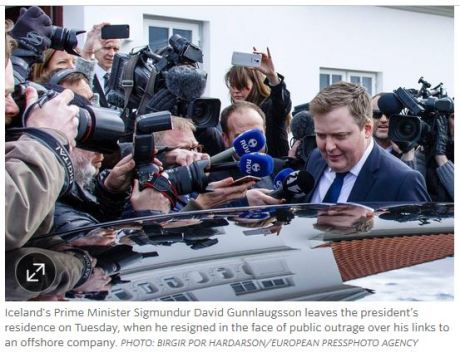
The ‘Panama Papers’ rekindled the public interest in the subject of ‘what legitimate goal could anyone have in setting up a company in a fiscal paradise?’.

Taxes, stupid!

Actually it’s quite simple.

Let’s pretend you are an alien from the outer space who has a business idea backed up by enough capital and you want to put it in practice somewhere on Earth. Aren’t you going to shop around for the best environment you might find? So that your business would have optimal conditions to grow? And when the business ripens wouldn’t you want to be able to cash on it – and end up with as much money as possible?

Rather conflicting demands, isn’t it?

First you want an ‘operational base’ with relatively low costs but secure and full of whatever amenities your business might need in order to thrive. Next you’ll need fast access to a market where to sell your wares. Last but not least it would be important for you to incorporate your business in such a way/place that you’ll end up pay the least amount of tax, both while operating the business and after the cash out moment.

While all these are legitimate demands there are a right and a wrong way to meet them.

I’ll refrain myself to discussing exclusively about the tax part, the rest being relatively easy to balance.

In this respect you can choose to incorporate the business in the same place you have selected for your operational base and pay whatever taxes are due in that place, under the rationale that those taxes cover the cost of doing business there and are nothing but a compensation for benefiting from the conditions present there at the time. After all, when you have chosen a particular place as the home of your business you have entered into an informal arrangement with that place. It lets you make good use of whatever is there to be used – exactly the things that convinced you to select that particular place, and expects you to fulfill your side of the bargain. Provide enough compensation so that that place can continue to be a good place to conduct business and, if possible, improve itself. Pay the local taxes.

Or, equally legitimate, use two different places for each thing. Organize your operational base where it would work best and incorporate your business in a place where you’ll be able to pay as little tax as possible.

And here’s the catch. No matter where you incorporate your business you’ll still have to pay some taxes in the place you have chosen as your operational base.

Then why bother?!? you might legitimately ask.
Since this is not an accounting dissertation I’ll just tell you that there might be serious financial advantages in making this choice, not the least of them having to do with the cash out moment.

And this is the very point where some people get greedy. They try to avoid altogether the taxes tied to the ‘operational base’ – by employing various semi, or even completely i-legal stratagems, and by doing so completely transform the very nature of the entire operation.

From one of fiscal optimization to one of money laundering.

There are a lot of rationalizations for this course of action. From ‘the state is a thief that uses force in order to part me from the fruit of my efforts!’ to ‘why give it to the state since the money will be squandered by the inefficient government?’.

Now let’s please remember where we started from.
OK, you are not an ‘alien from the outer space’ but what’s stopping you from conducting your business where ever you want on the face of this Earth? (My bad, this question is not valid for exactly everybody, there still are countries that don’t allow for people, or capital, to exit freely, but I’m sure you get my drift)
Oh, you like it where you are but you hate paying taxes and/or you’re disgusted by the way the government handles its finances!

Then let me remind you of two things.

First, you probably live in a democracy. Speak up. Make your concerns known. Loudly. Make sure you are listened to. Vote wisely.

Secondly, you are probably fed up not only by the fact that in your country taxes are really high but also by how little you get back in return.
Well… that’s because there are so many people who do not pay their fair share and that your government has to take more from those who do pay in order to make the ends meet.

Savvy?

iceland prime minister resigns over Panama papers

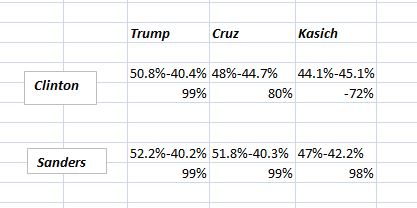
Us electoral sinopsis, re-edited

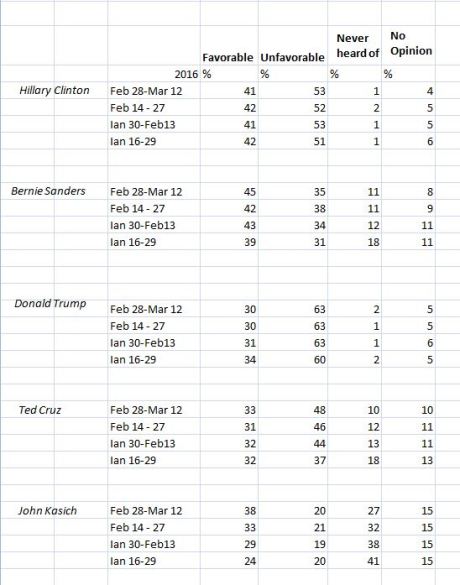
Favorability: People in the News, Gallup, April 2, 2016

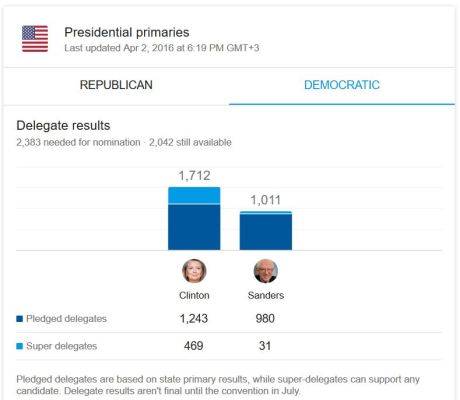
Clinton vs Sanders, April 2, 2016

Source: AP

So, it looks like that the concerned Democrats – those who bothered to show up for the preliminaries, and specially the ‘super delegates’, are going to send Hilary Clinton to compete on the national stage, despite her constant ‘negative favorability’ and despite the fact that Sanders is constantly improving his chances – both favorability and ‘never heard of’ scores are slightly better now than they were at the start of the year. Furthermore, Sanders is the one who can ‘grow naturally’ – simply by making himself known – while Clinton needs to convince the voters that their erstwhile opinion about her was mistaken. An almost impossible feat, given the length of her public career…

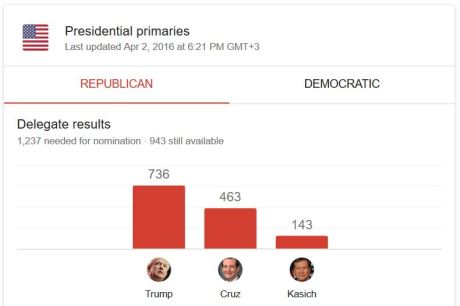
republican pack, April 2, 2016

Source: AP

On the Republican side things are even stranger.
Trump gathers more and more delegates while his ‘negative favorability score’ becomes slightly even ‘more negative’, Cruz gets a second lease on life despite his ‘unfavorable’ score increasing dramatically while Kasich, the least favored by the hard core Republicans, climbs nationally from +4% to + 18% in 4 short months. And if you look closely almost all new opinions on him, those that have been developed during the last 4 months, have been in his favor.

One of my Republican friends said “I can’t speak for the other candidates, but people support Cruz because they believe in what he believes, and feel that sometimes it’s more important to stand up for what’s right, rather than what’s popular.“.
OK, I can understand that. The despondent and/or exasperated use Trump as a banner for their state of mind while the hard core, value toting, Republicans hope that by backing Cruz they will somehow bolster those values.

But let’s see what some ‘significant Republicans’ have to say about the matter.

Scott Walker, Governor for Wisconsin and ex candidate, being interviewed on WTMJ’s Charlie Sykes Show:
““If you’re someone who is uneasy with the frontrunner, right now there’s really only one candidate—I think if you’re just looking at the numbers objectively, Ted Cruz, Sen. Cruz, is the only one who’s got a chance other than Donald Trump to win the nomination,” Walker said in the Wednesday interview on WTMJ’s Charlie Sykes Show. “Statistically, my friend Gov. Kasich can not.””

Then there is Lindsay Graham, Republican Senator for South Carolina and ex candidate who endorsed Jeb Bush when dropping from the race:
“Graham said there are other candidates he likes better, but he doesn’t think they can win. “I prefer John Kasich; Cruz is not my first pick by any choice,” the South Carolina senator explained. “But I don’t see how John Kasich can mount the opposition that Ted Cruz can to stop Donald Trump from getting 1,237” (the number of delegates needed to secure the nomination).
Graham has made it abundantly clear that he really doesn’t like Cruz at all. In January, he said Cruz has “exhibited behavior in his time in the Senate that make it impossible for me to believe that he could bring this country together,” adding that choosing between him and Trump is “like being shot or poisoned — what does it really matter?” Last month, he joked about Cruz’s general unpopularity among his colleagues, saying, “If you killed Ted Cruz on the floor of the Senate, and the trial was in the Senate, nobody would convict you.””

The way I see it, these guys, the Republican ‘apparatchiks’, are more concerned about derailing Trump than with promoting the more suited candidate among the trio. Suited for Presidency, that is.

sansele candidatilor

source: Huffpost Pollster

So, according to the polls compiled by Huffington Post, Sanders would lick the entire Republican field – if allowed to compete, while the Republican candidates are stacked, at least for now, according to the ‘who has the least chances on the national front’ criterion.

?!?

Does any of this make any sense? Any at all?

Here’s my Republican friend again: “In the case of Clinton, despite her unfavorability in the polls, there’s a sense in the Democratic Party that it’s her “turn.”
Some others think she is ‘in cahoots’ with the ‘big business’… “Family charities collected donations from companies she promoted as secretary of state“… Coming from Wall Street Journal this is a powerful allegation indeed…

But at least in this camp things are unfolding, lets say, ‘naturally’. The guys with vested interests (the super delegates, for example) are acting according to those interests while the rank and file Democrats are slowly (too slowly, maybe?) finding out what’s going on.

What really baffles me is what’s happening on the Republican side.

Some of the rank and file have adopted ‘the Donald’ as their mascot despite the obvious fact that he doesn’t belong, at all, in politics. He might have been a successful business man – read chock full of money, but the way he made that money disqualifies him from holding office. Does ‘eminent domain‘ ring any bells with you? Not to mention his antics on the public stage: “Excuse me”, ‘I’m the best thing that could happen to America!’
Are all these people delusional or are they so fed up with what’s currently going on in America that they can’t see the trees because of the forest (is on fire)?

Some others have gone ‘back to basics’ and try to revive what they consider to be the ‘sound Republican values’ – I’m speaking now about those who support Ted Cruz, if you didn’t figure that out by yourselves.
But what are these ‘hard core Republican values’?
How come some of Cruz’s followers are blaming Lincoln for being the first ‘statist’ in American history – not for abolishing slavery but for imposing that measure by force to the unwilling Southern States.
And how come those values have come to be embodied in someone so ‘popular’ among his Senatorial colleagues that “If you killed Ted Cruz on the floor of the Senate, and the trial was in the Senate, nobody would convict you.” ?

And isn’t it strange that so many Republicans are so mesmerized that they are willing to give up almost any chance of electing a Republican President?
OK, I can understand that way of thinking being used by ‘lay people’. But what is the real meaning of ‘pundits’ rallying behind the ‘value laden’ Cruz when it is obvious that Kasich is in a way better position on the national front?

Could it be that these pundits are more concerned about their own careers than with the fate of the Republican party? And even about the Republican values?
Farfetched?
Are you sure? Don’t you see that by energizing their constituencies into a frenzy they are simply building Republican (local) fortresses for their own use, leaving the rest of the (national) Republicans out to dry?

more stuff

Well, I was under the impression that Conservatism was about maintaining a common way of life, not about conserving privileges.

I still believe that.