According to the English lore, “there’s more than one way to skin a cat”. According to the cat, ‘who cares about how I lose my coat? I’ll end up dead anyway!’ According to the fur tanners, ‘the manner of skinning the pelt is of utmost importance for the end-result of the operation’.
Whom to believe? Specially since all of them seem to be right…
Well, truth has a marked tendency for being complicated. Hard to comprehend in its entirety and even harder to express in a concise manner. Meanwhile we, conscious human beings, have a marked tendency to notice only what we’re interested in. To notice only what we care about…
In fact, the manner in which we notice things speaks volumes about who we are. About how we relate to what we call ‘reality’.
The white colonists inhabiting a certain area in Northern America had become ‘Free Americans’ after fighting the British. Only after they had freed themselves through battle! A. Philip Randoph had fought for his freedom. And for human rights.
All this fighting leads to a bout of pondering. Are we free together? As in ‘all of us’ and ‘once and for all’? Or our freedom is defined against other people? Who might try to steal our liberty from us?
What is freedom, after all? A zero sum game? Where liberty is up for grabs but in limited supply? Or a ‘grace’ we impart with and upon our fellow human beings? Something to be jealously guarded or something to be collectively and cooperatively maintained and enhanced?
And one final question. Why would anyone attempt to steal other people’s freedom? When history gives us plenty of evidence that whenever freedom was out to be shared people were happy while whenever freedom was in short supply the entire society eventually crumbled under it’s own weight…
Now, what would you have done if this guy had started to swing his fists? In the very proximity of your precious nose? “Stood your ground” or gave him enough ‘space to exercise’?
You’re not exactly comfortable with the current meaning of ‘stand your ground’?
Then maybe it’s high time for us to understand that ‘stand your ground’ is the direct consequence of ‘your liberty ends where my nose begins’.
Not comfortable with the current situation?
Then maybe it’s high time for us to come up with another definition for liberty. One which brings forward the cooperative effort which made liberty possible in the first place. Instead of the confrontational one currently in use. Which serves perfectly the interests of those powerful enough to define evolution as “survival of the fittest”. Which serves perfectly the interests of those powerful enough to be convinced that only those able to defend their liberty are worthy to be free.
The key word here being “their”, not “liberty”! For this kind of people, for the Capones of this world, freedom – their freedom – is something to be appropriated rather than shared.
Think about it! Do you remember the argument ‘the west has provoked the current situation’?
What kind of freedom do we want? For us and for our children? The kind that must be constantly wrenched from the likes of Putin or one shared freely among all those present? Built cooperatively or defended against all others?
On the other hand… letting go, emotionally speaking, may not be as beneficial as advertised. We might lose some bitterness but we might become more liable to ‘repeat the experience’
As in …
Forgive but don’t forget is a lot easier to be said than done, you know…
All set goals which go ‘against the grain’ incur costly consequences. Which are detrimental to survival! Of the leading trespasser, of those in the following or of those hapless enough to be too close to that particular goal being pursued. Remember Marx? Nothing unpleasant had happened to him. Not as a consequence of his attempts to change the world! But to others… Which is equally valid for all other ‘world changers’. Along with all ‘world preservers’ who run along ideologically drawn paths.
Then what should we strive for? Simply ‘follow the heart’ to achieve ‘peace of mind’?!? Would that be enough?
‘OK, I can accept the concept of opportunity evolving in time. After all, the whole thing is nothing but a truism. Opportunity is fluid by definition. Evolution is its natural destiny. And time is the natural consequence of evolving opportunity. But where does this whole process take place?!?’
In our heads, where else….
Opportunity, evolution, time and, yes, ‘space’ are concepts. Ideas coined by us, conscious human beings acting as thinking agents who use contextualized observation to further our understanding of what’s going on around us.
‘Huh?!?’
Consciousness is a state of mind. A mind is like an AI machine. Something more than a live brain but not yet a wake, conscious, entity. The closest thing to a ‘mind’ is a sleeping human conscience. Sleeping – hence not doing its ‘thing’ – but able to be awaken. Able to do what it’s capable of doing. A brain is nothing but hardware. A mind is like a computer. Hardware and software put together. The only difference between a mind and a computer is that a mind is an expression of natural evolution while a computer is an expression of human ingenuity. Another thing minds and computers have in common is that both need a will to start them. To point their attention towards a goal. This being where consciousness takes over. A mind which is aware of its own ‘wokeness’ is a conscious mind. It can pay attention, do things and generate meaning.
‘Hardware, software, natural evolution… aren’t you throwing too much ‘content’ into a single post?’
I’ll try to keep it simple.
We, humans, are the pinnacles of ‘natural evolution’. According to our interpretation of the information we have gathered until now. As you already know, a pinnacle is a small thing perched on top of something way bigger. And for pinnacles is far easier to notice other pinnacles than to perceive what lies under them. Our bodies – including our brains – depend on what’s going on ‘beneath’ us. In fact, ‘our’ whole world – the world we depend on, the one we live in – is working ‘in the back ground’. Yet most of the time we’re interested only in what the other ‘pinnacles’ are doing… ‘Cause they are the ones which grab our attention!
Well, the ‘cool’ fact is that this is only ‘natural’. In the sense that this is how we’ve become human in the first place. That’s how our minds got their ‘software’. We’ve learned self-awareness by interacting with other human beings. We’ve built our culture by remembering the lessons learned by our ancestors. And we’ve built our civilization in concert with our brethren. Individually, we may know little. But together we can move mountains. As we did.
And got cocky. Our success has narrowed our attention span.
How do we get that faith? We don’t get it, it’s being built into our conscience during the process. Continuously. There are two factors which build our faith. Experience and reason. Past interactions we had with the wider world and the meaning we’ve derived from them. Putting it bluntly and oversimplifying things, based on previous experienced we convince ourselves, involuntarily, that it was us who were entitled to claim the merit for what had happened. Either we’ve done something right, ‘believed’ in the right things/gods or both at the same time.
Up to not so long ago, we have evolved in a religious manner. In the sense that faith was shared amongst us. We used to share a ‘core faith’. That things not only work in a certain manner but also that things should go in a certain direction.
Success has changed that. We’ve become so confident in our ability to generate meaning that we have emptied what’s left of the core faith. We, the pinnacles, have reached such heights that we’re no longer aware of our link with the rest of the mountain. We’re racing ourselves for the top forgetting that we need fuel and spare parts. That our very racing completely changes the ‘racetrack’. For better or for worse…
And everything described here takes place inside our heads! Happens inside our heads and changes, through our actions, the very world which keeps us alive.
About which individual are we talking about here? About me? The ONE above all? About us? The only ones who ‘belong’? About all individuals? Regardless of age, gender, ethnicity …
“On the other hand, the individualist or anti-collectivist can at the same time be an altruist…”
Sir Karl Raimund Popper had died in 1994. Long after all of the so called collectivist regimes of the XX-th century had shown their true colors. Long after all the self styled collectivist regimes had unveiled their murderous nature.
And murder, by definition, is the most individualistic attitude available to a human being.
Let me be absolutely clear. I’m talking about murder here. That thing perpetrated by an individual, alone or in cahoots with others, against other individual or individuals. Self defense – the minimal action meant to save one’s own life, which stops as soon as its goal has been fulfilled – has nothing to do with murder. Criminals can, indeed, try to camouflage murder as self defense but their actions are obvious for all level-headed observers.
My point being that individualism cannot be defined as being anti-collectivist. And what’s bothering me is the fact that Popper himself had fallen into this trap.
If I get this right, Popper’s main contribution to our understanding of the world is the notion of ‘falsifiability’. The idea that human knowledge – science – grows in fits and starts. That individuals notice things, formulate their observations as theories and put them forward for public examination. And that even the theories which hold water, for a while, will, by definition, be proven false – or at least incomplete – at some point in the future. The way I understand this process – I’m an engineer converted to sociology – is as a continuous dialogue between individuals and the community which nurtures them.
Just as you can’t have a working engine – I’m a mechanical engineer – without all the pieces fitted in the right places and without a tank full of fuel, you can’t have a ‘healthy’ collective without ‘established’ individuals. Symmetrically, no individual can survive – let alone thrive – alone. A baby needs to be fed and taught to walk/speak/think in order to become an individual. A conscious human being.
Collectives, currently known as nations, fare according to the opportunities enjoyed by the individuals comprising those collectives/nations. AND according to how each of the individuals understand to enjoy each of those opportunities. The members of the North Atlantic Treaty Organization – who treated their citizens far better than how the Soviet citizens used to be treated by their self styled collectivist leaders – have fared a lot better than the defunct Soviet Union. Democratic and free-market capitalist countries fare a lot better than those run in a more or less centrally planned manner by authoritarian regimes.
And the explanation is simple. Democracy and free market capitalism mean that many more individuals have many more opportunities to contribute to the well being and the ultimate survival of their community than what’s going on inside authoritarian regimes. Where the decision making is concentrated in a very few hands. Where most opportunity has been confiscated by a handful of self chosen few individuals. In fact, the democratic and free market capitalist countries are far more collectivist minded than the self-styled collectivist authoritarian regimes. Where only the high ranking officials count as individuals!
And no, Plato wasn’t exactly right either. His ideas haven’t reached us in their intended form… or it is us who can’t read them in an appropriate manner… “Plato suggests… that if you can’t sacrifice your self-interest for the sake of the whole, then you are a selfish person, and morally depraved.” ‘Suggests’ already comprises a healthy dose of individual latitude. A healthy dose of individual lee-way when it comes to interpreting each individual situation. Furthermore, this is rather a matter of how a collective deals with each individual situation than an individual being selfish or morally deprived.
All situations which determine the fate of a collective are experienced, interpreted and dealt with by individuals. No collective exists as a ‘unit’. Nor reacts as one, regardless of whatever efforts have been made, under whatever disguises, by ultimately individual dictators to implement such ‘unity’. Around the ‘individuality’ of the dictator…. And whenever the individual called to solve a particular situation considers his individuality as being superior to the fate of the collective… then that individual actually lights a fuse. Which might or might not detonate a charge. Which charge might or might not destroy much… but… The main problem here residing in the fact that many individuals haven’t figured out yet that their own individual fates are inexorably linked to that of the collective.
That if it’s not peer-reviewed, it’s not science! That being a bona fide individualist “does not mean (that the concerned individual is entitled) to take one’s own individuality particularly seriously, or to lay more stress (or even as much) on one’s own interests than on the interests of others.”
So. We’ve figured out that dreams are something which happen inside our heads. When sleeping. Then called them names. ‘Dreams’ if they were OK, ‘nightmares’ if not. Interesting, isn’t it? Then we have hallucinations. A sort of daydreaming – if you think of it – only less pleasant.
My point being that our consciousness – “our ability to observe ourselves observing” – opens up a new realm inside what we call ‘reality’. That we live, in fact, inside a world of our own making.
‘But this is valid for all living things, right?’
In the sense that all living things collaborate – albeit involuntarily – towards the continuous reshaping of what we call ‘biosphere’… yes! Life does indeed reshape the portion of space/time where it happens.
The way I see it, life is responsible for the ‘second layer’ of what we call reality. While we, the conscious observing cum living inhabitants, are responsible for the ‘third layer’ of what we call reality.
‘You keep saying “what we call reality”. Would you care to elaborate?’
You see, we have developed two concepts. ‘God’ and ‘Reality’. God is something which had suposedly made us. According to those who believe in God, we have been brought to life – along with the world we inhabit, in a voluntary manner, by the agent we call God. On the other hand, reality – according to those who believe in ‘science’ – is the ‘place’ where we have happened to ‘evolve’.
God is something we are told about by others. Something the ‘worthy among us’ might experience first hand through ‘rapture’. Those who believe in God consider that the original information about God had been delivered, through divine inspiration, to ‘prophets’. Or had been acquired one way or another by ‘elders’. Those who believe in God consider that God – and his will – are inaccessible to humans. That we, ordinary human beings, are only meant to simply experience ‘God’s will’. And adapt our behaviour accordingly.
Reality is something we, the present ones, are told about by our predecessors. And something we experience through observation. Those who believe in science consider that nobody – individually and collectively – will ever be able to know everything. Basically, those who believe in science are also convinced that reality is ultimately inaccessible to us. Those who believe in science consider that it’s our job, as conscious human beings, to find out as much as we can about ‘reality’ and adapt our behaviour accordingly.
For somebody unwilling to take sides, there’s not much practical difference between the two sides mentioned above. Both are states of mind. Convictions. Weltanschauungs which shape human action. Furthermore, both mandate us to do the very same thing. Adapt our behavior to what we ‘see’! Does it really matter whether what we ‘see’ was handed out to us by somebody or is the consequence of happenstance? Would our reaction be different? Why?
‘But God has handed out a series of commandments! For us to follow in order to be saved. Science doesn’t provide any ‘spiritual guidance”!
I beg to differ. The Bible – and all other sacred texts – have been written by people. Taught by people to other people. Science – everything we know about things, including what we call ‘best practices’ – has been put together by people. And taught by people to other people. Furthermore, technology – the manner in which we have put in practice what we know about the world, regardless of how we have acquired the information – has been put together by us. We’ve designed each and every tool we have used to transform our world into what it is today. And it was still us who have use those tools according to our own goals.
So it is us, collectively, who are responsible for the world we live in. For the dream we live. And for the nightmares experienced by some of us.
Etymologically speaking, reason comes from ratio. ‘Reason’ in Latin but also having to do with ‘reckoning’. With dividing the ‘big picture’ into easier to understandable slivers. Slivers meant to be analyzed and later assembled back into meaning. Into ‘truth’.
Now, which of the two reasons gives birth to the ‘genuine’ truth?
The analytical/synthetic one which attempts to develop reality into meaning or the one which defends and embellishes the already known truth? The revealed truth?
The whole thing depends on the “ends” of the reasoning agent?
Reason, hence truth, depends on the intention of the individual performing the act of reasoning?!?
Quite unreasonable, don’t you think? Truth was supposed to be anchored in reality, right?!? Not on ‘intention’….
Truth as unhiddenness… is a concept developed by Heidegger. Basically, this whole thing is about individuals being unable to discover nor formulate the ‘entire’ truth so a ‘bigger’ truth may be reached only through cooperation. Everybody ‘says’ – unhides – everything they know about a subject and that’s how the most complete truth available at that moment is ‘uncovered’.
‘But this means the Truth becomes fluid. No longer ‘fixed’. Unreliable!’
I’m afraid you’re right! Except for the ‘unreliable’ part. As long as enough people do their part, and honestly speak up their minds, the most reliable truth knowable at any given moment will become apparent to everybody. To everybody who cares to look for it! To everybody who accepts that their reason, while imperfect, can and should contribute to the common effort to get closer to truth. To everybody who accepts that other people’s reason, while imperfect, can and should be listened to in the common effort to get closer to truth. To everybody who accepts to continue this effort knowing very well that no matter how hard they will try, people will never find the entire truth
It is a truism that almost any sect, cult, or religion will legislate its creed into law if it acquires the political power to do so, and will follow it by suppressing opposition, subverting all education to seize early the minds of the young, and by killing, locking up, or driving underground all heretics. Robert A. Heinlein, Postscript to Revolt in 2100.
Religion is the metaphusical ‘thing’ inside which people who hold a set of tenets to be true are able to build a community.
Religion is sociological phenomenon. Something belonging to the realm studied by those who try to understand how large number of people work together.
Religions – on the other hand – are ‘sets of tenets’ put in practice by various groups of people. Sets of tenets which survive for as long as they continue to help the people who uphold them in their quest to survive as a group. As a community.
Religion cannot be ‘changed’. Religion can be studied. May be better understood. Like physics. You can’t ‘change’ physics! With what? With chemistry? Things don’t work like this. The only thing you may do about physics is to ‘deepen’ your knowledge about it.
Religions can, and sometimes have to, be changed. By the very people who ‘use’ them to survive.
Since nobody can survive on their own, each and everyone of us needs to belong. To a community. To a religion, actually!
And what do people do when they realize survival is impossible in certain conditions? Die or do something about it, right?
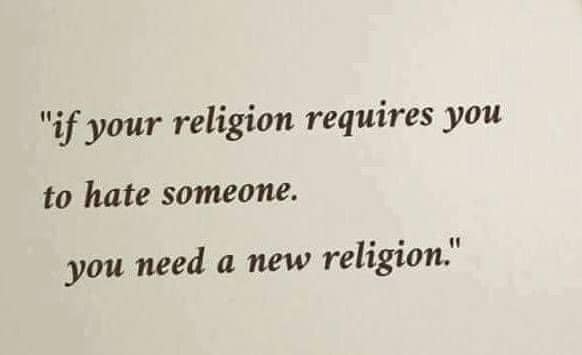
Now, which community can survive based on hate? It doesn’t matter whether you are asked to hate somebody inside or outside your community. Whether you hate individually or collectively. Hating – or despising – somebody blinds you and exhausts you. Puts a huge burden on your back. Focuses your attention so tight that you are no longer able to notice the real dangers. Those which actually make you less likely to survive.
And this is valid both for you as an individual and for you as a hating community.
Time, like everything else human, has two sides. Like a coin.
A ‘base’ and an interpretation.
There’s no interpretation without a base – even hallucinations are based on ‘something’ – and there’s nothing which has penetrated human conscience and ever managed to evade interpretation. In fact, human conscience needs to interpret, to assign meaning to, everything it ‘sees’. Everything it perceives. Anything which is uninterpretable, which has no meaning, cannot be controlled.It is, hence, dangerous. If you don’t know what’s going to happen next, you can assume anything. And since assuming the worst – and preparing for it – is far more useful towards survival than sleeping over it, we are biased towards erring on the side of caution. And towards relentlessly searching for meaning.
Time, like everything else human, is both a phenomenon – it happens – and a concept. The difference between the ‘time’ of a star and the human time being that ours has a name – given by us – and that the star cannot do anything about it. While we do!
We can do things to and about time!
We named it, we measure it, we attempt to interpret it…. and we try to do the best of it! We try to do, while alive, what we consider to be ‘the best’.
The best (?!?) for whom?
Tao.
The ‘road’. If everything flows, it has to flow ‘somewhere’. Not only from the start/spring to the ‘end’ (?!?)/never tranquil sea. Everything flowing needs a ‘riverbed’ to flow ‘through’. A plant needs soil to sprout, grow, bear fruit and ‘return to nature’. Even a star needs an Universe in order to shine… besides enough ‘fuel’, of course! I have started this post by saying that there’s no interpretation without a ‘base’ and that we, conscious human beings, need to attach meaning (a.k.a. interpretations) to everything of which we become aware. Same thing here. For anything to happen, a venue is needed. Some wise people in our past have used ‘Tao’ as a name for THE venue. For the venue where everything takes place.
Karma.
At first, when conscience had dawned on us, we were alone in the ‘dark’. And afraid about what was going to happen to us. To assuage that fear, we have identified God. As the ‘the meaning’ of the world. At first, when both the world and time seemed to be endless – to us, consequences came from God. We had to behave. Or else… God was there to punish each and every transgression. Sometimes using one of us as his proxy. After a while, some of our ancestors have learned to write. To reliably transfer information over generations. Very soon, those ancestors of ours have learned the link between cause and effect. Between behavior and consequence. Very soon God had become an outside observer. Or was out-rightly forgotten. But Karma survived.
Future.
I keep hearing that ‘evolution has no purpose’. Like many other human utterances, this one conveys far more information about the utterer than about the phenomenon described by the utterer.
‘This wooden table has 4 legs’. We learn about the table that it is in front of us, that it is made of wood and ‘has’ 4 legs. We learn about the utterer that: It was conscious when uttering those words. Only conscious agents are capable of ‘speaking like a human’. It has, at some point, learned to speak. English, and possibly other languages. It has, at some point, learned to count. At least up to four. And it had conserved that ability up the moment when it uttered those words. It was capable of identifying ‘wood’ as a material. When uttering that phrase, it was in a ‘casual’ state of mind. A ‘scientifically minded person’, a ‘grammar nazy’, for example – when in that mood, would not attribute human ‘abilities’ to a table. Which table is a mere object and objects cannot posses other objects. Tables cannot ‘have’, hence that person was speaking colloquially. Or, given the current ‘technological’ developments, those words might have very well been uttered by a statistically ‘minded’ AI application…. A man made ‘parrot’!
See what I mean?
Let’s go back to the presumably purposeless evolution.
Evolution is a phenomenon. Like a thunder. It takes a lot more time to unfold than a thunder, it’s about as hard as a thunder to predict the exact point where it will ‘strike’ but we know enough about both to be able to point out, quite reliably, a few ‘rules’ about how both phenomena take place. About where, when and how they will unfold. What’s the purpose of thunder? To ‘close the circuit’? To discharge the energy pent up in the cloud? I’m afraid that attributing purpose to thunder is akin to allowing tables to ‘have’ legs. What we have here is a ‘figure of speech’. An ‘implicit’ figure of speech… so implicit that it’s not even considered as such… Same thing when it comes to evolution.
Which evolution is paramount to survival. Just as no cloud can accumulate ad infinitum electric energy – hence thunder – no living thing ever – no species, more exactly – has yet been able to survive ‘everything’. Everything mother nature has thrown at it. Hence ‘evolution’! Which is a mere process which makes life possible. In certain conditions – in a certain Tao – after it had sprung up. And, again, attributing purpose to evolution is akin to allowing a table to own legs.
Then what about ‘future’? If God no longer decides for us – the God we have identified – and if evolution is ‘pointless’… then ‘future is blind’?!?
Not so fast!
Question: Where was God at Auschwitz? Answer: Where was man at Auschwitz?
Could any of those present at Auschwitz have done anything to fundamentally change the outcome? Probably not. Could we, as a species, have done – have behaved, actually – in such a manner as to avoid Auschwitz altogether? Specially after the Armenian Genocide had already taken place? Should we, as a species, have done differently when so many Tutsi had been killed in Rwanda? When 8000 Muslim Bosniak men and boys had been murdered in Srebrenica?
See what I mean? About the future? About our future?
What do we have here? “Eternity and endless return?” Or past mistakes haunting us through time? Until we figure out the way forward? Or else…
Yes, you who have enough spare time to read things like these and are open minded enough to continue. Who don’t worry too much about what you’re going to eat tomorrow and who would like to figure out what life’s about. What’s the meaning of all this which is going on around you.
You who have just figured out you’re different from the rest of the animals. That you’re able to think. And that you’ll never make it alone.
That no matter how smart you are, you’ll never be able to pull it on your own. That no matter how strong you are, now, you’ll always need to be helped by your brethren.







 nicichiarasa