Archives for category: Choices we make

It depends on the meanings we attach to these two concepts.

Yanis Varoufakis, Greece’s ex finance minister, is convinced that ‘Capitalism will eat democracy – unless we speak up.

Since he has some experience in this matter I’ll follow his line of thinking – for a while.

His point being that you can have successful capitalism in undemocratic societies – like Singapore and China – and that effective power has slowly shifted from the political sphere of the society to the economic one – which is undemocratic by definition.

Can’t say he’s entirely wrong, can we?

But we can say he’s somewhat confused…
So, he mentions Lee Kuan Yew’s Singapore and China as capitalistic success stories and then says that  the political sphere is gradually falling  under the yoke of the economic one… Well, last time I looked, in China the state was still in full control of everything that moved and the state was firmly in the hands of the politicians. Same thing was happenning during Yew’s tenure as Singapore’s good willed dictator.

Unfortunately there is some truth in his words when we look at what’s going on on the both sides of the Atlantic and that’s why I’m going to examine whether we have the same kind of capitalism in both situations.

By Google-ing the word I got two definitions for the concept.

The first definition that was offered by the search engine came from Oxford Dictionaries, “An economic and political system in which a country’s trade and industry are controlled by private owners for profit, rather than by the state” and the second one came from Merriam Webster: capitalism is “an economic system characterized by private or corporate ownership of capital goods, by investments that are determined by private decision, and by prices, production, and the distribution of goods that are determined mainly by competition in a free market“.

Putting them together we have private ownership, private decision, free market and profit as a goal.

Are these enough to describe a reasonably well functioning economic system?
I’m afraid not.

Let me give you some examples.
The French state has a controlling interest in Renault and the land of Bavaria quite a sizeable one in VW. Renault is in good shape and VW was too, until very recently. So private ownership is not an absolute necessity.
In the US we had quite an interesting situation. Two out of the three big car manufacturers  had to be bailed out by the state. All three were privately owned so we must look somewhere else: the Ford family still has a powerful word in the management of the single one which didn’t had to be bailed out. In Europe the best run auto company seems to be BMW – again controlled by a single family, the Quandt’s. It seems that it helps a lot if those who call the shots have a long time interest in the well being of the company versus the situation in which the top management has (short time) profit as the single/obsessive target.
Coming back to Renault and VW, they can be compared to Singapore, China and, maybe, Spain. Singapore was able to develop a ‘capitalistic’ economy despite it being an authoritarian society simply because Lee Kuan Yew was a very special kind of ‘dictator’ – one that not only cared sincerely for the greater good of his people but also didn’t loose his head during his long stage at the helm. A similar thing happened in Spain – Franco was the sole dictator who had made preparations for a democratic evolution after his demise, while China had to wait for another good-willed dictator to grab the power – Deng Xiao Ping – before it could steer towards the present course. No other authoritarian regimes but these two have ever managed to replicate this feat – we still have to wait a little before pronouncing Vietnam as the third, and very few other publicly owned companies fare so good as Renault does.

So, we have rather strong evidence suggesting that ‘skin in the game‘ trumps blind insistence on short time profit and that a free, democratic, society offers greater chances for economic development than a authoritarian one. In fact the politicians that need periodic confirmation from the people they govern do have some skin in the game while the authoritarians are in a position that is somehow equivalent to that of the CEO’s of the huge corporations whose stock owners are so disspersed that practically don’t count much – the members of the board practically slap each-other on the back and are able to do practically what they want with the companies. Look what happened at GM, Chrysler and, for example, ENRON.

But how free should be that society in order for capitalism to thrive?

Could it be so free that a guy could come from the street and claim your house as being his own? No?

So we need a free but orderly society. One where private property changes hands only when its owner says so – or has previously entered into a contract which stipulates that in certain conditions that transfer has to take place.

Meaning that in order to have a functioning capitalist society we need not only private ownership but also private owners who have enough trust in each other to start making business together.

You see, the feudal lords of the Dark Ages did have a lot of private property but capitalism couldn’t take hold in earnest as long as the (absolute) monarch could strip a man of his property and give it to somebody else. They couldn’t enter into (longish time) contracts because the era was dominated by huge uncertainties regarding various aspects of the social and economic life.

In fact it is exactly this well tempered freedom that is the crux of functional capitalism. Enough freedom so that everybody could feel confident that he is his own master but tempered by rules enforced in a pwerfully enough manner to give everybody sufficient trust that most contracts will be executed faithfully.

In this sense for capitalism to work properly we need to have a market that is free in more dimensions that one.

It has to be free from political intrusion in the sense that the government should leave it alone as a rule of thumb but also that the same government should keep it free from becoming cornered by a single group of interests.
In fact there is no difference from a market that is run by a governmental agency or by a monopolistic corporation – no matter if the latter is private. As soon as decision making becomes concentrated in too few hands mistakes starts happening. And their effect accumulate until the system finally collapse. Or is dismantled by some ‘exasperated’ more powerful agency – as Standard Oil and  ‘Ma Bell’ were dismantled by the US government. Which, by doing so, created the premises for  the huge development of those two respective markets – oil and communications.

Only this freedom of the markets can seldom be preserved by an authoritarian regime. Yew’s Singapore and contemporary China are exceptions, not the rule. Most authoritarian regimes cannot resist temptation and start meddling in the economic life of their countries. By doing so, they introduce a lot of ‘noise’ into the system. Eventually, this noise drowns the useful signals and ‘blinds’ the decision makers.

Same thing happens – and here Varoufakis has a valid point – when economic agents become so powerful that they can dominate the policy makers. The politicians can no longer preserve a balanced stance towards the economy and give in to ‘special interests’. This way the markets loose their freedom, with all the malign consequences that come with this situation. Among them, the lack of trust that slowly creeps in the souls of those who have to do business in the no longer free markets. Which lack of trust is very bad for all those involved.

And another thing about which Varoufakis is absolutely right. A lot of money are not being moved through the ‘front doors’. Not that they are not invested at all but because they are kept somewhat hidden they do not contribute as much to the well being of the world economy as they could/should.

2.1 $ trillion have been accumulated, as of  October 2015, in off shore accounts by the top 500 American companies in order to avoid taxes and
Between $21 an $32 trillion have been hiding in 2012 in various offshore jurisdictions.

Why is that? Simply because those who are called to decide about these money do not ‘trust’ that by bringing these money home and by investing them there, after paying the taxes, will be able to generate profits equivalent to those produced by leaving them off shore?

So what should we do? Tell them ‘democratically’, by electing somebody who is crazy enough to implement such a measure, to bring them home? Or even  confiscate them, one way or another?

I’m afraid that here I part again ways with Mr. Varoufakis. And with Aristotle: the way I see it democracy is not ‘the constitution in which the free and the poor, being in majority, control government‘. That would be ‘mob rule’.
A truly democratic process starts before the vote. When every stakeholder can make its point known to those who are going to cast a ballot so they’ll be able to do that having a reasonably clear understanding about what’s going on.

Frankly I’d rather rephrase Varoufakis’ message. ‘Corporatism has a tendency to disembowel democracy and transform it into ‘mob rule’ – the situation where the poor are no longer that free simply because they are convinced through ‘unholy’ methods to vote one way or another.

What can be done? Explain, loud and clear, that if jobs disappear the same thing will happen with the aggregate demand?
Explain that by giving their workers as little money as they can in reality the results are way worse than if the wages were as high as the companies could afford?
Ford didn’t give his workers more money because he loved them but simply because he had understood that in the long run he would be better off himself by doing this, you know!

grandson of sweetie pie

Grandson of TV’s Miss Sweetie Pie gunned down in St. Louis. (AP)

“St. Louis police say they found Andre Montgomery dead at a home Monday night. A second man was taken to a hospital in critical condition with gunshot wounds.
Police say that after someone shot Montgomery, the second man ran upstairs to help him. A third man who was in the home saw the second man carrying a gun and shot that man because he feared for his safety.”

So.
A guy invites some people in his home.
Judging by the way in which they interact they don’t know, or at least don’t trust, each-other.

Somebody – not necessarily from among the invited guests, shots the host.
Somebody else – presumably alerted by the noise, draws a gun and hurries to assist the victim.
A third person, fearing “for his safety”, draws his gun and shots the good Samaritan, simply because he was carrying a weapon.

Is there anything to be learned from here?

OK, by somehow removing all privately owned firearms in America, personal safety, on average, would be somewhat improved. But since something like that would be very unlikely to happen let’s concentrate on something more plausible.

How about taking grater care about who enters your home?

And something else.
Ever since reading about this I cannot stop thinking about the similarity between cars and guns.

Both are tools and both are dangerous. Yet almost everybody has the right to buy one.

But no-one is entitled to use a car without a license while so many people advocate that everybody should be allowed to carry guns, everywhere.

37 000 people dead and 2.35 million people injured or disabled as a consequence of road accidents. Per year.

32 000 people dead by fire arms. Per same year. 60% of them being suicides while roughly 34% are classified as homicides.
On top of this another 67 000 people are injured, per year, by fire arms.

Some could say that there is not any significant difference between the two situations and, as a consequence, a carry permit would not change much.
Are you sure about that?

Currently most guns do not follow their owners when they leave their houses – for various reasons. This is why I’m afraid that if more and more people would chose to carry their weapons, things would become a lot more complicated.

Not because people are bad or ill intended.

Simply because most ‘civilians’ are not trained to asses dangerous situations in an effective manner nor the necessary skills to use their weapons safely.

You see, defending your home – everybody else but you and your family becomes an enemy in this scenario, is very different from trying to help in a complex setting. When people might freak out at the sight of yet another gun.

That’s why not all those who own a gun should ‘drive’ them around without a license.

After all, how safe would you feel when driving in a country where no driver’s license is necessary and where DUI is not forbidden?

cz0qnrnwaaibsy2

First, some very condensed history.

Humankind evolved in Africa and then migrated around the word.

During its African childhood Man had never encountered Winter. OK, he did have to face barren desserts, dry seasons, inundations,  wild-fires, earthquakes, you name it…but none of these even comes close to watching the light of the day becoming shorter and shorter, the weather becoming colder and colder and the food becoming scarcer and scarcer.

Remember, at that time Man was a hunter-gatherer who had no notion of stashing food or any interest in astronomy. Simply because there is no real scope for hoarding large reserves of food in Equatorial Africa and no real scope for astronomy since at the Equator there are no seasons to speak of.

Now, try to imagine the horror experienced by the migrants who had climbed the Anatolian plateau for the first time and, after a while, felt the snow melting on their faces and the frost biting at their bare feet. All this while the sun kept sinking lower and lower towards the horizon.

Was it possible that those migrants did start thinking about the end of the world?

Were they pondering on whether they had entered the realm of a strange god who was trying to get rid of them by cooling the entire (or at least the ‘visible’) Earth and by making the food extremely scarce?

Did they try to placate that god? Through prayers and offerings?
Was that the very reason for which Abraham came back to Canaan after having “tarried for seven years at Harran“?

Were they extremely elated when noticing that the light of the day was becoming longer and longer? Did they throw a party to thank that God for listening to their prayers, soon after noticing that the winter solstice had passed – even before knowing what a solstice was?

And this is why in most cultures that have developed in the temperate regions of the Earth people celebrate, under various guises, the rebirth of the world that takes place right after the winter solstice.

That is why, after a while, Christians have started to celebrate Christmas on the 25th of December.

But, if you remember, those migrants didn’t take the whole thing as a gift but as a trade.
They prayed, made offerings and the God kept his side of the bargain.
Same thing here. Christ had to offer himself so that the world could be redeemed.

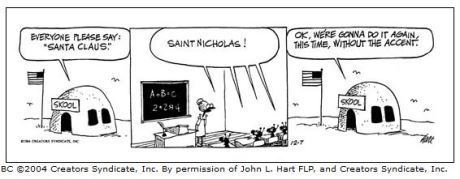
In time another habit had evolved. When I was a small child, even in communist Romania, Saint Nicholas was serious business. People used to eschew any formal links between Saint Nicholas – presented as an opportunity to educate the children – and Christmas. That’s why Saint Nicholas was tolerated by the authorities – and we, the kids, could discuss openly at school the presents that had miraculously appeared during the night in our socks, carefully prepared the evening before, while Santa Claus had disappeared altogether – having been replaced by a Santa-Freeze who came on the New Year’s Eve instead of during the Christmas Night.
And now I’m wondering how many of you remember that Saint Nicholas brought presents only to the good children and that those who misbehaved during the year got either a rod or a few lumps of coal instead of the candy so keenly expected by everybody.

In fact Saint Nicholas is way closer to reality than Santa Claus. He doesn’t give anything for free.
Not that he doesn’t love us.
He really does and that’s why he doesn’t indulge us with undeserved gifts.
So that we don’t become frustrated later in life when we’ll have to work, hard, for any whim we might have. Not to mention the effort to feed our belies, clothe our backs and make sure our children make it safely to adulthood.

That’s why I think it’s time for us to cut the crap. Santa Claus might be a nice gimmick for the big retailers who came up with the whole concept.
But look at what he brought to the rest of us.

saint nicholas

Yeah, I know.
“If I couldn’t have the nice childhood I dreamed about at least my children should have it.”
Only ‘nice childhood’ is one thing while ‘spoiled rotten’ is quite another one.

And ‘spoiled rotten’ can be achieved along many routes.

One of them being the one described above. Hard working parents, who consciously spoil their children, trying to compensate, through their kids, the hardships  experienced during their childhood.
Another one being followed by the parents who are so busy that they basically don’t get to know their children. And who try to compensate the time not spent with their kids by showering them with gifts. The end result being the same.

After the children have become young adults, with no marketable skills, no exercise at self control and after never trying hard at anything, the shit hits the fan:
‘We have done our best yet we’ve raised a couple of ‘good for nothing’ bummers!’

Well, your ‘best’ wasn’t good enough and, mostly, it’s your fault. Not theirs!

Just as most of our ancestors didn’t need to till the soil before migrating to the Middle East – simply because they had enough to eat even without having to work/plan hard for it, our children won’t develop the necessary skills nor the necessary mindset if we insulate them from the right stimuli. In fact, if we insulate them from the real world.

After all, our ancestors might have been ‘the children of the Humankind’ while ours are simply ‘children’ but, in the end, ‘children are children’.

“When the last tree has been cut down, the last fish caught, the last river poisoned, only then will we realize that one cannot eat money.”

Some people attribute this quote to the Apache Leader known as Geronimo.

Quoteinvestigator.com says it is highly probable that it belongs to a guy called Alanis Obomsawin.

But what is more important?
Who said it or what we make of it?

Dede Suryana

Mother breast feeding a baby

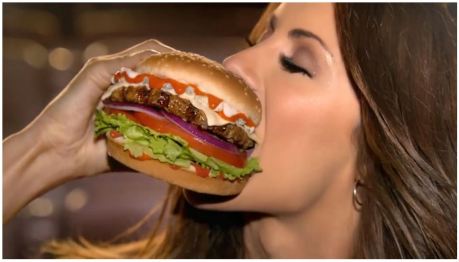
How come some people are absolutely disgusted
whenever something like this takes place in their presence

while most are perfectly OK with

Eating burghers

oliver_hardy___zenobia[1]

I’m not a huge fan of the EU but I have a mostly positive opinion about it.

This morning my stance on this matter was about to change, dramatically.

I had found in my email a link towards a newspaper article, in Romanian, which said ‘the European Court for Human Rights in Strasbourg had ordered that starting with March 1 2016 people in Europe are no longer allowed to baptize their under-aged children‘.

Hard to believe something like that, isn’t it?

Are you really sure about that?

Now try to read articles like this – which are reasonably ‘well’ written, using the right lingo and having enough details thrown in to make them sound credible – through the eyes of a guy already worried by the so much hipped ‘migrant invasion’. Who was already pissed off by the various rules and regulations handed over from Brussels and acquiesced by the local, and supposedly sovereign, governments without any fuss.

Most people do not have the exercise of doubting everything they read, specially if the message comes from somebody they trust – a friend, for instance, or if the site where they read it seems legit.
OK, a certain proportion of them – not all, will exert some discretion if money is involved. That’s why phishing has a limited, yet certain, impact.
But when a particular piece of information apparently confirms an already entrenched stereotype – the bossiness of the EU, for instance – quite a large number of readers will fall for it.

Yesterday evening I was reading a comment added by Nassim Nicholas Taleb on his own Facebook wall: What social media finally did: destroy the press. It is more organic to get information from word-of-mouth, which it accelerated.
Corroborate that comment with a quote from an excellent article published by the same guy on Wired.com: “I am not saying here that there is no information in big data. There is plenty of information. The problem — the central issue — is that the needle comes in an increasingly larger haystack.” (Nassim N. Taleb, Beware the Big Errors of ‘Big Data’, Wired.com, 08.02.2013) and things start to gain some perspective.

What we’re dealing here is the famous lack of symmetry that currently bothers the strategic planners who presumably shape the future of the humankind.

In the ‘good ole’ days’ – when we had writers, publishing houses (newspapers, magazines, you name it) and ‘specialized’ readers, things were a lot simpler.
The writers had a certain notoriety and most of them didn’t want to jeopardize it by publishing bullshit.
Publishing houses didn’t dare to publish bullshit – except for those that did it on purpose, because most of their readers would no longer have bought their papers.
The specialized readers – those who usually bought a certain kind of magazines or books – were able to recognize most bullshit when they saw it, simply because they had some experience in the fields that used to elicit their interest.

Bullshit was being pushed in those days too, for sure. But it was a specialized job, that had to be done carefully.
And in that era, for bullshit to be effective, you had to have very ‘favorable’ circumstances.
Communism didn’t take hold but in very poor countries and fascism only in war torn Italy, Germany and Spain.

Nowadays, “…any simpleminded partisan with a political ax to grind can find an online community of like-minded whack-jobs who’ll be happy to provide him with plenty of ideological ammunition (e.g., bogus stats, pre-fab arguments, etc.). Before long, what was once a more-or-less harmless, single-issue troll has morphed into something far more monstrous and formidable: a veritable Swiss-army knife of bullshit, a perfect storm of bad ideas, a walking Wikipedia of stupid.” (John Faithful Hamer, From Here (2016) )

And since it’s very hard to police the Internet – even harder if we are determined to preserve the ‘freedom of expression’, we are in a very delicate position.

Is there anything to be done about this? Considering that there will never be a real shortage of ‘simpleminded partisans with political axes to grind’?

I think there is.

I started this post by mentioning three related concepts.

Freedom, responsibility and discretion.

We should not tamper with Freedom. Basically this is everything we’ve got, our most precious achievement.

So, we are left with ‘responsibility’ and ‘discretion’.

How is it that most sites manage to stay on line?

They are either sponsored by somebody or they sell advertising space, right?
Who provides that money? Who buys those advertised products? Who spreads around the news about those sites?

Who reads those bullshit laden articles and swallow them hook, line and sinker, simply because some of the (seemingly legit) arguments presented there happen to be consistent with our previously held convictions?

So, if you wish that your kids will be able to live in a better world, stop distributing bullshit through social media, stop buying things advertised on bullshit peddling sites – or, even better, stop going there altogether, and, above all, learn your kids to think with their own heads.

Even if that means they’ll end up contradicting us. As long as they’ll do it in a respectful enough manner – the second most important thing we’ll have to teach them about, all will be OK.


Update. A friend of mine, thanks Lucian, has done some digging over the Internet and found out where all this has started from:

baptising

Read the comments to any article that deals with the European Community and you’ll certainly find something to this tune:
“This is the end of the EU”

That might happen anytime, of course, but I’d still like very much to know why so many contemplate this possibility with so much glee? And I’m not talking here about those who think they have something to gain from a weaker Europe. Putin, for instance. Or Erdogan.

Why so many ordinary Europeans are so angry towards the very idea of a closely knit European Union?

How about reading the entire history of this continent as a long story of individuals striving hard to become more and more autonomous?

Some would say that Europe was about individuals becoming free, and I can agree with that. Only that freedom had strings attached.

“My freedom stops where your freedom begins”.

Meaning that none of us is really free unless each of us respects the liberty of all the others. That our individual liberties depend on each-other. Well, that’s the definition of autonomy, not that of ‘absolute freedom’ but let’s not be bogged down by words.

In fact what helped Europe become what it is today is an unique combination of ever growing individual freedom made possible by an ever stricter respect for the rule of law.

This was not at all a smooth process.

From time to time some individuals garnered a lot of liberty for themselves precisely by depriving all other of theirs and sometime even succeeded in writing this into law. For instance, until 1848 it was still lawful to own slaves in France.

Another type of ‘garnered’ freedom is what happens in a dictatorship. The dictator and his henchmen are freer than the rest of the people, but none of them as free as the people living in a truly free country. And Europe had witnessed a considerable number of dictatorships.

Which all eventually failed.

But something lingered in the collective memory of the Europeans. Their disdain for being told what to do. Their mistrust for rules imposed from above, for regulations that did not have the opportunity to become evident, through the passage of enough time, for those called to follow them.

This is why the ‘enthusiasm’ with which “l’aquis communautaire” was peddled by the Brussels bureaucrats to the new entrants has been met with such reticence.
This is why the measures being practically imposed by the more powerful members of the Union to the rest of the gathering are met with such scorn.

Very little real consideration is being given to the manner in which these measures are adopted and then communicated ‘from above’  and, simultaneously, very little attention is paid, by those called to put them in practice, to what their real effect would be – if they’d be applied in earnest.

And, unfortunately, there is no real shortage of callous political mavericks who eagerly try, and sometimes succeed, to capitalize on these misgivings.

As if we didn’t know any better.


Modern England was shaped by a bunch of ‘French immigrants’ led by William II of Normandy. In the following centuries England and France fought each-other bitterly, in one instance for more than 100 years. Yet they ended up being best buddies, close enough to have fought, and won, two World Wars.

France and Germany started as the two wings of the Carolingian Empire. After it was divided in 835, France was the first to become a national state and, for a while, was Europe’s hegemon of sorts. During that period the French culture had influenced heavily the life of the entire German area. Take a walk through the Sanssouci palace in Potsdam and the Schonbrunn in Wien if you need any confirmation.
But none of this stopped a considerable number of French and German leaders from marshaling numerous armies that fought each-other bitterly, for various reasons.

In fact one could say that Europe itself was forged during those battles.

In this context, the Peace of Westphalia – that ended a 30 years long war, can be considered the seed of what we have now: a system of sovereign states that interact according to a set of practices that have been enshrined into international law.

But it seems that one war was not enough for the rulers that happened to gain precedence in both French and German speaking areas of Europe. So others followed. Culminating with the two World Wars that have involved almost the entire planet.

And what do we have now?
An European Union that has been built precisely in the spirit of the Franco-German Elysee Treaty signed in 1963?

So, could we say that Europe is the success story of so many nations, speaking different languages and having various cultural traditions, who have finally learned to live in peace?
Who have finally learned to silence the war-mongering among them?

Who have finally realized that they are “better off together than apart” and that what it takes for this to happen is “Mutual respect, no love, …but a considerable amount of curiosity“?

Then how come we are not able to extend that wisdom, that literally soaked in blood body of  knowledge, to cover the current events?
How can we not find in ourselves an effective way to help the so many people who are literally dying outside our closing gates?

Why is it that so many of us still pay any attention to those who teach us to ‘circle the wagons’ and to ‘leave behind those who didn’t make it’?

This tactic seldom worked, if ever.

trump torture

As a young adult I understood that there was no real difference between Hitler and Stalin. It didn’t matter that one of them was considered to come from the left while the other was depicted (by the communists but not exclusively) as a paragon of the right. Both of them had in common the absolute disrespect for everybody else. Each of them was convinced that only their opinions mattered and that all others were absolute morons.

That was when I started to have an inkling about what ‘the elders’ wanted to convey to us, green-horns bucking under the communist rule – which was crippling Romania at that time, when whispering:

‘there isn’t much difference between USSR and America. Their leaders want to rule as much of the world as they can grab while the ordinary people, in both countries, don’t have a clue about what’s going on’.

As I’ve become older I’ve started to figure out that the real difference between various activism-s has nothing to do with the ‘hue’ displayed on their banners. All that counts is the intensity of the sentiment that fuels them and the manner in which the activists relate to the other participants in the game.

At first glance the very notion of ‘conservative activist’ would be an oxymoron, given the fact that (most of the) conservatives define themselves as defenders of the existing order.
Who simply react, within the boundaries of the law and using the tenets of the Constitution, to whatever follies the progressive ‘liberal activists’ are trying to bring upon our heads:

“Like the American people I have watched this process for a number of years, and I fear this empathy standards is another step down the road to a liberal activist, results-oriented and relativistic world where — laws lose their fixed meaning, unelected judges set policy; Americans are seen as members of separate groups rather than simply Americans, and where the constitutional limits on government power are ignored when politicians want to buy out private companies… Call it empathy, call it prejudice, but whatever it is, it is not law. In truth, it is more akin to politics. And politics has no place in the courtroom.” (Senator Jeff Sessions (R-AL), speaking at Sonia Sotomayor’s confirmation hearings)

As usual, practice trumps theory. Regardless of whatever the theory says – and some of the pundits pretend, everybody has an agenda and everybody who has an agenda is actually an activist.

Now that we’ve successfully climbed down to the practical level let’s see what’s the real meaning of Trump backing down from his trumped up stance on torture:

trump defending torture

Hey, wait a minute! So he actually said that ‘we should go tougher than waterboarding’ and he still has such a strong following among the ‘law abiding defenders of the Constitution’?

Well, I’m afraid things are more complicated than that.
Here’s what he says about those who trust him:

trump shooting people

“The people, my people, are so smart…
And you know what else? they say about my people? the polls?
They say I have the most loyal people! Did you ever see that?
Where I could stand in the middle of Fifth Avenue and shoot somebody and I wouldn’t lose any voters.”

Well, if this isn’t ‘activism’ then I don’t know what else is.

But what kind of activism is it?
I’m not asking about where it should be placed in the political spectrum! I’m just wondering how are his proponents, Trump’s people, going to relate with their fellow citizens?
Or with the rest of the world…

And what’s the true meaning of the conservative activists coming out of the closet and assuming such an active stance? So active, in fact, that – as I said before – it is now way outside the realms of typical conservative behavior.

The explanation – as I see it – has little to do with Trump itself and everything with the present situation of the American society as a whole.

First things first.
Trump is nothing but an opportunistic bug, the real problem being how come the American Conservatives have not seen him for what he is and have not thrown him out yet.
I’ll concentrate on this from now on.

The American Conservatives, and not only those ‘loyal’ to Trump, behave as if they have been under a two thronged siege.
‘ The liberals are destroying America from within, the enemies from the outside are growing stronger and stronger yet the American Political Establishment does nothing meaningful about any of these, not even the ‘entrenched’ conservative ‘figureheads’.’

This didn’t start yesterday.

“Whenever you get a group of people together who share certain basic assumptions, there’s a natural tendency for the group to gravitate toward the most uncompromising, extreme, strident, fundamentalist, hard-core positions. Social psychologists call this tendency group polarization. It happens on juries with some regularity. It explains why the Tea Party became so insane, so deeply out of touch with the needs and views of the average American voter. And it explains why the Bush Administration invaded Iraq without an exit strategy (they stopped inviting people who disagreed with their assumptions—people like Colin Powell—to the planning meetings).” (John Faithful Hamer, From Here (2016))

But because of the internet things have gotten even worse:

“These days, any simpleminded partisan with a political ax to grind can find an online community of like-minded whack-jobs who’ll be happy to provide him with plenty of ideological ammunition (e.g., bogus stats, pre-fab arguments, etc.).” John Faithful Hamer, From Here (2016)

“Worse” not because of the ease with which these communities can grow but because too many of the members of these communities tend to give in to the apparent comfort and safety of single-mindedness.

Arguments are no longer able to penetrate the boundaries of this kind of communities.
Walls are erected to keep the odd man out. Then defended fiercely.

And this is why any attempt to cross those walls, be it aggressively or even in good faith, is too often perceived as a mortal threat by those within.

This is the mechanism through which the likes of Hitler and Stalin have managed to dominate for so long their hapless followers, by convincing them that all outsiders, all aliens, are conspiring to destroy ‘Das Vaterland’.

Fortunately the Internet works both ways. It’s true that the members of those communities can chose not to read anything else but the ideas promoted by their insiders but, just as easily, any of them can find out everything that ‘the others’ have to say about the matter.

But what if things are not (yet) as bleak as some of the media venues present them to be?
Not that all the media wants to scare the shit out of us or that all of them are politically biased. No. This happens simply because all of them want to make better ratings and because very few of them understand that ‘he who saws the wind will reap the whirlwind’. (Well, some of them might actually do it on purpose and that’s exactly what activism means but my post is more about those who let themselves be sucked into the whirlwind than about the tempest sowers).

A very short search of the Internet produced two extremely interesting ‘snapshots’.
The first, that the CPAC straw poll placed Trump no higher than the third place, should not surprise us very much. After all most of the participants are either GOP officials or young wannabees and for them Trump is akin to a ragging bull.
The second, though, is rather mind boggling.

gallup, candidates popularity, february 2016

Gallup, daily tracking

Four out of the six still running candidates nomination are perceived more or less unfavorably by the American public?

So what is this? A contest for ‘the least un-liked presidential candidate’ title? (The answer to this question might also explain why Trump has backed down on torture. He figured out that that was too much, even for him. And for ‘his people’.)

We couldn’t blame this on ‘activism’, as such – the remaining two candidates are also ‘active’, but shouldn’t we be asking ourselves about what kind of activism deserves our encouragement?

In any way, shape or form?

Well, before answering this we must consider another issue.
What brought us to the present situation, where both sides of the Political Establishment – and not only in America – are acting as if they want to tear everything apart instead of doing their best to make it all work together?

Lincoln activism

“Abraham Lincoln represented the entire nation, and his most serious actions were aimed at improving the lives of the oppressed and the poor. Lincoln’s values and actions still rank as the greatest period of social activism in the United States. Lincoln’s goal was to create a more perfect union by extending dignity to all — to once and for all end a diabolical, brutal, and oppressive system in which humans were property, mere production instruments.

In other words, Lincoln’s policies were designed for all of the people, not the just the wealthy, the privileged, or vested-interested lobbies.”

Later Edit

‘Conservative activism’ hasn’t been invented yesterday.
Nor by Trump’s supporters!

https://www.everand.com/article/357205089/Surviving-Koch-Nancy-Mac-Lean-Wants-You-To-Ignore-Donald-Trump

https://independentaustralia.net/business/business-display/murdoch-propaganda-machine-catastrophic-for-democracy,18117

Mencken, democracy perfected

Just stumbled upon this meme.

It gave me the creeps.

If such an influential personality like H.L. Mencken had such a warped understanding of the democratic process what can we ask from the proverbial ‘regular guy’?

One question haunts me.
How come so many otherwise bright people fail to grasp the obvious fact that ‘democracy’ is what happens before the voting process?

Voting itself is nothing but logistics, arithmetic and honesty. A process more or less akin to a social survey, one through which the electoral commission determines ‘the will of the people’ at a certain moment. A ‘mechanical’ process that has nothing to do with the living thing encapsulated in the concept of democracy.

…’living thing encapsulated in the concept of democracy’…

Do you think I’m exaggerating?

Then let’s go back to the Agora (the meeting place where the ancient Greeks congregated to discuss the public matters at hand) and watch carefully what happened there before each issue was decided upon.

Everybody who wanted to say something about a subject of interest had the opportunity to make his voice heard.

Yes, that’s the real essence of the democratic process! That’s why the Founding Fathers insisted so much about ‘The Freedom of Expression’. That’s why ‘the right to speak up’ comes First, before all others!

You see, the right to vote has no real meaning if the voters are kept in the dark, if they didn’t had access to all the information available prior to the deciding moment.

People will make a choice regardless of how much information they have, at a given moment, about something, precisely because they think they know everything that is to be known about that something.

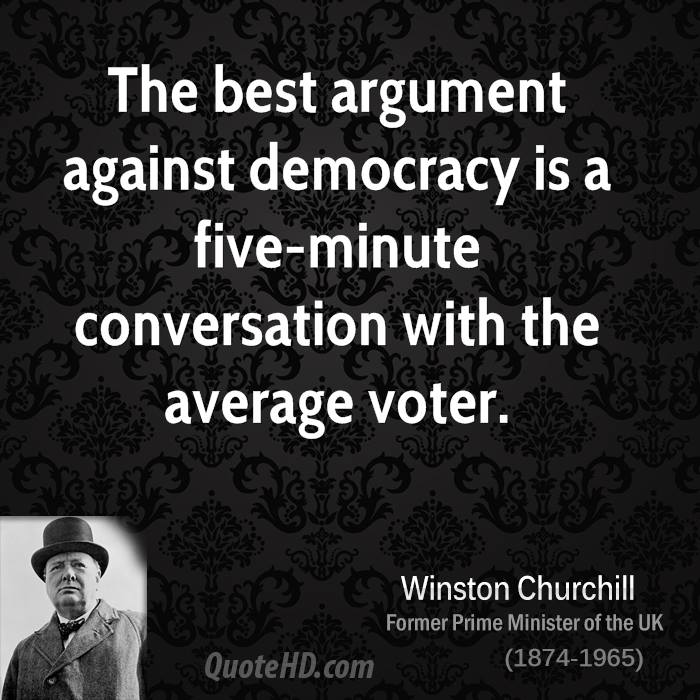
That’s why people privy to more information than the ‘general public’ have come to reach the conclusion that the ‘ordinary voter’ is stupid.

winston-churchill-government-quotes-the-best-argument-against

Because instead of putting everything on the table and letting ‘the people’ decide in earnest, for some time now some of the ‘pundits’ have been playing a dangerous game of  ‘hide and seek’.
One which has resulted in the profound distrust felt by ‘the people’ about the ‘political establishment’. And in the barely masked contempt displayed by the ‘political elite’ towards the rest of the society.

So, instead of having an open discussion about issues and an atmosphere of trust between the various segments  of the social organism we have to pry bits and pieces of information from those who guard it dearly and such mutual distrust that, if we’ll look around carefully, we’ll notice that we’ve been living, for some time now, way inside ‘paranoia land’.

Can we still pretend that our societies are governed in a democratic manner? That each of us tries to shed some light over his area of expertise and by doing so contributes to all of us avoiding as many of the ‘potholes’ as possible?

‘Cause this is the real essence of democracy.
Not finding the best possible solution to every problem but avoiding the known/foreseeable potholes.

No matter how many of us will study a problem we’ll never find the best solution. After five minutes some fresh information will come about and the erstwhile ‘best’ becomes ‘obsolete’.

Compare this situation to somebody stumbling in a pitfall waiting for all of us, coming  back to warn the rest and not one of us heeding to his cries…