Archives for category: Choices we make

For more than a year now I was struggling to understand the circumstances that have produced the current political mess in America.

I finally figured it out.

Confusion and dissatisfaction!

If you have enough people that are both confused and malcontent then all kind of ‘strange’ things will happen.

Only one of them won’t be enough to explain the whole gamut of what’s going on and that’s why I wasn’t satisfied by any of the many articles that pointed out one reason or another for the ‘popular discontent that brought the Donald to the White House’.
In fact no amount of ‘unhappiness’ can explain how two mature parties can nominate such lousy candidates. Neither Hillary Clinton nor Donald Trump fit, not even loosely, the profile of a decent President. That’s why the voter turn-out was the lowest in the last 80 years or so.

But if you add ‘confusion’… things begin to clear out.

And no, I’m not speaking here about the regular people being confused as a result of the ‘politicos’ having misbehaved horribly.
I’m afraid things are way deeper than this.
Even those who believe themselves to be educated in these matters seem to be swimming in a sea of thicker and thicker fog.

Take, for instance, the current debate about the differences between ‘republic’ and ‘democracy’.

A republic is a representative type of government, and its goal is to simultaneously control the majority while protecting the minority. For example, in the republic of the United States, the government is limited constitutionally, and power is divided between the three branches of government.

A democracy is a type of government that grants eligible citizens the right to equal participation. This right is provided directly through the creation and development of laws or through elected representatives. The interest of the majority is the most important aspect in a democracy.

A republic is a representative form of democracy. A republic has an elected head of state, such as a president, that serves for a specific period of time. In a republic, the interest of the majority rules through its elected representatives. However, a republic has a constitution that protects the minority from being entirely overruled or unrepresented.

See what I mean? Adding insult to injury this definitions were published by a site which calls itself ‘reference.com‘ …

I’m not going to pick truth from fiction in that quote, that would only add to the already too thick confusion.

Enough for me to say that ‘republic’ is indeed a manner in which societies are organized (a.k.a. ‘governed’) while ‘democracy’ is a manner in which societies decide for themselves. Yes, these two things have a lot in common but we should not confuse them.

There are republics which only pretend to be democratic – like the late Soviet Union or the current Democratic Republic of Korea, some which are democratic in a rather strange way – Iran for example, or which are slowly ‘loosing’ democracy behind – like Orban’s Hungary or Putin’s Russia. History has also a few examples of republics which had given up democracy all together. Hitler’s Germany, for instance.

On the other hand there are monarchies (OK, constitutional monarchies) which are perfectly democratic. The British Commonwealth, Sweden, Norway, Holland, Belgium…

What can explain the current confusion?
‘The interest of the majority is the most important aspect in a democracy’?!?
A major lack of understanding about what democracy really means?

A terrible confusion between the formal aspects of democracy – freedom to vote for what ever candidate accompanied by a fair account of the ballots – and the really important tenets of democratic behavior – honest, open and mutually respectful exchange of ideas about the current state of affairs between the interested members of the society?
My point being that true democracy is about the opportunity to rationally convince those around you/making yourself available to be convinced by rational arguments, not about the majority imposing its view on the minority. That is nothing but mob rule, a horrid perversion of what democracy was meant to be.

Basically, what happens – under all forms of social arrangements/forms of government: republic, constitutional or absolute monarchy – in a society is that people need to know where that society is headed to. Authoritarian societies are run by the ruler – and the people, willingly, unwillingly or with mixed spirits, agree for the time being – while the democratic societies entertain a certain ‘effervescence of ideas’ which bring forward the important problems that need to be resolved and what would be the socially acceptable manners for those problems to be fixed.

But in order for that ‘effervescence of ideas’ to be efficient, the ordinary people have to contribute in earnest to the exchange and the politicians need to pay close attention and to cooperate among themselves and with the rest of the society towards solving those problems.

That’s why I’d like you to remember when was the last time that people on the different sides of the political divide have actually talked together?
Why do we have a ‘political divide’ in the first place?

Aren’t we supposed to be ‘all together’ in our respective countries?

What’s gotten into us that made us fight each-other so bitterly?

Why do we succumb so easily to ‘divide and conquer’?

Why are there still so many politicos who keep using this method, despite the ample proof that has been provided to us, through out the history, that ‘divide and conquer‘ inevitably ends up in disaster?
http://politics.blog.ajc.com/2017/06/16/when-your-own-rhetoric-gives-you-license-to-commit-mayhem-and-worse/

when does chemistry become more than the sum of its parts?”

This evening I’ve read, in rather close succession, two very interesting lines.

The second was the one I just quoted above.  It comes from a BBC article titled: “There are over 100 definitions for life and all are wrong!

A little earlier I had come across Confucius’ “When it is obvious that the goals cannot be reached, don’t adjust the goals, adjust the action steps.

I could not resist the temptation to put these two together.

Rather than defining ‘life’ I’ll try to see what obviously (?!?) differentiates ‘living creatures’ from ‘chemically driven’ systems.

Inside/outside.

Life is about individuals. Huge, small, whatever. But each of them are individual beings.
Each of them, including the viruses, have a ‘membrane’ which separates ‘inside’ from outside and the survival of each individual depends on this membrane being able to do it’s job.

Chemical systems also have separations that ‘contain’ them into an ‘inside’ only those separations are not, in any way, controlled by the system itself as it happens with the membranes that separate the living individuals from their environment.

Lineage

While life is about individuals, it’s also about ‘species’.
If you remember, Darwin’s seminal book was entitled “On the Origin of Species by Means of Natural Selection, or the Preservation of Favoured Races in the Struggle for Life“.

Species are nothing but ‘lineages’ of slightly different individuals who somehow manage to pass from one generation to another enough ‘structural’ (genetic) information so that the species remains ‘consistent’ but, simultaneously, the ‘replication process’ is flexible enough to allow for enough ‘mutations’ – which constitute the engine of evolution. The process is very well explained here: “What Evolution is” by Ernst Mayr.
Moreover the information that is, somehow, passed from one generation to another is contained inside each individual and ‘entrusted’ individually and ‘personally’ – not by an outside agent, as it maybe the case for the chemical systems we use in our labs or industries.

According to these ‘criteria’ viruses would be alive while computer programs ‘not yet’. Not until they’ll learn to replicate themselves in a manner flexible enough to be called ‘evolutive’.


Growing in a communist country, Romania, I was ‘exposed’, naturally, to all sorts of communist propaganda. ‘Embedded’ in almost everything.
One ‘sugar coating’ that was very popular among the apparatchiks of the day was ‘crime novels’. ‘James Bond’-like  ‘literature’ which was supposed to educate us, ordinary citizens  who could almost never get an exit visa to go to a ‘capitalist’ country,  about the perils ‘our’ trading agents/diplomatic personnel had to ‘negotiate’ when sent abroad to ‘serve the country’.
The most publicized ‘peril’ being the ‘prostitute trap’. Supposedly the ‘pure’ communist was trapped by a skillful prostitute into believing she was heavily enamoured  of him and then lured to an apartment were the couple would be filmed while ‘consummating’  their new found passion. Later, of course, the recording would have been used to exert pressure in order to influence the hapless fool into betraying his country.

The recent articles regarding ‘the art of kompromat’ tend to suggest that those ‘novels’ were nothing but yet another example of a wolf crying wolf… but who knows…

Fast forward to our times.

Is there anything clear in all this?

And no, I’m not wondering whether there is an actual tape of Trump ‘frolicking in bed’ with anybody. Even if it exists, it is well guarded. After all, such a tape is way more valuable as long as it is hidden away than when out in the open. The threat to reveal it works only as long as nobody else but the black-mailer and the victim know about its existence.

Then why all this brouhaha?

A preemptive strike meant to dull the effect of Putin actually publishing such a tape?
Putin trying to ‘soften up’ his intended target?
But what is Putin’s goal? He cannot dream of ‘controlling’ the President of the United States. Even when that position is fulfilled by someone like Trump… The actions of any POTUS are so public that any influence would very soon become apparent, on one side, and Trump, himself, is a very ‘unreliable’ person to start with.

But what if Putin has another, and way more insidious, goal?

What if he wants to compromise the very concept of democratic elections?
To ‘demonstrate’ to us that ‘the public’ is (has become?) incapable of electing a good man to lead it to the future?

Well… the problem with ‘kompromat’ is that it has to be tailored to its intended victim.
Just imagine what effect would have had a tape depicting Obama in bed with someone else but Michelle. Who would have believed such a thing?
But Obama was, to a degree at least – as Trump had very astutely estimated, vulnerable to a campaign focused on his birth certificate. We all know what kind of ‘passion’ the birthers have managed to instill into some of the die-hard conservatives.
And we should not forget that Trump had started his political life as a friend of the Clintons. His words, “that Hillary Clinton ‘had no choice’ but come to his third wedding“, are now world famous…

Now, bearing all these in mind, shouldn’t we ask ourselves how farfetched is Putin’s project of destroying our faith in democracy? Using ourselves as minions?

After all, Trump was elected democratically!

And do you remember those discussions about the US being intended as a Republic by the forefathers, and not as a Democracy? Or Orban’s – Hungary’s authoritarian prime minister, one of Putin’s close political friends, concept of ‘illiberal democracy‘?

“I voted for Trump because I think his illiberal tendencies are actually a feature rather than a bug. When he undermines rule of law, I see not a danger, but someone who is undermining a system that has become a game for elites with access to armies of lawyers. When he browbeats Congress, I don’t worry about “checks and balances” which have become a recipe for dysfunction, but rather see him as a man taking on useless political prostitutes servicing everyone who can write a sufficiently large campaign check. When he strong-arms multinational companies like Carrier, I see someone standing up to the worst aspects of globalization.”

Who built the world as it is right now? The one where the young adult who wrote the words quoted above, had grown up into and was modeled by?

We did it? With both its good-s and its bad-s?

It is us who kompromised it?
Then it is us who’ll have to fix it!
Or we’ll have to endure the yoke the likes of Putin and/or Trump will undoubtedly try to put on our shoulders.


Modern technology has produced some rather perverse ‘side effects’.

What used to be called ‘democracy’ has slowly been driven into ‘mob rule’.

It is hard to determine whether this is the desired effect of some (un) ‘intelligent design’ or an unforeseen consequence of the callous machinations of the ‘power hungry’ but it doesn’t matter much, does it?

Let me first clarify some concepts.

For me ‘democracy’ is way much more than what happens in and around the polling stations.
Fairly counting the votes is indeed important but even more important is what takes place long before the ballots are cast.
A really functional democracy is that where every stakeholder has the opportunity to voice their concerns and where the rest pay attention to everything that is said in the public square. By both their political friends and by their political adversaries.
In fact no ballot can be cast efficiently unless the voters have developed a fair image of what is going on in their society. While no one can develop an actually complete understanding of anything, let alone one regarding such a complex system as an entire society, we must jealously keep in our minds that ‘not entirely complete’ is one thing and ‘heavily biased’ through a severe lack of pertinent information is quite a different one.

On the other hand ‘mob rule’ is a what happens when voters’ passions are so high that enough of them are no longer able to think with their own heads and allow themselves to be ‘led by the nose’. Into voting for a specific somebody or, alternatively, into not voting at all ‘because it doesn’t matter, anyway’.

At first democracy actually meant first hand, person to person, meetings in the public square.
The Ancient Greeks solved their ‘state affairs’ in the Agora, the Romans in the Forum while “Althingi” (the name of the oldest parliament that is still in existence, that of Iceland) means ‘General Assembly’.

Slowly, as the constituencies grew larger, the stakeholders needed some more sophisticated manners of keeping in touch. Luckily for them, Gutenberg had already invented the printing press. The American Founding Fathers – who had made good use of this first instrument of what was going to be the mass-media – had insisted passionately on the ‘freedom of the press’. And for good reasons. As I pointed out a little earlier, access to information is paramount for an efficient decision. Further more printed material is a very handy tool when it comes to conveying information from one person to another. Its rather stable nature allows it to survive unadulterated, at least for a while. So it can be handled around or kept for further reference since it is relatively easy to organize. And searched at will. All these discouraging the ‘communicators’ from lying – blatantly, at least. Since lies where relatively easy to pin-point and prove those who needed to maintain their credibility refrained themselves from ‘exaggerating’ too much. The fact that the general public was rather particular about this kind of things also helped in this matter.

Later, when radio and television were introduced, things had become more complicated. Given the fleeting nature of spoken – rather than printed – words, the ‘talking heads’ felt less compelled to stick to the straight and narrow.
Things were compounded by the advent of the ‘political-marketing specialists’ and of the ‘bean counters’.
The latter kept insisting that the mass-media venues have to be as profitable as possible – hence publish more and more of ‘what the audience asks for’ instead of bona-fide information while the former kept telling to the politicians that they have to ‘get under the skin of their constituents’ – by, again, telling them what they were more likely to believe instead of treating them as the grown-up adults they were.
The consequence of all this merchandising was that the erstwhile more or less compact public has been gradually carved up into discrete, and growingly separate, ‘publics’. Otherwise known as ‘echo-chambers’.

The apparition of the Internet/social networks has further deepened the already existent divides. People no longer know what the others really think or feel. But their ignorance doesn’t keep them from having opinions. Or from voting about things they do not really understand. So they vote how they are told by their trusted ‘analysts’/’experts’.

Now, is it of any use for us to blame anybody for what had happened?

Or would it be a lot better for all of us to grow out of this before the ‘whirlwind’ makes a ‘hard landing’ on top of our heads?


Israel has been backed up by the US ever since it was established.
They didn’t enjoy an unconditional carte blanche but the amount of help was  very consistent and, above all, very dependable .

Until a few days ago.
Nowadays Netanyahu, Israel’s PM, feels like he has been thrown in front of a bus by the departing President of the US, Barack Obama. Because the US ambassador, Samantha Powers, had abstained herself, instead of exercising her veto, about a resolution calling for Israel to “immediately and completely cease all settlement activities in the occupied Palestinian territory, including East Jerusalem.

Ever since Israel has been reestablished by his original inhabitants Russia’s rulers have tried to use this situation in their advantage. Egypt, Syria, Iraq, and lately Iran, have received backing from Kremlin in their fight against Israel. By meddling into this conflict Russian rulers were simply trying to get international stature.

Recently Russia’s ambassador to the UN had used his veto power to block a resolution asking for the ceasing of the bombardments in Aleppo. Yet another proof that Russia’s leaders do not care about how they become respected on the international stage, as long as that respect is manifest. As in ‘the world listens when they speak’.

During the Obama administration the US refrained itself from such drastic measures. The US has refused – for now, at least – to re-engage in the brinkmanship game with the Russian leaders. Effectively denying the latter the kind of status they so strongly desire.

Israel has just become yet another collateral victim in this conflict.
Just as the Arabs have been for the last three centuries.
Caught, at first, in the middle of the endless colonial wars between England and France on one side and the Ottoman empire on the other. And later in the cold conflict between Russia and the US.

Theoretically it means “from each according to their abilities, to each according to their needs”.

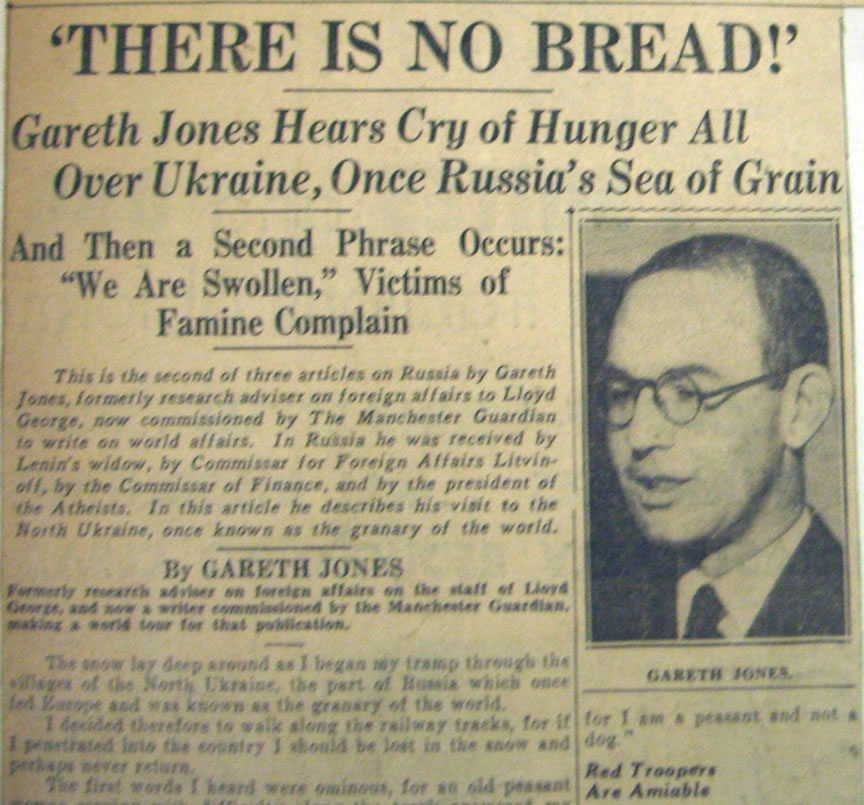
Practically it looks like this.

famine-in-ucraine

In fact real life communism still is, and always was, about a whole country kow-towing to a dictator who pretends to care for nothing else but for the welfare of the people. His people!

The point being that each resource allocation game needs a referee. Otherwise all rational people would take as much as they could carry from the communal reserve – because it is free – and bring back as little as possible, hence nothing if not coerced to – because it implies some effort.

OK, any reasonable five years old would tell you that the communal reserve would very soon become empty if things would go like this – hence that presumably ‘rational’ behavior would be anything but – only it would be very rational to at least try, wouldn’t it? For how long it would work, no matter how short that interval…

And something else.
You are most likely familiar with ‘bad money drives out good’. There have been a lot of examples to prove this, one of them being Christ driving the money changers out of the Temple.
Some of you might not be familiar with how money worked in those days so here is it.
A coin was a simple ‘slab’ of precious metal, of somewhat constant weight, approximately round, which had been ‘stamped’ with the face of the local ruler. At first, in the minting shop, all coins belonging to the same edition were more or less of the same weight. But, since the edges of the coins were not ridged, ‘smart’ people started to ‘shave’ the coins.
And, after the first guy had started to shave them, each individual who got a coin would have been foolish not to shave it, just a little bit. Maybe the next guy would be foolish enough to accept it, after being shaved. To contest it the recipient would have had to go to the money changers and pay for their expertise. And this is how the coins became smaller and smaller…
Only the priests at the temple didn’t want to be fooled. So they hired some money-changers to vet the coins the believers brought to the Temple. The very money-changers that Christ had driven away. “God doesn’t need this kind of guardians. If we keep them here it would mean that we expect people to cheat. Even here, at the Temple. And if we expect them to cheat, they will surely do so!”

Only some people do cheat. And since some cheat, the rest will have to do something about it. Either make cheating the rule, which would lead nowhere, or make it so hard to cheat as to become impractical. Hence the ridges at the edges of the modern coins. Which can no longer be shaved because the ridges would make it obvious.

Coming back to our ‘communal reserve’ you would have to employ a guardian to make it sure that no one would take any more than they really need and that everyone periodically brings back stuff according to their abilities.
But how would that guardian determine what are the real needs and the real abilities of each of those individual members of the community?
And, even more importantly, what would stop the guardian from taking the whole ‘communal’ reserve into his private possession? As in acting like a communist dictator? Simply because ‘he needs it’?

The only alternative that worked was the free market. That where you sold your abilities and where you could buy things to fulfill your needs. Where prices were set at the meeting point between ask and demand.
But the same principle, bad money drive out the good, acts even here.
‘Smart’ people try to organize ‘monopolies’. Which, basically, is the same thing as they attempting to become the owners of the ‘communal reserve’.

This whole thing looks like an intractable vicious circle?
Take heart, that’s what ‘reeds’ are for.
We invented those, when we realized that we needed them, didn’t we?

reeded-coins

You still wondering what to use in order to transform that vicious circle into a virtuous one?
How about individual freedom coupled with a healthy dose of mutual respect?

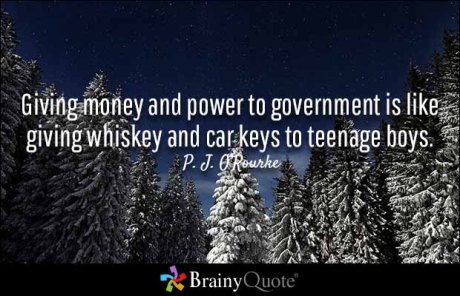
teenager-government

Why am I am trying to make any sense of something said by a comedian?

orourke-trump

Because he’s right?

With a twist, of course!

While ‘government’, all of them, tend indeed to behave like ‘teenage boys’ their actual behavior depends very much on their up-bringing and on the amount of supervising their stakeholders/parents invest in them.

Which brings us to

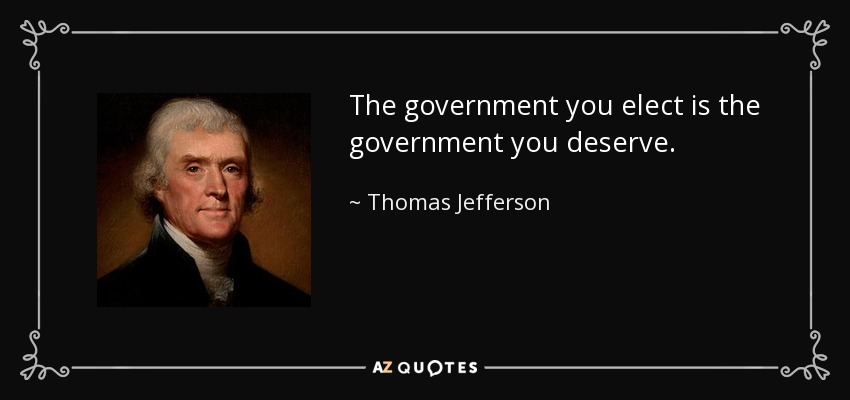
the-government-you-deserve

Now all that is left for us to do – for ‘all’ of us, that is, including ‘the Government’ – is to remember that the individuals who make up the government also belong to the people. They cannot be essentially different from the people itself and they will, eventually, share the same fate as the rest of us.

Or even worse.

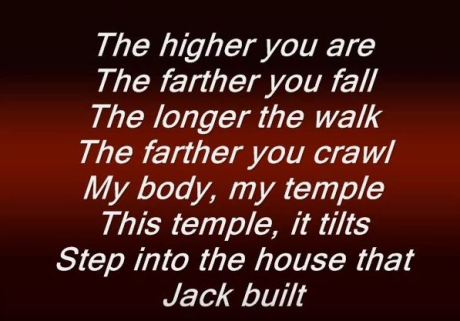
the-higher-you-are

The House Jack Built, Metallica


hacked doublespeak.JPG

The overseers of the U.S. intelligence community have not embraced a CIA assessment that Russian cyber attacks were aimed at helping Republican President-elect Donald Trump win the 2016 election, three American officials said on Monday.

Yet
“ODNI is not arguing that the agency (CIA) is wrong, only that they can’t prove intent,” said one of the three U.S. officials. “Of course they can’t, absent agents in on the decision-making in Moscow.”

The Federal Bureau of Investigation, whose evidentiary standards require it to make cases that can stand up in court, declined to accept the CIA’s analysis – a deductive assessment of the available intelligence – for the same reason, the three officials said.”

Now, since when is anybody in this ‘line of work’ concerned with anything more than ‘a deductive assessment of the available intelligence’?

Wasn’t it the DA’s office which was interested in making the cases ‘stand in court’?

Anyway, this whole exchange sends a very clear message.

Nobody disputes the simple fact that some Russians have indeed hacked into servers which harbor information pertaining to the electoral campaign. What the various branches of the intelligent services cannot agree about is the precise intent of the hackers.

Aha.

donald-trump-grab-them-by-the-pussy-cartoon

Or is it the (unforeseen?) consequence of some very ‘intelligent design‘?

Until not so long ago it was possible to buy unlimited coverage against the risks that scared you.
After things became too complicated and fraud a too widespread occurrence even the Lloyd’s gave up and started to introduce caps on insurance policies.
In fact Lloyd’s of London was the only place – that I knew of – where risk was understood, at least in part, in a ‘functionalist’ manner.
Risk is something that can be seen in two ways.
As yet another opportunity for making profit or something that has to be mitigated for the profit of the entire community.
Let me deal with the latter ‘option’ first.
Somehow I don’t buy it that Bismarck was primarily motivated by the well-being of the workers.
But what the German industrial barons of the day needed in order to catch up with the British ones – the Albion was the industrial power house of that time, o tempora…- was more and more people willing to leave the relative safety of the country-side and come to the city to work in the newly built factories.
In order to appreciate the huge difference between these two situations we must remember that in those times families were a lot larger than they are now and that their members used to help each other in times of need. But this could happen only if the members of the same family remained in close vicinity and worked on very flexible schedules – agriculture or family owned shops. You cannot go help your ailing mother if you work in shifts and live two hundred miles away from her.
So, in order to ‘lure’ more and more people out of the fields, and in a very short time, Bismarck had to offer them a ‘safety net’.
OK, let’s accept the idea that, maybe, there are some risks that the society, as a whole, should concern itself with.
But how to fulfill this ‘social need’?
How to identify which risks should be dealt with in a collective manner and which should be left alone. Then how to manage the whole process?
‘State-wide’ or through privately owned/operated initiatives?
Does it really matter?
I don’t think there is a universally valid recipe here.
The Bismarck’s social insurance system worked in Germany.
Lloyd’s has functioned almost seamlessly for 3 centuries. In England.
Both systems, one centered mostly on profit and the other on the safety of those who took part in it, worked because they spread out both the risks and the profits.
Current systems, where only the risks are being mutualized while the benefits tend to become more and more centralized – by ‘design‘, by corruption or both – are no longer functioning properly.
Take ‘Obama Care’, for instance. Most people, including Donald Trump, agree that something has to be done about ‘public health’ but the whole thing isn’t yet working properly.
Instead of fighting among ourselves on whether the state/government should have anything to do with risk management how about considering for a moment where our current infatuation with ‘profit‘ has brought us?