Archives for category: Choices we make

The oldest surviving civilized nation, China, calls itself Zhongguo.
The Middle Kingdom. ‘In the middle’ of the barbaric people that surrounded her but also at middle distance between Heaven and the rest of the Earth. The aforementioned barbarians.

And, according to Confucius, it was the emperor’s job to ‘keep things as they should remain’.

Which makes sense. After all, the whole kingdom was the exclusive property of the emperor. And whose job is to watch over one’s property?

Well, things went on long enough for those involved to believe this was the natural order of things.
Until the whole arrangement was upset by a small number of people which had come, more or less ‘under their own steam’, from the other side of the world. And who were, at that time, a lot less civilized than the Chinese.

How can be explained something like this?
OK, the Aztec and the Inca empires might have been primitive relative to the Spanish invaders. They might have prevailed over the small number of invaders by brute force but they had been overcome by the sheer novelty and the apparent sophistication of the assailants.
But China had been in contact for centuries with the rest of the ‘civilized’ world! And way advanced than the rest. Both culturally and economically.

So, what had happened?
How can something like this be explained?

We might try to take the ‘historical route’. And observe that, exactly as Confucius and Laozi had told us, China’s destiny had been tightly linked to the ability of those in charge – the emperors, to manage the empire. From the paleolithic migrations until the Mongol invasion in 1271, nothing from outside had any significant impact over the Chinese hinterland. But the fortunes of those living in that hinterland had oscillated from the misery induced by almost constant ‘live conflict’ during the Warring States period to the various prosperous eras. The Han, Tang and Song dynasties, to mention just a few of them.
The same principle had been valid also for what went on while foreign dynasties had been in power. As long as the ‘managers’ were doing their jobs, things continued to improve. As soon as the helm was grabbed by an incompetent leader… all hell broke loose.

But is the emperors’ incompetence enough to explain what had happened during the XIX-th century? The most advanced, and numerous, nation on Earth had been subjugated – for all practical purposes, by a bunch of drug pushers pretending to act in the name of the far away, and far weaker, British King?

Or we can take the sociological route.
Along which we’ll notice that the ‘drug pushers’ were only nominally subjects of the British Empire. Which empire was behaving imperially only towards the exterior while inside it was already a democracy!

Sounds familiar?

Ancient Athens, the first known democracy, had dominated the Eastern Mediterranean for as long as it had retained its democratic character and had failed, abysmally, each time it had reverted to tyranny?
Ancient Rome had established a huge empire as a democratic republic and collapsed four short centuries after becoming a totalitarian empire?
And so on…?

And what might be the difference between a totalitarian empire and a democratic one?
On the face of it, a democratic empire sounds like an oxymoron… yet there’s plenty of such examples in our history…

As you might guess from the title of this post, the ‘famous’ middle class was both the engine and the explanation for the ease with which the ‘democratic’ empires had been established. And yes, the Spanish and Portuguese ones can be explained in the same manner. At that time none of the Iberian monarchies was yet behaving in the absolutist manner they had pursued as soon as the looted precious metals had started to pour in…

But what makes the middle class so special?

Nassim Nicholas Taleb would tell you that the middle class has enough skin left in the game to really care about the outcome and I’m going to add that the middle class is simultaneously distanced enough from the fray to act in a reasonable enough manner.

Let me put back, for a short while, my historian’s cap.

Most of us consider that the middle class is a late appearance. That most of the time, humankind had been divided in two. The haves and the have-nots. The powerful and the meek.
Well, I’m not so sure about that…
For the first 60 000 years after we had learned to speak – which had made us really human, we had been living in small packs. Led by the more powerful male member of the group – if we consider that our ancestors used to behave like our Chimpanzee cousins, or ‘self managed’ in a more or less democratic manner if our ancestors had used the model followed by our other cousins, the Bonobos.
Or we could look at how the surviving ‘primitives’ lead their lives. None of the Hadzabe, Yanomami or Inuit, who have survived in the most difficult conditions on Earth, have a hierarchical social structure.
Primitives?!? Maybe… but not because of their social arrangements. After all, they are freer than most of us.
And what is it that we, proudly modern people, value more than our individual freedom?

Money? I’m going to let this rest… for a while.

Let’s go back to our ancestors.
Who, by all indications, had been living as ‘extended middle class societies’. Without any 0.1% and without people who went to bed hungry while the rest of the gang had been gorging themselves.
Let’s remember now that during those times we had actually transformed ourselves from apes to humans. And if you consider this to be a small feat, just try to teach a bonobo to speak. Then remember how many people who had been born in poor and backward countries are now successful business people or scientists. After passing through a thorough educational process, true! Only that educational process is in no way accessible to any bonobo…
Don’t disparage the long evolution we had graduated from, as a species, while living in ‘extended middle class societies’.

‘But you haven’t explained what you mean by middle class! Most of us see the middle class as those people who make a certain amount of money each year and you keep speaking about primitive people… who have absolutely no use for any money…!’

OK.
For good or for bad, our present society consist of three categories of people.
The haves, the in-between and the dirt poor.

I’m not going to assign numerical values to any of these.
Taleb’s Skin in the Game criterion is far more useful in this situation.

The haves qualify only after they have no skin left in the game. In the sense that they have so much ‘money’ that come hell and/or high water they feel safe. What they make of this world is heavily influenced by the thick ‘insulation’ which separates them from the rest of the world.
The dirt poor – or the lumpen proletariat, in Marx’s terms, have all their skin in the game. In fact, they are the famous ‘Boiling Frog’. They have no way of leaving the kettle so…

In a sense, both haves and the dirt poor are  prisoners. Neither can leave their respective cell blocks. Simply because the dirt poor have no way to go anywhere while almost none of the haves would be able to survive ‘outside’.
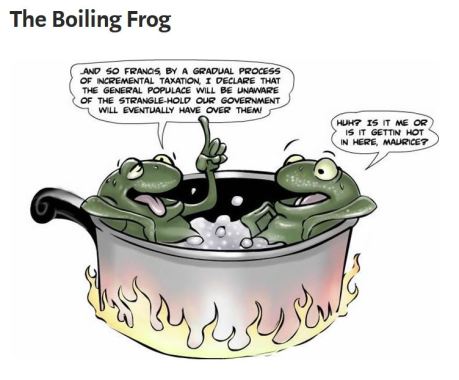
the boiling frog

Wesley Chang, The Boiling Frog, Medium.com

Which leaves us with the middle class.
Who have some resources stashed away – or enough credit available, to weather some crises. But not enough to last them for their entire remaining lives.
Which makes the middle class the only really interested people in the long term well being of the entire society. The only ones really interested in maintaining the freedom of the market as the main economic engine. The only ones really interested in maintaining democracy as the main manner of avoiding catastrophic mistakes perpetrated by the too powerful autocrats.

Or, from a psychological point of view, we can look at the haves/dirt poor as being stuck in an immobile state of mind while the middle class are the only open minded members of the society.
In fact, I prefer this last approach.
You see, until recently the American Dream was relatively accessible. With some luck, a ton of determination and a fair amount of brain power, the sky was the only limit. Belonging to any of those three categories, haves, middle class and dirt-poor was as much about the state of mind of those involved as it was about actual economic conditions.
The haves were free to consider the big picture, the dirt poor could contemplate brighter perspectives while the middle class were doing their thing. Keeping the whole show afloat.

I’m afraid we have reached an inflexion point. A watershed mark, if you prefer.
For whatever reason – I’m not ready to tackle this subject right now, we’ve become so preoccupied with something in particular that we’ve lost sight of everything else.

Including the middle class.

Exactly those which were supposed to maintain their cool heads and open minds.
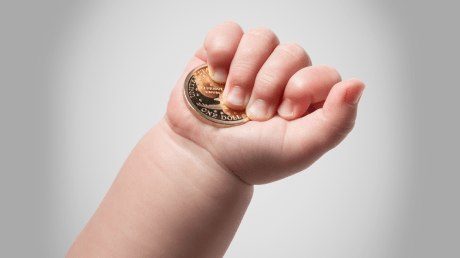
part of the problem

Matthew Stewart,
The 9.9 Percent is the New American Aristocracy,
The Atlantic

I’ve ended my previous post by saying that we, humans, are tempted to see almost everything as a potential tool.

And the present one by asking myself ‘to what avail?’.

What are we trying to accomplish?

I kept telling you that we, humans, haven’t invented much. That everything we do has already been experimented by our predecessors. Plants and animals…

Well, one of the things that we did invent was ‘intent’. As in ‘premeditation’.

We don’t know whether plants are driven by anything else except their ‘vital spirit’.
Same thing is valid for ‘inferior animals’ (those which don’t have brains) while the superior (a.k.a. brained) ones seem to be driven by what we call emotion.

Including us!

No matter how much we pride ourselves about our ability to reason, we’re still driven by emotion.
Actually, we’re not even close to being rational!
At best, we rationalize our emotional impulses. Before or even after we put them into practice.
Dan Ariely and Daniel Kahneman, among others, have already settled this point.

Then why am I talking about ‘premeditation’?!?

And who said ‘premeditation’ is necessarily rational?

It is planned, OK, but …

You see, the real difference between us and the rest of most other animals is our ability to ‘watch ourselves watching the world‘. As if something inside each of ourselves is able to send a probe somewhere ‘outside’ and then examine its own individuality as an outside observer. I didn’t say an impartial observer, just an outsider. However biased.

I won’t elaborate on how we got here, Maturana had already done that. Brilliantly. I’m far more interested in the consequences of each of us being able to observe their own selves ‘from outside’, keeping in mind that our rationality is heavily bounded – Simon Herbert and others, and that we’re mainly driven by emotions.

The very first thing that each of us observes about their-selves is the overwhelming fragility which defines us.

And this is why we search solace in religion. In no matter which one of them, atheism included. There is ‘safety in numbers’, you know…

Our goal, professed or not, is to find inner peace.
No matter whether you call it salvation, redemption, nirvana, self acceptance or whatever else, what you crave is peace.

The sentiment (illusion?) that you are safe.

At least for a moment.

How long is that moment going to last?

Well, that depends on how you got there!
And who accompanies you…


Remember Sheba?

The Chimp I mentioned earlier? Who was able to tame her greed by making good use of symbolic reckoning?

I wouldn’t go as far as considering that she used numerical symbols as tools. Mainly because she didn’t initiate the process… had she been able of proper/complete symbolic thinking she would have been able to solve the task even when dealing with real candy…

Nevertheless, the whole encounter does speak volumes. If in a hurry, jump to 28:01.

Ape genius


Let me start from a little farther away.
I’ve already mentioned the that we, humans, haven’t really invented anything. All living organisms are already involved in elaborate trading, use tools and have at least a rudiment of self-awareness.
Let me elaborate on the tool making and using part.

The whole thing has suddenly become rather eerie? All living organisms making and using tools?

OK, what is a tool?
Something used by somebody to accomplish a task?

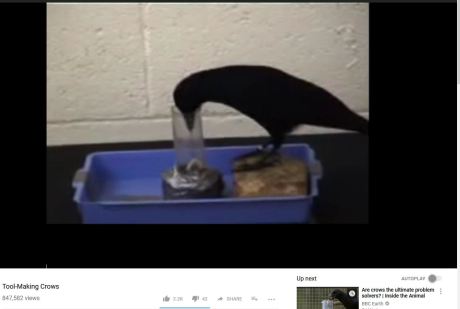
Crow making tools

Watch this crow fashioning a hook and using it to retrieve something and tell me whether that hook was a tool or not.

Says who? Us?

As smart as crows are, I seriously doubt that any of them really understands the concept of ‘tool’. Or any other concept, for that matter…
OK, some of them are able to use tools. Just as some of us are able to drive cars! That doesn’t mean that all drivers understand how cars work or all those capable to use tools are able to understand the concept of tool. Or what a concept is….

And what has any of this to do with Sheba and her bowls of candy?

I haven’t yet finished with tools, hold your horses.

A tool actually becomes a tool when at least one of us think of it as a tool. When some of us consciously try to determine alternative uses for that object.

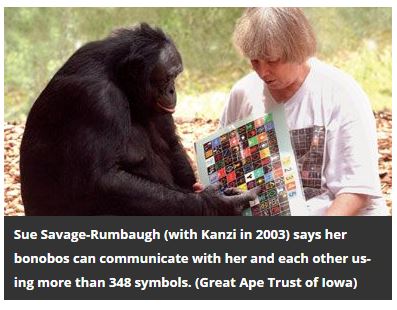
When we see a monkey picking up a rock to ‘pry open’ a nut, it is us who congratulate it. ‘Wow, such a smart monkey!’. For her, it was a natural thing to do. Something she had either found out by ‘mistake’ – when a rock had fallen on her toe, for instance, or by observing a more experienced member of her gang. But no monkey has yet tried to fashion a ‘proper’ tool… Just as no monkey has yet communicated more than in a ‘mechanical’ manner… In the wild they use various calls for more or less precise events and that’s it. After being taught some symbols  a few apes are now able to transmit their wishes/commands to other apes – including humans, or even to operate  various machines. But that doesn’t mean they are able to communicate impressions or to ‘talk about about something’ with a ‘friend’.

Kanzi

My point being that our very ability to use symbols to communicate among us has developed our ability to think. Because it is through thinking that we identify an object as a tool. And then expand the manner in which we use it.
You see, speaking has taught us that ‘what you hear’ almost never corresponds exactly with the ‘real thing’ … nor with what the speaker actually meant/tried to say … After millennia of conversations with our peers, we’ve learned that words/symbols are relative. That they can stand in for a piece of reality but that they’ll never be able to replace it. And that the same symbol might stand in for a lot of things….

The same phenomenon had happened with tools. After learning that one symbol might be used to represent two or more objects it was simple to put the same object to multiple uses. Even the most primitive stone axes were simultaneously used for ‘chopping’ fire wood, cracking bones for their marrow and for bashing in the skull of ‘thy neighbor’.

According to the various needs and wishes of the human agent who ‘called the shots’ in each instance.

Be it word or tool.

Hey, you said earlier that all living things use tools, not only an odd monkey and some crows…
Indeed… Have you ever watched a dog munching on a bone? Cracking it open and enjoying the marrow? Is it possible for us to consider that the dog has used its jaws as a tool?

No? Because the jaws are an integral part of its organism?
So what?

As a foolish teenager, I used to open beer bottles with my teeth.
Was I not using them, my teeth, as if they were tools?

Have a look-see at this short video.

seed developing tools

Had I not been conditioned to see it as a germination process, I might have interpreted it as the seed simultaneously developing a tool for retrieving nutrients from the soil and a solar panel to cook them with….


There is an almost unanimous consensus about laws having to be considered either natural or man made.

As in the law of gravity is implacable – hence ‘natural’, while the Penal Code is a lot more ‘amenable’.

Yeah, right…

Then how come Hammurabi had been able to write his Code some three and a half Millennia before Newton famously noticed that apples do fall to the ground? Besides being such irresistible objects of temptation, of course.
One way out would be to assume that Hammurabi was a lot smarter than Newton but that would be too easy, don’t you think?

Now that I’ve mentioned the noticing game, let me point out some of my own observations.
People have tried to fly way before Newton had told them this is impossible – for us, at least.
Individuals might occasionally get away with murder but murderous societies are far less stable than the more peaceful ones.
Gravity has been already ‘defeated’ while no totalitarian government has yet managed to ‘stay afloat’ in a consistent manner – no matter how many dissidents it had murdered.

Another approach to this conundrum would be to consider that natural laws deal with the non responsive kind of chaos while man made ones are meant to approximate what happens when the chaos is able to respond to what’s being thrown in it.

For instance weather and financial market. No one can change the weather – hence it is considered a non-responsive kind of chaos, while the market is constantly pushed one way or another by the various pieces of information that reaches the participants. Which participants respond to those inputs – according to their own abilities and preferences, hence the ‘responsive’ character of the market.

So, could we consider that nature is non-responsively chaotic while humans behave equally chaotic but in a responsive manner?

The key word here being ‘we’, of course.
After all, we have coined the very concept of law, we are the ones speaking about the difference between ‘natural’ and ‘man made’ and we have discovered, formulated and eventually bent all laws… both natural and man made.

It seems that the whole situation is a lot foggier than at the begging.
That I’ve messed things up instead of making some sense of them…

Let me use another tack.

First of all, let me notice that we’re surrounded by ‘things’. And that these things relate to each other. And to us, of course.
From this point of view, the world is made of things AND of the relationships that appear amongst these things.

And here’s the catch. Laws are not things. They are a small part of the relationships that appear between the things that exist in this world. And since we’ve already discovered that there are a lot more things around us than we will ever be able to ‘see’/notice, it would be unreasonably to expect us to be able to notice all the relationships that ‘tie together’ the world.

That doesn’t mean we shouldn’t try!

Returning to what we call ‘laws’, let me add yet another classification.

‘Noticed’ laws versus ‘pro-active’ laws.

In this sense ‘thou shalt not kill’, the Law of Gravity and ‘drive on one side only’ are, all three of them, ‘noticed’ laws. In the sense that things remain in order as long as we observe these laws.

On the other hand, pro-active laws are a lot more trickier.

‘Do this, do that’! …

‘Why?!?’

‘Because I know better AND/OR because I can make you obey my orders!’

While observing the noticed laws is essential in letting things flow naturally, imposing/accepting ‘pro-active’ laws is the recipe for disaster. Man made disaster.

Let’s take it one step at a time.

A guy hires a woman. A ‘working girl’, to be precise.

After a while, an attorney pays a hefty sum to the working girl and has her sign a confidentiality contract.

When asked about the whole thing, the guy first said that he didn’t know much about anything and then that he had reimbursed the hush money to the attorney.

The attorney apparently gets a lot of money from somebody else. Which somebody else might be, now or become in in the future, in a conflict of interests with the organization presently run by the guy who had once hired a working girl.

It becomes apparent that the attorney is a confidante of this guy. Or, in plain English, that this attorney takes care of the dirty laundry that ‘happens’ around this guy.

It also becomes apparent that this attorney is not satisfied with the amount of money he gets from this guy. That this guy is not his only client. And that this attorney is not very particular when accepting other clients.

What am I to understand from all this?

This guy is cheap?
This attorney is very greedy?
This guy is not very particular when choosing who takes care of his dirty laundry?

two sided coin

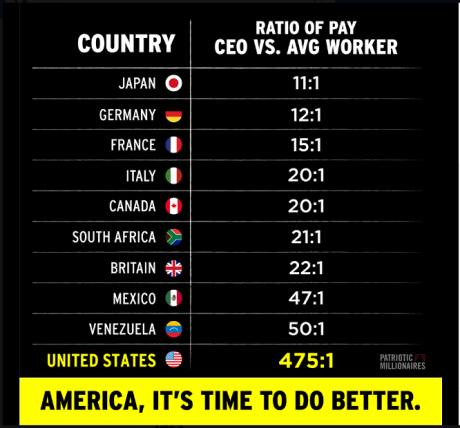
So, Japan and Germany have huge trade surpluses. Despite their workers being the best paid in the whole world. In both absolute and relative terms. Among the major economies, anyway.
Meanwhile, the US has a humongous trade deficit. Yet the American CEO-s are ‘compensated’ as if they were the best in the world…

Interesting, right?

More ideas about the same subject here:

Why is Japan Economy (surplus of over $100 Billion) a considered Weak Economy? & Why is USA Economy (deficit of over $400 Billion) Strong Economy?


thor

“Before being rescued, Thor had dragged himself around the streets of Mexico for months. A young woman named Eva pulled over to the side of the road seeing that the dog was barley alive. She took a picture and sent out a desperate cry for help. The REAL Bark (located in Los Angeles) saw it posted and immediately committed to this handsome pitt-bulldog mix. He was broken, paralyzed, and wounded, and a lot of doctors advised the rescue to put him down. Even if he lived, which was unlikely, he would need to be in a special-needs chair for the rest of his life. Jf Pryor, the founder of The REAL Bark, claimed that Thor’s eyes begged, “Let me live. Let me show you”- so instead of ending his life, The REAL Bark team began it.

His therapy, or “thorapy” as The REAL Bark team calls it, consisted of acupuncture, hydrotherapy, laser therapy, muscle building, and stretching. The most difficult part of recovery was helping end the enduring pain Thor was experiencing. Thor’s main doctor and biggest advocate was Dr. Jessica Waldman, the owner of California Animal Rehabilitation (CARE). When Thor attended CARE, the rescue team knew he needed a new set of wheels, a cart for him to pull his lifeless body along. Dr. Jessica Waldman surprised the team however with her response, “You can borrow a cart, but there is no need to purchase.” Thor’s doctor continued, “We will get him walking,” she said. “He wants to walk”. This hope kept the team going.”

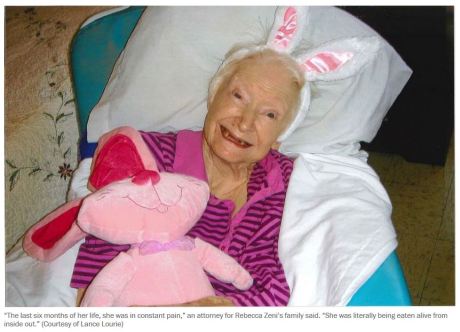
eaten alive by scabies

“The scabies that infected Zeni’s body had become so severe that bacteria seeped into her bloodstream. She died in 2015 at age 93.

Zeni’s death is now the subject of a lawsuit filed against PruittHealth, a for-profit company that owns dozens of nursing homes, including Shepherd Hills in LaFayette, Ga., where Zeni lived for five years until she died. Shepherd Hills, a nursing home that had multiple scabies outbreaks in recent years and a history of health violations, failed to follow policies and procedures to prevent the occurrence and spread of the highly contagious disease, documents say. Instead of providing the care that Zeni desperately needed, the lawsuit alleges that the nursing home allowed her to die an agonizing death.

“The last six months of her life, she was in constant pain,” Prieto said. “She was literally being eaten alive from inside out.””

I’m gonna insert three links.
They might be opened in any order, the link between them is evident, in all directions.

 “It’s a natural and powerful temptation to do unto them as they have done unto others. They have abused, reviled, and humiliated others: So let them be abused, be reviled, be humiliated. Yet if you go that way, you do not repudiate Trump. You become Trump.”

David Frum,
Michelle Wolf Does Unto the White House as It Has Done Unto Others,
The Atlantic, Apr 30, 2018

“It is particularly rich, too, to see a president who brags about his lack of political correctness and willingness to tell it like it is to be so thin-skinned he won’t even attend a party where he knows he’ll be roasted. It is revolting to see members of the press, who should have an adversarial relationship with the White House, comforting the press secretary and standing up for her honor when she is a chief architect of and apologist for these new political norms of idiotic crudeness, rank corruption, and unapologetic deceit.

Reporters allegedly expressed their sympathy to Huckabee Sanders after the dinner. This is insane. Reporters: Sarah Huckabee Sanders lies to you. She is a powerful and influential figure, and it is your job to be a check on her and the administration she speaks for – not to commiserate with her when a comedian makes some salty jokes, and certainly not to be her sympathetic friend.

Michelle Wolf ended her monologue by wishing the audience a good night, and then adding, “Flint still doesn’t have clean water.” “

Jill Filipovic,
The Bizarre Reaction to the WHCD Reveals We’re in Deeper Trouble Than We Thought,
Cosmopolitan, Apr. 30, 2018

Donald Trump is here tonight! Now, I know that he’s taken some flak lately, but no one is happier, no one is prouder to put this birth certificate matter to rest than the Donald.
And that’s because he can finally get back to focusing on the issues that matter –- like, did we fake the moon landing? What really happened in Roswell? And where are Biggie and Tupac?
But all kidding aside, obviously, we all know about your credentials and breadth of
experience. For example — no, seriously, just recently, in an episode of Celebrity Apprentice – at the steakhouse, the men’s cooking team cooking did not impress the judges from Omaha Steaks. And there was a lot of blame to go around.
But you, Mr. Trump, recognized that the real problem was a lack of leadership. And so ultimately, you didn’t blame Lil’ Jon or Meatloaf. You fired Gary Busey.
And these are the kind of decisions that would keep me up at night.
Well handled, sir. Well handled.
Say what you will about Mr. Trump, he certainly would bring some change to the White House.”

Barack Obama,
2011 White House Correspondents Dinner.

Apparently, heretics are hated while nonbelievers are simply despised.

Does any of this make any sense?

Actually, yes.

First of all, faith is like riding a bike.
If you stop moving, you either fall or you  have to put a foot on the ground.
And, after you learn how to do it, you don’t have to think about it anymore.
All is fine as long as you keep on moving…

Secondly, some people need to learn how to curb their initial enthusiasm… which is not such an easy thing to do… and the more dedicated among them have the greater difficulties…
Let me give you an example from the world of the martial arts.
The corpus of knowledge pertaining to this domain includes a series of resuscitation and first aid methods. Very efficient ones.
Our current, safety above all attitude, would mandate for these methods to be taught first to every new student. Which doesn’t happen. Age old experience has demonstrated that ‘enthusiastic’ newcomers would hit/choke each-other far harder and take far less precautions when knowing that resuscitation is so readily available. This is why these powerful methods are taught only to the more experienced,  and self controlled, practitioners of the art.

Going back to the difference between heretics and nonbelievers, let me point out another less obvious thing.
Most of us are imprinted with a faith or another in our early childhood. Way before any of us was capable of thinking for their-selves. As a consequence, most of us are very relaxed towards something which is both very familiar and shared by most of those around us.

Until something happens, that is.
Something which contradicts our faith. Something which might force us to ‘stop the bike’. Which might cause us to fall. Or stop and reconsider.

And this is the real difference between heretics and nonbelievers.

As believers, we’ve always known about nonbelievers. That they’ll go straight to hell. There’s nothing unsettling for us about that. They are so different from us that, practically, they don’t count. We might bump into them on the street, we might even do business with them… but, in the end, they don’t count.
They cannot influence our ‘deep thinking’. The way we see the world.

Heretics are something totally different. They are people like us, who share most of our beliefs and who behave almost like us on most occasions.
If we don’t pay special attention, we might confuse them with ‘our own people’.
And by being so close to us, they constantly remind us that, maybe, it is us who are wrong. About that small thing which makes the difference between us and them.
I must add here that ‘fresh’ converts have the ‘worst of it’. They had already reconsidered their faith, reached a conclusion and are now under a more intense pressure to defend their ‘deliberate choice’. The ‘born again’ are in the very same situation, choosing to comeback to an erstwhile lost faith is no different from adopting a new one.

This pressure is unbearable. Having to nurse such a huge doubt is like a devil constantly whispering in our ear… A culprit must be found, blamed for the torment we had to endure and punished for their arrogance. For their audacity to exist. To constantly remind us that there are alternatives to what we’ve been led to believe.

And this is valid for all kind of faiths. The phenomenon is not restricted to the religious world.
People who had vaccinated their children actually hate those who had chosen not to.
Well, some of them… I’ll come back to this…
Atheists hate the faithful.
The progressives hate the conservatives and the conservatives respond in kind.
Those who believe the Earth is round hate and/or make fun of those who are convinced  the Earth is Flat… and so on…

In this situation, people might ask themselves ‘how come we hadn’t yet slit each other’s throats in sleep?’

‘well, some of them…’

The point being that, most of the times, the haters are a small minority. Most of the believers have either understood that the main tenet of all ‘faiths’ is ‘don’t harm anybody unnecessarily and respect all other human beings/opinions’ or actually have better things to do than to split hairs.

Which brings us to the present situation.
When various ‘con-artists’ have learned to inflame hate and to prod the haters to fight each-other.

Only both the haters and the rest of us – the silent majority who, until know, have been too lazy to intervene, have forgotten that ‘divide et impera’ had always ended up disastrously. Usually for those who allowed themselves to be divided and, quite often, for the ‘imperators’ themselves.

Both Alexander the Great and Cesar, two of the most acclaimed generals and political figures, had ended up both prematurely and in an undignified manner. After causing enormous suffering to both the conquerors and the conquered.
Let’s not forget that Greece had practically disappeared from the world stage after Alexander the Great and that Cesar had been the first – well, the second, of the long list of Roman dictators who had led the empire to its eventual demise.
This might have been a ‘natural’ occurrence. ‘Natural’ as in ‘then inevitable’.

But why repeat it, now that we’ve already learned how it invariably ends?


Isn’t this funny? In a somewhat tragic way?

An Ugandan native makes a few bucks ‘educating’ white tourists about the Coriolis effect.

what's the magic, boss

The videographer, an England born Australian, jokingly asks him “What’s the magic, boss?”

Meanwhile, another guy tries to convince us that the Coriolis effect is fake and that the Earth is flat.

coriolis fake Earth flat

What next?
When are we going to watch a Youtube video claiming the fact that all the Northern Hemisphere  tornadoes spin in the same direction while those in the Southern Hemisphere ‘do it’ in the opposite one is due to … no, I give up …

I’m going to ask you something else.

At the end of the previous post, I promised that I’ll come back on why God was so afraid that Adam and Eve might grab some fruit “from the tree of life and eat, and live forever“.

Now imagine what would have happened if humans were immortal and a guy from the ‘flat Earth community’ was in charge.

Or if Stalin lived forever.

Click the pictures above to watch the videos.