Archives for category: Choices we make

In America,
voters don’t pick their politicians.
Politicians pick their voters.”

Wayne Dawkins

America is the land of the free.
‘The people’ can, according to the Constitution, choose among the candidates.
The politicians can, also in ‘certain’ conditions, choose their voters…

And those so inclined can choose their gender!

Do I have a problem with that?

No!
But I find it very interesting that ‘gender-mandering’ is such a divisive subject.
Very revealing, actually.

Let me start with the beginning.
“The word gerrymander (originally written Gerry-mander; a portmanteau of the name Gerry and the animal salamander) was used for the first time in the Boston Gazette[b] on 26 March 1812 in Boston, Massachusetts, United States. This word was created in reaction to a redrawing of Massachusetts Senate election districts under Governor Elbridge Gerry, later Vice President of the United States. Gerry, who personally disapproved of the practice, signed a bill that redistricted Massachusetts for the benefit of the Democratic-Republican Party.” https://en.wikipedia.org/wiki/Gerrymandering.
In this context, it’s worth mentioning that the Democratic-Republican party very soon later divided itself into the present day Republican and Democratic parties…

So, gerrymandering is one of the many common traits shared by both parties…
“The Founders frequently wrote about the dangers of political parties. They often labeled them “factions” that were divisive and rooted in self-interest. In Federalist #10, James Madison wrote that factions were a majority or minority animated by “some common impulse of passion, or of interest” harmful to the rights of others and the common good. They could be a source of unjust laws and a threat to popular self-government. President George Washington concurred and warned in his 1796 Farewell Address that “the baneful effects of the spirit of party” included strong passions, jealousies and revenge, dissention, and despotism.” https://billofrightsinstitute.org/essays/the-history-of-political-parties-in-the-united-states

“Some common impulse of passion, or of interest”

And there is a common impulse of passion. And of interest!
Both parties want power. And in order to get it…

Hence not only gerrymandering – used by both parties – but also ‘gender-mandering’.
Using gender as a bone of contention. A very useful posturing pretext…

Who, but those experiencing gender-dysphoria, is actually interested in the subject?
Maybe those baffled by the insistence with which some trans-women demand to be allowed to participate in professional sports… against cis-women, of course!

On the other hand… as a posturing pretext, the subject is invaluable!
To some, it epitomizes ‘you can be whatever you want to become’. ‘Progress’ in its purest form.
To others, it is anathema. The very notion of ‘against’. Against of nature, defying God’s will, you name it!

Did I make myself clear?

What about those living ‘in hell’?!? ‘Caught in the wrong person’?
Who cares about them?!? They are few enough to be negligible. Except for when a scapegoat is in order…

Do your own thinking!

How many times did you came across this message? ‘Do your own thinking!’. ‘Do your own research!’. ‘Don’t believe everything you are told!’

Sounds reasonable, doesn’t it? What’s wrong in googling up a subject before making up your mind? What’s wrong in storming your brain before calling something one way or another?

Let’s examine something else first.
There are ways in which we relate to ‘reality’. ‘Conservatively’ or ‘open-mindedly’.
And no, this has very little to do with our intelligence or with our level of education.

It depends on how important the subject at hand is to our well being and whether we have already made up our mind about it!

How open minded are you when it comes to spending the last money you have in your pocket? With no prospect of getting any in the near future?
How open minded do you remain after you have already declared, publicly, one way or another?

Most of those lavishly spraying their audience with ‘use your own heads’ – in my FB feed – also told their followers to avoid vaccines, at all cost. The one against Covid in particular – ‘it will eventually kill you’, but also those against measles. ‘It might cause autism’.

How this thing works?

Survival bias.
We not only want to survive, physically, but also to ‘feel good’. To preserve the good opinion we have constructed about ourselves.

This being the reason for which those of us who struggle to find their next meal will not take time to consider any philosophical subject. Will gladly accept the more ‘convincingly’ stated opinion and get back to the more important task of ‘foraging’.
And this being the reason for which those of us already entertaining a strong opinion about a subject see the world ‘differently’. Effectively associate different meaning to the same words!

“Do your own thinking” actually means different things to different people.
For those who have already made up their minds it means “feel free to stick to your own opinion”.
While for those who, for whatever reason, are open-minded about the subject at hand it means “please hear me out”.

Take your pick.

Each situation comes with possibilities.
Which of them happen, and in which order, determine the ‘future’.

As of now, AI – plain vanilla, generative and even agentic – is nothing but a tool.

A tool used by us to peruse what ever information it has access to. Information already ‘generated’ by us…
A tool used to organize, and present, said information according to algorithms. Algorithms learned from us…
A tool used to solve tasks we have set for it. According to our needs, whims and, above all, our ability to relate with the surrounding reality.

And now we’re scratching our collective head.
Wondering why the result isn’t that different from the one we get when using our own heads…

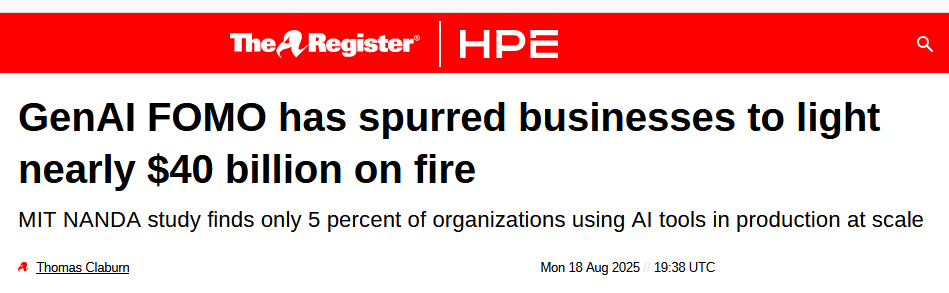
https://www.theregister.com/2025/08/18/generative_ai_zero_return_95_percent

https://www.theregister.com/2025/08/19/us_government_ai_procurement

Things happen.
The consequences of which

reshape what we call ‘reality’.

‘Things happening’ is how ‘reality’ works.
Is how we came about…

Believers and nonbelievers alike, all of us are consequences of ‘things happening’. ‘Naturally’ or ‘as commanded by God’.

‘Reality’, on the other hand…
What we call ‘reality’ is determined by ‘us’.

(What we call) reality is the consequence of things happening inside itself.
Consider a huge cauldron full of ‘events’. What’s going on inside that cauldron, each stage ‘reached’ by its content depends on what happened inside that cauldron. And to that cauldron if we accept the ‘god’ hypothesis.
Which ‘god hypothesis’ only compounds the reality. Which can be construed as being simple, evolving in an unhindered manner, or being run by a (bunch of) god(s).
Examined in this manner, the existence of a putative god doesn’t change much, does it?

Reality being shaped by what’s happening inside it leads to further considerations:
We, humans as part of this reality, have had played a role in all this. And continue to contribute to the process.
We, humans, as part of this reality, are one of the many consequences engendered by this whole ‘evolutionary’ process.

Another way of looking at this produces another train of thoughts.
Until we had reached the conscious state, things had happened exclusively in a ‘natural’ manner.
Furthermore, until that moment there was no difference between ‘natural’ and ‘non-natural’.
For the simple reason that there was nobody to make it…
Nobody able, let alone willing, to make that difference!

The gist of today’s post being the fact that we are shaping reality according to our wishes.
Not entirely, not fully aware of what we’re doing, yet our actions have more and more important consequences.

Let me give you an example.
Until not so long ago – historically speaking, all empires – most socio-political arrangements, usually known as ‘states’, functioned as authoritarian regimes – used to crash under their own weight, had been crushed by the competing empires ‘happening’ in their vicinity or a combination thereof. The Western part of the Roman empire, weakened by the mistakes perpetrated by its rulers, had been ‘dismantled’ by the nomadic people who fancied the riches accumulated inside its borders.
The process had many iterations. An aggressor, a would be ‘imperator’, noticed an opportunity. What he considered to be an opportunity…
Mounted an aggression. And was either successful or defeated…

Until Napoleon Bonaparte had stirred so thoroughly the hornets nest that enough people noticed what was going on. Were aggravated enough to spring into action.
So they banded together, twice, and sent the initially successful aggressor where he belonged. In exile!

For the first time in modern history – as far as I know it – an aggressor had been ‘tamed’ by a ‘coalition of the willing’.
The same process had unfolded during WWI, WWII and WWIII. Otherwise known as the Cold War.

The only other example which comes to my mind – but I’m no historian – was the Persian Empire being defeated by a coalition led by Athens. Some 2500 years ago…

What’s keeping us from understanding this simple thing?
That unless we band together, we’re at the mercy of whoever puts up a fierce enough aggression?

https://www.britannica.com/event/Greco-Persian-Wars

Commodities are things produced for exchange, with a market value,
rather than for their intrinsic use or benefit.
Commodification prioritizes exchange value over use value,
meaning things are valued primarily for their potential to be sold and generate profit,
not for their inherent purpose or usefulness. 
AI Overview

US soldiers kneeling for Putin? Viral red carpet photo triggers backlash…” The Times of India

We’ll never know how many people have watched, mesmerized, the ‘breaking news’ detailing what had happened yesterday in Anchorage.

Otherwise put, we’ll never know how many people have watched exactly nothing.

On the other hand, there are some who know. How many people have already watched and how many continue to watch. The countless interpretations offered by the talking-heads regarding what had happened. Regarding the nothing which had been breaking the news all day yesterday…

What’s going on?

Until not so long ago – until Robert Murdoch has launched the first 24-hours news channel, Sky News, UK 1989 – ‘fresh information’ was provided to the general public mixed up with other ‘things’. TV channels used to air, some of them still do, a carefully choreographed mix of entertainment, sports, movies and news. And news…
TV watchers used to be treated as people. As individual human beings. With various tastes, indeed, but also with a common interest. A common interest in the well being of the place where they happened to live…
The common denominator uniting the audience was, even if never stated in plain language, the understanding that all of them cared for the important things. Country, values, tomorrow…society…

Not any longer.
Nowadays the audience is considered/treated as a herd of consumers.
How many times have you heard “welcome to the show” at the start of a news bulletin?
News bulletin which is meant to keep you riveted to the TV set for long enough so that you’ll be exposed to the commercial messages being ‘trafficked’ by the TV stations…

I argued in the previous post that democracy is a weeding out mechanism.
That in a functional democracy the informed citizen will, eventually, weed out inefficient politicians. Those who had allowed themselves to become ‘corrupted’. Not necessarily in the direct sense, as in taking bribes and all that. Political corruption takes many forms, all of them drastically diminishing the efficiency of government.

The informed citizen…
But what kind of information is currently available?
And, furthermore, who initiates the ordinary TV watcher in the fine art of watching the news?
Remember, in this context, that the ‘ordinary TV watcher’ is considered to be a ‘consumer’, no longer a ‘concerned citizen’.

And who are the people who know exactly how many viewers have watched yesterday’s news bulletins? And today’s interpretations of what had happened yesterday?
The ‘media watchers’, of course. Those who measure the audience for the sole purpose of extracting as much money from selling commercials as possible…


Kiss an ass for long enough, its owner will become god.
And start behaving accordingly…

We all know that no communist regime has ever worked. For long…
Some of us have noticed that all empires, all imperial regimes, eventually collapsed. Under their own weight. Under the weight of accumulated errors…

The mechanism is simple.
Lord Acton was convinced that “Power corrupts and absolute power corrupts absolutely”.
Frank Herbert, looking from the other direction, argued: “It is not that power corrupts but that it is magnetic to the corruptible”.
My experience suggests that both were right. Power is magnetic to the corruptible and when enjoying it those in power are subjected to innumerable ‘temptations’. Already corruptible, most of them indulge themselves…

Democracy is nothing but a weeding mechanism. “The People”, realizing that (some of) those in power have become too corrupted, have the necessary tools to weed them out. To replace those corrupted politicians peacefully.
With other politicians, not – as yet, anyway – as corrupted as those sent away.

Imperial regimes, the communist ones included, do not have such mechanisms.
The already corruptible, once in power, sink deeper and deeper into corruption. Become more and more impervious to any advice. More and more confident in their own infallibility. More and more prone to making bigger and bigger errors.
The consequences of which errors keep pilling one on top of the other.
Until nothing works anymore…

Which is why all reasonable political regimes have limits.
Elections are organized on a timely manner.
And no more than two presidential mandates, for example.

Given all of the above, I’m afraid. Petrified, actually.
Two people are going to meet, in a short time, pretending to solve…
The entire planet seems mesmerized!
Two people are going to determine the fate of billions!?!

Are we nuts?


Mind what you wish for,
for it might happen…

Putin wants to survive while Trump wants the same thing.
Xi also wants Putin to survive…

Without Putin(ism), Europe wouldn’t spend a dime on weapons. On American weapons!
America would have to develop and maintain alone the hardware needed to keep Xi at bay.

Once Putin gone, the Russian people will completely turn their attention towards Europe.
Leaving the ‘Chinese model’ stranded. In limbo…

What do we want?!?
Who cares?!? But now, that you’ve asked…

We want America back!
The already great America…
The one wise enough to save Europe from itself. Twice!
The one wise enough to help Japan back on its feet after WWII.
The one wise, and brave, enough to defend South Korea.
The one wise enough to understand that behaving like a bull in a China shop might be fun. For a while… but inexorably produces a fine mess… Specially when the bull owns much of the china being traded in that shop!

America does have a huge responsibility in maintaining the world in a working state. For the simple reason that America’s wealth depends, directly and indirectly, on the smooth functioning of the increasingly integrated world market.
Forgetting this, and concentrating your attention on ‘particular interests’, vested or not, is nothing short of blinding yourself. Of shutting reality out!

And we want Europe back!
Europe has already done the same mistake America is about to commit.
Behaved like the bull in the China shop. Literally. Then, overwhelmed by the consequences, left out without clearing up the mess.

Finally, but equally important, we need China – along with all other ‘wishful thinkers’ – to learn.
To understand that behaving like a bull in the China shop, even if you do it at home, doesn’t help anybody. Not in the long run.
Everybody, including the bull, ends up in tatters…

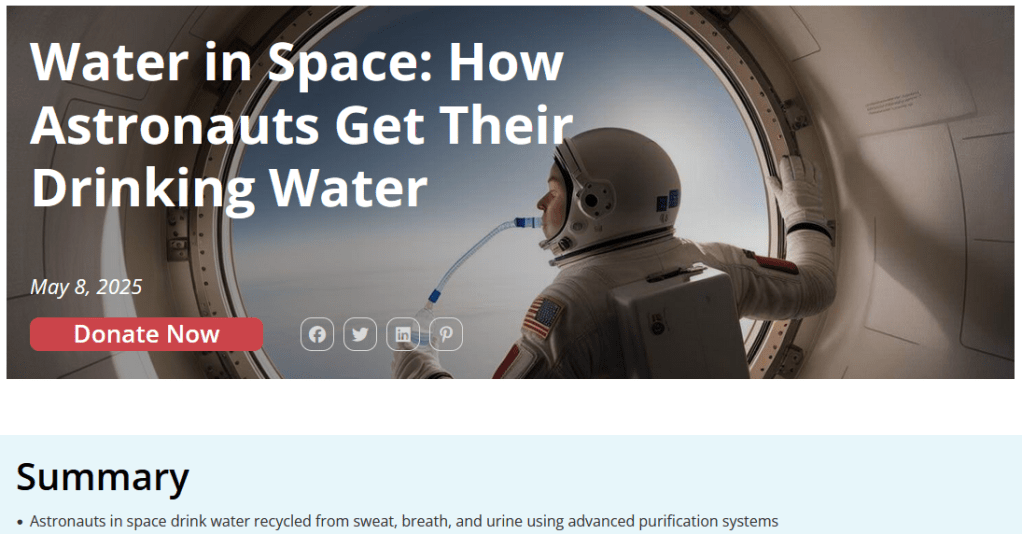
Astronauts don’t bring all their drinking water from Earth.
Instead, they rely on closed-loop water recycling systems
that recover and purify nearly every drop of moisture produced onboard.
That includes urine, sweat, breath vapor, shower water, and humidity from the air.

In space, nothing is wasted.

NASA 1132 77.0F

A space station circling the watery pebble we call home…

Cooperation brought us so far.
A majority of us have enough to eat and some of us – albeit very few – get to see the world from above.

Some of us might wonder:
What’s the point of ISS?!?
Wouldn’t that money be better spent feeding the hungry?

The short answer is:
‘We don’t need the ISS money. Feeding the hungry is well within our current possibilities. We just haven’t yet figured out how important this is!’

And here’s the explanation.
We’re no longer able to feed ourselves. Individually…
In order to enjoy our current standard of life, we need to cooperate.
In order to cooperate, we need to trust each-other.

Nobody has asked to be born.
Yet here we are.
La Legion Etrangere goes by “Marche ou Creve”. Keep walking or ‘make way’.
Now that we’ve been born, how about we make the best of it?

Those who get to see the world from above did have a say about the whole thing.
Nobody gets there against their wishes.
And they know what they’re signing for. Not everything – some of them don’t get to get there – but they have a fair image of what’s gonna happen to them. Including the facts about the water they’ll be drinking while enjoying the view.

Maybe it’s time for the rest of us to understand the limited nature of the Earth itself.
Not as limited as the ISS but I’m sure you understand my drift.

The astronauts trust each-other.

And they trust the rest of us.
Those who have made it possible for them to go there.


We, the rest, need to learn the trick.
How to actively, agentically, build trust 2.0.

Deeds?
Or individuals?
What do you see first?

Most of you are more likely than not to be familiar with the ‘straw that broke the camel’s back’ metaphor.
My straw borrowed the shape of a book. Erich Fromm’s The Anatomy of Human Aggression.
At some point, when discussing the differences between Skinner and Freud, Fromm asks more or less the same question. His point of interest being different from mine… his thoughts follow a different path from mine…

So? What do you you reckon?

I feel the need to remind you a few things.
Fromm, a famous psychologist, had a PhD in sociology.
I, an engineer, have a BSc, in sociology.
Skinner, the entire behaviorist school of thinking, was contemporary with the dissolution of ‘God’.

Once the camel’s back had given way, things have started to fall into place.
Those who see ‘individuals’ first are psychologists, at heart, and those who see ‘deeds’ are sociologists.

‘So Skinner should have been a sociologist?!?’

I would never go as far as telling people what any of them should be doing!
I leave that to Marx’s followers. To all those, in general, who are confident enough to do it. I’m sure this is a wrong thing to do but I’m not here to judge. Only to express a few considerations.

‘You don’t tell people what to do, only what to NOT do! Semantics…’

There is an old story which sheds some light on this problem.

A teacher gave an after school assignment:
‘Do a good deed. Come back tomorrow and share the experience.’
John:
‘At a traffic light, sounding the right kind of beep, a blind person was already halfway across. A runaway truck was fast approaching without a sound. I pulled the person out of the danger. They was very grateful.’
Kevin:
‘An elderly lady was approaching a traffic light which was about to change. There was no chance in hell that she could have made it. I hoisted her over my shoulder and carried her across. She screamed and kicked like hell. She had no business on that side of the road. I felt ashamed and I left her there.’

Skinner, the behaviorists in general, do not care about ‘intent’. ‘I have no clue about what’s going on inside people’s heads. All I know, and can ‘measure’, is what they do. How they behave. In any given circumstances after whatever conditioning had been exerted upon them’.

Which makes a lot of sense, right? Specially for an engineer…

Freud, on the other hand, puts the onus on the manner in which each individual ‘digests’ – ‘internalizes’, according to the lingo – the whole history of interactions (conditioning?!?) they have experienced on the road towards their present state.

For Freud, behavior is something to be studied in order to understand the individual while for Skinner behavior is something to be fine-tuned.

Not so different, from my perspective.
Both Freud and Skinner somehow forget about the elephant in the room.
Who studies the individual? Who makes the (psycho)analysis? Who attempts to fine-tune ‘the behavior’?
I’m not going to go any further. And ask ‘why?’. What’s the end goal of any of those individual ‘experimenters’. ‘Motives’…
I’m no psychologist.

Being an engineer, I’m more interested in consequences. In what comes out…

In what we, ordinary people, have to survive in!

Living organisms constantly exchange information with their environment.

Then where is the difference between ‘us’ and the rest of the living creatures?
Information-wise, of course!

Language…

As far as we know, humans are the only critters currently living on Earth which are interested in how other creatures learn. Or teach…

An individual actor A can be said to teach if it modifies its behavior only in the presence of a naive observer, B, at some cost or at least without obtaining an immediate benefit for itself. A’ behavior thereby encourages or punishes B’s behavior, or provide B with experience, or sets an example for B. As a result, B acquires knowledge or learns a skill earlier in life or more rapidly or efficiently that might otherwise do, or that it would not learn at all.” Caro and Hauser, 1992

In the 20 odd years since Caro and Hauser have set the bar for what teaching means quite a number of species have been found to do it. To fully or at least suggestively cross all the necessary t-s. From ants to primates.

Interestingly enough, all of those species have a clear ‘collective’ behavior.
All individuals belonging to a species collaborate, of sorts, towards the survival of that species. This goes without saying.
But in some species this collaboration is more intense than in others.
Ants and bees versus most other insects.
Elephants versus cheetahs. Or leopards.
Even chimpanzees versus orangutans…

OK, for some species hand to hand collaboration between generations is impossible. Most parent insects are dead when their offspring hatch. Orangutans live in forests where food is too scarce for more than 1 individual to forage.
Others have found their niches. Where the individual approach is good enough for them to survive. Cheetahs, leopards. Bears, even…

Charles Darwin taught us about evolution. Merging individual lives into the survival of the species those individuals belong to.

Life, as I see it from a “functional and mechanistic perspective“, is yet another manner in which matter is organized. Yet another ‘state of matter‘.
For life to be present, three conditions have to be met.
– Individual organisms have to be exchanging, in a controlled manner, substances with their environment. To ingest nutrients and to excrete the by-products of their metabolism.
– Individual organisms have to be exchanging information with their environment. And with their interior. Otherwise the exchange of substances would no longer be controlled by the individuals.
– Individual organisms have be passing to the next generation the pertinent information needed for the species to survive. In the kind of life we are familiar with, that would be ‘the genetic information’.

Considering the above, I dare to make a difference between what Caro and Hauser consider to be teaching and what we, humans, do.
Intent!

I doubt that any of the ‘animal teachers’ do it under their own volition.
After all, nobody has yet identified an animal con-artist who cons the members of their own species… as we do!
As far as we currently know, ‘teaching behavior’ is displayed inside species which collaborate more closely than other species. Which suggests that that kind of behavior is somehow innate to those species. A ‘habit’, not a choice. As it is with us.

What makes it possible? This difference?
Our special kind of conscience and our use of language.
The fact that we are the only species – as far as we know – capable of building a ‘virtual image’ of the surrounding reality. Capable to select certain aspects of what surrounds us and codify them using various forms of ‘notation’.
And to do this according to our own, individual, interests!
Sometimes even against the interests of the community/species to which we belong.