Archives for category: Choices we make

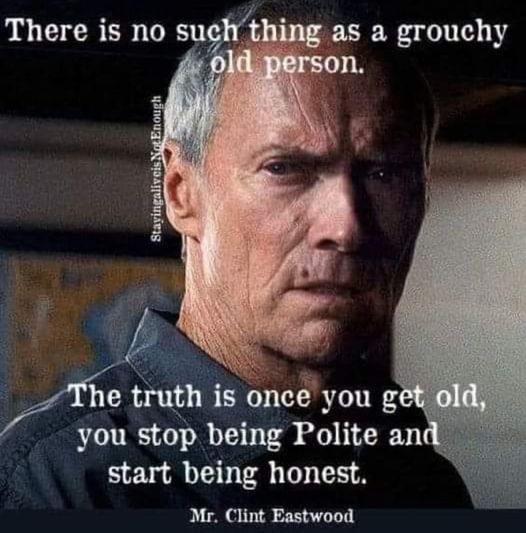
Well, from where I stand – 62 years and counting – ‘grouchy’ starts when people forget that truth – even the naked one – can be ‘exposed’ in a polite manner.

Becoming old doesn’t come with a license to stop caring about how the others feel about things.
On the contrary.
At some moment in time, each of us will reach ‘the point of no return’. After which we’ll depend on others. Totally!
For food, for water, for somebody to change our diapers…

After all, we’ve been lucky enough to reach the ‘golden age’.
How about becoming wise instead of devolving into rude punks?

‘Cause the opposite of polite is being rude. Not truthful!

Because neither has any damns to give…

They call it Cuetlaxochitl.
They used to call it that way for a very long time.
And it was they who had associated it with the Winter solstice. With the Winter solstice, not the ‘Aztec’ solstice…

We, or rather I, don’t know how they used to call the mistletoe. All I know is they used to associate it with their ‘spells’. Performed, again, during the Winter solstice.

At some point, we – or rather after the Christians got in contact them, the mistletoe first and poinsettia later – have associated both with our manner of celebrating the Winter solstice.

In fact, we have appropriated both the celebration itself and the plants associated with it!

I’m not going to discuss whether this was a good or a bad thing.
It had just happened. And we have to live with the consequences of all those things having had happened in the past.

All I’m going to discuss in this post is their association with Christmas.
With what the Christians consider to be ‘Christmas’ and celebrate it as such.

But is there anything to be discussed about the matter?!?

They have associated each of these plants to their celebrations.
We have associated both to one of ours.
What is to be discussed here?!?

Do we feel bad for what we – our ancestors, actually – have done to them?
And want to atone for what had happened? And for the consequences of what had happened? Which consequences continue to unfold to this day…

We want to make amends – and to get rid of our guilt – by giving them back their plants?!?
Really?

How will any of this benefit them?!?
‘Cause this is about them, not us… right?

How about we stop buying the drugs coming from there?
Making it possible for them to shake off the drug lords which make their lives miserable?

How about we stop patronizing them?
How about we start respecting them for being our ‘brethren’? As in equally-fledged human beings?
Instead of we acting as if they were immature children. Liable to feel hurt that we have borrowed their ‘toys’…. For the sole reason that we think that giving them back their ‘sacred’ plants will cleanse our consciences….

The world doesn’t belong to leaders.
The world belongs to Humanity.

Proper = As it should be. As expected. ‘Clean’.
Property=Something which belongs to someone.
A mutually respected arrangement among the members a certain community which establishes boundaries. Which members have the right to go ‘there’ whenever they want while all others have to ask for permission before crossing that ‘boundary’.
A convention among the members of a certain community about what is the proper thing to do in each ‘patrimonial’ situation. A convention about who has the right to do what to the things which happen to co-exist with the members of the above mentioned community.
The above mentioned ‘things’ include the place where the entire community happens to live. ‘Their’ land.

Which brings us to who owns the world.
The leaders? As many of them assume?
Or the humanity, as Dalai Lama has reportedly said?

How about neither?
My point being that we are nothing but guests in this world.
We come empty handed and we leave empty handed.

Yes, we need property while dwelling on this planet.
But only in the sense of who can do what where. And with the limitation that the ‘what’ we do has to be ‘reversible’.
Just as we leave this world with nothing – we leave even our hands here, our presence on the planet has to be ‘discrete’. Has to produce as little disturbance as possible and all that disturbance must disappear in time.

We need to keep the world a proper place.
It’s the only place we have.
No other home for our children.
No other place to spend our last days.
Properly.

“If the only tool you have is a hammer,
you tend to see every problem as a nail.”
Abraham Maslow

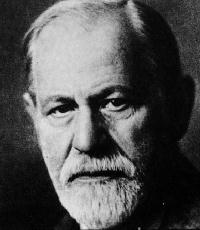
Did you recognize him?
Yes, Sigmund Freud. Dr. Sigmund Freud, as depicted on http://www.marxists.org.

“While the different religions wrangle with one another as to which of them is in possession of the truth, in our view the truth of religion may be altogether disregarded.
Religion is an attempt to get control over the sensory world, in which we are placed, by means of the wish-world, which we have developed inside us as a result of biological and psychological necessities.
But it cannot achieve its end.
Its doctrines carry with them the stamp of the times in which they originated, the ignorant childhood days of the human race. Its consolations deserve no trust. Experience teaches us that the world is not a nursery.
The ethical commands, to which religion seeks to lend its weight, require some other foundations instead, for human society cannot do without them, and it is dangerous to link up obedience to them with religious belief.
If one attempts to assign to religion its place in man’s evolution, it seems not so much to be a lasting acquisition, as a parallel to the neurosis which the civilized individual must pass through on his way from childhood to maturity.”
[Sigmund Freud, “Moses and Monotheism”, 1932]

No, I’m not going to argue with Freud.
I’m not going to compare his opinion on religion with that of Durkheim. Which makes more sense to me. You may find them here, at #e., and compare them yourself. If you wish, of course.

What I’m trying to point out in this post is that reason is over-rated.
That reason is an extremely powerful tool but, like all other tools, the consequences of yielding it depend on the yielder.
On the person using reason in order to get somewhere.
To find the intended meaning…

Which is?

The sound of one hand clapping…

While worrying is indeed a waste of time, it is also a very good pointer!
If not the only one…
The only one powerful enough to make us ‘move’!

Worry is a powerful attention grabber. Points us towards the things we feel the need to solve.

What we do after our attention has been pointed… that’s the most important thing!

Continue to worry or start doing things?
Meaningful things…
And the first meaningful thing to do while worrying is to stop.
Now, that the attention grabber had done its thing… to continue would be a waste of energy!

You cannot learn
what you think you know.

Epictetus

How many times have you been hit by something you didn’t see coming?

Not very often… for the simple reason that these encounters use to end up badly!
Bent fenders, broken bones…
Hence we pay attention. Or get killed… end of story!

But how many times have you experienced bad consequences, really bad consequences, after misjudging a situation?
After a ‘doesn’t matter’ uttered nonchalantly?

There are no facts, only interpretations.
Friedrich Nietzsche

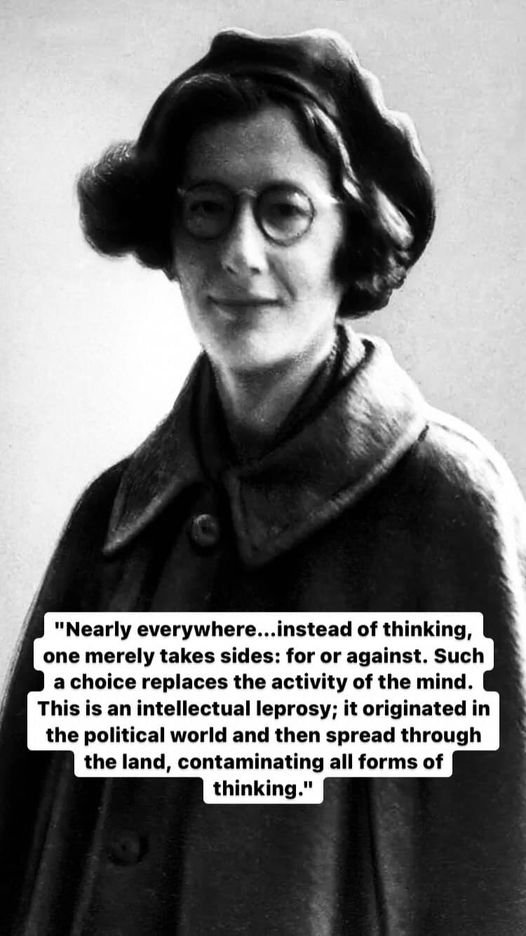
I’m afraid the political world wasn’t where this intellectual leprosy had originally came from.
The political world was only the place where this disease had become ‘viral’.
Where this manner of (not) thinking had been weaponized!

Its origin can be traced back to our intellectual arrogance.
To our conviction that ‘I can be right on my own’. Without any ‘input’ from the outside…
Even in spite of whatever information might reach me from ‘outside’, if that information doesn’t fit my already held convictions. My ideology….

In fact, this belief – ‘I’m entitled to my own convictions’ – is exactly what people on both sides of the divide have in common. Intellectually speaking!
A shared disease… a virus infecting indiscriminately…

There is an old ‘rule’ which maintains that even a broken watch may be accurate.
From time to time, if it retains its arms…
Twice daily, to be precise!

Same thing is valid for people.
From time to time, each of us will utter something which actually makes sense!

Sort of, anyway…

The catch being that in order to ‘prove’ the temporary accuracy of the broken watch you need one in good working order. Or, alternatively, you need a good understanding of time.

Same thing with Peterson’s uttering.
On the face of it, the phrase is catchy.
In fact, it’s just as useful as a broken watch.
What solace will be felt by the victim of a tough tyrant when that person realizes that no tyrant, however tough, was ever capable of ‘achieving’ anything without the compliance of the weak? Without the compliance of those who had done, in their weakness, what the tyrant had told them to do…

So yes, broken watches are, sometime, accurate.
And yes, Petersen is right to tell us that both tough and weak people can wreak a lot of havoc.

But neither of these two pieces of trivia will be useful to us until we’ll understand it’s up to us to put them to good use. To understand the temporary nature of the accuracy displayed by the broken watch and the fact that no man, however tough, becomes really dangerous unless condoned, or even helped, by ultimately hapless weaklings.

The things we believe
are
what we have in common
with those who promote them.

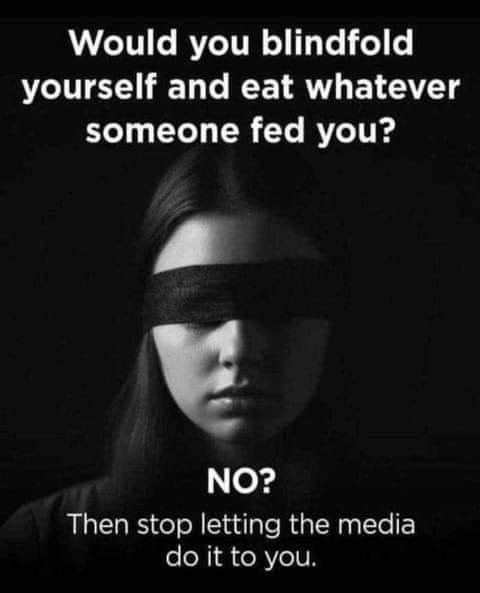
Well, nobody ‘blindly’ beliefs anything published in the media!
We use our cognitive biases in order to do that.

The media publishes the things we like to hear.
To sell advertising space, to please their sponsors…
While those who actually do this, the journalists, appease their consciences with ‘we have to give them what they want’. ‘Cause we actually do ‘buy’ their stuff…

And we believe the things we read in the kind of press we ‘buy’ because we no longer bother to keep in check our cognitive biases!

Who has anything to gain? From this vicious circle spinning faster and faster?

Nobody, really!
But we all have something to lose.

Everything, actually!

When was the last time you met a dead person who regretted anything?

It is not from the benevolence of the butcher,
the brewer, or the baker, that we expect our dinner,
but from their regard to their own interest.
We address ourselves, not to their humanity
but to their self-love,
and never talk to them of our own necessities
but of their advantages.
Adam Smith, The Wealth of NATIONS, 1776

I’m sure you already know that Adam Smith didn’t invent capitalism. As Marx invented communism and Lenin invented bolshevism.

Adam Smith had done nothing more and nothing less but described what was going on around him. How a bunch of people acting according to their ‘moral sentiment’ took care of business. How individual needs – for meat, beer and bread – were met and how the wealth of nations was built in the process.

“To some people, Gen Z may seem salary ‘obsessed’. In some cases, say experts, it may be hard for older generations to understand why young workers have such an intense focus on pay. “At Gen Z’s age, older people worked 40 hours a week, and made enough money to buy a house and have barbecues on the weekend,” says Corey Seemiller, an educator, researcher and TEDx speaker on Gen Z. “Gen Z works 50 hours a week at their jobs, and another 20 hours a week side hustling, yet still make barely enough to cover rent.””

Do you notice any need being fulfilled, in earnest, in this, new, situation?
OK, things were not that rosy in Smith’s times either. Most people had to work hard, a lot harder than today, to make ends meet. But since Smith and until some 40 years ago things went better. Year after year.
When Smith was writing his books, Regular Joe-s used to live in crowded shacks, usually rented out from their employers. Nowadays, most of those in their 50-ies and 60-ies own the house they live in. Which house has nothing in common with the afore mentioned shack.

So, is this the new kind of progress?
A looking back in anger kind of progress?
Are you even aware of the huge number of people pondering whether capitalism is not as good as advertised – by those who have already enjoyed its spoils? For the simple reason that in the current (no longer) free (enough) market so many people can no longer enjoy the kind of economic well being their grand parents took for granted…

As someone who had experienced both communism and capitalism, the situation is clear.