Archives for category: Bounded rationality

You cannot learn
what you think you know.

Epictetus

How many times have you been hit by something you didn’t see coming?

Not very often… for the simple reason that these encounters use to end up badly!
Bent fenders, broken bones…
Hence we pay attention. Or get killed… end of story!

But how many times have you experienced bad consequences, really bad consequences, after misjudging a situation?
After a ‘doesn’t matter’ uttered nonchalantly?

What are the errors of Marxism?

Marxism is an ideology.
Ideologies don’t have errors, they are thought templates used to evaluate a certain situation and to determine what to do next. Ideologies are tools.
They can be used properly or improperly.
Sometimes, the best use for certain tools is to be left alone. Particularly when you understand they are useless. If you understand they are useless…
Hence it’s not Marxism which is full of errors, it’s the Marxists who are barking up the wrong tree.

If you really need to put your finger on something, if you need to point out a culprit, I give you Marx.
Yes, Karl Marx is your man.
His analysis was brilliant. His diagnostic was spot on.
Finally, in times when the class struggle nears the decisive hour, the progress of dissolution going on within the ruling class, in fact within the whole range of old society, assumes such a violent, glaring character, that a small section of the ruling class cuts itself adrift, and joins the revolutionary class, the class that holds the future in its hands. Just as, therefore, at an earlier period, a section of the nobility went over to the bourgeoisie, so now a portion of the bourgeoisie goes over to the proletariat, and in particular, a portion of the bourgeois ideologists, who have raised themselves to the level of comprehending theoretically the historical movement as a whole.
His cure – the mandate he gave to the “bourgeois ideologists who have raised themselves to the level of comprehending theoretically the historical movement as a whole”, and whom he called “communists” – was abysmal.

Which tells us Marx’s brilliant analysis wasn’t deep enough. He had noticed a series of facts but he had failed to notice the bigger picture. He had failed to see that all authoritarian regimes had failed. Under their own weight. Inevitably. And he had failed to notice that all democratic regimes had survived, and thrived, for as long as they had managed to preserve their democratic nature.

Hence the Marxist cure, communism, was stillborn.
A tool to be left alone.
The attempt to impose yet another authoritarian regime – with no matter how generous intentions – after the overwhelming experience of all other authoritarian regimes failing abysmally, is nothing but the compelling proof of social and historical blindness.

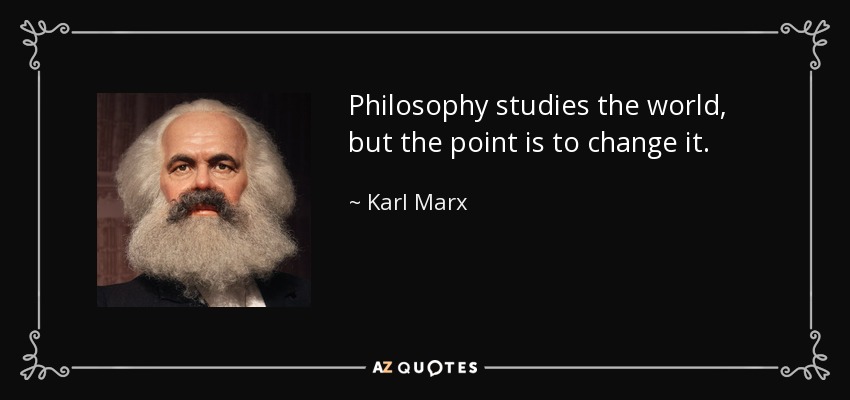
And why start this post by quoting Marx himself?
Because that quote is more than enough. More than enough proof for Marx being a bully.
It’s OK to ‘change the world’ if you own it. If it was yours…
But bearing in mind that there are other people living in the same world… wouldn’t it be nice to ask their opinion about the whole thing? About the changes you want to make? Which changes will dramatically affect the world they live in?!?
They are simpletons? Whose opinions are worthless? Because you said so yourself?

“The lower middle class, the small manufacturer, the shopkeeper, the artisan, the peasant, all these fight against the bourgeoisie, to save from extinction their existence as fractions of the middle class. They are therefore not revolutionary, but conservative. Nay more, they are reactionary, for they try to roll back the wheel of history. If by chance, they are revolutionary, they are only so in view of their impending transfer into the proletariat; they thus defend not their present, but their future interests, they desert their own standpoint to place themselves at that of the proletariat.

The “dangerous class”, [lumpenproletariat] the social scum, that passively rotting mass thrown off by the lowest layers of the old society, may, here and there, be swept into the movement by a proletarian revolution; its conditions of life, however, prepare it far more for the part of a bribed tool of reactionary intrigue.”

As I just said.
Bullly!!!

For everybody, no matter how powerful, crimes are those that others commit….

The powerful are the ones who have the means to evade the consequences but when it comes to ‘who thinks what’, there’s no difference among variously powerful people!

There is an old ‘rule’ which maintains that even a broken watch may be accurate.
From time to time, if it retains its arms…
Twice daily, to be precise!

Same thing is valid for people.
From time to time, each of us will utter something which actually makes sense!

Sort of, anyway…

The catch being that in order to ‘prove’ the temporary accuracy of the broken watch you need one in good working order. Or, alternatively, you need a good understanding of time.

Same thing with Peterson’s uttering.
On the face of it, the phrase is catchy.
In fact, it’s just as useful as a broken watch.
What solace will be felt by the victim of a tough tyrant when that person realizes that no tyrant, however tough, was ever capable of ‘achieving’ anything without the compliance of the weak? Without the compliance of those who had done, in their weakness, what the tyrant had told them to do…

So yes, broken watches are, sometime, accurate.
And yes, Petersen is right to tell us that both tough and weak people can wreak a lot of havoc.

But neither of these two pieces of trivia will be useful to us until we’ll understand it’s up to us to put them to good use. To understand the temporary nature of the accuracy displayed by the broken watch and the fact that no man, however tough, becomes really dangerous unless condoned, or even helped, by ultimately hapless weaklings.

It is not from the benevolence of the butcher,
the brewer, or the baker, that we expect our dinner,
but from their regard to their own interest.
We address ourselves, not to their humanity
but to their self-love,
and never talk to them of our own necessities
but of their advantages.
Adam Smith, The Wealth of NATIONS, 1776

I’m sure you already know that Adam Smith didn’t invent capitalism. As Marx invented communism and Lenin invented bolshevism.

Adam Smith had done nothing more and nothing less but described what was going on around him. How a bunch of people acting according to their ‘moral sentiment’ took care of business. How individual needs – for meat, beer and bread – were met and how the wealth of nations was built in the process.

“To some people, Gen Z may seem salary ‘obsessed’. In some cases, say experts, it may be hard for older generations to understand why young workers have such an intense focus on pay. “At Gen Z’s age, older people worked 40 hours a week, and made enough money to buy a house and have barbecues on the weekend,” says Corey Seemiller, an educator, researcher and TEDx speaker on Gen Z. “Gen Z works 50 hours a week at their jobs, and another 20 hours a week side hustling, yet still make barely enough to cover rent.””

Do you notice any need being fulfilled, in earnest, in this, new, situation?
OK, things were not that rosy in Smith’s times either. Most people had to work hard, a lot harder than today, to make ends meet. But since Smith and until some 40 years ago things went better. Year after year.
When Smith was writing his books, Regular Joe-s used to live in crowded shacks, usually rented out from their employers. Nowadays, most of those in their 50-ies and 60-ies own the house they live in. Which house has nothing in common with the afore mentioned shack.

So, is this the new kind of progress?
A looking back in anger kind of progress?
Are you even aware of the huge number of people pondering whether capitalism is not as good as advertised – by those who have already enjoyed its spoils? For the simple reason that in the current (no longer) free (enough) market so many people can no longer enjoy the kind of economic well being their grand parents took for granted…

As someone who had experienced both communism and capitalism, the situation is clear.

Then Jesus entered the temple and drove out all who were selling and buying in the temple, and he overturned the tables of the money changers and the seats of those who sold doves. He said to them,

“It is written,

‘My house shall be called a house of prayer’,

but you are making it a den of robbers. ”

What’s wrong with them?
They know plenty and they have everything…
Yet they’re not even content, let alone happy!

The Universe has no other meaning
than that we attach to it.

How do we find that meaning? How do we make sense of things?

“The subjective and the objective,” writes the philosopher, (Schoppenhauer) “constitute no continuum, that which is immediately known is limited by the skin, or rather by the external end of the nerves which lead out from the cerebral system. Within lies a world of which we have no other knowledge than through pictures in our head.” Stephen S. Colvin, 1902

According to Schoppenhauer’s take on the matter, we make sense of the world by carefully (?) ruminating the “pictures in our head”. The information which has already reached our ‘inner forum’.
Which means that we should be very careful when letting something ‘in’!
When reading a text, for example…

‘You should follow science, not scientists. Because scientists can be sold.’

Logically speaking, the phrase makes a lot of sense. Right?

Practically… not so much.

Do we learn everything about medicine before taking the pill prescribed by the doctor? Simply because the doctor might have been sold to the big pharma?
Do we learn everything about microwaves before using a microwave oven? Simply because the physicist who had invented the thing might have been sold to the makers of household appliances?
Do we stop using planes because they are used to spray our skies?

Literary speaking, what do you make of “scientists can be sold to the highest bidder”?!?
Sold by whom? How can anybody sell a scientist?
I might understand the notion of a scientist being bought… of a scientist selling his soul, his scientific soul, to the highest bidder… but selling one… Is there a market for scientists?

only because it happens to resonate with something you are already inclined to believe.

‘Evolution is not about “the survival of the fittest”.
Evolution is about the demise of the unfit!’

What Evolution Is, Ernst Mayr

It’s not ‘what doesn’t kill you’ which may make you stronger.
You are! That guy….

But only if you learn enough from the experience!

The first ‘virtual’ tool invented by Man, language made it possible for humans to become conscious.
By sharing information among them, individual human beings learned to speak to themselves. To think. To evaluate their activity. To evaluate themselves. Their own selves.
Speaking to each-other, people have developed self-awareness.

The process is a work in progress.

Words are ‘stamps’.
Images.
‘Commodified snapshots’ of the thing we call reality.

Which reality is simultaneously a word and the place we live in.

A word/concept into which – like in all other words – we’ve crammed everything we know about the thing itself. Which everything is nowhere near enough to actually cover the entire thing.

Reality, the word, covers everything we know about the thing but the thing itself, the thing we call reality, is far wider/deeper than that.

Hence the problem we’re stuck with.

We instinctively consider that words are apt representations for the things we attempt to describe using those words. Which, most of the time, isn’t exactly true.
We – most of us, most of the time – consider that those of us we talk to understand the words we share in the same way we understand them. Which is never the case!