Archives for category: awareness

We all know about it.
To the tune that none of us cares
anymore about what the rest of us think about it.

We’ve conditioned ourself to use a single perspective.
To measure with a single yard-stick.
To have but a single goal…


We have not yet been able to replace the founding illusion
The naturally born idol.
Our image of God…

Our hunting-gathering ancestors have become conscious, learned to speak, invented crafts. And painted numerous caves.
Life was nice in those days. A few hours spend foraging then you could do whatever you fancied. No point in gathering more food – it would have spoiled – and no point in making more tools than you could carry with you. So… lay back and enjoy.
The only problem with this was the fact that those people lived in a state of an extreme precarity. No provision could be made for tomorrow. Nobody ever knew what they were going to eat, if anything, the next day!

Hence they jumped at the first chance of agriculture. A far safer approach.

The problem with agriculture was that it had brought three things with it.

People were divided in three. Rulers, free people – men, usually and slaves.
It was far cheaper, and way more efficient, to use slaves instead of hiring free-people. They were spared for trading, fighting and other occupations which needed self esteem and a lot more personal autonomy than tilling.

Agriculture also brought about the need for protection. For an army.
Stashed produce, saved to be used during the entire year and sometimes beyond that, was liable to tempt some of the neighbors. Those who preferred to steal something rather than work for it.
The ‘protection force’ also came in handy when the slaves tried to leave their posts.

The third ‘thing’ was philosophy.
The society had enough spare resources to allow a few of its members to spend their time thinking. Instead of performing ‘menial’ tasks.

These thinkers have started to notice.
And continue to do so.
For as long as the thinkers concentrated their efforts towards the well being of the community and the community paid attention, things went well. Each generation fared better, on average and statistically speaking, than the previous ones.
Whenever things went astray – the thinkers started to ‘hallucinate’, the ‘public’ no long cared and/or both, things went the other way.

Until some 50 years ago, things were going in the right direction.
People were increasingly freer and fared increasingly better.
Since some 15 years before the communism had collapsed, things has started to sputter.

Stay tuned.

Living organisms constantly exchange information with their environment.

Then where is the difference between ‘us’ and the rest of the living creatures?
Information-wise, of course!

Language…

As far as we know, humans are the only critters currently living on Earth which are interested in how other creatures learn. Or teach…

An individual actor A can be said to teach if it modifies its behavior only in the presence of a naive observer, B, at some cost or at least without obtaining an immediate benefit for itself. A’ behavior thereby encourages or punishes B’s behavior, or provide B with experience, or sets an example for B. As a result, B acquires knowledge or learns a skill earlier in life or more rapidly or efficiently that might otherwise do, or that it would not learn at all.” Caro and Hauser, 1992

In the 20 odd years since Caro and Hauser have set the bar for what teaching means quite a number of species have been found to do it. To fully or at least suggestively cross all the necessary t-s. From ants to primates.

Interestingly enough, all of those species have a clear ‘collective’ behavior.
All individuals belonging to a species collaborate, of sorts, towards the survival of that species. This goes without saying.
But in some species this collaboration is more intense than in others.
Ants and bees versus most other insects.
Elephants versus cheetahs. Or leopards.
Even chimpanzees versus orangutans…

OK, for some species hand to hand collaboration between generations is impossible. Most parent insects are dead when their offspring hatch. Orangutans live in forests where food is too scarce for more than 1 individual to forage.
Others have found their niches. Where the individual approach is good enough for them to survive. Cheetahs, leopards. Bears, even…

Charles Darwin taught us about evolution. Merging individual lives into the survival of the species those individuals belong to.

Life, as I see it from a “functional and mechanistic perspective“, is yet another manner in which matter is organized. Yet another ‘state of matter‘.
For life to be present, three conditions have to be met.
– Individual organisms have to be exchanging, in a controlled manner, substances with their environment. To ingest nutrients and to excrete the by-products of their metabolism.
– Individual organisms have to be exchanging information with their environment. And with their interior. Otherwise the exchange of substances would no longer be controlled by the individuals.
– Individual organisms have be passing to the next generation the pertinent information needed for the species to survive. In the kind of life we are familiar with, that would be ‘the genetic information’.

Considering the above, I dare to make a difference between what Caro and Hauser consider to be teaching and what we, humans, do.
Intent!

I doubt that any of the ‘animal teachers’ do it under their own volition.
After all, nobody has yet identified an animal con-artist who cons the members of their own species… as we do!
As far as we currently know, ‘teaching behavior’ is displayed inside species which collaborate more closely than other species. Which suggests that that kind of behavior is somehow innate to those species. A ‘habit’, not a choice. As it is with us.

What makes it possible? This difference?
Our special kind of conscience and our use of language.
The fact that we are the only species – as far as we know – capable of building a ‘virtual image’ of the surrounding reality. Capable to select certain aspects of what surrounds us and codify them using various forms of ‘notation’.
And to do this according to our own, individual, interests!
Sometimes even against the interests of the community/species to which we belong.

100 divided by 2 equals 50
100 divided by .2 equals 500

Meta. “An ancient Greek word meaning “beyond”, “after” or “behind”
Morphe. Another Greek word, meaning “form, outward appearance; nature, character“.

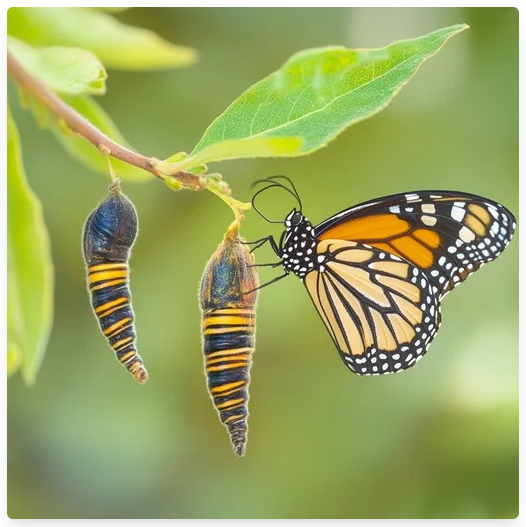
So. Metamorphosis can be interpreted as both the process of changing shape and/or nature and the result of that process.
My point being that we are the ones who make the connections. Who connect the dots…

We are the ones who have noticed the link between the caterpillar and the butterfly.
We are the ones who have taken the notion of division way further than its very nature.

How much (natural) sense does it make to divide something to a divisor which is smaller than 1 ?!?
It is nevertheless possible… arithmetically speaking… we do it by carrying the rule into the ‘sub-unitary realm’ … without giving much thought to the ‘metaphysical’ aspects of the ‘operation’.
To the fact that by dividing something to a sub-unitary divisor we actually transform division into multiplication!

We do that by applying a rule beyond, also known as ‘meta’, its natural domain.

All of a person’s behaviors and emotions
serve the purpose of moving them closer to their goal
—which arises from the individual’s feelings of inferiority
and the desire to become perfect.

Alfred Adler

I am, first and foremost, an engineer.
‘Down to earth’ used to be my middle name.

Until I started to notice things. And to ask questions…
At first, under communist rule, I worked blue-ish collared jobs. Despite – or because?!? – holding an MSc in Mechanical Engineering. For me, ‘industry’ had a very clear meaning. And involved getting your hands dirty.
After the regime change, I also changed tack. My hands were still dirty but with a difference.
That was when I first got in contact with the ‘banking industry’.
At the time, those two words put together didn’t make much sense to me. But I was too busy making money…
Now, half a life later, things are falling into place.

‘Industry’ is the where things actually happen. Banking, hospitality, ‘heavy’, transportation, mining, garment, you name it! The point being that ‘industry’ is an actual place. A factory, an office, the open sea, a rolling meadow or a ‘dust bowl’, industry needs an actual place for the people involved to do their thing. Solving other people’s problems and meeting their needs.

Why? Why do we do it? Toil?!?
Because we cannot escape ‘economy’. A virtual space we inhabit, which conditions us to be efficient. Money-wise.

Where?
Inside ‘politics’!

– But you just said that ‘actual things take place inside industry’…

Yep. Actual things do take place inside industry and the interaction between industry and economy takes place inside ‘politics’.

You see, we’ve lived – for a very long time, at least three millennia – in a virtual world.
Vir is a latin word. Has a lot of meanings, ‘hero’ amongst them. ‘Virtual’ means ‘made, on purpose, by a hero’. By us, actually.
People who pretend to be civilized live in a world of their own doing. Knowingly and purposely.
A world carved according to those people’s wishes. Maybe not exactly but at least tentatively.

How did they pull this stunt? Built their own world? As close to their wishes as humanly possible?
Industriously, economically and driven by politics.


One man’s junk
is another man’s treasure

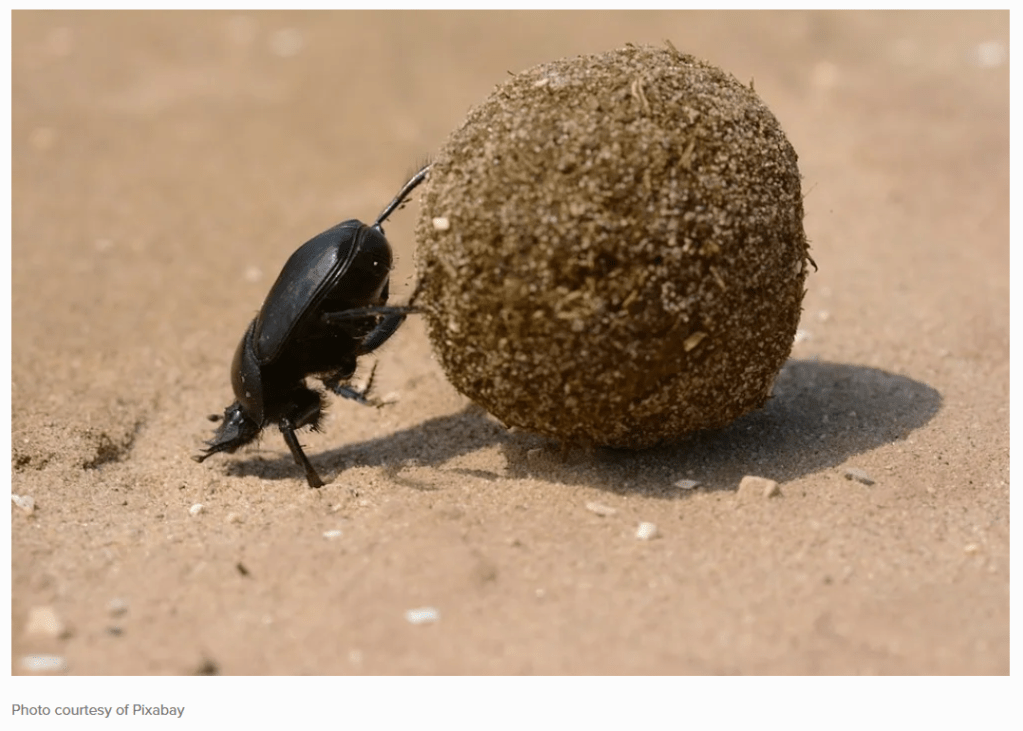
Dung beetle are very industrious.
They don’t think much but are very useful.

And they have been useful for quite a while.
Since long before our ancestors had started to roam the Earth…

My point being that their attempt at taking care of their next generation – their species collective effort to survive – have helped shaping the current version of Earth’s ‘environment’. The current version of the place which we, all of us, call home.

Where we, humans, do our thing. Think!

Think and make differences.

For the dung beetles, poop is both a resource and an opportunity. They need dung in order to ‘nest’ their eggs so whenever they find it they start working.

Dung beetles are very good at using poop. In doing their job they perpetuate their species and they reintegrate poop into the natural order of things. Read here what happened in Australia between man had introduced cows and the ‘same’ man had got wise enough to bring some dung beetles specialized in using that particular kind of poop.
But dung beetles are not able to think. Or to speak. About anything, including their most prized resource. Dung.

We do. We are able to think. And to speak. Among ourselves. And with ourselves…
How else do we do what makes us humans?
How else do we think except by using words? Concepts…

And this is how we get to the gist of today’s post.
The difference between a resource and an opportunity.

It was by thinking that we have identified something as being a resource. That something can be used.
And it was through the same process that we have coined the concept of ‘opportunity’.

We don’t eat everything in sight, right?
We understand the difference…

In fact, we are able to understand.
We have the necessary resources to make the difference!
But we don’t always make good of the opportunity…

At the trial of God, we will ask:
why did you allow all this?
And the answer will be an echo:

why did you allow all thi
s?

Ilya Kaminsky, The Deaf Republic.

“I chose English because no one in my family or friends knew it—no one I spoke to could read what I wrote. I myself did not know the language. It was a parallel reality, an insanely beautiful freedom. It still is.”

He has the opportunity.
He feels good doing it.
And he doesn’t care. About the consequences experienced by those affected.
As long as those affected are not able to affect him back, of course!
And if you analyze the whole thing in a dispassionate manner,
this is a perfectly rational behaviour!

There is a difference. Between differences.
There is a quantitative difference and a qualitative difference.

There is a quantitative difference between moral and immoral behaviours/persons. An immoral person is someone who cannot restrain themselves in certain instances. Who knows the difference between good and bad and yet cannot resist. Cannot resist doing the bad thing.
And there is a qualitative difference between a moral/immoral person and an amoral one. The amoral one’s actions are not affected by morals. That person does anything they want to do as long as they is not affected by the consequences of their doings. Regardless of whatever consequences may have to be endured by others.

Which brings us to the difference between bad and evil. Also a qualitative one.
Which difference has nothing to do with the amount of damage caused to the bystanders. And everything to do with the attitude of the perpetrator regarding their actions!

As an aside, I have to remark that we are all ‘bad’.
In the sense that all of us commit bad things. That none of us is able to completely restrain ourselves from doing immoral things. From knowingly performing ‘bad’ things. Bad for ourselves or even bad for other people.

The difference between us, normal immoral people, and the evil amoral ones being simple.

The immoral perform things which are potentially bad. For themselves and for others.
For example we smoke. Which is bad. Both for us and for all those who breathe our smoke. But the damage isn’t obvious. We might die before developing a cancer, right?
And most of us have driven a car after having enjoyed one drink too many. With no intent to commit an accident, obviously.
Meanwhile, the amoral may commit things which will certainly cause harm to other people. Regardless of whatever rationales the perpetrators invent to justify their actions. From Ponzi schemes to terrorism.

I’ve saved the juiciest bite for the end of my post.
While immoral is necessarily bad, amoral is morally neutral. Anything in between necessarily bad and necessarily good.
For instance, using weapons of mass destruction and compulsory vaccination/quarantine are amoral. Both are used with a blatant disregard towards the feelings of all those who have to endure.
The first is ‘a certain killer’ while the latter has saved entire populations… go figure!

Before you argue with someone,
ask yourself,
is that person even mentally mature enough to grasp the concept of a different perspective.
Because if not, there’s absolutely no point.

Not every argument is worth your energy. Sometimes, no matter how clearly you express yourself, the other person isn’t listening to understand—they’re listening to react. They’re stuck in their own perspective, unwilling to consider another viewpoint, and engaging with them only drains you.
There’s a difference between a healthy discussion and a pointless debate. A conversation with someone who is open-minded, who values growth and understanding, can be enlightening—even if you don’t agree. But trying to reason with someone who refuses to see beyond their own beliefs? That’s like talking to a wall. No matter how much logic or truth you present, they will twist, deflect, or dismiss your words, not because you’re wrong, but because they’re unwilling to see another side.
Maturity isn’t about who wins an argument—it’s about knowing when an argument isn’t worth having. It’s realizing that your peace is more valuable than proving a point to someone who has already decided they won’t change their mind. Not every battle needs to be fought. Not every person deserves your explanation.
Sometimes, the strongest thing you can do is walk away—not because you have nothing to say, but because you recognize that some people aren’t ready to listen. And that’s not your burden to carry.

I seldom quote this extensively. But this is worth sharing.
It perfectly epitomizes the difference between ‘me’ and ‘us’.
Specially in a ‘democratic’ environment.
Specially when we try to figure out what’s gonna happen to us ‘going forward’…

From where I’m standing, there’s a fine difference between doing something – planning for it, even – just because ‘that’s how we do things over here’ and performing the very same thing as the consequence of a genuinely free decision making process.

Am I making any sense here?

The words of Abraham Lincoln to honour the soldiers that sacrificed their lives in order
“that government of the people, by the people, for the people,

shall not perish from the earth”
were spoken at Gettysburg,
but these words apply as well to the countless soldiers
that died for the cause of democracy in the following 150 years.

How about people respecting each-other?

After all, government is supposed to be by the people and for the people…

Those serving in the government come from among the same people, don’t they?

2010

Former Pennsylvania judge Michael Conahan has pleaded guilty to a racketeering conspiracy charge for helping put juvenile defendants behind bars in exchange for bribes.
He is accused along with former judge Mark Ciavarella of taking $2.8m (£1.8m) from a profit-making detention centres. Mr Ciavarella denies wrongdoing.

2024

“Conahan’s actions destroyed families, including mine, and my son’s death is a tragic reminder of the consequences of his abuse of power,” Sandy Fonzo said to the outlet. “This pardon feels like an injustice for all of us who still suffer. Right now I am processing and doing the best I can to cope with the pain that this has brought back.”
Similarly, Amanda Lorah, who at age 14 was wrongfully imprisoned as part of the scheme, told WBRE: “It’s a big slap in the face for us once again.
“We had … time taken away from us. We had no one to talk to, but now we’re talking about the president of the United States to do this. What about all of us?”

2025

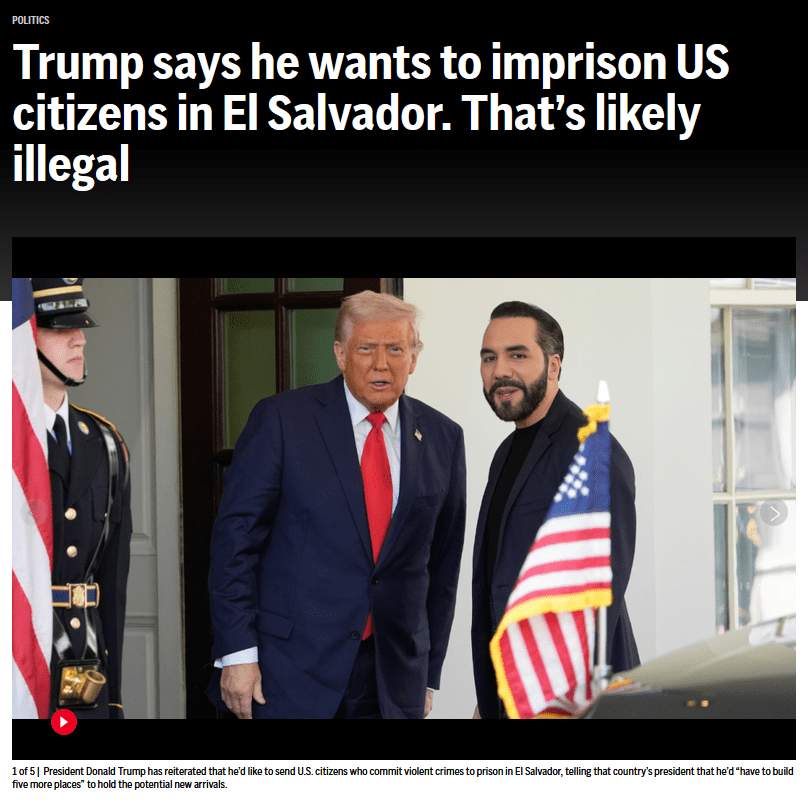
President Donald Trump on Monday reiterated that he’d like to send U.S. citizens who commit violent crimes to prison in El Salvador, telling that country’s president, Nayib Bukele, that he’d “have to build five more places” to hold the potential new arrivals.
Trump’s administration has already deported immigrants to El Salvador’s notorious mega-prison CECOT, known for its harsh conditions. The president has also said his administration is trying to find “legal” ways to ship U.S. citizens there, too.

Back in 2020

The question was posed, “Why do people continue supporting Trump no matter what he does?” A lady named Bev answered it this way:
“You all don’t get it. I live in Trump country, in the Ozarks in southern Missouri, one of the last places where the KKK still has a relatively strong established presence.
They don’t give a shit what he does. He’s just something to rally around and hate liberals, that’s it, period.
He absolutely realizes that and plays it up. They love it. He knows they love it.
The fact that people act like it’s anything other than that proves to them that liberals are idiots, all the more reason for high fives all around.
If you keep getting caught up in “why do they not realize this problem” and “how can they still back Trump after this scandal,” then you do not understand what the underlying motivating factor of his support is. It’s fuck liberals, that’s pretty much it.
Have you noticed he can do pretty much anything imaginable, and they’ll explain some way that rationalizes it that makes zero logical sense?
Because they’re not even keeping track of any coherent narrative, it’s irrelevant. Fuck liberals is the only relevant thing.
Trust me; I know firsthand what I’m talking about.
That’s why they just laugh at it all because you all don’t even realize they truly don’t give a fuck about whatever the conversation is about.
It’s just a side mission story that doesn’t matter anyway.
That’s all just trivial details – the economy, health care, whatever.
Fuck liberals.
Look at the issue with not wearing the masks.
I can tell you what that’s about. It’s about exposing fear. They’re playing chicken with nature, and whoever flinches just moved down their internal pecking order, one step closer to being a liberal.
You’ve got to understand the one core value that they hold above all others is hatred for what they consider weakness because that’s what they believe strength is, hatred of weakness.
And I mean passionate, sadistic hatred.
And I’m not exaggerating. Believe me.
Sadistic, passionate hatred, and that’s what proves they’re strong, their passionate hatred for weakness.
Sometimes they will lump vulnerability in with weakness.
They do that because people tend to start humbling themselves when they’re in some compromising or overwhelming circumstance, and to them, that’s an obvious sign of weakness.
Kindness = weakness. Honesty = weakness.
Compromise = weakness.
They consider their very existence to be superior in every way to anyone who doesn’t hate weakness as much as they do
.”