Archives for category: 1989 and the Global Financial Crisises.

As in mob rule?

A British historian that went by the name of Lord Acton observed more than a hundred years ago that
“All power tends to corrupt; absolute power corrupts absolutely.”

Judging by what historians keep writing and the politicians keep ignoring this observation tends to be pertinent.
Click on the highlighted quote to see some of his arguments in Ben Morrell’s interpretation.

Somewhat unhappy with this vision, a sci fi writer, Frank Herbert, contradicted the historian:
“Power attracts pathological personalities. It is not that power corrupts but that it is magnetic to the corruptible. Such people have a tendency to become drunk on violence, a condition to which they are quickly addicted.”

In fact it’s more like a completion than a contradiction but I’ll have to leave it at that because both are dead now and way past such mundane preoccupations.

Recently, things having not been properly set yet, a team of Swiss scientists lead by John Antonakis decided to sink their teeth in the matter. They gathered a group of people, ‘measured’ all sides of their personalities – including their honesty – and then involved them in a game of ‘lets play dictator’.
“The findings showed that those who measured as less honest exhibited more corrupt behaviour, at least initially; however, over time, even those who initially scored high on honesty were not shielded from the corruptive effects of power.”

OK, so Acton was right altogether, ‘power’ does corrupt. The problem is that Antonakis never tried to verify Herbert’s hypothesis. If he was right then the honest people stand no chance at becoming powerful enough to become corrupted because the already corruptible are fighting dirty to get on top, something the more honest would not do, at least not from the very beginning. Seen this way the very competition for power selects the people who get on top based on how corruptible they are.

Luckily things are not that simple. Really smart guys, no matter how corruptible, figure it out – sooner rather than later, that by ‘stealing’ too much/misbehaving really bad  they destroy the entire structure upon which their very existence, let alone power, depends.

So how come really bad dictators do come into existence?
From Lenin to Hitler, from Ceausescu to Pol Pot and nowadays from Putin to al-Baghdadi.

Here Antonakis’ findings fit in perfectly.
Participants “were given complete control over deciding pay-outs to themselves and their followers. The leaders had the choice of making prosocial or antisocial decisions, the latter of which resulted in reduced total pay-outs to the group but increased the leader’s own earnings.”

The key concept here is ‘complete control’. In fact this ‘dictator game’ is no game at all. It’s nothing but a solitaire. It has rules, certainly, but it’s up to the ‘player’ himself to decide whether to respect them or not. If the rest of the people concerned – those who suffer the consequences of the ‘game’, have no say in what is going on then they don’t count. And are not able to help, either. The final outcome will depend exclusively on the honesty of the ‘player’. And we haven’t, as yet, made any mention about skills…

Besides the very important insight Antonakis also offers us a valuable piece of advice:
” “We think that strong governance mechanisms and strong institutions are the key to keeping leaders in check,” concludes Antonakis. “Organisations should limit how much leaders can drink from the seductive chalice of power.” “

It’s a very good starting point. Add to it a renewed insistence on initial honesty – it helps, just as the study showed, coupled with intense surveillance and continuous feed back from the stakeholders and things might improve dramatically.

After all ‘governance mechanisms’, ‘strong institutions’ and ‘organizations’ are nothing but words. Powerful and meaningful words indeed but ‘words’ cannot do anything by themselves. They have first to be pronounced by pertinent persons and then diligently put into practice.

And this would mean that ‘power’ won’t belong to anyone in particular, not even to ‘the people’.

Keep tuned for the difference between real democracy and ‘mob rule’.

‘Selective focus’ is a technique used by skillful photographers to grab the attention of the viewer by opening the lens at its widest and focusing it on the most interesting part of the picture. This way everything else is left ‘out of focus’ and more or less blurry so the viewer concentrates his attention on the clear part it. Nowadays, when most pictures are taken using smartphones or pocket cameras this is no longer possible because the lenses in those cameras are too short for this technique to work. There are computer that can mimic this but it’s not the same thing.

The point is that if we are not really careful our attention can be grabbed by glitzy but insignificant aspects of the reality while the more mundane but infinitely more important ones remain hidden in full view.

Here for instance.

Selective focus

Frankly I don’t care about how they live, that doesn’t concern me. Not in the least.
The problem is that by being so few they induce a lot of fragility in society.
Empires and other totalitarian regimes fail inevitably because they are run by very few people while more democratic countries survive/thrive for longer periods of time because they make better use of whatever human potential they have.
By allowing more people to have their say democracies have a way bigger pool of potential solutions for the problems they have to face while totalitarian regimes have to make do with only the very few solutions envisaged by those who happen to be at the top when a particular problem has to be dealt with.


Pe vremea lui Ceasca umbla un banc a carui poanta era ‘ultimul sa stinga lumina!’

Au trecut aproape 25 de ani de cand ‘Odiosul Dictator si Sinistra sa Sotie’ au fost trimisi sa-si incalzeasca oasele in Iad dar:

– Fundatia Bertelsmann din Germania a constatat ca “munca in Romania nu prea asigura traiul zilnic”.
Romania este “tocmai pe ultimul loc, adică 28 din 28 de state UE, la rata de sărăcie a celor care lucrează ( ”in work poverty rate” în lb. engleză), cu 15,9% din populație, mult sub locul 27 ocupat de Grecia (13,7%) și, atenție mare, locul 26 ocupat de Polonia (dar cu numai 9,7%)”

– Teoretic asta ar trebui sa insemne ca ‘antreprenorii’, adica exact cei care exploateaza forta de munca, o duc excelent, nu?

“„M-am apucat de antreprenoriat fără un leu şi m-am întrebat adesea de ce nu mă bagă nimeni în seamă, dacă sunt prea mică pentru a conta în ochii lor. De fiecare dată când se modifica legea, în dimineaţa următoare îmi venea să ma dau cu capul de pereţi  pentru că mă duceam la administraţie să îmi explice cum se aplică şi funcţionarii îmi spuneau că nu ştiu pentru că nu apăruseră normele. Ca antreprenor, trebuie să joc după reguli. Ştim că birocraţia nu se poate elimina, dar trebuie diminuată, iar taxele pe forţa de muncă sunt prea mari“, a spus Cristina Chiriac, fondator şi preşedinte al Asociaţiei Naţionale a Antre­prenorilor, la prima conferinţă orga­nizată de asociaţie. Ea a fost anterior vicepreşedinte al Autorităţii pentru Valorificarea Activelor Statului şi director general al World Trade Center Bucureşti.”

Cine sa fie de vina pentru aceasta situatie? ‘Mortul’ si statul, cine altcineva?!?

“Problema este însă că până şi crearea locurilor de muncă a devenit o misiune aproape imposibilă pentru ei, (antreprenori) în condiţiile în care tinerii nu numai că nu sunt suficient de pregătiţi pentru un anumit job sau nu cunosc o limbă străină, dar nici nu ştiu să scrie corect în limba română sau să compună un mail. În plus, pentru a plăti un angajat cu 1.000 de lei net, spre exemplu, angajatorii sunt obligaţi să cheltuiască aproape dublu (peste 40% din costuri fiind îndreptate către buget).”

Bine ca nu se revolta fermierii spanioli. Si unde mai pui ca ne primesc asa cum suntem, unii ne platesc si darile, iar la sfarsit ne dau si noua suficient de mult incat sa ne ramana de o bere. Si de niste tapas pentru ca in conditiile astea multi dintre noi n-or sa se mai intoarca…

“Diminuarea cu 7% a remiterilor românilor care lucrează în străinătate, consemnată în 2013, a condus la scăderea numărului de locuinţe noi livrate pe piaţă, în contextul în care economiile rezultate în urma muncii în străinătate sunt direcţionate cu preponderenţă către construcţia sau achiziţia de locuinţe noi, potrivit unei analize realizate de producătorul de BCA Xella România.”

wind back history

Humankind is a vast and extremely diverse collection of human individuals grouped in various ‘nations’.
Each of these nations have evolved in certain geographical and historical circumstances and, because of that, is different from all others.

Still, there is one thing all of them have in common, one thing that has happened, in various degrees, to all surviving nations.

Statistically, individual members of all nations have constantly grown more and more autonomous.

True, this was not a linear development. Actually it was not even consistent, from time to time some nations have reverted, for longer or shorter periods, to states where individual autonomy was curtailed but on the whole personal autonomy has constantly increased.
And another thing. Those instances when the ‘march’ towards more individual autonomy was halted or reversed coincided with historical hiccups: civil wars, economic hardships, natural disasters, external aggression… things like that. Never in the entire history of man has this process been halted without that stop being caused by some forceful event, just because an individual or a collection of individuals have decided so.

Franco transformed Spain into a dictatorship only after being helped by external military forces.
Hitler became ‘Fuehrer’ in the special set of circumstances created by the inept way in which the allies treated Germany after WWI combined with the Great Depression.
Lenin transformed Russia into the biggest gulag on Earth helped by circumstances produced by the same WWI while Mao rose to power in the aftermath of WWII.

In our days Putin has been able to tighten, again, the screws on Russia mainly because of the corruption and greed that sapped from within the Russian society while the ‘Western World’ has become, almost overnight and completely against the natural course of nature, an immense Big Brother set only after some nuts declared war on the civilized world under the pretext of Islam.

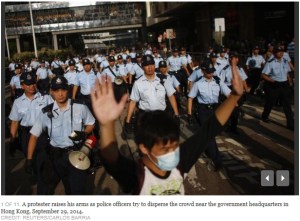
What is going on now in Hong Kong is a first. An entire community, and not a small or insignificant one, is having its freedoms curtailed simply because some people gathered around a table have decided so.

Karl Marx’s version or Max Weber’s?

“the difference between truth as the “unhiddenness of beings” and truth as the “correctness of propositions” (Martin Heidegger)

Only after reading (again) the Essence of Truth I started to grasp the huge mistake made by Marx and his followers.
His declared motives were ‘the emancipation of the oppressed’ and if we are to grasp his work we need to read him in this key.

Only this way I could finally understand why for him ‘capital’ means exclusively ‘trade-able wealth’, money or things easily measurable in monetary units.
Only this way I could finally understand why for him ‘capitalism’ was exclusively about personal profit and hence despicable.

All this had happened because Marx wasn’t really interested in understanding how capitalism works, what it means and how it generated a medium in which creative and hard working people could make better use of the available resources than in previous social settings.
Marx was a man of a mission (it’s not that clear for me if he considered himself a saint that was meant to free the working class, a con-man who swindled a lot of money from Engels under the pretext of helping the poor or both at the same time) and we need to accept that almost all he did write was dedicated to this mission of his, whatever that was.

On the other hand Max Weber was also a man of a mission only his was different from Marx’s.
What he set out to do was to understand the inner workings of capitalism, how it came about and what consequences it might have.

““The most trifling actions that affect a man’s credit are to be regarded. The sound of your hammer at five in the morning, or eight at night, heard by a creditor, makes him easy six months longer; but if he sees you at a billiard table, or hears your voice at a tavern, when you should be at work, he sends for his money the next day; demands it, before he can receive it, in a lump. ‘It shows, besides, that you are mindful of what you owe; it makes you appear a careful as well as an honest man, and that still increases your credit.’ “

This is a brief excerpt from Weber’s “The Protestant Ethic and the Spirit of Capitalism” – retrieved, ironically, from an internet site run by “marxists”, http://www.marxists.org.
Weber is quoting here Benjamin Franklin in an attempt to make us understand what is the true spirit of capitalism.
At the first glance we might say it corresponds closely to what Marx had said about the subject – that it all boils down to money – only after further consideration it becomes apparent that while Marx had stopped there, at ‘money’, Weber and Franklin had seen way deeper than that.

Capitalism is not that much about mere money as it is about credit. Trust that is.

No one would extend credit without trust, no one would enter a contract without mutual trust and so on.

So what would it be? Which version of capitalism would you prefer?
The one in which we would strive to get hold of as much money as possible or the one in which each of us is held responsible by the others for his actions and holds those around him responsible for their actions – this being the only manner in which real trust can be established among us?

Please note that in reality these two sides of capitalism are like the two hands of a working man. For a short time one can get along with only one of them but no sane individual would prefer to live, and work, with only one hand, right?

Then how come our obsession about mere money has come to trump almost everything else?

reason vs comon sense

To an employer, simple economic reason tells him to extract as much work as possible from his employees.
To an employee, the same attitude tells him to ‘resist’, to make himself as ‘scarce’ as possible without giving the employer obvious reasons to fire him.

Add modern technology to all this and here is what you get: employees locking themselves into toilets booths and surfing the internet on their smartphones while employers counteract by installing access control machinery in the ‘rest areas’.
“Not more than 6 (six) minutes a day and a $20 gift card if you don’t go there at all”.

How about a more complex understanding of the whole business?
Can we see economic contracts (work related ones included) as a form of cooperation instead of mindless/ruthless/mutually crippling competition?

Fair sport versus ‘no holds bared fight’?

Or am I too naive?

Ayn Rand utopia

“A community made up of American ex-pats deep in the South American hills of Chile – far away from America’s annoying taxes, healthcare mandate, and legal abortions — was supposed to be a libertarian paradise of rugged individualism. Instead it cost many of the people who bought into it almost everything, and now is buried under lawsuits — a reminder that everything that glitters is not inflation-proof, Ron Paul-backed gold.

It seems pretty obvious that basing one’s society on a single work of (poorly written) fiction is folly, but for many adherents of Ayn Rand and her seminal book of Objectivist allegorical grandstanding, Atlas Shrugged isn’t just any book. It’s about as close to the Bible that many libertarians have — apart from the Bible, of course.”


To me this looks more like an Umberto Eco novel than anything else… layers upon layers of information connected solely by what human individuals living in one of them think about what is going on in the next one…
– Ayn Rand grew up in Russia and wrote in and about the US… OK, she might have had some interesting ideas but so did a lot of other controversial thinkers. Karl Marx and Nietzsche, among others. Would any of you become a dedicated follower of any of these two? I had to live in a Marxist society for the first 30 years of my life and I wouldn’t recommend it…
– The guys that came up with this… scheme… have as much in common with libertarianism as Bernard Madoff has with bona fide capitalism…
– Investing, money or time, into something without due diligence is not a very libertarian thing to do either…
– Etc., etc….

After all an utopia, even one supposedly based upon Ayn Rand’s ideas, is nothing more than another … man made dystopia.

Citesc astazi dimineata doua articole din Ziarul Financiar. (Recunosc ca nu prea mai citesc presa, si cu atat mai putin articolele de opinie)

Mai intai “Eu cred in Romania pentru lucrurile pe care le poti face aici”  si apoi “Generatia care a facut bani din dezastrul demografic si secarea Romaniei”.

Din primul aflu de ce unii dintre antreprenorii de top ai Romaniei nu au parasit-o (cel putin nu inca) si cam ce ar trebui facut pentru ca din ce in ce mai multi antreprenori sa isi incerce ‘puterile’ aici si nu aiurea iar cel de al doilea imi confirma impresia ca exista o suma de indivizi care au identificat si exploatat extrem de eficient, in  Romania, niste oportunitati extrem de favorabile.

La prima vedere am putea spune ca amandoua articolele sunt despre acelasi lucru – oportunitatile din Romania, iar ca singura diferenta dintre ele ar fi ca primul incearca sa sondeze viitorul iar cel de al doilea se uita catre trecut.

Totusi, daca ne uitam mai bine, vom intelege ca autorul celor doua articole, Cristian Hostiuc, a inteles pe deplin si incearca sa ne avertizeze si pe noi – inainte de a fi prea tarziu – ca daca mai continuam asa se va alege praful de tot si de toate.

De fapt in nici unul dintre articole nu este vorba despre ‘resurse’ sau despre ‘oportunitati’ ci despre modul in care acestea sunt utilizate si despre responsabilitatea fiecaruia dintre noi.

De fapt pe nimeni nu intereseaza/n-ar trebui sa intereseze ca o intrega generatie de ‘fosti’ si de ‘conectati’ s-au imbogatit imediat dupa ‘Revolutie’. In schimb, si indiferent daca ne intereseaza sau nu, soarta fiecaruia dintre noi este influentata intr-un mod hotarator de modul in care acestia s-au imbogatit. Nu este acelasi lucru sa construiesti ceva nou si sa te imbogatesti exploatand acel ceva – vedeti ce frumos suna ‘a exploata’ in acest context? – sau sa distrugi ceva ce functiona de bine, de rau, si sa te imbogatesti vanzand fiarele vechi obtinute in urma demolarii.

Hostiuc ne mai avertizeaza ceva. Ca daca o tinem tot asa, daca aplicam generatiei urmatoare metoda pe care Stefan cel Mare o aplica invadatorilor – cea a fantanilor otravite  si a pamantului parjolit, vom constata ca tot ce am reusit sa facem este sa ne taiem singuri craca de sub picioare.

Drama comunismului era ca aveam ceva bani in buzunare dar nu aveam ce sa facem cu ei iar drama capitalismului este ca magazinele sunt pline de marfa dar nu mai avem noi bani sa cumparam tot ce ne dorim.
Guvernatorul BNR Mugur Isărescu îşi punea problema, în public, acum vreo doi ani, cine o să-i plătească lui pensia, uitându-se la generaţia care vine din spate.” Cred ca problema reala a lui “Isarescu” si a colegilor sai de generatie va fi ca in pofida tonelor de bani pe care le vor fi acumulat nu vor avea pe cineva suficient de apropiat incat sa ‘ii stearga la fund’ atunci cand nu vor mai putea face singuri acest lucru.

O sa imi spuneti ca daca ai suficient de multi bani vei reusi intotdeauna sa angajezi pe cineva sa munceasca in locul tau. Da, cu conditia ca banii aceia sa mai valoreze ceva.Adica ca acel ce ii primeste in schimbul muncii sale sa aiba ce sa faca cu acei bani.

Quite a large number of us, regular people, are concerned about ‘survival’. From what to do in order to feed our children to how to protect wealth from being eroded by the inflation.
Some others, more ‘extreme’ or more sensitive, are actively preparing for what is known, by them, as ‘the imminent ending of the world’. There is no consensus on what will bring about this catastrophe – from the odd meteorite falling on Earth before the appropriate measures being taken to the unsustainable way we manage our economy or the environment but this is no deterrent for the hardcore survivalists.
In a way, they are right. After all it doesn’t matter how it happens, the main thing is to be prepared.
And this is exactly were the ‘fun’ part starts.
Most of them concern themselves with learning how to survive out in the open, how to build and stock an ‘anti-atomic’ bunker, how to use firearms, etc., etc… In fact what they do is recreate the medieval ‘castle’ mentality where the world was disputed by strong armed thugs who tried to control as many resources as possible. In time, tired by the slow burning conflict that occasionally burst into open fighting, they ‘invented’ the rules of ‘chivalry’, a framework that provided both a venue for their need to ‘prove themselves into ‘battle’ (the jousting tournaments) and enough social predictability which enabled relative stable economic relations between human ‘settlements’ that were ruled by different land lords.
From that moment on survivability was no longer improved by simply erecting higher and thicker walls but rather by maintaining a workable equilibrium between the members of a certain community – be it group of people, ‘commonwealth of villages’ or federation of states.

Fast forward to the XX-th century and we find out that the survival problem hasn’t been fixed yet. Andre Malraux, a Frenchman who started as a communist writer and ended up as an anti-totalitarian philosopher once wrote that “le vingt-et-unieme siecle sera religieux ou ne sera pas”. A rough translation would be ‘in the XXI-th century people will rediscover religion or they will perish’. Coming from a professed agnostic this continues to create huge controversy as to its real meaning.

A solution to both the riddle and the survival problem might not be so hard to find.

Lets turn to the utmost survival specialists, the Jews. For the first 15 centuries or so they survived living in ‘history’s turn-still’ – Palestine – while for the next 20 they made do even without the benefit of having a place to call their own.
How did they do it?
By fighting each other? No, on the contrary.
By fighting against the people they were living amongst? They would have been wiped out long ago. Even when they were used as escape-goats by reckless and callous temporal rulers the Jews somehow found a way to survive, mainly because enough members of the general population remembered the normalcy of the situation before the pogroms were instigated, normalcy during which the Jews were adept at conserving their traditions yet playing their role as useful members of the wider community.

And, maybe, this is also the key of Malraux’s riddle. Religion is more than following ritual, considerable more than that.
The word itself comes from the Latin ‘reliegare’, ‘connecting to’. It can mean both the connections that appear between members of the same community but also the connections that appear between the community itself and its environment. So it doesn’t really matter if religious teachings are said to have been handed down from a God or are considered to be a distillation of long accumulated tradition. All it matters is ‘have those teachings proven useful?’ Were they helpful enough to their followers so they could cope with whatever history has thrown at them?

Well… in the case of Judaism they did that, for more than three and a half millennia. And nowhere in those teachings one can find ‘if things get rough leave everybody behind and hide someplace waiting for the worst to pass’. Every religion, be it based on a God or not – Buddhism, for instance does not have a godlike figure in its center – teaches its followers that it is a lot easier to survive helping the others than fighting against all others.

Honing individual survival skill is of course important. But we should not forget that crises come and go. What we really need is to learn how to survive the long stretches of apparent stability, during which we allow the build up of immense tensions that end up by tearing apart our livelihood. As it is about to happen.

Initially politics was an activity. “Was” and not “were” because it was something in which every concerned citizen played an part, a collective effort. Oh, I forgot to tell you that this happened in Ancient Greece during what we now call the ‘first stage of democracy’.

Then, after a little less than two millennia, it became an occupation. People who had successful careers behind them were deemed trustworthy by the rest of the community and elected into government positions. The countries which used this ‘democratic mechanism’ thrived: the US, Britain, France, …to name just a few of them.

Lately politics have become a profession. People study it in Universities and engage in it without any prior experience outside the field. I believe you all know what ‘community organizer‘ means, right?

No, I’m not going to discuss this notion right now. The results can be both good or bad, exactly as it happens with almost all human professions: both Mengele and Albert Schweitzer were MDs…

For now I’ll refrain myself to observing that people have less and less tolerance for digression on the part of the politicians.

“Nicholas Sarkozy arrested over corruption allegations”

Gerhard Schroeder, lionized in his time for cutting down to size the German welfare state is now widely criticized for his involvement with GAZPROM.

Silvio Berlusconi is serving time, disguised as ‘community service’, for tax evasion.

Need I go on?

And this is happening in what we call ‘democratic countries’. In other places former rulers are stabbed to death  or brought to justice in a cage.

In fact we have indeed progressed, as a species. The last time the French got really pissed off by their leaders quite a few people lost their heads…

The most disturbing thing in all this is that the politicians were supposed to be the ones capable/willing of doing ‘the good thing’ AND professional enough as not to exaggerate in anything they do….

Is there anything to be done about all this?

How about upping the ante?

I keep hearing ‘we need a strong leader’ or ‘we need more true leaders’. Are we really sure about that? Leaders would do almost anything to take us where THEY see fit.
How about politicians acting as ‘administrators’?
Right now politics is played, in a lot of places, as a beauty pageant. Would be rulers (leaders) come up-stage to make promises and we choose the ‘best-looking’ charmer. After a while he unfailingly fails so we ‘boo’ him out of office.
Switzerland, for instance, has another way of doing things. They talk a lot more among themselves, many ideas are put forward and then some of them get to become policies and other get dumped.
When have you last heard about a Swiss political leader or about a Swiss political scandal?