Archives for category: 1989 and the Global Financial Crisises.

Se discuta intens despre motivele pentru care foarte multi oameni au iesit la vot si uite asa Iohannis a devenit presedinte in locul lui Ponta, asa dupa cum prognozau toti ‘specialistii’ ca ar fi trebuit sa se intample.
Una dintre ‘justificari’ este prezenta nu atat masiva cat neasteptata la vot a romanilor din Diaspora…. si efectele colaterale ale indignarii populare (= votul ‘antisistem’)

‘Ma leși’?!?

In primul tur la prezidentiale au fost trimise in strainatate 500 000 de buletine de vot. Au reusit, cu greu, sa voteze ceva mai putin de 150 000 de oameni. Pentru turul doi au fost trimise 800 000 de buletine si, cu toate ca procedurile au fost simplificate – nu intru acum si in viesparul asta – tot n-au reusit sa voteze mai mult de 400 000 de oameni.

Pai?

Exista cel putin doua explicatii:

– Estimarea cu privire la intentia de vot a romanilor din Diaspora a fost cat de cat corecta dar cei care au alocat buletinele nu s-au coordonat cu cei care au stabilit numarul de circumscriptii sau

– … fiecare cu imaginatia lui.

Nu stiu ce ma face sa cred ca ‘votul antisistem’ doar a cautat un motiv sa iasa din casa. Daca nu era asta era altul…

ba pe-a ma-tii
Si atunci care mai e deosebirea?

Poate ca asa simt ei, poate chiar or avea ceva motive… dar chiar este utila, cu adevarat, folosirea unui ‘limbaj’ atat de frust incat nu lasa, sub nici o forma, loc de buna ziua?

La ce? Cui?

Eduard Hellvig facea aseara observatia ca unul dintre motivele pentru care Ponta a pierdut alegerile a fost acela ca “intensitatea” mesajelor transmise de echipa sa a reusit sa “ghetoizeze” electoratul PSD, adica a reusit sa-i ingramadeasca pe cei deja convinsi intr-o incinta in care altii n-au mai vrut sa intre tocmai pentru ca acolo puțea prea tare a intoleranța.

Acum ce facem, ne ghetoizam si noi? Singuri?

the-best-blow-chart-ever-bird-shit

It took me a while.
Long enough to become ashamed of myself…
But I finally got it!

All those individuals are birds! In order to get there they had to fly!

In human terms they were free, nobody forced them to get in those relative positions.
If living in a democracy, those above the basic level had run for those positions and their attempts had been validated by those residing on the lower branches!

So what’s keeping them there?

Do they really enjoy it?
Are they afraid that if they leave, even temporarily, somebody else would take their places?
Have their wings became so stuck with shit that they are no longer able to take off?

Besides that, what kind of leader can find any satisfaction in presiding over such a filthy mess?

Am descris intr-o postare precedenta ce se intampla atunci cand populatia este constant nemultumita de-a-lungul unei perioade considerabile de timp daca in toata acea perioada nu se intampla nimic care sa aduca lucrurile pe un fagas normal:

O scurta istorie a votului negativ.

Am enumerat cele trei conditii ce trebuie pastrate pentru ca democratia sa ramana autentica si sa nu se transforme in tirania majoritatii:

“Democratia, pentru a fi cu adevarat functionala – altfel are mari sanse sa se transforme in tiranie a majoritatii, are nevoie de un cadru institutional care sa asigure trei lucruri:

– Ca voturile exprimate sunt transformate in actiune politica conforma cu intentia alegatorilor – domnia legii!
– Ca informatia circula liber in societate, in asa fel incat alegatorii sa decida in cunostinta de cauza – libertatea cuvantului!
– Ca alegatorii sunt motivati sa analizeze cu atentie optiunile pe care le au la dispozitie si sa exprime in mod explicit, prin vot, deciziile la care au ajuns!”

Ce am putea face, toti cei interesati – populatie, societate civila/presa si clasa politica, pentru a pastra sistemul in stare de functionare?

Trebuie sa va marturisesc ca in momentul in care am ajuns in faza asta am avut o surpriza extrem de placuta. Exista un ‘loc comun’, un punct de plecare aupra caruia toti suntem de acord, cel putin la nivel declarativ.

Asa nu se mai poate.

‘Alegatorii’ sustin ca:

nu vrem stat...

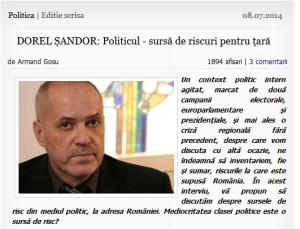
Presa, prin gura cuiva cu adevarat priceput in materie, avertizeaza cat se poate de clar:
politicul sursa de risc

Din stanga spectrului politic ni se atrage atentia ca luptele intestine din interiorul clasei politice dau pe din-afara, otravind totul in jur, si ca o posibila solutie ar fi “Societatea in care castigatorul nu ia totul!”.

Din dreapta, si aici nu cred ca mai este nevoie sa citez pe cineva, se insista pe valori – in special pe libertatea individului – si pe necesitatea stringenta a consolidarii statului de drept.

Pai?!?
Ce ne mai opreste sa ne apucam de treaba si sa transformam aceasta stare de spirit – unanima, nu?!? – in realitate practica?!?

E distanta mare de la vorba pana la fapta?
E, intr-adevar, o distanta considerabila intre ele.
‘Pana la Dumnezeu te mananca sfintii’ si ‘camasa e mai aproape de corp decat paltonul? In sensul ca atunci cand vine vorba despre interesele personale omul, oricat de ‘sfant’ ar fi el, mai uita cateodata (dar de fapt prea des) ca ‘Dumnezeul e sus si vede’?
Da, si asta.

Eu cred totusi ca mai e un aspect pe care l-am cam pierdut din vedere.
Mai intai datorita marasmului spiritual in care ajunsesem in timpul si din cauza comunistilor. Da, ati citit bine, al comunistilor, nu al comunismului. Fara comunisti ‘comunismul’ ar fi ramas o vorba goala. Ba, mai mult, chiar si comunistii au fost de mai multe feluri. Altfel nu se explica de ce fiecare tara actual fost comunista arăta diferit inca de pe vremea regimului trecut…. Sa revenim totusi la zilele noastre.
Apoi datorita modului complet aiurea in care am inteles ‘sa devenim liberi’ imediat dupa ’89. “Gata bai, de-acum a venit libertatea, fac ce vreau. Ce te bagi tu in ciorba mea?”
Si uite asa am distrus cooperativele agricole si sistemele de irigatii.
Uite-asa am intors capul cand au fost furate (oare de catre cine daca nu chiar de unii dintre noi si chiar in prezenta noastra?) vapoare intregi de utilaje si vandute la fiare vechi.
Apoi cand fabricile au fost ‘luate’ cu totul…
Daca omului de pe strada nu-i mai vine sa atraga atentia semenului său ca nu e bine ce face atunci cand goleste scrumiera “Jeep”-ului cat un vapor pe jos, la stop, iar politistul de circulatie nu-i ia carnetul aceluiasi sofer de “Jeep” atunci cand intra in intersectie pe rosu dupa ce a ‘depasit’ si refugiul de tramvai atunci cum sa nu i se para politicianului ajuns, imun, in parlament, ca face parte din alta specie?
Libertatea e una, faptul ca nu ne mai ‘tragem de maneca’ unul pe celalalt atunci cand gresim e cu totul si cu totul alta chestie.

Solutii exista si intelepciunea populara este intotdeauna un bun punct de plecare in momente de genul asta.

Fa ce spune popa si nu ce face popa!

Basescu o fi avand o gramada de bube in cap numai ca a si spus, de foarte multe ori, lucrurilor pe nume:
“Coruptia si ea tine de doua parti. Nu mut la nimeni responsabilitatea, dar ea trebuie impartita si asumata. Un functionar corupt nu poate fi corupt daca nu are un partener care sa-i dea un ban in mana, un minister nu poate plati cu 50% mai mult daca nu exista un consultant care sa va­li­de­ze ce spune constructorul: «Da, ma­rim factura». Si ministerul este in im­posibilitatea de a actiona pentru ca in justitie oricine castiga daca are si avi­zul consultantului ca trebuie sa ma­reasca pretul cu 50% la lucrari publice. Eu cred ca esenta realitatilor romanesti, in primul rand, trebuie sa iasa din ipocrizie. Daca este coruptie, statul singur nu poate fi corupt, are un partener.”

Ce vreau sa spun e ca aceasta ‘clasa politica’ pe care o injuram cu totii si din toate pozitiile se afla intr-o situatie atat de ciudata incat eu unul ma mir ca n-au devenit cu totii schizofrenici.
Pe o parte avem un “mediu de afaceri” care se comporta extrem de fatarnic. La nivel colectiv toti clameaza necesitatea starpirii coruptiei iar la nivel individual prea multi dintre ei dau spaga.
De partea cealalta avem, la gramada, populatia. Care nici ea nu da un semnal clar. Unii dintre ei dau spaga. Altii iau. O a treia categorie se fac ca nu vad. O a patra nu fac nimic, nici macar nu fac efortul minim de a-si face cunoscute nemultumirile atunci cand au ocazia. Adica sa voteze.
In schimb toti, inclusiv cei care dau si iau spaga, ii injura pe politicieni si le reproseaza ca fac acelasi lucru ca ei. Ca sunt corupti si/sau ca nu le pasa.

Si ce sa facem?

Simplu. Sa nu mai asteptam sa vina alegerile pentru a ne spune parerea despre ce se intampla in jurul nostru. De cate ori am lasat nemultumirile sa ni se acumuleze in suflet am votat ‘negativ’. Si uite unde am ajuns.

Ne place unde suntem? Nu?!? Pai si atunci nu ar cam fi cazul sa schimbam cate ceva?

Slide105[1]

 Einstein spune ca doar cei care nu sunt intregi la cap fac acelasi lucru de mai multe ori la rand si se asteapta ca la un moment dat sa iasa altceva…

Daca vrem cu adevarat sa se schimbe ceva trebuie sa incepem mai intai cu noi.

Da, cu fiecare dintre noi.
E foarte important sa intelegem ca atunci cand cineva ne trage de maneca de fapt ne ajuta. Atragandu-ne atentia asupra greselii de-abia comise acea persoana ne ofera oportunitatea sa o remediem inainte ca aceasta sa aiba repercursiuni grave. Adica inainte ca efectele greselii noastre sa ne strice chiar noua insine vietile.
Asta inseamna cu adevarat sa ne respectam intre noi.
Intorsul cu spatele nu insemna prea des ‘respect pentru persoana/dorintele/intimitatea omului’. De prea multe ori inseamna doar lasitate. Si din pacate efectele lasitatii tind sa se acumuleze intr-atat incat unii ajung sa creada ca ‘mamaliga nu explodeaza’.
O fi bine sa ajungem pana acolo?

Nu mai bine, daca tot declaram in cor ca ‘asa nu se mai poate’, ne apucam sa facem ceva tocmai ca sa nu ajungem pana acolo?

Adica sa ne tragem unul pe celalalt, cu respect dar cu fermitate si la timp, de maneca?

Pana la urma despre asta este vorba in democratie.
Fiecare isi spune parerea despre ce se intampla in cetate. Cu respect pentru ceilalti si pentru parerile lor dar in asa fel incat sa se auda.
Abia dupa aceea vin ‘alegerile’. Dupa ce fiecare care a avut ceva de spus a avut ocazia sa o faca si spusele sale au fost luate in seama.

Altfel nu mai este vorba despre democratie ci despre domnia gloatei.

modern triad


I’m afraid things are a tad more complicated than that.
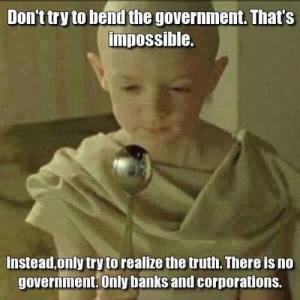
There is us, government and banks/corporations.
None of these three can survive, at the present level of ‘sophistication’, without the other two.
Unfortunately people tend to forget that and to concentrate on their own personae/interests. In hot pursuit of those interests some of these people ‘bend’ the normal interactions between ‘us’, government and banks/corporations.
Those ‘bends’ make life easier for the benders but only on the short run. After ‘power’ becomes too concentrated the system becomes fragile, exactly as Nassim Nicholas Taleb has amply demonstrated and Vilfredo Parreto suggested more than 100 years ago.

Inainte de decembrie ’89 oamenii ‘votau cu picioarele’, intr-un singur sens.

In ’89, pentru ca se adunasera destul de multi, au votat cu ‘pumnul’.

In Duminica Orbului, 20 Mai 1990, si apoi in 1992, au fost primele doua dati cand am votat ‘rational’: ‘Ne-a dat Iliescu pamantul inapoi?’ ‘Ne-a dat!’ ‘Partile sociale?’ ‘Ni le-a dat si pe alea’. ‘Banane si portocale?’ ‘Da, nu mai vazusem de mult!’ ‘Ne-a lasat sa iesim mai devreme la pensie?’ ‘Da!’
Pai si atunci cum sa nu-l votam?
Oricat ne-am da acum cu pumnii in cap nu putem reprosa unei populatii neobisnuite cu exercitiul democratic si cu functionarea unei economii de piata ca a votat ‘primitv’, ca s-a lasat cumparata cu maruntis.
Ii putem intr-adevar reprosa lui Iliescu ca a irosit un bun prilej de a intrepta tara catre o cu totul si cu totul alta directie dar…’cine a stat cinci ani la rusi nu poate gandi ca Bush’ … asa ca …

In orice caz in ’96 ne cam lamurisem ca nu mergeam chiar in directia cea buna asa ca iar am votat ‘contra’.
Unii ar spune ca atunci am votat cu Emil Constantinescu si ca acesta ne-a dezamagit.
Eu unul nu sunt de acord cu asta. Noi suntem cei care am gresit fundamental. Am crezut ca Milica era tot un fel de Iliescu. Ca dupa ce va ajunge la putere se va ocupa el de tot.
Ar fi putut face asa ceva? In primul rand fotoliul de presedinte al Romaniei nu confera ocupantului suficienta putere pentru a face asa ceva daca nu se bucura si de colaborarea unei majoritati parlamentare functionale. In al doilea rand Constantinescu era exact opusul lui Iliescu. Un democrat convins ca rolul unui politician este acela de a asigura cetatenilor un spatiu in care acestia sa isi poata folosi cat mai bine calitatile si nu un ‘tatuc’ care se crede dator sa-si duca ‘con-cetatenii’ – momindu-i daca se poate, cu forta daca nu se lasa – acolo unde crede el ca trebuie sa ajunga.
Ori, dupa ce l-am ales, noi insine l-am lasat pe Constantinescu de unul singur. Cei 15000 de specialisti erau acolo, asa cum ni se promisese, numai ca au preferat sa intre in afaceri in loc sa intre in administratia publica. Si, de fapt, de ce ar fi facut-o? Erau tineri, capabili, de ce sa se ingroape singuri cand in fata lor se desfasura, virgina, economia de piata?!?

In 2000 am fost atat de scarbiti de ceea ce se intamplase incat iar ne-am sucit. Atat de scarbiti incat pe locul doi a iesit Vadim. Iar in turul doi scarba de scarba ne-a orbit atat de tare incat am fost in stare sa votam cu Iliescu incat sa nu iasa CVT-ul!

Si apoi iar, in 2004 am votat cu Basescu de frica lui Nastase, nu pentru ca am fi inteles ceva din proiectul lui Basescu. Noroc de Tariceanu ca nu si-a pierdut capul si a stiut sa-i faca fata.

In 2008 si 2009 parca ne-a luat cineva mintile. Dupa ce Tariceanu si PNL-ul – tocmai pentru ca nu s-au bagat unde nu le fierbea oala, in mațele economiei – permisesera Romaniei sa ia parte la cresterea economica mondiala – asa fortata cum fusese ea – i-am aruncat la alegeri tocmai pe locul 3. PDL-ul care nu facuse nimic 4 ani a luat de doua ori mai multe mandate decat PNL iar PSD-ul, care nu facuse nimic altceva decat sa sprijine din umbra PNL-ul, a iesit pe locul doi. Si ne mai miram acum de ce Tariceanu se comporta asa cum o face in zilele astea si de ce PNL-ul a stat pe bara in turul I de la prezidentialele de acum? Si dupa aceea sa-l reconfirmam pe Basescu pentru inca 5 ani?!? Doar pentru ca ni se paruse Geoana prea moale?!? Ne-a invatat Basescu minte ce inseamna un lider puternic…

2012, in schimb, promite sa fie inceputul schimbarii. Pentru prima oara am votat un ‘proiect’. S-au adunat unii, au facut un program cu cap si coada, au parut ca se inteleg si bine am facut ca i-am ales. Dupa aceea s-au certat intre ei…

Acum avem ocazia sa terminam schimbarea. N-am sa va spun cu cine am de gand sa votez, din posturile mele anterioare rezulta foarte clar ca sunt de parerea lui Lao-Tzi ca datoria conducatorului este sa stea deoparte si sa vegheze, nu sa se bage in toate cele. (Recitind imi dau seama ca s-ar putea intelege ca ma compar pe mine cu Lao-Tzi… ma refeream la conducatorul pe care urmeaza sa-l alegem! Nu vreau sa iau, acum, pe fata, partea nici unuia dintre ei pentru ca imi doresc ca mesajul meu sa ajunga la cat mai multi dintre voi, indiferent de simpatiile voastre politice.)
Am sa fac in schimb remarca ca situatia de extrema polarizare in care se afla Romania se datoreaza in foarte mare masura exact acestui ‘vot negativ’.
Polarizare politica, adica imparirea populatiei in TREI tabere care aproape ca nu vorbesc intre ele – o masa imensa de scarbiti pe care nu-i mai intereseaza nimic, iar alaturi de ei o ‘stanga’ si o ‘dreapta’ care au in comun doar autoritarismul, nu si vre-un proiect de tara – si polarizare economica – o mare masa de saraci, cativa indivizi extrem de bogati si o mana de oameni despre care ei cred ca fac parte din clasa mijlocie numai ca sunt atat de departe de cei saraci incat acestia din urma nu-si pot da seama pe unde or fi ajuns aia acolo.

Ce legatura are votul negativ cu polarizarea?

Simplu.
In situatia in care populatia este scarbita este nevoie de masini puternice de partid pentru a fi scoasa la vot. De unde si tendinta ca partidele bine organizate – PSD si PDL, in realitate amandoua urmase ale FSN-ului – sa se transforma in partide-stat. Iar aceste doua lucruri – o populatie scarbita si dezabuzata si niste masinarii puternice de partid, organizate aproape militareste – fara prea mare libertate interna, imping inexorabil inapoi catre campanii negative. Un cerc vicios. Este mult mai usor sa starnesti o populatie nemultumita provocandu-i emotii negative decat sa o aduni in jurul unui proiect si e mult mai usor sa raspandesti ‘zvonuri’ decat sa convingi atunci cand ai la dispozitie ‘soldati’ disciplinati dar pe care nu i-ai incurajat niciodata sa gandeasca de unii singuri – tocmai ca sa nu intre la idei.
Acest cerc vicios ii prinde pe unii si ii arunca pe alti afara. Afara de tot, adica afara din tara, sau la periferia jocului. De unde, in aparenta linistiti dar in realitate mereu la panda,  vaneaza oportunitatile. Unii ii acuza de venalitate, altii ii scuza – ‘pai ce sa faca si ei, saracii?’. O fi bine? O fi rau? Cert este ca la fiecare dintre schimbarile de macaz/guvern o parte dintre acestia cad victima schimbarii. Unii se prabusesc de tot, altii se inregimenteza in cate o masinarie de partid. In felul acesta polarizarea se adanceste si mai tare.
La varful piramidei, in zona rarefiata a atmosferei, ajung doar cativa, sa-i numeri pe degete. Tocmai din cauza acestui razboi continuu in care nimeni nu iarta pe nimeni. Iar problema nu este ca sunt extrem de bogati – nu ma intereseaza cum au ajuns sa fie asa – ci extrem de putini. Fiind putini fiecare dintre ei este foarte puternic – destinele a extrem de multi oameni depind, direct sau indirect, de deciziile pe care le ia fiecare dintre ei. Situatia este valabila atat in ceea priveste clasa politica cat si pe ‘oamenii de afaceri’. Iar in conditiile in care foarte multa putere este concentrata in foarte putine maini ori de cate ori oricare dintre aceste maini tremura efectele sunt dezastruase. Acest lucru este valabil chiar in conditiile in care detinatorii puterii sunt bine intentionati, cu cat acestia sunt mai putini cu atat creste probabilitatea ca greselile comise de unii ei, involuntar sau chiar cu buna credinta, sa treaca neobservate de ceilalti – tocmai datorita numarului lor insuficient. Reteta clasica pentru dezastru si explicatia pentru prabusirea inevitabila a tuturor imperiilor cunoscute in istorie si a tuturor companiilor care au ajuns vreodata sa domine autoritar o anumita piata.

Ce facem in situatia asta?
Cu cat stam mai multi acasa cu atat hotarasc ‘ceilalti’ pentru noi si se adanceste polarizarea dintre noi.
Macar sa iesim, masiv, la vot. Eu, unul, stiu cu cine voi vota. Cu toate ca sunt sigur de optiunea mea nu va pot cere si voua sa faceti aceiasi alegere. Cred ca intelegeti de ce.
Ce pot face insa este sa va rog sa ma ‘urmati’ catre sectiile de votare. Doar in felul acesta le putem transmite ‘lor’ ca ‘ne pasa’. Ca am inteles. Ca nu mai suntem dispusi sa ne lasam purtati de vant incolo si incoace.

Extreme fragility, dead ahead.

Just prior to the Great Depression an American accountant, Ralph Elliot, had taken Charles Dow’s insight about economic cycles a step forward and came up with the ‘Wave Theory’.
I won’t enter into details here but I have to give you some broad outlines.
Charles Dow: In any market, prices evolve in trends – sustained moves towards the main direction fragmented by ‘reactions’ that run contrary to the trend. According to Dow there are three categories/levels of trends: major, intermediary and minor. The major trends cannot be manipulated and comprises three phases: ‘accumulation/distribution’, ‘public participation’ and ‘panic’. The names are self explanatory but if you want to read some more please click here.
Ralph Elliot: (If a certain asset is traded by a large enough number of traders so that market could be considered ‘free’) Price action is fractal in nature and hence can be broken down and analyzed as such. While Dow identified 3 levels of trending Elliot uses 9 but both ‘agree’ that each action in the direction of the analyzed trend is followed by a reaction contrary to that direction.

Robert Prechter, the brain behind ‘Elliot Wave International’, ” the largest independent financial analysis and market forecasting firm in the world” – the guys from whom I borrowed the picture above – has been using successfully the ‘Elliot Wave theory’ for some 40 years now.
And here comes the really interesting part. Besides building Elliot Wave International as a market analysis company Prechter also founded The Socionomics Institute, a think tank that starts from the assumption that the markets are driven by the prevalent social mood (sentiment) that dominates at any given moment and not all the way around as it is usually believed. Prechter posits that markets go down when/because ‘people are afraid’ and not ‘people start to panic after the market has begun to go down’.
For some people this whole process is a tug of war between greed and fear. It makes a lot of sense but we still lack an explanation about why at some points the bulls are stronger than the bears and at some-other points the situation is completely turned over. Reason was supposed to take care of business at all times, wasn’t it?
Now some of you will tell me that Daniel Kahneman and others have provided ample proof that the market is far from being rational... OK, I agree with that but still, we continue to need an explanation for why the market behaves for so long as if it were reasonable only to break down exactly when everybody was so happy – as it constantly did, from the Tulip Mania in the the XVII-th century Holland to the last financial melt down.

Now please remember two things that I already mentioned.
– One of Charles Dow’s assumptions was that ‘major trends cannot be manipulated while the lesser ones might
– (If a certain asset is traded by a sufficient number of traders so that market could be considered ‘free’). Here I was presumptuous enough to introduce my own experience into the equation. After I was introduced to the Elliot Wave theory I found out that it worked (meaning that I could use it successfully – statistically, of course) for indices or other frequently traded symbols while it is completely useless for illiquid ones.

I started to understand what’s going on only after reading Nassim Taleb’s Antifragile.
The gist of this book is that for a system to remain viable, to conserve it’s chances to survive, it has to keep open as many options as it possibly can.
Does it make any sense to you?
To be alive means being able to make decisions, as freely as possible. If you are forced to make one thing or another then you are not free anymore, right? If you have at least the slightest opportunity to choose among two or more possibilities then it means that you still have a sparkle of life in you! Stephen Hawkins, tied in his wheelchair for so many years, is alive just because he choose not to be overwhelmed by his condition while so many of us are (brain) dead because we indiscriminately follow fads, fashions, habits, you name it. The moment we give up our individual autonomy and enroll into a crowd (read ‘herd’) we might have the impression of becoming safe, or at least safer, but in reality we are already headed for the slaughterhouse.

It is somewhat true though that ‘there is safety in numbers’. And no, I’m not contradicting myself. The bigger the crowd the harder it is for someone to control it (take it to the slaughterhouse, by will or by error) and the greater the chances for an individual to escape an unforeseen  predator. So you need a really big crowd if you want to have a survival situation, a reasonably viable system.

If we look back in history – no magical solution can be found there, only a long list of errors – we’ll see that empires never fail to crash, authoritarian regimes survive for considerable shorter periods than the more democratic ones and that the more powerful a fad was the least it survived. And all these situations fit perfectly Taleb’s theory: the less open options a system has the less able it is to survive. The emperor is but a single man, who inevitable ends up being ‘naked’, no matter how capable it is – and people notice it sooner or later. Also the more an authoritarian a regime the less are the ordinary people inclined to contribute to the welfare of the community.
And something else. When a fad becomes intense enough the people involved become blind to any other alternatives but those prescribed by those convinced that they have a lot to gain by keeping that fad alive. That’s why it is very hard for a social ‘vicious circle’ to be broken until enough people hit the rock bottom. No grown up will voluntarily shout ‘the emperor is naked’ because he thinks he has nothing to gain from this. As strange as it may seem it is rather hard for the regular Joe, who’s afraid of the emperor, to understand that the entire kingdom becomes a laughing stock for the rest of the world if the emperor is known to stroll naked through the public square.

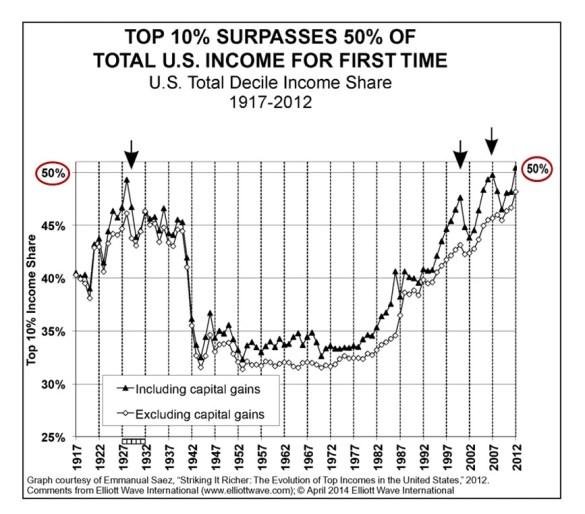
Now please take a second glance at this picture.
Extreme fragility, dead ahead.

What does it suggest?
That there is a certain correlation between income being concentrated in fewer and fewer hands and the probability of a market crash?
But correlation is not causation!
No, it isn’t. Not unless we can find a reasonable story for what may ’cause’ that correlation! Explain it, that is!

By now I’m almost convinced that most of you have already ‘got’ it.
Concentration of revenue means concentration of decision power. As less and less people (proportionally) remain in ‘powerful’ positions they not only command a higher proportion of the aggregated revenue of the entire community but they also control in a greater measure the destiny of that community.

No, I don’t think that ‘they’ are ill intended. ‘They’ live here too. They are not idiots, otherwise they wouldn’t have reached/been able to retain those lofty positions. So no, I don’t think they are willingly leading us to disaster.

The problem is that they are too few! No individual human being is able to make a considerable number of decisions in a short period time. That’s the very reason why we have consultants and so on, right? The problem is that ‘consultants’ only give advice, they cannot/are not allowed to make actual decisions. And the fewer are the people wielding real power the more the rest of us become mere consultants…

And according to Taleb’s theory and to an immense number of historical occurrences the less people are involved in the decision making process the higher are the chances for a catastrophic error to ‘reset’ the entire system.

PS I. Funny for a conclusion like that to be drawn from a picture published by somebody who caters for those ‘working’ hard to get as rich as possible, isn’t it?
On the other side…if these people considered the issue to be important enough to write about it … maybe it’s worth a moment of our precious time.

PS II Never say never!
I don’t think we are necessarily facing another economic melt-down in the immediate future. It might happen, of course. It will happen – sooner or later, of course again, but there is no sure way of telling when.
What I’m trying to suggest here is that there is a very strong possibility that in the near future we’ll witness a considerable change in how we manage the economy and in the way we relate to the concept of ‘money’.

Altruism is a behaviour that has been ‘naturally’ selected at the ‘social’ level,
Communities that encourage it fare better, as a whole, than communities which condone widespread indifference towards the others.
Please notice that the opposite of altruism is not ego-centrism and not even egoism but complete indifference. An egocentric or egoistic individual is one who is aware of his person and values his individuality. As such he will try to take good care of himself and never dare to behave in a completely callous manner because he fears social rejection, provided his egoism is tamed by reason.
If his egocentricity becomes unmanageable he turns into a socio-path that will be, sooner or later, expelled from the society.
If nothing out of the ordinary (extremely good or extremely bad) comes along, naturally (randomly) occurring ‘altruism’ is encouraged by some, faked by others and on the whole a ‘moderately altruistic’ behaviour becomes the modus vivendi of that particular community. Ties between the members of that group gather more and more force but don’t overwhelm the individual autonomy of the members, on one side because of the ‘fakers’ and on the other because the ‘real’ altruism involves a certain degree of respect towards the others.
If a particular social group, for whatever reasons, stops discouraging extreme egocentricity, like the one Caligula and his heirs ‘practised’ in Ancient Rome, that entire group is doomed. The largely disseminated egocentricity gives birth to indifference about the fate of the group, later to lawlessness and eventually to a state described as ‘anomie’ by a certain Durkheim – a French sociologist who discovered the link between the number of suicides taking place inside a community and the intensity of the forces that coalesce that community.
Durkheim had reached the conclusion that although the actual decision belongs to the individual, each of the members of a community is more or less ‘prone’ to consider ‘doing’ it according to the strength of the bonds that exist inside that community. (Suicide, A study in Sociology). He continued by introducing the concept of Anomie “a condition or state in which there is a breakdown of social norms and guidance for the citizens of a society. Anomie occurs when society has little influence on individuals’ propensity to follow rules and norms, and individuals are, therefore, left without moral guidance. Individuals do not feel attached to the collective society.”

Meaning that there is almost nothing to bind together a society whose members no longer value their own lives, let alone those of their neighbors.

Let’s go back in time to Caligula’s Ancient Rome or to the pre-Revolutionary France. The general atmosphere in both instances could have been very accurately described by ‘apres moi, le deluge‘ (‘a huge amount of water will be needed to cleanse after me’) – a phrase attributed either to Louis XV of France or to his mistress.
Well, we all know what followed. Ancient Rome collapsed under the attacks of the barbarians and the famous Bastille was occupied by the sans-cullotes.

Pentru cei care nu isi aduc aminte de razboiul rece: MAD nu insemna doar nebunie ci si ‘Mutual Assured Destruction’.

Ideea era ca fiecare dintre cele doua parti avea suficiente bombe incat daca incepea razboiul ambele parti urmau sa fie, in cele din urma, distruse. In situatia asta nici una dintre ele n-ar mai fi avut vre-un interes sa inceapa ostilitatile. In perioada aceea rationamentul acesta s-a dovedit a fi fost valabil.
Sa nu uitam totusi ca aceasta valabilitate a avut loc in anumite conditii. Comanda era extrem de centralizata, ‘butonul’ nu era la indemana oricui, iar distrugerea ar fi fost efectiva. Absolut nimeni nu avea unde sa se ascunda pentru asi putea continua viata. Bine, daca nu cumva socoteai ca traiul, pentru cateva luni sau ani, in niste pesteri de beton si la cheremul unor masinarii ar putea fi considerat viata …

Mi-am adus aminte de nebunia asta gandindu-ma la ce se intampla de ceva vreme la noi in tara.

Presedintele este acuzat de ani buni ca ar fi fost ofiter sau informator al securitatii, ca ar fi vandut flota si ca si-ar fi dat singur o casa pe vremea cand era primar. Mai nou a iesit la iveala si ca una dintre fiicele sale ar fi cumparat niste teren agricol care ar fi fost retrocedat in mod ilegal.
Un fost prim ministru condamnat la puscarie in doua spete diferite.
Un alt prim-ministru, in functie, acuzat de plagiat.
Un vice prim ministru, tot in functie, cercetat pentru fraudarea unor alegeri.
Nici nu mai stiu cati ministrii la puscarie, unii eliberati deja. Nici nu conteaza daca au intrat pe merit sau nu, si intr-un caz si in celalalt ‘ceva e putred in Danemarca’. (Nu conteaza pentru analiza rece a situatiei, fiecare dintre acesti oameni trece in mod evident printr-o drama intensa, iarasi indiferent daca sunt sau nu vinovati de cele ce li se pun in carca).
Fratele presedintelui aflat in arest preventiv pentru trafic de influenta
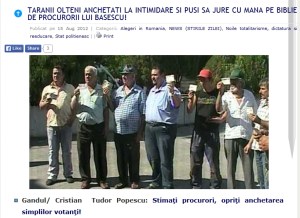
Votanti alergati de procuratura si pusi sa jure cu mana pe biblie daca au fost sau nu la vot.

biblia electorala


Si acum ne pregatim de un nou demers electoral… Avand in vedere ce au patit ultima oara or mai iesi oamenii sa voteze?

Ca pentru a-i incuraja in ultimele doua saptamani lucrurile au luat-o si mai repede la vale.

O intreaga pleiada de figuri importante din intreg spectrul politic a fost acuzata de ‘relatii incestuase’ cu Microsoft, sau mai exact spus cu un distribuitor al acestuia pentru Romania.
Iar cand procuratura a cerut un aviz parlamentar pentru anchetarea unora dintre acestia dosarul care a ajuns la comisia de resort nu respecta niste norme ‘tehnice’ extrem de banale. Comisia a amanat luarea vreunei hotarari. Incompetenta crasa? O intamplare nefericita? Incercare disperata de a trage de timp?
Presedintele tarii il acuza pe primul ministru, care este si cel mai bine cotat candidat la presedentie, ca ar fi fost ofiter de informatii sub acoperire pe vremea cand lucra in procuratura – situatie de incalcare flagranta a legii.
Dosare de coruptie din ce in ce mai importante incep sa iasa la iveala pe banda rulanta, cel mai recent referindu-se la fratele vitreg al regelui, printul(?!?) Paul ‘de Romania’ (?!?) care ar fi primit vreo doi trei munti ‘moca’. In dosar fiind implicati si membri marcanti ai PSD-ului. Nici partea cealalta n-a fost uitata, personaje cel putin la fel de celebre refugiindu-se deja ‘prin tarile calde’…
Se pare ca si securizarea frontierelor de stat a fost un bun prilej pentru ca ‘unii’ – de ambele parti ale ‘frontierei’ – sa-si ‘rotunjeasca veniturile iar dosarul cu privire la chestia asta a fost reactivat tocmai acum.

Prin ce se deosebeste situatia de la noi de cea din timpul razboiului rece?
Dupa cum devine din ce in ce mai evident taberele se pregatisera din timp cu tot felul de dosare numai ca nu prea stiau unii de altii. Nu ca n-ar fi stiut ce au facut ceilalti… pur si simplu nu credeau ca ceilalti sunt la fel de hotariti.

Cand a cazut prima lovitura replica a venit cat se poate de promt. Iar acum situatia a inceput sa semene cu o partida de ping pong… Nu ca ce se intampla ar fi ceva rau, mai ies scheletele de prin dulapuri…Mai cred si ca fenomenul a fost amplificat de faptul ca celor din Ministerul Public li s-a cam facut lehamite de tot circul asta… plus ca in ultima vreme chiar au posibilitati reale de a cerceta pe bune… iar cand doi se cearta chiar ar fi cazul ca cel de al treilea sa nu se mai lase calcat pe cap de niciunul dintre cei doi.

Cum de s-a ajuns in situatia asta?
Pentru ca au dat de fundul sacului. Nu ca n-ar mai fi… problema e ca nu le mai ajunge!
Si mai ales pentru ca isi inchipuie ca au unde sa se ascunda. Mai un paradis fiscal, mai un pic de uitare din partea populatiei, mai o prescriptie…

Si inca ar mai fi cum ar mai fi daca tot ce se intampla i-ar afecta doar pe ei!
Partea proasta este ca ei se cearta iar oalele sparte ne cad noua in cap!
La o adica ei pot merge si cu elicopterul, in schimb noi trebuie sa ne multumim cu gaurile din autostrazile care ba sunt drumuri rapide, ba nu se mai fac deloc… iar cand se fac nu au ‘parapeti de siguranta’…

Oare cand vom intelege o data ca nici unul dintre smecherii astia nu poate face nimic de unul singur?

Acum vreo cativa ani l-am auzit cu urechile mele pe Basescu la televizor – era la o intalnire cu Camera de Comert Romano-Americana in decembrie 2011 – spunandu-le ‘oaspetilor straini’ ca nu se poate ‘coruptie fara corupatori’ si ‘partii romane’ ca ‘nici un ministru n-ar putea sa-si faca de cap daca unii dintre cei din jurul lor nu i-ar ajuta iar ceilalti n-ar intoarce capul’.

Cred ca ar trebui sa aplicam si de data asta intelepciunea populara: ‘fa ce spune popa, nu ce face popa’.
Pana la urma MAD inseamna si Make A Difference.
Fiecare ce alge.
Trebuie totusi sa alegem cu foarte mare grija pentru ca alegerile noastre influenteaza si vietile celor de langa si de dupa noi. Si nu stiu daca vom avea toti pe unde sa ne ascundem de consecintele colective ale alegerilor noastre.

“Middle Class doesn’t understand wealth”:

“Few people in the middle class really understand the mindset of the richest people.

After all, if they did, they would be among the top earners as well.

“Among the many money issues misperceived by the general public is the notion that acquiring great wealth is more about showing off than creating choices. While money certainly brings status, it’s acquired mostly for the purpose of attaining personal liberty.It’s impossible to be truly free without wealth. The middle class is controlled by employment, government, and other entities with superior resources that dictate what they can and can’t do. It’s tough to make a moral stand for freedom when you’re worried about making your next mortgage payment.Rich people can afford to stand up and fight oppression. They can afford to buy their way out of unhealthy work environments, bad bosses, and other unpleasant situations. They have the means to enlist the best doctors when they get sick, and they are able to make themselves as comfortable as possible when they can’t get well. When they want to raise money for business, politics, or charity, a few phone calls to their rich friends is all it takes. If they need more money, they throw a party or host an auction and charge $1,000 a ticket. The examples of how much money buys freedom are endless.Start thinking about the freedoms you’ll gain when you are wealthy!

“It’s impossible to be truly free without wealth. The middle class is controlled by employment, government, and other entities with superior resources that dictate what they can and can’t do. It’s tough to make a moral stand for freedom when you’re worried about making your next mortgage payment.

Rich people can afford to stand up and fight oppression. They can afford to buy their way out of unhealthy work environments, bad bosses, and other unpleasant situations. They have the means to enlist the best doctors when they get sick, and they are able to make themselves as comfortable as possible when they can’t get well. When they want to raise money for business, politics, or charity, a few phone calls to their rich friends is all it takes. If they need more money, they throw a party or host an auction and charge $1,000 a ticket. The examples of how much money buys freedom are endless.

“The rich really are different”

“This one-room house was about a mile away from any road. It had no floor, no latrine, no electricity, no running water, no windows. Twelve people lived in it, all under the age of 25, and every one of them were born in that house.
  Several of the kids were showing signs of malnutrition. Their only source of water was a fetid stream that was polluted with cholera.

 There were a lot of houses like this, but this one was the worst.

  When I tell my friends in the States about this place their responses are always “Wow. That’s sad.” or something like that.
   What my friends don’t do is ask questions like, “How do they do such-and-such?” The questions never occur to my working class friends because this level of poverty is foreign to them.

  Sure, people in America understand the fear of not being able to find work, or losing their homes, or having their kids go to bed hungry.
   But that isn’t 3rd world poverty. So while working class Americans empathize, they can’t understand it in a day-to-day way.

  As for the super wealthy, who have never experienced the fear of losing a home, or missing a meal, they simply have no associated experience.
  They say to themselves, “I work hard. Why can’t you?”
And one thing you can’t hold against the super wealthy on Wall Street and elsewhere is that a lot of them do work hard and put in long hours.
   What they don’t understand is simply not having opportunity. Something their lives are filled with. They don’t have empathy because everyone they have ever met has succeeded if that person worked hard.”


See what I mean? Both articles amply demonstrate one thing and one thing only. ‘Having it’ or ‘not having it’ dramatically changes one’s perspective on almost all things.

Why did I bother with such ‘common knowledge’?

Because this is NOT AT ALL ‘common knowledge’. Had it been common it would have created mutual understanding, as it is it creates a wider and wider chasm.

People knowing that something exists doesn’t mean ‘common knowledge’. It becomes so only after enough of those people have an at least partially overlapping view of that something.