
Click the link below to see the entire album.

Click the link below to see the entire album.
For some time I’ve been ‘wriggling’ my brain continuously yet I failed, as of now, to find the difference between those who ‘paint Islam using a big brush’:
and those who use a more subtle one to poke fun at Jews:
I only hope that people like Reza Aslan will go on explaining to us that ‘Islam is just a religion and like every other religion in the world it depends on what you bring into it”.:
and that those who ‘spread bullshit about religion’ will finally understand that they are not helping anybody. OK, they do increase their audience but at what price? Is it really worth it to pitch one community against another just in order to make ratings?
https://nicichiarasa.wordpress.com/2014/10/01/george-carlin-spreading-bullshit-about-religion/
Will there be any Good if there isn’t any Evil?
Will there be any Evil if there isn’t any Good?
For aren’t good or evil simply relative degrees of each other?
Doesn’t each exists only as a relative comparison of other, simply depending on the viewpoint?
So, then Is a stage of all good(fully white) even possible and should it be aspired to?
What difference then does it make to walk down either path, be it good or evil?
Why be Good then?
Why not be Evil then?
This video is funny as hell and more than half true.
Unfortunately Carlin belongs to that group of people (religious as well as un and anti religious) that confuse ‘religion’ with those who ‘administer’ (use) religious passions of the people in order to reach their personal goals.
‘Religion’, per se, is nothing but a set of convictions held in common by the members of a community, convictions that have been accumulated in time and represent the affective memory of the community that partakes in those convictions.
‘People’, on the other hand, are individual members of the community who have been influenced all their lives by the afore mentioned convictions – regardless if a particular individual currently holds those convictions or not – and who lead their lives negotiating continuously inside their minds, consciously or unconsciously, about how to apply those convictions in their daily lives.
In this respect every ‘bullshit’ – perpetrated in the name of religion, against it or having nothing directly to do with it – is the ‘work’ of ‘people’ – who have ‘free will’ (= personal autonomy) – not the direct result of ‘religion’.
Christian teachers tell us that god works through man, never directly. Same thing applies to religion.
That’s why blaming ‘religion’ for anything is logically equivalent to blaming god for everything.
Not a very ‘atheist’ attitude, is it?
‘Selective focus’ is a technique used by skillful photographers to grab the attention of the viewer by opening the lens at its widest and focusing it on the most interesting part of the picture. This way everything else is left ‘out of focus’ and more or less blurry so the viewer concentrates his attention on the clear part it. Nowadays, when most pictures are taken using smartphones or pocket cameras this is no longer possible because the lenses in those cameras are too short for this technique to work. There are computer that can mimic this but it’s not the same thing.
The point is that if we are not really careful our attention can be grabbed by glitzy but insignificant aspects of the reality while the more mundane but infinitely more important ones remain hidden in full view.
Here for instance.

Frankly I don’t care about how they live, that doesn’t concern me. Not in the least.
The problem is that by being so few they induce a lot of fragility in society.
Empires and other totalitarian regimes fail inevitably because they are run by very few people while more democratic countries survive/thrive for longer periods of time because they make better use of whatever human potential they have.
By allowing more people to have their say democracies have a way bigger pool of potential solutions for the problems they have to face while totalitarian regimes have to make do with only the very few solutions envisaged by those who happen to be at the top when a particular problem has to be dealt with.
Pe vremea lui Ceasca umbla un banc a carui poanta era ‘ultimul sa stinga lumina!’
Au trecut aproape 25 de ani de cand ‘Odiosul Dictator si Sinistra sa Sotie’ au fost trimisi sa-si incalzeasca oasele in Iad dar:
– Fundatia Bertelsmann din Germania a constatat ca “munca in Romania nu prea asigura traiul zilnic”.
Romania este “tocmai pe ultimul loc, adică 28 din 28 de state UE, la rata de sărăcie a celor care lucrează ( ”in work poverty rate” în lb. engleză), cu 15,9% din populație, mult sub locul 27 ocupat de Grecia (13,7%) și, atenție mare, locul 26 ocupat de Polonia (dar cu numai 9,7%)”
– Teoretic asta ar trebui sa insemne ca ‘antreprenorii’, adica exact cei care exploateaza forta de munca, o duc excelent, nu?
Cine sa fie de vina pentru aceasta situatie? ‘Mortul’ si statul, cine altcineva?!?
“Problema este însă că până şi crearea locurilor de muncă a devenit o misiune aproape imposibilă pentru ei, (antreprenori) în condiţiile în care tinerii nu numai că nu sunt suficient de pregătiţi pentru un anumit job sau nu cunosc o limbă străină, dar nici nu ştiu să scrie corect în limba română sau să compună un mail. În plus, pentru a plăti un angajat cu 1.000 de lei net, spre exemplu, angajatorii sunt obligaţi să cheltuiască aproape dublu (peste 40% din costuri fiind îndreptate către buget).”
Bine ca nu se revolta fermierii spanioli. Si unde mai pui ca ne primesc asa cum suntem, unii ne platesc si darile, iar la sfarsit ne dau si noua suficient de mult incat sa ne ramana de o bere. Si de niste tapas pentru ca in conditiile astea multi dintre noi n-or sa se mai intoarca…
Humankind is a vast and extremely diverse collection of human individuals grouped in various ‘nations’.
Each of these nations have evolved in certain geographical and historical circumstances and, because of that, is different from all others.
Still, there is one thing all of them have in common, one thing that has happened, in various degrees, to all surviving nations.
Statistically, individual members of all nations have constantly grown more and more autonomous.
True, this was not a linear development. Actually it was not even consistent, from time to time some nations have reverted, for longer or shorter periods, to states where individual autonomy was curtailed but on the whole personal autonomy has constantly increased.
And another thing. Those instances when the ‘march’ towards more individual autonomy was halted or reversed coincided with historical hiccups: civil wars, economic hardships, natural disasters, external aggression… things like that. Never in the entire history of man has this process been halted without that stop being caused by some forceful event, just because an individual or a collection of individuals have decided so.
Franco transformed Spain into a dictatorship only after being helped by external military forces.
Hitler became ‘Fuehrer’ in the special set of circumstances created by the inept way in which the allies treated Germany after WWI combined with the Great Depression.
Lenin transformed Russia into the biggest gulag on Earth helped by circumstances produced by the same WWI while Mao rose to power in the aftermath of WWII.
In our days Putin has been able to tighten, again, the screws on Russia mainly because of the corruption and greed that sapped from within the Russian society while the ‘Western World’ has become, almost overnight and completely against the natural course of nature, an immense Big Brother set only after some nuts declared war on the civilized world under the pretext of Islam.
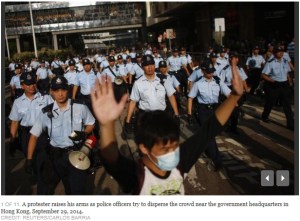
What is going on now in Hong Kong is a first. An entire community, and not a small or insignificant one, is having its freedoms curtailed simply because some people gathered around a table have decided so.

Karl Marx’s version or Max Weber’s?
“the difference between truth as the “unhiddenness of beings” and truth as the “correctness of propositions” (Martin Heidegger)
Only after reading (again) the Essence of Truth I started to grasp the huge mistake made by Marx and his followers.
His declared motives were ‘the emancipation of the oppressed’ and if we are to grasp his work we need to read him in this key.
Only this way I could finally understand why for him ‘capital’ means exclusively ‘trade-able wealth’, money or things easily measurable in monetary units.
Only this way I could finally understand why for him ‘capitalism’ was exclusively about personal profit and hence despicable.
All this had happened because Marx wasn’t really interested in understanding how capitalism works, what it means and how it generated a medium in which creative and hard working people could make better use of the available resources than in previous social settings.
Marx was a man of a mission (it’s not that clear for me if he considered himself a saint that was meant to free the working class, a con-man who swindled a lot of money from Engels under the pretext of helping the poor or both at the same time) and we need to accept that almost all he did write was dedicated to this mission of his, whatever that was.
On the other hand Max Weber was also a man of a mission only his was different from Marx’s.
What he set out to do was to understand the inner workings of capitalism, how it came about and what consequences it might have.
This is a brief excerpt from Weber’s “The Protestant Ethic and the Spirit of Capitalism” – retrieved, ironically, from an internet site run by “marxists”, http://www.marxists.org.
Weber is quoting here Benjamin Franklin in an attempt to make us understand what is the true spirit of capitalism.
At the first glance we might say it corresponds closely to what Marx had said about the subject – that it all boils down to money – only after further consideration it becomes apparent that while Marx had stopped there, at ‘money’, Weber and Franklin had seen way deeper than that.
Capitalism is not that much about mere money as it is about credit. Trust that is.
No one would extend credit without trust, no one would enter a contract without mutual trust and so on.
So what would it be? Which version of capitalism would you prefer?
The one in which we would strive to get hold of as much money as possible or the one in which each of us is held responsible by the others for his actions and holds those around him responsible for their actions – this being the only manner in which real trust can be established among us?
Please note that in reality these two sides of capitalism are like the two hands of a working man. For a short time one can get along with only one of them but no sane individual would prefer to live, and work, with only one hand, right?
Then how come our obsession about mere money has come to trump almost everything else?


 nicichiarasa