
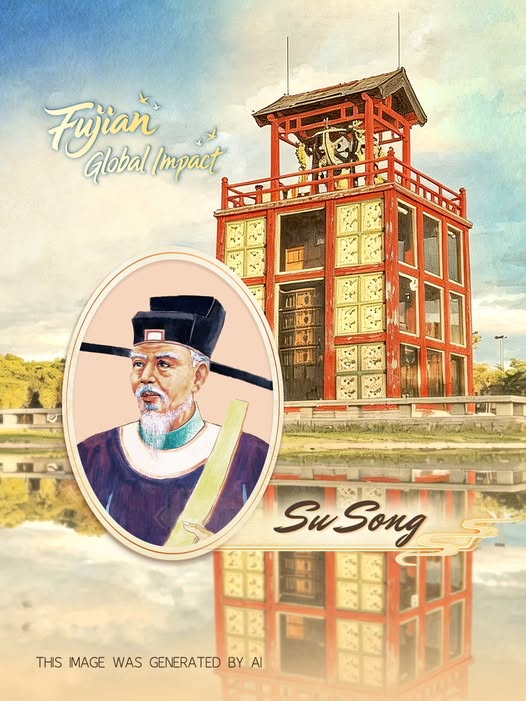
Su Song has build a mechanical ‘watch’ some two hundred years before his European equivalent.
Sun Tzu is credited for writing a, some say ‘the’, military ‘vademecum’ two millenia before von Clausewitz.
These two examples, along many others, demonstrate that China is both different and similar to Europe. Culture wise.
China was the first to discover things. Magnetic needle, printing press, paper, gun powder, mechanical watches, treaties of war…
Yet the Europeans were the first to put all these to work.
They’ve used chronographs and compasses to sail around the world, improved the printing press and used it for commercial purposes, ‘up-graded’ gun-powder from propelling fire-works to firing cannons…
As if the Chinese were trying to learn/discover for the sake of knowing while the Europeans did it to solve problems.
Yet both cultures are now more or less in the same ‘place’.
Each had ‘generated’ a very much appreciated war treaty. Then stopped ‘winning’ wars. Their influence in the world continue to grow but their military prowess is no longer the spear point of that expansion.
Each had entered the demographic ‘death-trap’. Stopped giving birth to enough kids to replace the deceased.
The differences can be explained. We’ll propose one, redacted from what we learned from you, sometime soon.
The similarities are simpler. Both Europe and China are inhabited by people. No difference between them, biologically speaking.
Culture is something else. Socially accrued knowledge which heavily depends on the specifics of the space where the accruement has taken place.
As if time flows differently in various spaces. But, somehow, the resting places are the same.

