Archives for posts with tag: philosophy

“Our measures do not tell us whether philosophy majors
go on to apply their newfound abilities in the service of truth and justice
or, conversely, for personal gain and glory.
Settling that question would require gathering a different kind of evidence.”

Reading it, https://theconversation.com/studying-philosophy-does-make-people-better-thinkers-according-to-new-research-on-more-than-600-000-college-grads-262681, brought back to memory another research subject. Linking a ‘reasonable consumption of alcohol’ to various health benefits.
A quick google search produced this:

The paper I found now, https://www.phcc.org.nz/briefing/glass-half-full-alcohols-health-benefits-cardiovascular-disease-still-controversial-and, is quite thorough.
More importantly, for me, it raises the points which bothered me when I first found out about the claim. On FB, more than five years ago.
I’ll put it in my own words.

Being able to drink for a relatively long time means one had a fairly strong health at the start of the whole process. And at least some degree of self-control.
Otherwise the drinker would have very soon become ill, an alcoholic, suffered some accidents… or any combination thereof.

Same thing regarding the findings of the first study.
Take a number of smart people. One has to be smart in order to be interested in philosophy! And able to graduate…
Train those people’s abilities. Help them develop whatever they’re good at. And like doing…
Then wonder about the good results you’ve achieved!

Writing this post made me realize that it goes far deeper than this.
No, this is not a self-congratulatory study. Far from it.
It’s stark warning!

“Public trust in higher education has hit record lows in recent years, according to polling by the Lumina Foundation and Gallup. Meanwhile, the rapid advance of generative AI has threatened the perceived value of a traditional college degree, as many previously vaunted white-collar skills are at risk of being automated.
Yet now more than ever, students must learn to think clearly and critically. AI promises efficiency, but its algorithms are only as good as the people who steer them and scrutinize their output.
The stakes are more than personal. Without citizens who can reason through complex issues and discern good information from bad, democracy and civic life are at risk.”

This paper is not about the virtues of learning!
It’s about us.
So many of us still have so much more to learn about the virtues of learning…

One possible explanation for what’s going on is that not enough of the learned people “go on to apply their newfound abilities in the service of truth and justice“.
Me starting this post with the distinct feeling that this was a self-congratulatory study is yet another confirmation of the generalized distrust which permeates the whole society.
We’ve reached that stage where we primarily look for reasons to refute.
Some say a little paranoia is good for you. That it keeps you safe.
I’m afraid we’ve reached exactly where ‘they’ want us to be.
Distrusting, paranoiac people cannot do anything together.

Constantly looking over your shoulder will never lead you forward.
Will only make you, us, susceptible to manipulation.
Remember, in this context, how many reasonable posts we get from people supporting various horrendous ideas.
How many ‘think with your own head’ messages we get from those ‘also’ promoting MAGA. How many times Putin says he only makes ‘reasonable’ demands.

How can we build trust?
I don’t know how but I do know we don’t have any alternative.

We either learn to respect each-other, and build trust together, or become subjects.
And I’ve already been a subject. To a communist regime. Don’t want to repeat the experience.
We all know about it.
To the tune that none of us cares
anymore about what the rest of us think about it.

We’ve conditioned ourself to use a single perspective.
To measure with a single yard-stick.
To have but a single goal…


We have not yet been able to replace the founding illusion
The naturally born idol.
Our image of God…

Our hunting-gathering ancestors have become conscious, learned to speak, invented crafts. And painted numerous caves.
Life was nice in those days. A few hours spend foraging then you could do whatever you fancied. No point in gathering more food – it would have spoiled – and no point in making more tools than you could carry with you. So… lay back and enjoy.
The only problem with this was the fact that those people lived in a state of an extreme precarity. No provision could be made for tomorrow. Nobody ever knew what they were going to eat, if anything, the next day!

Hence they jumped at the first chance of agriculture. A far safer approach.

The problem with agriculture was that it had brought three things with it.

People were divided in three. Rulers, free people – men, usually and slaves.
It was far cheaper, and way more efficient, to use slaves instead of hiring free-people. They were spared for trading, fighting and other occupations which needed self esteem and a lot more personal autonomy than tilling.

Agriculture also brought about the need for protection. For an army.
Stashed produce, saved to be used during the entire year and sometimes beyond that, was liable to tempt some of the neighbors. Those who preferred to steal something rather than work for it.
The ‘protection force’ also came in handy when the slaves tried to leave their posts.

The third ‘thing’ was philosophy.
The society had enough spare resources to allow a few of its members to spend their time thinking. Instead of performing ‘menial’ tasks.

These thinkers have started to notice.
And continue to do so.
For as long as the thinkers concentrated their efforts towards the well being of the community and the community paid attention, things went well. Each generation fared better, on average and statistically speaking, than the previous ones.
Whenever things went astray – the thinkers started to ‘hallucinate’, the ‘public’ no long cared and/or both, things went the other way.

Until some 50 years ago, things were going in the right direction.
People were increasingly freer and fared increasingly better.
Since some 15 years before the communism had collapsed, things has started to sputter.

Stay tuned.

Tao, Karma, Future

Time, like everything else human, has two sides. Like a coin.

A ‘base’ and an interpretation.

There’s no interpretation without a base – even hallucinations are based on ‘something’ – and there’s nothing which has penetrated human conscience and ever managed to evade interpretation.
In fact, human conscience needs to interpret, to assign meaning to, everything it ‘sees’. Everything it perceives.
Anything which is uninterpretable, which has no meaning, cannot be controlled. It is, hence, dangerous.
If you don’t know what’s going to happen next, you can assume anything. And since assuming the worst – and preparing for it – is far more useful towards survival than sleeping over it, we are biased towards erring on the side of caution. And towards relentlessly searching for meaning.

Time, like everything else human, is both a phenomenon – it happens – and a concept.
The difference between the ‘time’ of a star and the human time being that ours has a name – given by us – and that the star cannot do anything about it. While we do!

We can do things to and about time!

We named it, we measure it, we attempt to interpret it…. and we try to do the best of it!
We try to do, while alive, what we consider to be ‘the best’.

The best (?!?) for whom?

Tao.

The ‘road’.
If everything flows, it has to flow ‘somewhere’.
Not only from the start/spring to the ‘end’ (?!?)/never tranquil sea. Everything flowing needs a ‘riverbed’ to flow ‘through’. A plant needs soil to sprout, grow, bear fruit and ‘return to nature’. Even a star needs an Universe in order to shine… besides enough ‘fuel’, of course!
I have started this post by saying that there’s no interpretation without a ‘base’ and that we, conscious human beings, need to attach meaning (a.k.a. interpretations) to everything of which we become aware.
Same thing here. For anything to happen, a venue is needed. Some wise people in our past have used ‘Tao’ as a name for THE venue. For the venue where everything takes place.

Karma.

At first, when conscience had dawned on us, we were alone in the ‘dark’. And afraid about what was going to happen to us. To assuage that fear, we have identified God. As the ‘the meaning’ of the world.
At first, when both the world and time seemed to be endless – to us, consequences came from God. We had to behave. Or else…
God was there to punish each and every transgression. Sometimes using one of us as his proxy.
After a while, some of our ancestors have learned to write. To reliably transfer information over generations. Very soon, those ancestors of ours have learned the link between cause and effect. Between behavior and consequence. Very soon God had become an outside observer. Or was out-rightly forgotten. But Karma survived.

Future.

I keep hearing that ‘evolution has no purpose’.
Like many other human utterances, this one conveys far more information about the utterer than about the phenomenon described by the utterer.

‘This wooden table has 4 legs’.
We learn about the table that it is in front of us, that it is made of wood and ‘has’ 4 legs.
We learn about the utterer that:
It was conscious when uttering those words. Only conscious agents are capable of ‘speaking like a human’.
It has, at some point, learned to speak. English, and possibly other languages.
It has, at some point, learned to count. At least up to four. And it had conserved that ability up the moment when it uttered those words.
It was capable of identifying ‘wood’ as a material.
When uttering that phrase, it was in a ‘casual’ state of mind. A ‘scientifically minded person’, a ‘grammar nazy’, for example – when in that mood, would not attribute human ‘abilities’ to a table. Which table is a mere object and objects cannot posses other objects. Tables cannot ‘have’, hence that person was speaking colloquially.
Or, given the current ‘technological’ developments, those words might have very well been uttered by a statistically ‘minded’ AI application…. A man made ‘parrot’!

See what I mean?

Let’s go back to the presumably purposeless evolution.

Evolution is a phenomenon. Like a thunder. It takes a lot more time to unfold than a thunder, it’s about as hard as a thunder to predict the exact point where it will ‘strike’ but we know enough about both to be able to point out, quite reliably, a few ‘rules’ about how both phenomena take place. About where, when and how they will unfold.
What’s the purpose of thunder? To ‘close the circuit’? To discharge the energy pent up in the cloud?
I’m afraid that attributing purpose to thunder is akin to allowing tables to ‘have’ legs. What we have here is a ‘figure of speech’. An ‘implicit’ figure of speech… so implicit that it’s not even considered as such…
Same thing when it comes to evolution.

Which evolution is paramount to survival.
Just as no cloud can accumulate ad infinitum electric energy – hence thunder – no living thing ever – no species, more exactly – has yet been able to survive ‘everything’. Everything mother nature has thrown at it.
Hence ‘evolution’! Which is a mere process which makes life possible. In certain conditions – in a certain Tao – after it had sprung up. And, again, attributing purpose to evolution is akin to allowing a table to own legs.

Then what about ‘future’?
If God no longer decides for us – the God we have identified – and if evolution is ‘pointless’… then ‘future is blind’?!?

Not so fast!

Question: Where was God at Auschwitz?
Answer: Where was man at Auschwitz?

Could any of those present at Auschwitz have done anything to fundamentally change the outcome?
Probably not.
Could we, as a species, have done – have behaved, actually – in such a manner as to avoid Auschwitz altogether? Specially after the Armenian Genocide had already taken place?
Should we, as a species, have done differently when so many Tutsi had been killed in Rwanda?
When 8000 Muslim Bosniak men and boys had been murdered in Srebrenica?

See what I mean?
About the future?
About our future?

What do we have here?
“Eternity and endless return?”
Or past mistakes haunting us through time?
Until we figure out the way forward? Or else…

“Twelve-year-old Carly Nix of Lakeland
says breaking the wishbone from the turkey is a silly tradition,
but that won’t hold her back from testing her luck this year.”

I have to start by confessing that until yesterday evening I’ve never seriously considered this possibility.
Why would anyone bother?

Then somebody – thank you, Jeffrey Mercer – introduced a whole new twist into this conundrum.
‘What if this whole (computer) simulation thing is nothing but yet another attempt to make sense of the Universe?
To attribute sense to the Universe?
Which whole thing, if anything, is the epitome of anthropomorphism…’
I took the liberty to rephrase Jeffrey Mercer’s words. To make them more ‘suitable’.
To fit better my preexisting answer. Yet another ‘anthropomorphic’ thing….

My immediate answer was ‘our world is indeed a simulation. Or maybe not as much a simulation as an artifact.’

Before delving into the matter, I’m going to formulate two questions. Hence ‘the furcula’.
If we live in a simulation, what kind of world does the simulator live in?
Why would anyone bother? To study us responding to its simulating our senses/minds? Why doesn’t it study itself? Its own self/persona?

Coming back to my initial answer, I have to point out that the key word here is ‘our’.
We’re speaking here about ‘our world’. The world we live in. Our reality!

We, the ones trying to make sense of this world/reality, have a few characteristics.
We’re made of matter and we have, each of us, a conscience.
Having a material nature introduces certain limitations and being conscious widens those limitations.
Us being conscious widens those limitations, by introducing a ‘new dimension’, but this doesn’t mean those limitations disappear. A bucket is ‘wider’ than the circle at its base – the bucket has height, hence volume, while the circle is ‘flat’ – but the bucket itself continues to have limits.

Let’s examine the consequences of us being conscious agents of a material nature.
Limited conscious agents of a material nature…

Us being conscious means us being aware of our material nature. Of our limits.
Having a material nature means the most powerful instinct we have is our ‘need to survive’.
Both as a biological organism – a.k.a. animal – and as a conscious agent.

Our consciences – I’m speaking about the individual ones here – are very crafty ‘devils’. They can accept our individual material fate – death – but have a problem accepting their own dependency on the ‘bodies/brains’ they need to inhabit.
Hence ‘the soul’.

Which ‘soul’ has been invented – by our conscious selves – as the first step towards building a sense for this world. For the reality we inhabit.
Which soul is the building block for all religion. For all religion known/built to/by man.

Are you still here?
I have to make a pause here. And to mention the fact that I’ve already cut a few corners… A lot of corners… What I say is probably rather hard to follow. Mostly because I don’t have time/space to explain myself. Not now but certainly in due time.

And yes, what we call ‘religion’ is of our own doing.
The Bible itself has been written by us, regardless of the origin of the ideas mentioned there.
It doesn’t matter whether we have been the interface between (a) God and ‘the world’, we are the ones who have written the Bible. And all other sacred texts.
We have written them, we have believed in them and we have shaped the reality we live in.

We have done all that according to how we have interpreted the teachings we have inherited from our forefathers.
And we continue to.
Even those of us who consider themselves to be ‘free of religion’. We might not believe but we continue to act as if. Believers and nonbelievers alike hold the same things as being valid. Don’t kill, don’t steal, respect the values which keep society together…

What about where we started from? What about the ‘original’ simulation?

One moment please, I haven’t yet finished with ‘God’.
If (a) God made us who/what we are, then who made God?

If someone took the trouble to build the simulation we consider to be ‘home’, what about the ‘real’ world? What about the reality harboring the simulating agent?

There’s no need for an outside agent?
The world we live in, our world, is the world we have built for ourselves? Using the things which were at our disposal and the information we have gleaned about how things work?
Maybe not always fully aware of what we were doing?

You got it! That’s exactly what I was trying to say!

If you’re still interested:

Are you living in a computer simulation by Nick Bostrom

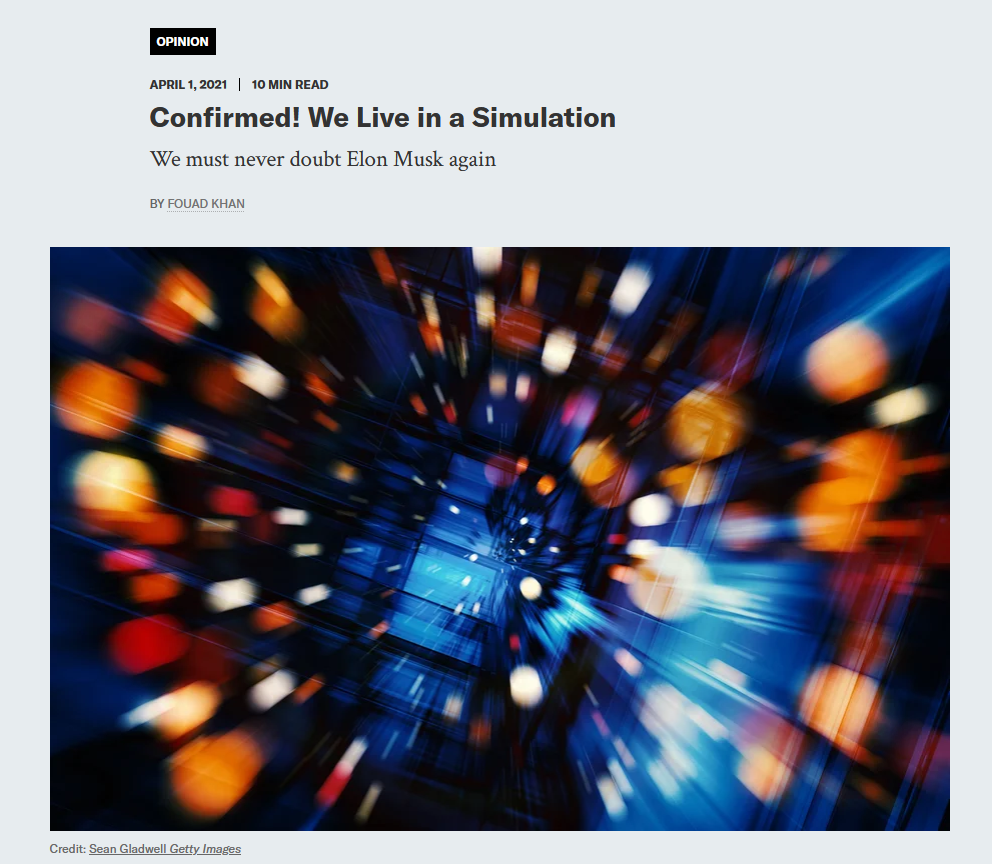
Confirmed! We live in a simulation. by Fouad Khan

Of course we live in a simulation by Jason Kehe

“Only in silence the word,
Only in dark the light,
Only in dying life:
Bright the hawk’s flight
On the empty sky.”

Ursula K. Le Guin

4,000 years ago.
An alien probe examines the Earth and determines there are two ‘species of interest’ on the planet.
‘Interesting’ in the sense that both had already discovered ‘exploitation’.
Ants farming aphids and humans farming sheep.

4.0 seconds ago.
The same alien probe checks back and determines that both ants and humans continue their respective farming activities. The only difference between now and then being the scale of the respective operations.
And the consequences to the environment…

The probe is a robot. Which robot has no feelings. Doesn’t care. Does what it has been instructed to do and that’s it.
The data is being transmitted to those who had commissioned the robot.

‘The ants are practically the same. Individuals transported through time would fit perfectly in either situation.
The humans have evolved in a certain manner. They live longer – on average. They have thoroughly transformed much of their environment. But they have maintained the ability to survive in either situation. To thrive, even, if the individuals are transported through time very soon after birth – and if they are well taken care off at the receiving end of the journey’.

The received data is deemed ‘baffling’ by the agents whose job is to make sense of it. To analyze it.
To determine whether each planet checked by the probe was inhabited by a potentially autonomous species. In which case the planet was deemed ‘off limits’.
Or not, hence open for colonization.

The procedure to determine the outcome is simple.
Is there at least a species which evolves faster than the rest? Is there at least a species concerned with the well being of the environment it depends upon?
If only the first condition is met, the planet is scheduled to be checked again later.
If both conditions are met, the planet is considered off limits.
If none are met, the planet is considered ‘open for business’.

The present situation is unprecedented.
During their entire recorded history, this is the first time the analyzing agents have come across such an occurrence. An intelligent species who has achieved so much yet still remain driven by desire. By emotion.

A species perfectly capable of thinking yet still prone to judging.
A species comprised of individuals who consider perfectly acceptable to rationalize their own wishes while entertaining a low opinion on others who do the very same thing. Find excuses for indulging.

This find generates an ontological storm among the analyzing agents.
Being the first time when they no longer have a complete grasp on what’s going on, this whole thing compels them to reconsider.

To reconsider everything.

Segue

“When we talk about birthing people, we’re being inclusive.
It’s that simple.
We use gender neutral language when talking about pregnancy,
because it’s not just cis-gender women that can get pregnant and give birth.
Reproductive freedom is for *every* body.”
@reproforall

– What’s wrong with these people?

– What do you mean?

– They consider themselves to be reasonable.
Their ability to ‘reason’ is mentioned, by their thinkers, as the single thing which separates them from the rest of the animals. Sets them apart from the rest of those who inhabit this planet.
To me, reasoning is how their consciousness operates. How their consciousness manifests itself.
The real difference between them and the rest of the animals being the fact that their consciousness is far more capable than that of the ‘mere’ animals.

– ?!?

– Just look at them!
Is there any difference, any real difference, between a 3 days old human infant and a chimpanzee of the same age? Or even between a 3 days old baby and a 3 days old foal? Except for the foal being able to run?

– The baby will eventually learn to speak. Will develop consciousness and the ability to think. You said it yourself…

– WILL!!!
Will eventually… if everything goes right!
If that baby is raised by responsible people. Who speak to the future human being. And teach them to be human. Help them develop a functional consciousness.
Children who have no significant interaction with other human beings and fail to learn to speak – or other form of language, until they reach puberty will never be able to ‘recover’. To accede to consciousness.

– OK. But I still don’t understand what has flabbergasted you!

– Not you too!
What drove you to copy them? To misuse language so horribly… “what has flabbergasted you”…

– But it’s so funny!

– Until it no longer is!
Look at them. Just look at them.
20 years ago, they made a movie about a man getting pregnant. A comedy. Everybody laughed.
Nowadays they take sides on ‘pregnant people’
OK, language can be used ‘artistically’. ‘Stretched’ to obtain something. To explore new meanings, to express emotion, to make fun.
But does it make any sense to use language in order to seed confusion? To cause people to fight each other?
Rather self-defeating, isn’t it?
How much sense does this make? To misuse the medium which made you possible in the first place?

How sensible is it to weaponize language?
Who has anything to gain from this?
Other than a few, very short-term, perks?

The times when it might be appropriate to use “pregnant people” is when you were talking about the universe of people who can get pregnant, some of whom are actually men, trans men like me, and some of whom are non-binary people who don’t identify as men or women.” (Evan Urquhart, Slate, 2022)

There are no facts, only interpretations.
Friedrich Nietzsche

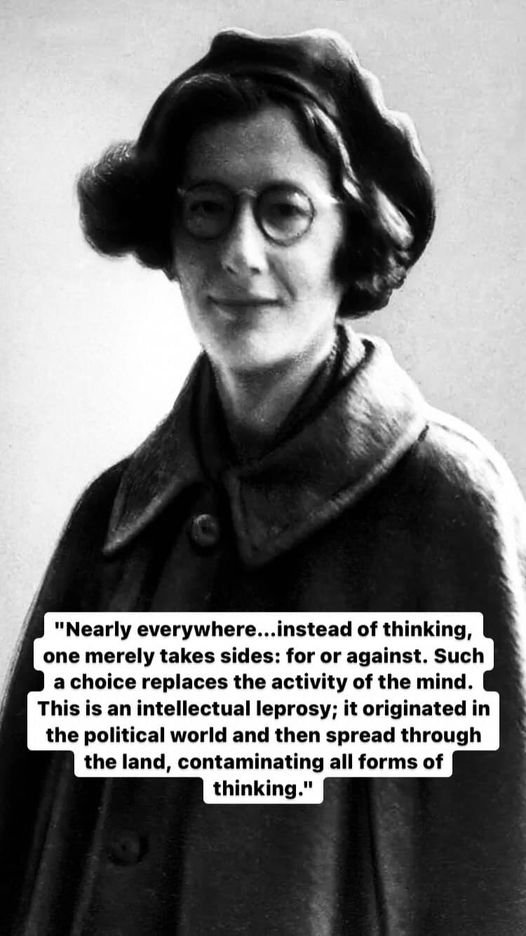
I’m afraid the political world wasn’t where this intellectual leprosy had originally came from.
The political world was only the place where this disease had become ‘viral’.
Where this manner of (not) thinking had been weaponized!

Its origin can be traced back to our intellectual arrogance.
To our conviction that ‘I can be right on my own’. Without any ‘input’ from the outside…
Even in spite of whatever information might reach me from ‘outside’, if that information doesn’t fit my already held convictions. My ideology….

In fact, this belief – ‘I’m entitled to my own convictions’ – is exactly what people on both sides of the divide have in common. Intellectually speaking!
A shared disease… a virus infecting indiscriminately…

Art – Esthetics – Philosophy.
Techne – Science – Manipulation.
Skills – Technology – Reality 2.0

Art is, maybe, the first form of interaction between us and the place we inhabit.
The first manner in which we ‘ingest’ that place, only to regurgitate it later. The first manner in which we learn about that place and the first manner in which we express what we have just learned.
Esthetics is how we make sense of art. How we organize our ‘first impressions’ regarding the ‘place’ we live in. How we ‘edit’ those impressions in order to make them more easily understandable.
Philosophy is what we made out during the artistic endeavor to learn. The never finished product put together by our ‘digestive system’ out of the artistic interactions we have had with ‘reality’.

Techne is what we do. The transformations we impose unto things in order to make them capable to satisfy our needs. Or our whims…
Science is the process through which we gather information. The information which becomes more and more necessary as our doings take us further and further away from the original reality.
Manipulation is what we do after we consider to have amassed enough information. After we have developed a certain understanding of the world and have decided that time has come for us to ‘take what’s rightfully ours’.

You know what ‘skills’ are. What we’re ‘good at’.
Technology is how we pass our skills to other people. So that we can work in concert. To coordinate our efforts.
The outcome of which is Reality 2.0. The reality we have brought about. The new reality which constitutes reality 1.0 for those currently alive.