Archives for posts with tag: Negotiation

After Putin ordered the Russian army to invade Ukraine, the rest of the world ‘took sides’.

Some sided with Putin, many extended a helping hand to Ukraine – for various reasons, and others felt their lives have been ‘disturbed’.

This morning I almost blew my top.
I was listening to the radio. A usually decent station. Usually decent and, like all of us, imperfect.

The news anchor was interviewing an ‘expert’. An Ivy League Professor of International Relations and other blah-blahs. I’m not giving their names because I want them forgotten, not even more famous than they already are.

‘Is there any chance for this conflict to end in a negotiated manner?’
‘Yes, if/when both sides will find a mutually acceptable solution.
For example, if the Ukrainian side would accept a referendum in Donbass – and in Crimea, and if the Russian side would accept UN inspectors to validate the process. This would be in line with the general accepted policy of self-determination and ….’

OK, and where’s the difference between what Putin keeps saying and what I’ve just heard?!?

Two non-Ukrainians telling Ukraine what to do…

I’m going to set aside, for now, what these two – wait, three! – people are saying.
That Ukraine, the Ukrainian People, should give up a piece of their land.
My immediate interest lies in ‘who these three guys think they are’?!?

OK, only those who don’t want to see haven’t yet found out that Putin is a dictator.
But for a renowned Ivy League Professor to elaborate a scenario according to which the UN would supervise a referendum where an occupied population would have the opportunity to vote whether they want ‘their’ aggressor to maintain its control over the already occupied territory….

Would that distinguished Professor be comfortable with a referendum – equally supervised by the UN, taking place in California? Which California had already been occupied by Mexico? For which referendum, the Californians were asked where they want to live? Whether Mexico should continue its occupation or should the Mexican army retreat behind the internationally recognized border?

No, I don’t think the Professor has been paid by Putin. Or ‘compensated’ in any other way by the ‘red Satan’.
I just consider he was not paying real attention to what he was saying.
He had just opened his mouth and verbalized what his mind was churning.
The current ‘events’ have disturbed his pleasant existence to such a degree that he really needs this ‘fly in the ointment’ to ‘fly away’.

He is so ‘driven’ by his ‘need’ that he is no longer ‘patient’. He just can’t ‘stop talking’ for long enough to realize how fast Putin’s propaganda machine will make ‘good’ use of his ‘verbalizations’…

‘See, the good Professor confirms what our Beloved Leader has already done.
It’s the Ukrainians who are not reasonable!
They should first change their leadership then come back into Mother Russia’s arms.’

When are we going to understand?

Don’t tell others what to do unless you are prepared to ‘take advice’ yourself…
And, for your own good, don’t trade your future freedom for your present comfort!
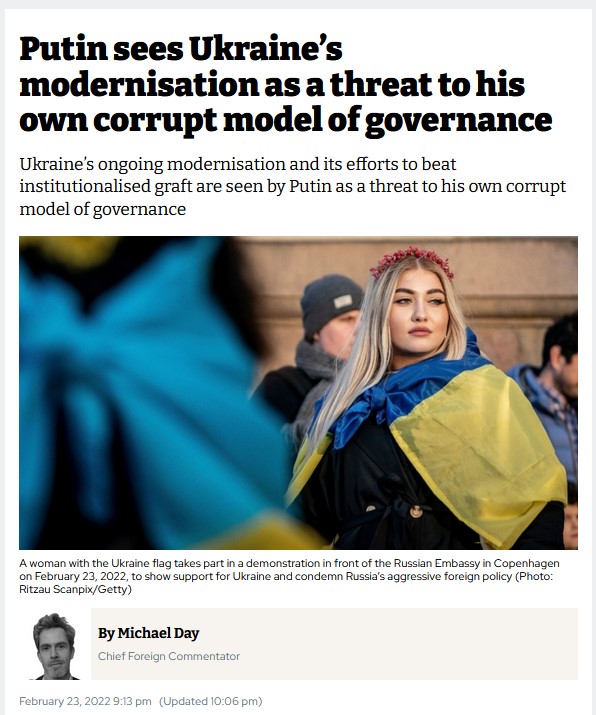
The internet is full of articles attempting to understand Putin’s motives starting from what he had said about the subject.

Here’s but the last I’ve read.
Why has Russia invaded Ukraine and what does Putin want?

Nothing special inside but it illustrates well enough the point I’m trying to make.

At first, Putin’s words are summarized and then proven ‘wrong’. Misleading. Or plain false.
In the next section of the article, the author – Paul Kirby, like many more before him, attempts to divine what Putin will do. Starting from the same words which have just been proven false and/or misleading.

?!?

No, the author is not ‘dense’.
He simply does what he was trained to do.

We, here in the land of democracy, understand language as a medium for negotiation.
And negotiation as an exchange where we let our needs be known, in earnest. As an exchange where we ‘trade’ information with the goal of finding the best mutually acceptable solution for whatever problem we attempt to solve.
In this sense, a negotiation is a form of cooperation. And compromise is something which both sides find beneficial.

For people conversant in ‘dictatorian’, ‘compromise’ is something to be shoved down the throat of the weaker side. The bigger the power differential, the harder to swallow becomes the ‘compromise’.

Doesn’t make much sense?
To us, democrats?
Because we know that shoving things down the throat of now weaker people doesn’t work on the longer time frame?

‘Assuming’ is the worst thing a negotiator may make.

We keep assuming that dictators are rational. Even worse, that they follow the same ‘ratio’ as we do.
That we – as in we and them, see the same world and have ‘slightly’ different goals.
And express those different goals in the same manner. Using the same kind of language.

We are wrong.

We, the democratically minded, are trained – conditioned is a truer word, to consider ‘the other’ as being equivalent to us.
At least some of the others, but that’s another discussion.
We actually ‘know’, in our bones, that we cannot ‘do’ anything by ourselves. That we exist only in cooperation with those around us. That everything we have ever accomplished was the result of a common effort.

People conditioned in dictatorial regimes see things rather differently.
They don’t cooperate, they just obey.
Their existence does not stem from the common effort but from following orders.
Language is not at all a medium where information is being passed between equivalent agents but a two way conduit. Orders are flowing from top to bottom and acknowledgments crawl from bottom to the top.

‘And what about ‘information’?!?
How does it travel among those people?’

Piecemeal.
Exclusively on a ‘need to know’ basis.
Nobody ‘volunteers’ any information unless expressly asked about it by a superior.

This is why dictatorships end up crumbling under their own weight.

That’s why we don’t understand, for real, what Putin attempts to communicate.
That’s why he is extremely annoyed right know.

Putin no longer understands what’s going on.
Let aside the fact that nobody around him dares to volunteer any information – which would be contrary to what Putin wants to hear.
My point being that Putin had been accustomed to having his way.

I’m not going to enumerate all the things he had done. Things we should have reacted against…
As in ‘reacted’, not meowed meekly.
As a consequence, he had grown accustomed to shoving things down our throats…

Suddenly, we have stopped swallowing!
Without giving him a ‘reasonable’ reason…
A reason he could understand!

Do you remember what I’ve told you?
A few moments ago? That dictators don’t care about those who are weaker? Nor about the long term consequences of their decisions?
That dictators are concerned exclusively with their own survival?

Savvy?

First and foremost language is perceived as a communication medium.

As such it needs clarity and consistency, otherwise information could not have been reliably exchanged and or preserved through its use.

But language is used for many other purposes than for simply ‘translating’ raw data. Where to find a certain object or how to execute a certain task.
We use it to convey sentiment – the way we are affected by the raw data that has become known to us, and to communicate our particular understanding of things. Our point of view about what has happened around us.
Furthermore we use it to convince people. To do things or to accept our points of view.

All these different uses involve a considerable amount of negotiation.

Regarding immediate goals – the things we are negotiating about, but also some that is taking place ‘under the table’ and involves the continuous fine tuning of the instruments used during the negotiating process. The words themselves.

These negotiation instruments – the language itself, in fact, have to be constantly re-calibrated for two rather obvious reasons.
For starters, the reality around us – and our understanding of it – is changing constantly.
Secondly, every negotiation involves a degree of ‘shade’. In fact that ‘shade’ is exactly the space where ‘change’ happens, where the positions of the two negotiators overlap and where the two can swap ideas.
If words would be rigidly precise than we’d have to invent new ones every time reality changes, no matter how minutely. Also whenever our understanding about things deepens, no matter how shallowly.
Simultaneously, too much ‘linguistic precision’ would kill not only poetry and our ability to convey our real feelings to other human beings but would also gravely impair our ability to influence each-other. Could you imagine how our life would be if a polite intervention would sound exactly like an SMS message of if a marriage proposal would be similar a requisition order?

More about how the linguistically mediated interplay between us has brought about our own self-awareness can be found here:

Humberto Maturana, The Origin and Conservation of Self-consciousness.