Archives for posts with tag: logic

For a proposition to be ‘true’
it is not enough for it to be logically valid.
It also has to make sense. Epistemologically speaking.

Oscar Hoffman

“This house belongs to me”.
“I own this house”.

Logically, these two propositions are equivalent. Both state the same thing.
But which one makes real sense?

Where do you belong?
Where do you feel at home?

What can your house do for you?
What have you done to your house?

Two things cannot exist
simultaneously
in the same place

Logic, ‘the correct way of thinking’, starts from the notion that no two things can exist, simultaneously, in the same ‘place’. Not even in our own head… Until they do, actually.

I’ll make a break here and tell you about Oscar Hoffman. A Romanian Teacher.
Who kept telling us, those who had the privilege to hear him teaching,
‘It’s not enough for a proposition to be valid from the logical point of view. It also has to make sense. Epistemologically speaking.’

The bottom part of the picture describes a stance which does make some epistemological sense and is seriously deficient when examined logically.
The top part is logically correct but also includes the meaning hidden in the bottom part.
Let me elaborate.

“100% irrefutable study that is proof and absolutely statistically significant.”
Absolute BS.
No scientific study has ever proved anything. Other than the facts examined confirm, or contradict, the hypothesis being tested during that study. Hence the hypothesis is allowed to stand, temporarily, as a theory or declared to be wrong.
A single study being claimed to be ‘absolutely statistically significant’ is so outrageous that it isn’t worth any comment.
“100% paid studies with an agenda and of little to no value or significance whatsoever”…
Nowadays 99.99% of the studies do involve money changing hands. Scientists have to eat and ‘money’ want to learn things. Hence ‘agendas’, on top of ‘money’.
‘Little to no value’ makes a lot less sense. If those studies yield results without any “value or significance whatsoever”, then why is any money involved and any time spent? To discuss about them, let alone to put them together….
To fit an agenda?
The scientists involved – all of them?!?, “100%” – are frauds and all those paying the hefty sums of money are suckers?
Then how can be explained the huge technological leap and the scientific breakthrough we currently witness?

‘Outlier’ versus ‘General trend’, is a far more ‘logically sound’. But also a lot more vague… The first proposition/picture, when examined with an open mind, does include everything claimed by the science deniers and the conspiracy speculationists. An outlier can be right, all change starts with one, and trends can be wrong. As all of them end up being…

So. What will it be?
Are we going to let ourselves be divided into warring camps?
Or understand ‘superposition’? Accept that having an agenda is not necessarily bad and that money is an excellent servant but a horrible master?
Or continue the current trend? Until we will have killed each-other along the line of divide et impera while repeating at nauseam ‘greed is good’?

‘A proposition needs more than ‘mere’ Logic
in order to be True.
It also needs to be epistemologically correct.’

Oscar Hoffman, 1930-2017

This morning (February 22, 2013, thanks FB) I had a very interesting discussion with my son.

Trying to ‘soften’ him up to my arguments I said: “I don’t understand how a person with such a command of logic as yourself is unwilling to accept that…”

I should have seen this coming:
“If you have such an admiration for MY logic why don’t YOU accept that…”
That very moment I recalled a lecture by Professor Oscar Hoffman: ‘A proposition needs more than ‘mere’ Logic…’

How do you translate that to a 13 years old?

“Look here. Being Logical is only the beginning. You cannot do anything without it but it isn’t enough just by itself. It’s only the formal side of Things”.
And that was the very moment when inspiration hit me:
“Let me give you an example. You have a lot of wooden pieces: spheres, cubes, pyramids, cylinders, cones..etc. and two boards with holes in them: circles, squares, triangles. Your task is to put each wooden piece through the corresponding hole but you must also follow a second rule: half the wooden pieces are made of red oak and they belong to the red board while the other half are made of birch and they belong to the blue board”.

“Let’s presume you have no idea about either geometry or kinds of wood. Using logic you might separate red oak from fir using the grain and then learn to thread various shapes each through the corresponding hole. But no amount of logic will ever enable you to associate the correct pile of wooden pieces to which colored board unless somebody tells you which pile is made of red oak and which pile is made of fir.
Savvy?”

I’m proud to report that he got the point!

Present day edit.
He remembers the discussion but neither of us can recall where it started!

I don’t know anything.
I don’t know everything hence, logically, I cannot pretend to know anything.

Seems odd, since I obviously know something… to type, for instance!

Indeed, only the key word here is ‘logically’.
From a logical point of view, you either know something or you just don’t.

Not very reasonable… This line of thinking leads up, fast, into a dead end!

As soon as I realize I know ‘nothing’, I must stop!
I can no longer ‘do’ anything.
Because I cannot control – in an absolute manner, each and every consequence of any of my actions.
Further more, there is no justification for me to continue thinking.
Again, because I will never be able to achieve ‘knowledge’.

Yet so many things are being done around me…
From the sun rising in the morning to the ant helping its mates to dig a nest.
From the electron ‘flying’ around the nucleus of a Hydrogen atom to a man developing a computer application.
How can all these actions be performed when nobody, not even the ‘performers’ themselves, is able to determine the ultimate consequence of what’s going on?
How can so many thoughts be ‘spun’, and books published, when the ‘thinkers’ themselves – well… some of them, actually, are fully aware of their intellectual limits?

What drives this frenzy?

And, if I may allow myself a thought, why ‘logic’?
How can such a ‘paralyzing habit’ survive?

“For a proposition to be true, it is not enough for it to be logically correct. It also needs to make epistemological sense.” Oscar Hoffman

Ricky Gervais is right, right?
There’s no logical connection between being offended and being right…
There’s no doubt about this!

Only Gervais is wrong.
Wrong in saying it, not in what he said.

Yes, there are people who declare themselves to be offended in an attempt to get something. Sympathy, some slack… or even the others to accept their version of things. That ‘they’ are ‘right’.

But this is not always the case!
Some (other) people are so offended by the manner in which things are unfolding that they actually need to express their feelings.
To send the warning ‘don’t continue in this manner or you’ll loose my attention/will to cooperate’.

In this sense, Gervais is actually wrong.
His saying had been used by numerous meme builders to create a bubble inside which callousness is actively encouraged.
‘Go on disregarding other people’s sentiments. They’re nothing but pussies.
It’s just words, not sticks nor stones.’

Here’s a more detailed analysis:

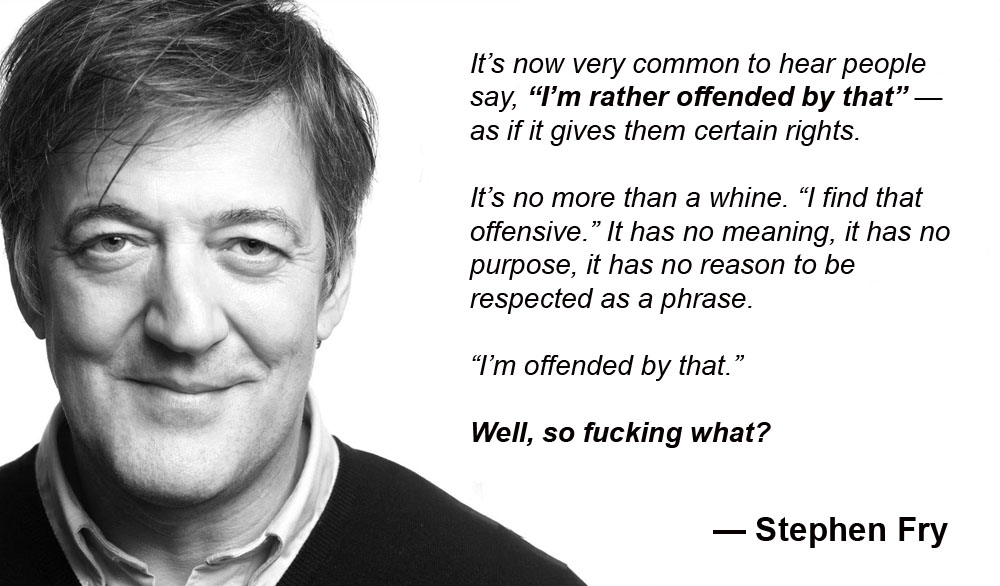
So fucking what?!?
Somebody just told you they are not going to stop paying any real attention to what you are trying to say to them and you don’t care?
Why did you start communicating in the first place? Or ‘performing’ the ‘offensive’ thing in public?
Was the ‘offense’ premeditated? For a reason or just for fun? Then it’s not ‘so fucking what’ anymore…
Or you just hadn’t thought about it beforehand? And you’re looking for an easy way out?

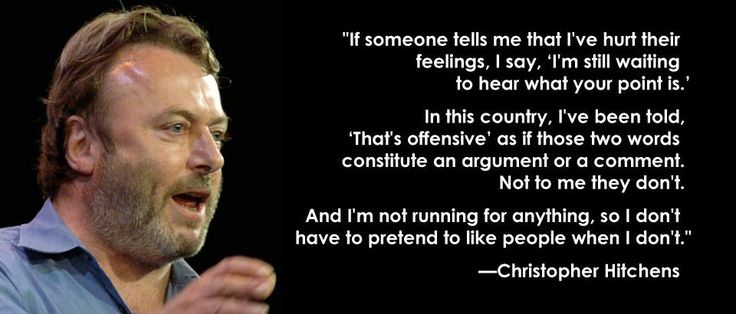
No, you don’t have to pretend to like people when you don’t.
But, in the longer time frame, it pays to honestly respect those you get in contact with. All of them.

Your life will get a lot better!

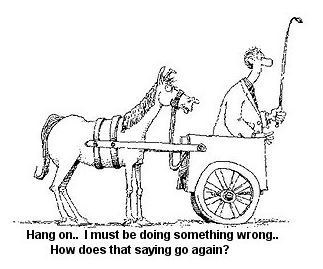
I need you to pretend a few things.

That you don’t know what a cart is. Or a horse.
That you are a logical machine.
That you are told a cart is something laden with merchandise, that the horse is what moves the cart and that the purpose of the whole endeavor is to transport the merchandise from A to B.
Then you will be asked to stack the three elements according to their importance.

How likely are you to arrange them in this order:
Merchandise, cart, horse?

It would be perfectly logical, right?

Remember that you don’t know anything else but what you’ve just been instructed.
That the ‘action’ is ‘transport merchandise M, laden in cart C – moved by the horse H, from A to B’.

Mere logic convinces you that the most important thing here is M. Simply because the whole brouhaha revolves around M. Followed by C – closest to M, and only then by H. Right?

Only mere logic is seldom enough… Each of those three has its own merits and their relative importance depends on many things.

On what the owner thinks about each of them. If all three belong to the same person.
On the relationship between the person asked to determine their relative importance and each of those elements.
The owner of the merchandise will certainly consider his property to be more important than either horse or carriage. But will consider the horse more important than the cart if the merchandise has to arrive sooner rather than whenever. Or the carriage more important than the horse if the merchandise is fragile…
The owner of a single horse will try to protect the animal. Simply because he will also need it tomorrow.
The owner of the trucking company will ask the drivers to drive the horses to their limits. Simply because he has so many of them.
And so on.

My point being that logic is almost never enough.
We must also understand what’s going on there before passing judgement on something.

Otherwise we’ll end up scratching our heads.


Click the drawing above and read what tborash has to say about the whole thing. He’s right too, you know.