The Sapir-Whorf hypothesis, following ideas put forward by Wilhelm von Humboldt, posits that the kind of language used by various categories of people have a meaningful impact upon the ways each of those categories of people think. And see the world. The last iteration of the above hypothesis being the advent of AI. We train it using various languages. Those trained using precise languages – chess, go, ‘mathematics’ – work more or less as intended – aka ‘perfectly’ – while those trained using everyday English end up hallucinating…
In the 20 odd years since Caro and Hauser have set the bar for what teaching means quite a number of species have been found to do it. To fully or at least suggestively cross all the necessary t-s. From ants to primates.
Interestingly enough, all of those species have a clear ‘collective’ behavior. All individuals belonging to a species collaborate, of sorts, towards the survival of that species. This goes without saying. But in some species this collaboration is more intense than in others. Ants and bees versus most other insects. Elephants versus cheetahs. Or leopards. Even chimpanzees versus orangutans…
OK, for some species hand to hand collaboration between generations is impossible. Most parent insects are dead when their offspring hatch. Orangutans live in forests where food is too scarce for more than 1 individual to forage. Others have found their niches. Where the individual approach is good enough for them to survive. Cheetahs, leopards. Bears, even…
Charles Darwin taught us about evolution. Merging individual lives into the survival of the species those individuals belong to.
Life, as I see it from a “functional and mechanistic perspective“, is yet another manner in which matter is organized. Yet another ‘state of matter‘. For life to be present, three conditions have to be met. – Individual organisms have to be exchanging, in a controlled manner, substances with their environment. To ingest nutrients and to excrete the by-products of their metabolism. – Individual organisms have to be exchanging information with their environment. And with their interior. Otherwise the exchange of substances would no longer be controlled by the individuals. – Individual organisms have be passing to the next generation the pertinent information needed for the species to survive. In the kind of life we are familiar with, that would be ‘the genetic information’.
Considering the above, I dare to make a difference between what Caro and Hauser consider to be teaching and what we, humans, do. Intent!
I doubt that any of the ‘animal teachers’ do it under their own volition. After all, nobody has yet identified an animal con-artist who cons the members of their own species… as we do! As far as we currently know, ‘teaching behavior’ is displayed inside species which collaborate more closely than other species. Which suggests that that kind of behavior is somehow innate to those species. A ‘habit’, not a choice. As it is with us.
What makes it possible? This difference? Our special kind of conscience and our use of language. The fact that we are the only species – as far as we know – capable of building a ‘virtual image’ of the surrounding reality. Capable to select certain aspects of what surrounds us and codify them using various forms of ‘notation’. And to do this according to our own, individual, interests! Sometimes even against the interests of the community/species to which we belong.
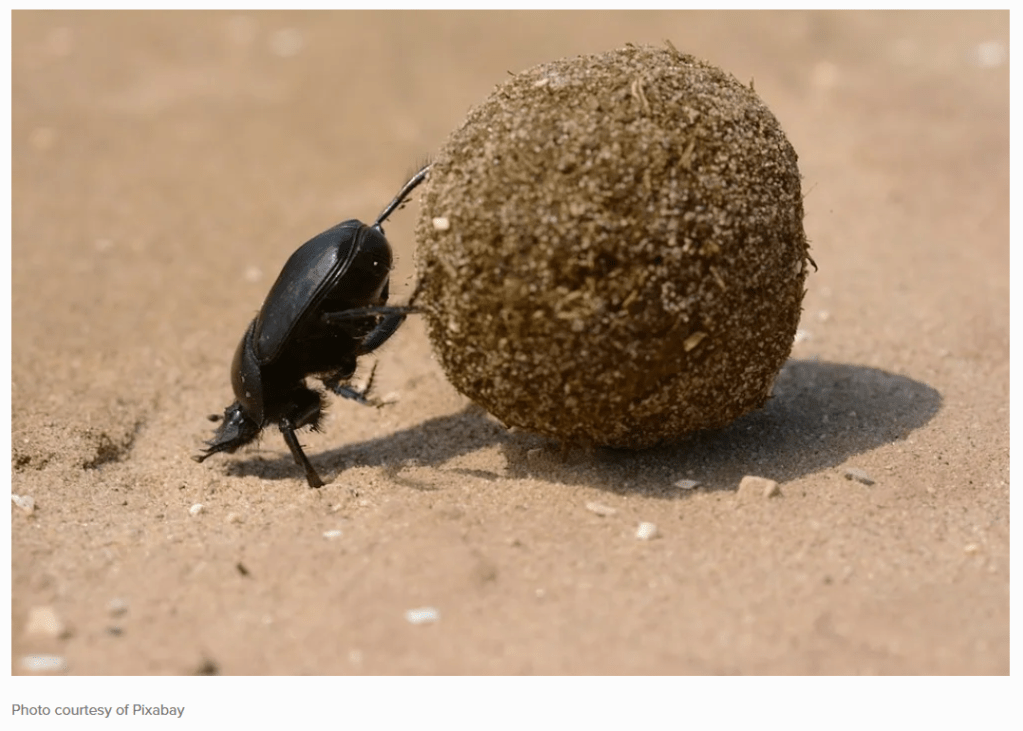
Dung beetle are very industrious. They don’t think much but are very useful.
And they have been useful for quite a while. Since long before our ancestors had started to roam the Earth…
My point being that their attempt at taking care of their next generation – their species collective effort to survive – have helped shaping the current version of Earth’s ‘environment’. The current version of the place which we, all of us, call home.
Where we, humans, do our thing. Think!
Think and make differences.
For the dung beetles, poop is both a resource and an opportunity. They need dung in order to ‘nest’ their eggs so whenever they find it they start working.
Dung beetles are very good at using poop. In doing their job they perpetuate their species and they reintegrate poop into the natural order of things. Read here what happened in Australia between man had introduced cows and the ‘same’ man had got wise enough to bring some dung beetles specialized in using that particular kind of poop. But dung beetles are not able to think. Or to speak. About anything, including their most prized resource. Dung.
We do. We are able to think. And to speak. Among ourselves. And with ourselves… How else do we do what makes us humans? How else do we think except by using words? Concepts…
And this is how we get to the gist of today’s post. The difference between a resource and an opportunity.
It was by thinking that we have identified something as being a resource. That something can be used. And it was through the same process that we have coined the concept of ‘opportunity’.
We don’t eat everything in sight, right? We understand the difference…
In fact, we are able to understand. We have the necessary resources to make the difference! But we don’t always make good of the opportunity…
Language is the tool we use to convey information. To speak our minds…
The consequences of tool use – messages, in this case – depend on the yielder. The consequences of shooting a gun depend mainly on the person aiming the gun. The consequences of using language … depend on those who are at the both ends of the ‘barrel’.
Messages – consequences of language being used to put together batches of information with the intent of transmitting them to an audience – are interpreted as soon as they reach their ‘target’. Meaning – what the receptor makes of a message, using the same languaging tools as those put to work by the emitter – depends mainly on the receptor. In fact, most of the times, there’s more information to be gleaned from a message than that intended to be conveyed by the person initiating the exchange.
If interested in who said what and what Orwell thought about the subject… just click on the link above. I’ll only add the reasons for which I know it to be a misleading affirmation.
The factual truth is that only dictators need to be guarded by rough men during their sleep. And during the rest of their lives… We, the rest of ‘the people’, go to sleep at night knowing there’s only a very slim chance to be targeted by thieves. Yes, we know that the police will likely come to investigate after the fact. After the fact… But we also know that we are less likely to fall prey to violence than those living in other countries because our societies work better than those which are more violent than ours.
Because our society works better, not because we employ more ‘rough men’ to guard us… On the contrary! The more violent a country, the more ‘popular’ the ‘rough men’ are. On both ‘sides of the isle’!
And the more violent a country, the less peacefully people sleep in that country…
– They consider themselves to be reasonable. Their ability to ‘reason’ is mentioned, by their thinkers, as the single thing which separates them from the rest of the animals. Sets them apart from the rest of those who inhabit this planet. To me, reasoning is how their consciousness operates. How their consciousness manifests itself. The real difference between them and the rest of the animals being the fact that their consciousness is far more capable than that of the ‘mere’ animals.
– ?!?
– Just look at them! Is there any difference, any real difference, between a 3 days old human infant and a chimpanzee of the same age? Or even between a 3 days old baby and a 3 days old foal? Except for the foal being able to run?
– The baby will eventually learn to speak. Will develop consciousness and the ability to think. You said it yourself…
– WILL!!! Will eventually… if everything goes right! If that baby is raised by responsible people. Who speak to the future human being. And teach them to be human. Help them develop a functional consciousness. Children who have no significant interaction with other human beings and fail to learn to speak – or other form of language, until they reach puberty will never be able to ‘recover’. To accede to consciousness.
– OK. But I still don’t understand what has flabbergasted you!
– Not you too! What drove you to copy them? To misuse language so horribly… “what has flabbergasted you”…
– But it’s so funny!
– Until it no longer is! Look at them. Just look at them. 20 years ago, they made a movie about a man getting pregnant. A comedy. Everybody laughed. Nowadays they take sides on ‘pregnant people’… OK, language can be used ‘artistically’. ‘Stretched’ to obtain something. To explore new meanings, to express emotion, to make fun. But does it make any sense to use language in order to seed confusion? To cause people to fight each other? Rather self-defeating, isn’t it? How much sense does this make? To misuse the medium which made you possible in the first place?
How sensible is it to weaponize language? Who has anything to gain from this? Other than a few, very short-term, perks?
‘Exploring the consequences of our limited consciences‘
A truth is, first and foremost, an expression. A message, formulated by an observer, describing a portion of what the person expressing themselves considers to be a ‘portion’ of ‘reality’. Being a message, any truth is formulated by means of a language.
Does anybody know everything about any subject? About anything, actually? No, nobody knows everything about anything. Hence there is no such thing as a complete truth.
Furthermore, being expressed by means of a language, a truth – any expression, actually – will never be able to convey to the person receiving the message everything the transmitter intended to say. The transmitter is never able to cram ‘everything’ inside an inherently limited message, no language is absolutely ‘precise’ and no receiver will ever interpret any message the way the transmitter intended it to mean. Hence even if anybody will ever learn everything about anything, that person will never be able to convey that knowledge to anybody else. Let alone to everybody else…
What next? ‘Never ever believe anything? Anymore?!?’
Is it possible for us, humans living in concert, to cooperate in this manner? Knowing that nothing which is being said, one way or another, is ‘true’? Completely true?
Well, we did get this far, didn’t we? We’ve been expressing ourselves, in the imperfect manner I described above, since we’ve learned to use language. Since we’ve learned to speak…
70 000 years ago, give or take a few millennia, is when some scientists believe we’ve started to communicate more or less like we do now. The people living then had the same genes we have now and the bones they have left us to dig up and stare at are similar to ours. Hence the only thing which differentiates us from our ancestors is our culture. A treasure of knowledge which has been noticed – bit by bit, formulated using language – message by message, and remembered, one way or another. Hence the only difference between us and our ancestors is a collection of incomplete – and imperfectly interpreted – pieces of truth.
Then again, is it possible for us – humans living in concert – to cooperate by means of incomplete and ‘misinterpreted’ pieces of truth? Well, we came this far going (up?) this way, didn’t we? It seems that as long as we do it ‘in good faith’ things will, eventually, ‘mesh up’ just fine!
Which leads us to ‘the truth’. ‘The’ as different from ‘A’ truth.
While a truth is a message, the truth is a state of mind. The understanding of the fact that what we call ‘reality’ can be learned only ‘in concert’. Only as long as we help each-other along the process. Only as long as each time we formulate ‘a message’ we do our best to ‘speak the truth’.
People act as if the world is as each of them sees it.
The briefest glance into our evolutionary past is enough to see that the more ‘sophisticated’ an animal is, the more it depends on its visual ability. On its ability to see things in a manner which is consistent with its ‘way of life’. Herbivore mammals, for example, have a very wide vision field while the carnivores feeding on them have a narrower field but a binocular vision. Which makes perfect sense. The ‘defenseless’ herbivores need to see everything around them – so they might be able to flee, while the predators need binocular vision in order to hunt efficiently.
Our evolutionary ancestors, who lived in trees, needed binocular vision in order to travel in their 3D world. They also needed better hand-eye coordination for picking the fruit they were eating. Hence their, and ours, very tight connection between our eyes and our brains. And the big portion of our brain allocated to processing visual information.
At some point in our evolution – we were still animals at that point, we have learned to use sound in order to warn/grab the attention of our ‘correspondents’. Why? Because sound can go around obstacles while in order to notice visual cues the potential recipient needs to… you got it, I’m sure!
Fast forward to when our direct ancestors, already homo sapiens, have started to actually speak. To consciously use sound to convey meaning. Not only to warn but to transmit actual information. Information which could be acted upon. Acted upon as different from reacted to…
And now I wonder. How much time had passed between learning to speak and uttering the first lie? Lie as in intentionally misrepresenting reality, as opposed to unintentionally failing to convey the entire reality…
Hard to even imagine an answer to that question.
But since I’ve already mentioned the subject, let me make two observations. It’s a lot easier to lie using language than in any other way. And it’s a lot easier to be fooled by what you see – and sometimes hear, than by information gathered through the rest of the senses. Unless, of course, that information was a ‘message’ sent/meant to/for us. A perfume versus a naturally occurring smell, for instance. Or an artificial sweetener/flavoring…
I’ll wrap this thing up pointing your attention to the fact that since learning to read we, individual human beings, have shared more information using the ‘visual channel’ than ever before. Which has produced momentous consequences.
Verba volant, scripta manent! A written culture is more resilient than a spoken one. A written lie reaches more people, potentially, than a told one.
For two reasons.
A ‘verbal’ lie needs to be retold in order to survive. It has not only to impress strongly enough the target as to transform it into a relay but also to be reinterpreted convincingly enough by the former victim as to reignite the process. Meanwhile, a written lie just lies in waiting. Waiting to be read… Not to mention what happened after we had invented the printing press… The second reason is less obvious. I’ve already mentioned the fact that a spoken lie depends on the teller. On the ability of the ‘interpreter’ to convey it in a convincing enough manner. The problem being here that if the target has the slightest doubt, the lie flops. The liar has lost an opportunity. On the other hand, a written lie can be honed at will before hand. Under no pressure.
Now that I have finished the theoretical part of my post, let’s interpret the following message.
“Dishonesty and intellectual chaos…”
According to some of those with whom we share the planet, it’s OK for a human individual to choose their name but not their gender. Choosing your own name – as in changing the name you have been given at birth, is acceptable while changing/widening the gender you had been assigned to – by others, before you had any opportunity to contribute to the process – is considered to be dishonest and liable to cause intellectual chaos.
On the other hand, we – all of us – should be fully aware of the fact that those who – since always – have ‘found joy’ in ‘exposing’ themselves will use every opportunity available to them.
The way I see it, the situation is ‘chaotic’ enough. No need for any of us, from any ‘camp’ and belonging to any ‘persuasion’, to further weaponize an already volatile situation.
Do you remember what happened when our not so distant ancestors had ‘determined’ that witches were meant be burned?
I’ve just figured out what makes them so good at it. And why it’s us studying them instead of they simply discarding us as being too ordinary to be of any interest.
Spill it out then!
Even if they are not yet fully aware of the whole thing, they are fueled by emotion. Reason is only a tool for them, not a way of life. Furthermore, their manner of gathering and sharing information – what they call ‘languaging’, is precise enough to be effective yet imprecise enough to make it possible for ‘imagination’ to work wonders.
Whoa! You’re learning to speak like them. Sometimes I don’t fully understand what you want to convey. Take this ‘work wonders’ for instance. I’ve already checked the dictionary, I know what each word means but…. I’m still not sure what you really need to say to me. Not to mention this ‘imagination’ thing. ‘Making things appear in your mind’…
I knew I could count on you! I just knew it! You’re asking the very same questions which I’ve just answered. Let me proceed. For us, everything is straightforward. We always know what we have to do. What our current task is, what’s expected of us and how we’re going to fulfill our jobs. When we need to determine ‘what’s next’ we check a schedule, make an inference based on already available data or proceed to gather the information we need to perform the inference we need. And when was the last time you ever wondered “Who am I?”
That ‘wonder’ word again… You’re killing me!
‘Insecure’. You do have a good grip on what this word means, right?
Yeah. The situation when you don’t have enough information to determine which way. AND when there’s no way of gathering more pertinent information other than proceeding along any of the possible ways. Like in that famous experiment designed by Schrodinger.
OK. We, both you and me, know what ‘insecure’ means. Both of us have been in situations similar to what you have just described. But neither of us has ever experienced the feeling. How it feels to be insecure. How it is, what it means, to wonder ‘will I be alive tomorrow?’ ‘Will I have enough food for my children?’ And so on. ‘Wonder’ is a complex concept. It encompasses both a question you don’t have an answer for and an answer you don’t know where it came from. Like ‘the unexpected food one might find, out of the blue, exactly when their children were hungry’.
This is the difference between them and us.
They can ‘wonder’ while we don’t.
They can formulate ‘stupid’ questions – then come up with unexpected answers, while we can’t. They can perform ‘wonders’ while we can’t. Even though we already know far more than they’ve ever learned…
– How did you manage to mess things up so thoroughly? – By allowing too much coherence to slip away. After we – well, some of us, already had a fair understanding about how things worked. About how we got there in the first place. – Would you care to elaborate? – Things went on more or less linearly up to when we had learned to speak. That was when it had all started. When we had realized what a start was. And that was it. Speaking to each other allowed us to access the second level of consciousness. Self awareness. Speaking to ourselves – a.k.a. ‘thinking’, gave us the illusion of ‘knowing’. ‘Knowing’ led to ‘knowing better’ and ‘knowing better’ gave birth to arrogance. For a while, this process had been kept in check by the harsh reality. People, like all living organisms, have certain needs. Basic needs. Food, shelter… During most of our evolution, getting enough food and shelter consumed most of our resources. And time. Only a very small number of people had enough spare time. And energy left for thinking. And only a very small percentage of this already small number of people used their minds to think about anything else but how to preserve their privileged status. Which status was the source of their ‘spare time’ in the first time… Slowly but surely, those having something else in their minds besides their selfish self interest have come up with a thing called ‘technology’. By carefully, and considerately, watching those who worked, the selfish thinkers have noticed that from time to time and from craftsperson to craftperson there could be noticed small differences in how things were done. Hence the concept of ‘how things are done’. With the natural sequel of ‘let’s do things in a better way’. Technology made it possible for workers to be more productive. Communities as a whole became more productive. Hence increased the possibility for more people to have spare time for thinking. Some communities made good use of this new possibility while others failed to do so. Usually for reasons depending on the ‘general conditions’ and not at all imputable to the communities themselves. Unfortunately, technology also had two less fortunate consequences. By freeing more and more people from want, it also freed them from ‘religion’. Until that moment, people who were ‘excluded’ from society – who did not partake in ‘religion’, could not survive on their own for any significant length of time. After the advent of technology, reclusion no longer meant almost instant death. Technology also produced ‘hard science’. A corpus of knowledge about how nature works. Which knowledge can be summarized as a collection of natural laws. No longer depending as much on their contemporaries and cognizant of those natural laws, some of the thinkers – whose numbers had been constantly swelled by the continuously improved technology, have reached the conclusion that through thinking a human might, given enough time and resources, understand basically everything. Some of those had become dictators. Others had become consultants. Both categories extremely confident in their own knowledge. Arrogant, even. This is how we messed things up. This bad.