Archives for posts with tag: freedom

You’re handed a pot.
So heavy, you need to hold it with both hands.
So hot, you want to let go of it.
On your feet?!?

I’ve argued sometime ago that all living organisms act as if they were ‘aware’.
All of them are adept at keeping their insides in, most of the outside out and, most importantly, they are the ones deciding what from the outside goes in and what from their inside goes out. And when!
I call this awareness 1.0. Or life…

We congratulate ourselves over being the only creature wielding ‘self-awareness’. The ‘full fledged’ variety… according to our way of understanding it, of course. “Consciousness”, we call it.
How about ‘awareness 2.0’?

Some of us are involved, heavily, into ‘faking’ things. From building something called ‘artificial intelligence’ to using ‘technology’ to mess up other people’s minds.
They are ‘delving’ in the ‘next’ level. Knowingly but unwittingly playing god.

Life is driven by ‘natural selection’. Or ‘evolution’… as Darwin called them.
‘Happenstance’, if you look at it from another angle.
The process of life/natural selection/evolution depends on it taking place ‘individually’. While evolution is a matter regarding ‘species’ – as Darwin itself had put it – the whole process depends on the fact that each individual organism which belongs to each species is distinct/different from all other members of the same species.

‘Self-awareness’ depends on the existence of other self-aware individuals. Willing to cooperate with the ones developing it. Just as no living organism has been observed, yet, while putting itself together starting from innanimate matter, no individual has ever been observed developing self-awareness with no outside help.
Mind you, while the process involves ‘mature’ individuals helping ‘fledglings’ to ‘fly’, the process isn’t entirely ‘voluntary’. The outcome, the emerging individual consciousness, depends on the actions performed by those helping it but only inasmuch as the result of the natural evolution depends on the actions performed by the previous generation. Achieving ‘self-awareness’ is a ‘natural’ process, not a ‘deus ex machina’ machination!

Awareness 3.0, on the other hand… the ‘artificial’ kind…
In this context, I wish to remind you of what happened when we, willingly but unwittingly, have reduced the natural bio-diversity in certain areas. According to our needs and understandings…

The Green Revolution’s success also brought serious costs: intensive farming drained groundwater, degraded soil and contaminated fields with pesticides, while wheat and rice monocultures eroded biodiversity and heightened climate vulnerability, especially in Punjab and Haryana.
Swaminathan acknowledged these risks and, in the 1990s, called for an “Evergreen Revolution” – high productivity without ecological harm. He warned that future progress would rely not on fertiliser, but on conserving water, soil, and seeds.
A rare public figure, he paired data with empathy – donating much of his 1971 Ramon Magsaysay Award amount to rural scholarships and later promoting gender equality and digital literacy for farmers long before “agri-tech” was a buzzword.
Reflecting on his impact, Naveen Patnaik, former chief minister of Odisha, says: “His legacy reminds us that freedom from hunger is the greatest freedom of all.”
In Swaminathan’s life, science and compassion combined to give millions that very freedom. He died in 2023, aged 98, leaving a lasting legacy in sustainable, farmer-focused agriculture.

https://www.bbc.com/news/articles/cn7eln1pm4ro


We all know about it.
To the tune that none of us cares
anymore about what the rest of us think about it.

We’ve conditioned ourself to use a single perspective.
To measure with a single yard-stick.
To have but a single goal…


We have not yet been able to replace the founding illusion
The naturally born idol.
Our image of God…

Our hunting-gathering ancestors have become conscious, learned to speak, invented crafts. And painted numerous caves.
Life was nice in those days. A few hours spend foraging then you could do whatever you fancied. No point in gathering more food – it would have spoiled – and no point in making more tools than you could carry with you. So… lay back and enjoy.
The only problem with this was the fact that those people lived in a state of an extreme precarity. No provision could be made for tomorrow. Nobody ever knew what they were going to eat, if anything, the next day!

Hence they jumped at the first chance of agriculture. A far safer approach.

The problem with agriculture was that it had brought three things with it.

People were divided in three. Rulers, free people – men, usually and slaves.
It was far cheaper, and way more efficient, to use slaves instead of hiring free-people. They were spared for trading, fighting and other occupations which needed self esteem and a lot more personal autonomy than tilling.

Agriculture also brought about the need for protection. For an army.
Stashed produce, saved to be used during the entire year and sometimes beyond that, was liable to tempt some of the neighbors. Those who preferred to steal something rather than work for it.
The ‘protection force’ also came in handy when the slaves tried to leave their posts.

The third ‘thing’ was philosophy.
The society had enough spare resources to allow a few of its members to spend their time thinking. Instead of performing ‘menial’ tasks.

These thinkers have started to notice.
And continue to do so.
For as long as the thinkers concentrated their efforts towards the well being of the community and the community paid attention, things went well. Each generation fared better, on average and statistically speaking, than the previous ones.
Whenever things went astray – the thinkers started to ‘hallucinate’, the ‘public’ no long cared and/or both, things went the other way.

Until some 50 years ago, things were going in the right direction.
People were increasingly freer and fared increasingly better.
Since some 15 years before the communism had collapsed, things has started to sputter.

Stay tuned.

The words of Abraham Lincoln to honour the soldiers that sacrificed their lives in order
“that government of the people, by the people, for the people,

shall not perish from the earth”
were spoken at Gettysburg,
but these words apply as well to the countless soldiers
that died for the cause of democracy in the following 150 years.

How about people respecting each-other?

After all, government is supposed to be by the people and for the people…

Those serving in the government come from among the same people, don’t they?

“All governments suffer a recurring problem:
Power attracts pathological personalities.
It is not that power corrupts but that it is magnetic to the corruptible.”

Frank Herbert, Chapterhouse: Dune

Some people are convinced that all they have to do is to follow the rules.
Other people are convinced that freedom – their freedom, in particular – is the most important thing.

Apparently, these two convictions are incompatible.

Which is not true.

Those convinced that following the rules is the only way to ‘get there’ – wherever that might be – forget one thing. Two things, actually…
That no journey starts until the traveler makes the first step. And decides where they want to go…
Those convinced that freedom is the only important thing forget one thing. One thing only.
That whenever the traveler breaks a rule… there will be consequences!

The fact of the matter being that freedom is a human achievement.
Achieved during the long journey towards the future.
Achieved as a consequence of the process through which we have learned about rules.

‘Rules’ is our definition of ‘possible’. Defines a space where things can happen. As long as the pertinent rules are being observed, of course.

At first glance, flying is possible. For birds…
After learning the pertinent rules – and mastering certain skills – we have learned to fly. But we can continue to fly for only as long as we keep observing the pertinent rules!

At first glance, walking a rope strung between Manhattan’s Twin Towers was impossible.
Not for Philippe Petit. He had the skills and he was crazy enough. He even didn’t ask for permission… Click on the picture and read ‘all about it’. My point being that he remained alive because he had observed the laws of physics. All of them! And because the human laws he had trespassed didn’t involve the capital punishment…

I believe you already understand what I want to convey.
Have a nice week-end.

The truer the lie,
the harder it is be recognized.

It is true that many fighters die during a war.
That many castles are built, after the war, by the profiteers.
But, when won by the right people, wars also bring freedom!
For those who deserve it.

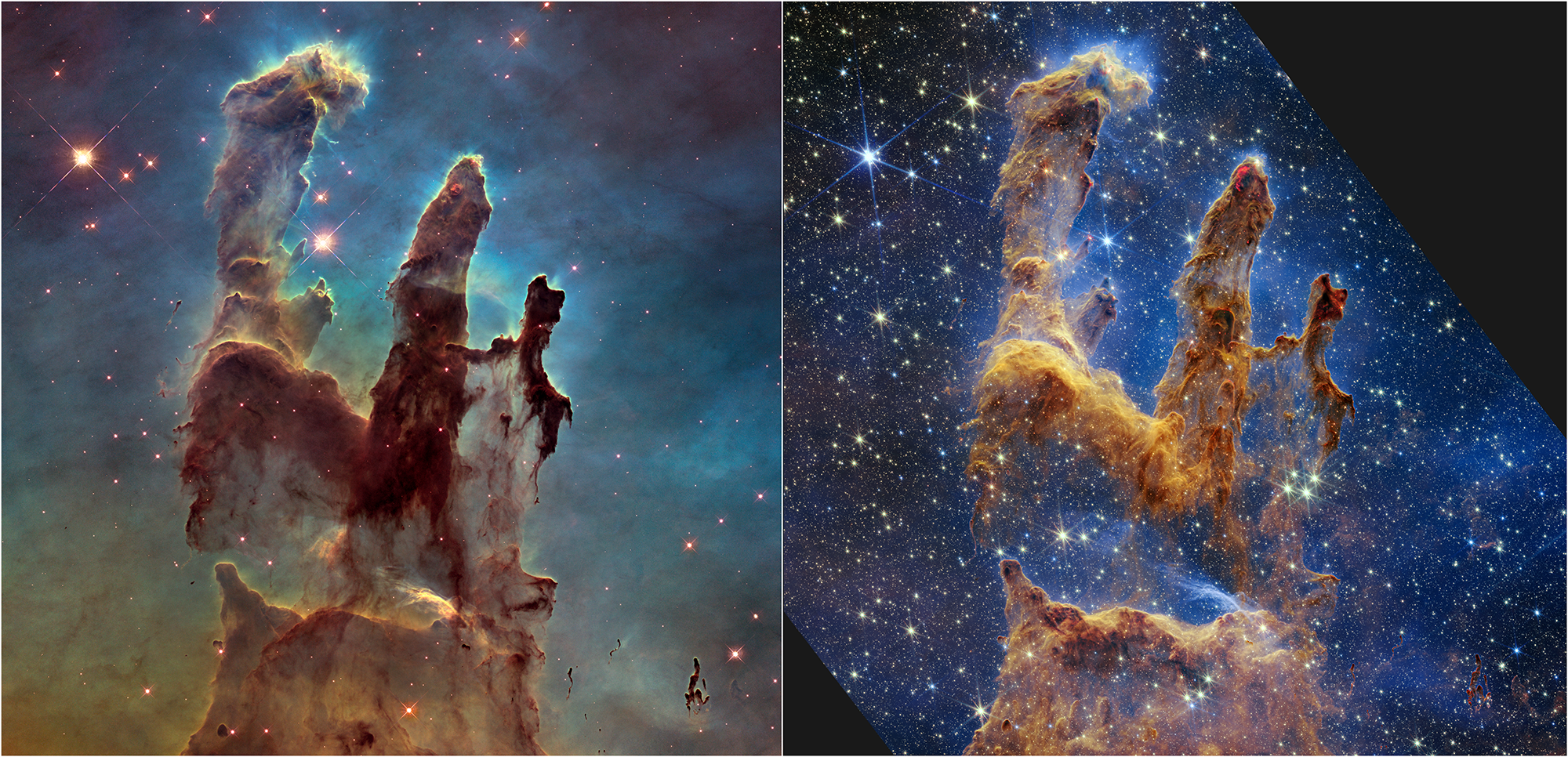
‘Universe’ has no meaning. Other than what we assign to be its meaning…

‘Universe’ is a word we use to encompass everything around us. Whether we know of it or not. Whether we understand (of) it or not.

From ‘where’/’when’ we are in/attempt to perceive this huge environment, things look like ‘this’.
Depending of the wavelength of the light we use to ‘reinterpret’ the picture…
Nota bene, the colours were assigned by a computer app, starting from a series of ‘black&white’ images shot using filters which select short intervals of light-wavelength.

By sheer change, life appeared on Earth. And on who knows, if ever, how many other planets.
Evolution, an impersonal process, playing the odds in the current setting, had engendered the set of circumstances into which we happened to ‘burst’ into existence.

We, for better or for worse, have shaped the planet into what it has become.

Regardless of what each of us believes, religiously speaking, it doesn’t actually matter whether a god did or didn’t do anything. Since each and every religion currently biasing human thinking on Earth speaks about individual responsibility – hence freedom, for you can’t have individual responsibility without freedom – it actually doesn’t matter whether any of the teachings we refer speak about have been induced by an outside agent or have been produced ‘in house’.
Since each of us is individually responsible for our thoughts/actions – hence ‘free’ – then the meaning we assign to the object of our judgement, the ‘Universe’, belongs to us. To each and to all of us.

‘God save us!’

But since we’re ‘free’, we must save ourselves.

And since nobody can be free on their own – freedom has been defined by ‘us’ and put in practice collectively – saving ourselves will be a collective effort.
Or else.

Nota bene!
We are a ‘collection’/community of individual human beings.
We either ‘save’ ourselves maintaining what makes us human – our distinct individual individualities – or we become a hive. Of something else but ‘human’.
Of what we currently understand as being ‘human’…

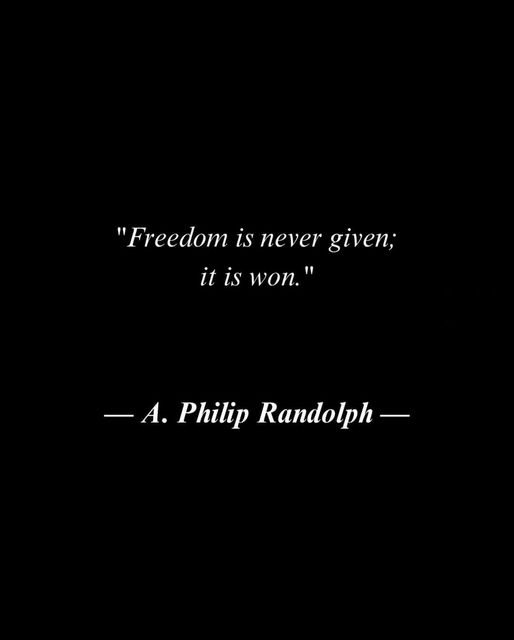
With Chandler Owen, A. Philip Randolph founded and became co-editor of The Messenger,
an African American socialist magazine, in 1917.
In 1925, Randolph established the first predominantly black labor union,
the Brotherhood of Sleeping Car Porters, to improve working conditions
for the nearly 10,000 black railroad employees.
The Brotherhood would enjoy longstanding prominence in the labor and civil rights movements.

According to the English lore, “there’s more than one way to skin a cat”.
According to the cat, ‘who cares about how I lose my coat? I’ll end up dead anyway!’
According to the fur tanners, ‘the manner of skinning the pelt is of utmost importance for the end-result of the operation’.

Whom to believe? Specially since all of them seem to be right…

Well, truth has a marked tendency for being complicated.
Hard to comprehend in its entirety and even harder to express in a concise manner.
Meanwhile we, conscious human beings, have a marked tendency to notice only what we’re interested in. To notice only what we care about…

In fact, the manner in which we notice things speaks volumes about who we are. About how we relate to what we call ‘reality’.

The white colonists inhabiting a certain area in Northern America had become ‘Free Americans’ after fighting the British. Only after they had freed themselves through battle!
A. Philip Randoph had fought for his freedom. And for human rights.

All this fighting leads to a bout of pondering.
Are we free together? As in ‘all of us’ and ‘once and for all’?
Or our freedom is defined against other people? Who might try to steal our liberty from us?

What is freedom, after all?
A zero sum game? Where liberty is up for grabs but in limited supply?
Or a ‘grace’ we impart with and upon our fellow human beings?
Something to be jealously guarded or something to be collectively and cooperatively maintained and enhanced?

And one final question.
Why would anyone attempt to steal other people’s freedom?
When history gives us plenty of evidence that whenever freedom was out to be shared people were happy while whenever freedom was in short supply the entire society eventually crumbled under it’s own weight…

If ye continue in my word, then are ye my disciples indeed;
And ye shall know the truth, and the truth shall make you free.

John, 8:32

Bruno, Giordano Bruno, was speaking the truth.
Something we consider to be true…
Yet he ended his career as a definitely unfree person! At the hands of people who considered themselves to be disciples of Christ…

Something doesn’t add up!
Either at least some of the truth mentioned here isn’t actually true… or we’re dealing with altogether different truths!

The way I see it, Giordano Bruno had died because he was defending an absolute truth while his killers had never realized that the truth pronounced by Christ was relative.

Let me elaborate.

An absolute truth – there are many – is a piece of truth of the kind which will eventually trips over you.

‘Reckless driving will kill you’.
‘High water will knock down the levy’.
‘A red hot iron will brand a cow’.

Relative truth, which has many faces but is essentially one, depends on us.
According to Christ, those who follow his word – who remain his disciples – will know the truth. And will become free.

According to Christ, it is not possible for an individual to know the truth – nor become free – in an individual manner. To accomplish the feat, WE have to follow his word.

We have to ‘love’ each-other. To respect each-other!
To turn the other cheek…

For us to be able to get near the truth – near the many absolute truths that are there – we need to share whatever knowledge we have.
Keeping anything hidden from our brethren – not turning the other cheek for ‘inspection’ – means disrespect. Means distrust. Lack of love. Inability to be in communion with the rest. Incapacity – or unwillingness – to partake in the same piece of reality. To partake in the same piece of absolute truth.

This is why Christ, who was right, has been killed. By those who didn’t want to share freedom. Who wanted to keep freedom for their own use. Who wanted to restrict the freedom of others.
This is why Bruno, who was right, has been killed. By people who behaved exactly – and for the same reasons – like those who have killed Christ. Despite declaring themselves to be the disciples of Christ…

Truth and freedom are human concepts. Words.
Both need us, human action, to become reality.
Both need us, working in communion, to become practice!

Individual absolute truths are relative to us. Are relative to us noticing, formulating, sharing and validating each of them.
‘Relative truth’, the ‘only one’, is absolute. In the sense that the only absolute – and definitive – truth is the fact that we can learn, and become free, only in concert. Respectfully helping each-other.

“Denn selbst muss der Freie sich schaffen”
Hence the free must define their own nature
Richard Wagner, Die Walkuere

In my previous post, I related to ‘life’ as a living creature. I described life from the inside. The perception of a living organism.
But what if ‘life’, as a phenomenon, is how meaning is created by the environment where the process takes place?

For an outside observer, there are three stages.
Pre-biotic, self-driven and meaning-driven life.

Life, as we know it, cannot exist on the surface of the Sun. Or on the surface of any other star.
But neither can life exist without the processes taking place inside the stars. Without the energy being radiated by the stars and without the atoms being ‘cooked’ inside them and spewed out during the last stages of their ‘lives’.

Having said that, the rest is simple.
Where ever conditions are ‘right’, atoms get together in such a manner that ‘structures’ become ‘alive’. Those structures become organisms and display the characteristics we’ve come to associate with life.
In this stage, the only ‘force’ which drives the process is what we call ‘evolution’. Species cease to exist as they are no longer able to weather changes in their environment and new species arise along with the advent of new opportunities.
And, at this stage, a second ‘disturbing agent’ starts to influence the environment.
Living organisms, in order to live, need to ingest portions of where they live. To excrete the by-products of their metabolism. And they leave behind ’empty carcasses’ at the moment of their death.
For example, the oxygen we breathe in is the by product offered to us by the plants which live at our side.
And the fertile soil those plants ‘eat’ in order to provide us – the oxygen breathing organisms – with what we need to survive, is the consequence of previously living creatures.

In the third stage, that where ‘meaning’ becomes a force to be reckoned with, the changes perpetrated to the environment cease to remain ‘natural’. As they used to be during the second, self-driven, stage.
In the third stage, an increasing number of changes to the environment are driven by purpose. Are purposefully staged by agents acting according to the meaning they have found.

Trying to make sense of this this proverb, one might find handy a deeper understanding of ‘it’.

I’ll be arguing in a future post about the synthetic nature of equality. A concept we came up with, based on things found in the natural world. But the concept itself has no natural precursor. It was invented by us and exists exclusively in our minds.

On the other hand, liberty – the ‘it’ I’m writing about right now – is ‘artificial’. Another concept we’ve came up with, based on things found in the natural world.
But one which has evolved from a natural precursor. It still exists exclusively in our minds – like all other concepts, but we didn’t actually invent it. We only noticed its natural precursor and built on in.

Orangutans are freer than us. They live individualistic lives, depending on no one but themselves. They are strong enough to do this and they live in such a manner and place that they don’t have to face any natural enemies. We, humans – their cousins, are the only agents powerful enough to represent a real danger for them.
Gorillas are less free than us. They live in strict autarchies, where they need nothing but what already exists in their domains – the plants they feed on, and where they respect the strict discipline imposed by their strictly authoritarian male leaders. Which are the only free(ish) members of the groups.
Chimpanzees and bonobos, each in their own way, are the closest to us. Some freer than others but none as free as the orangutans.

None of our cousins have the concept of liberty. As far as we know, they long for it – for freedom, that is – when they lose it. Hence they feel (for) it. But they haven’t, as far as we know it, came up with the notion of it. This being the reason for which the concept of liberty might be synthetic – like all other concepts, but liberty itself is artificial.

Our experience of liberty has a lot in common with what our cousins feel when they lose theirs. When they lose theirs to us!
We being the only agents who, after synthesizing the concept of liberty, have taken the process a step further.
Have started to take prisoners. And to justify our actions!