Archives for posts with tag: death

And the Truth shall set you free.

Heidegger, the philosopher, has an interesting take on this ‘truth’ thing.
Nobody does, and never will, know everything about anything. Lest of all about ‘everything’. Hence nobody has access to a ‘true’ piece of knowledge.
Furthermore, ‘truth’ is about communication. About a message. An expressed piece of knowledge. And since there is no language precise enough to allow a communicator to cram into a message all they want to express… nor precise enough to allow a ‘reader’ to figure out everything the communicator had attempted to express…
Which drives Heidegger to posit that truth depends on intent. On a communicator sharing honestly everything they know about a subject. On a communicator allowing the receiver of the message to reach their own conclusion.

I ended my previous post by mentioning the ‘fairy tales’ our ancestors have spun in order to ease their ‘passage into the great unknown’. Thus making their lives bearable. Enjoyable, even.
In those times, ‘the truth’ – the unconcealed truth, in Heidegger’s terms – was that nothing made sense. That life itself was a meaningless joke. As a Romanian saying goes, ‘life resembles a hair from the private parts of the body. Short and full of shit…’
I’m not going to make a historical inventory of the various fairy tales the humankind has used to lullaby itself into accepting life as it used to be. Enough to say that they, the fairy tales, did the trick. Helped us reach the present stage.

I’m going to make a break here.
And notice that any, or even all, of those fairy tales might, eventually, be proven as being true. No matter how improbable this might be. I’m not an atheist. I just don’t know whether a god, or more, do exist.
What I do know is that, by their own admission, all of those stories have been spun by people.
Each of those stories is about what the original ‘spinner’ saw fit to communicate on the subject.
And the better stories, those who made more sense in the particular circumstances where they had survived, made it up to the present.
Helped the respective believers to survive. Helped some of them to thrive, even.

Now, today, we need to make up our minds.
Accept that our consciences are works in progress.
That consciousness is a space caught up in an accelerating evolution. A cauldron of sorts.
That each of those ‘fairy tales’ was useful in its own time. That the need to mitigate our cognitive dissonances continues to exist.
That we’re responsible for our future. Nothing new here.
And that there’s no one to save us. Not now. Or after we will have fucked up everything.


The ‘Truth’ being that ‘Give me Liberty or give me Death’ was a very effective call at arms.
On the face of it, on the ‘logical front’, it doesn’t make much sense.
‘Death’ was, and continues to be, inexorable. Why, for the sake of ‘liberty’, jeopardize the few precious moments left to be experienced as a living creature? Specially when, according to the lore considered valid when Patrick Henry had uttered the words, a second life was going to open just ‘after’…
‘The Devil is in the details’!
The belief in the ‘after-world’ works both ways. It encourages the freedom-fighters to take risks – believing they will get their reward ‘afterwards’ – and encourages the prudent to endure. Believing that they will get also get their reward ‘afterwards’.

Now, that I’ve ‘spilled it out’, I must confess that I’ve successfully convinced myself.
I’ve rationalized, according to my standards, my belief that it’s our responsibility.
To understand and accept that we’re responsible for the consequences we’re leaving for those coming after us.
I don’t know what we should do. I’m no prophet.
But I do know what we shouldn’t.
You do too!
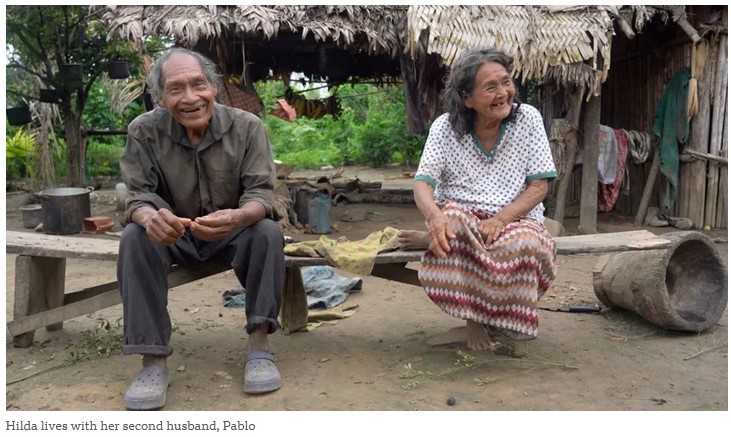
“According to their records, Hilda is 81,
but she says recently her family killed a pig to celebrate
her “100th birthday or something like that”.”
“Many Tsimanes never reach old age, though.
When the study began,
their average life expectancy was barely 45 years – now it’s risen to 50.
“But for Hilda, old age is not something to be taken too seriously.
“I’m not afraid of dying,” she tells us with a laugh,
“because they’re going to bury me and I’m going to stay there… very still.””

Big Bang 1.0 had been inconspicuous. There was nothing there to vibrate so sound could not travel. Also, there was no space so light had nowhere to travel to. On top of everything else, there was nobody there/then to notice.
What am I talking about? There even weren’t any ‘there’ nor ‘then’ at ‘that moment’…

Not for us, anyway!
Hence ‘Big Bang’ is a rather blatant misnomer.

Big Bang 2.0, the currently unfolding one, is an increasingly flashier event.
It began when we have started to talk. And developed conscience as a consequence. According to Humberto Maturana.

The first thing our ancestors had discovered was that they were heavily dependent.
On each other and on what we currently call ‘nature’.
Not having any of what we consider to be ‘scientific knowledge’ they didn’t know much about how things worked.
But they learned, slowly, to use fire.
How to make tools. And how to improve their dwellings.
All these things – fire, tools and protection from the elements – were auspicious circumstances for the first qualitative transformation of the genus. Not only our direct ancestors – Homo Sapiens – but also their cousins – Homo Neanderthalensis – had started to consider ‘the future’.

‘What is going to happen to me/us?’

This question, ‘am I going to eat this much/tasty again?’, demands three things.
A full belly, some time off and a (proto)conscience. At least some self awareness.
The fact that our ancestors, both the Sapiens and the Neanderthalensis, buried their dead and used tools to build/carve ‘jewelry’ strongly suggests that both of them did have a certain awareness/preoccupation about their own condition.

We don’t know whether they were ‘religious’ people.
What we do know is what people very close to what was going on then were doing until recently. And some continue to do. Populations which until have been ‘discovered’ were living like our ancestors used to do. They used to thank their totems for the food they hunted. And they erected ‘altars’ to celebrate the movements of the Sun.
Which strongly suggests that ‘what am I going to eat tomorrow?’ was far more important to them than ‘how much longer am I going to live?’.

The way I see it – following Maslow’s cue – people who live in rather ‘undeveloped’ communities don’t have enough ‘time’ to think about ‘death’.
They are accustomed to it – death is a lot more present in their life than it is in ours – and they still haven’t solved the ‘basic needs’. Not to the tune of reaching the ‘re-actualization’ stage.
They do think about tomorrow but they do it in far more practical terms than we do it.

They are not afraid of death as they are of dying of hunger. Painfully. Or both.

It was us, the ‘civilized’ people, who have become afraid of dying.
Concerned about ‘redemption’.
Thirsty for ‘meaning’.

Which ‘meaning’ brings me back to where this post has started.
One of the experiments which have convinced Rosenblatt et all to develop the ‘Terror Management Theory’ involved a number of municipal judges. Half were ‘primed’ by making them think about death while the others were left ‘unprimed’. The primed ones had imposed tougher bonding conditions to similar fictional suspects.
The experimenters posited that death was so important to them that thinking of it changed the conclusions they derived from the information available to them. Which is more or less correct.
Yet this experiment suggests something even more interesting. To me, at least.

Death is, besides a biological phenomenon, a cultural construct. An artifact.
And the fact that the judges had to be primed in order to be influenced by ‘death’ is a strong suggestion that they were rather influenced by the artifact than by the biological phenomenon.

We do know that we’re gonna die.
But we don’t constantly think about it. Our mere mortality isn’t a constant presence in our mind.
For it doesn’t make sense. It doesn’t help any. A waste of brain power which brings no real benefit.

What we do think – those of us who have a full belly and enough spare time, only during some of that spare time – is ‘what’s all this fuss about?’

What’s the meaning of all this?
Of all this man-made terror which is creeping on more and more of us…

It ends almost like it had started.
Make good use of the interval!

Life and death are two strange words. Very different yet they describe the very same thing.
If you think of it, death and life are like the faces of a coin.
After all, the exclusive qualification for being able to die is to have been born… And it’s only us, languaging rational beings, who make the difference between living and dying. At the conceptual level, of course.
OK, many others are capable of making the functional distinction between a corpse and a living body. We are impressed by the mourning behavior displayed by the elephants, for example. And even more so by the chimpanzee mothers who continue to carry the bodies of their deceased babies…
But since we are the only species – known to us, humans – who uses language to relate to each-other, to think about the world and to plan ahead, I’m going to discuss here only the languaging/reasoning aspects of us making the difference between life and death.
By making this difference we actually separate the inseparable. With momentous consequences. For us – individual human beings, for the species as a whole, for the rest of the species and for the rest of the world. The world as we know it…
The origin of this difference is our conscience. Which is sophisticated enough to be able to make it and to talk/think about it. The elephants are also conscient enough to act upon the difference between a living body and a corpse. To recognize the skeleton of a deceased relative. To remember it. But, at least apparently, they are not able to speak about the whole thing. Nor to transmit over generations that those particular bones belonged to a particular individual who had been related to … As soon as all individuals who had directly known the deceased individual, all information about the identity of the corpse/skeleton are lost. For a while, the survivors remember only the fact that their ‘mothers’ used to ‘mourn’ over this particular set of bones but nothing more. Again, this is what we know, now, about the manner in which the elephants treat their dead.
Which is very different from how we treat ours. And from how we relate to matters pertaining to life and death.
We cherish life and we dread death.
We cherish our lives and we dread our death. Ours and that of our (cherished) relatives and friends.
And we are somewhat indifferent to the lives of others… To the tune of being able to dispatch animals, and plants, for food. And to kill other human beings. In war but not exclusively.

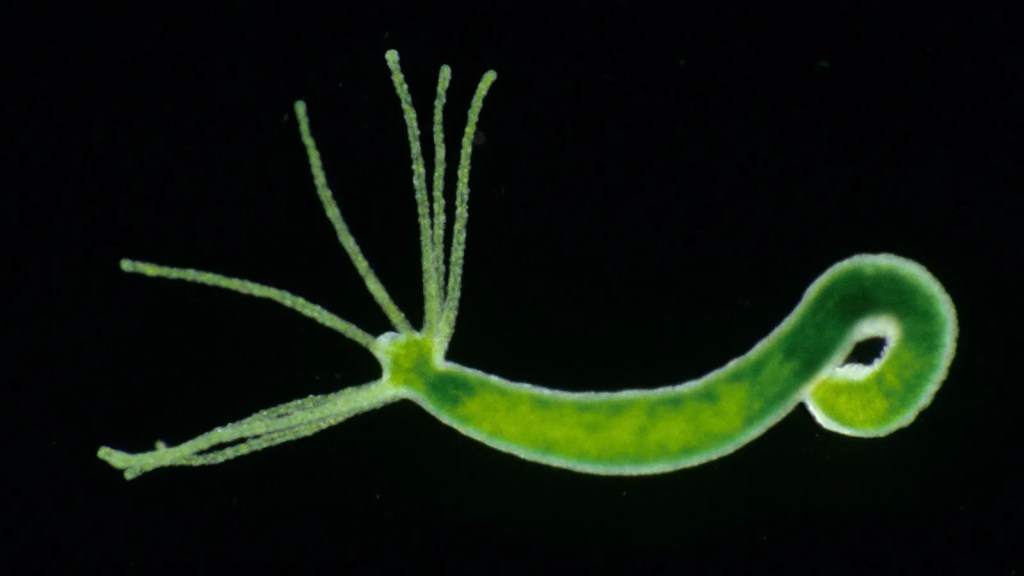
Named after the Ancient Greek mythological serpent, the freshwater hydra has a remarkable ability to regenerate (Credit: Natural Visions/Alamy)

Just finished reading a very interesting article on BBC.com/future. Why do we die. Authored by William Park.
Just click on the picture above and read it.

Despite the “we” in the title, it’s a compendium of plausible explanations for why most individual organisms eventually die. And an interesting row of examples of species comprised of individuals which live practically for ever.

Here’s another explanation.

Charles Darwin’s Evolution was about ‘species’. Not about individuals!

Very few species have been able to survive without ‘killing’ their individual ‘members’.
Hydra, the species of fresh water jellyfish pictured above, is one of those species. Each individual hydra is able to survive practically everything but total annihilation. Cut it into pieces and each piece would regenerate the rest of the organism. Allow a big enough (?!?) piece of it to survive while attempting to eat a hydra… and you may be able to eat it again! If you live long enough for the encounter to happen again…

Since when have we been observing this species? A hundred years? Two hundred? Have we had preserved an individual hydra since the start of our observations? Is is still alive? In the ‘original form’?
And even if ‘yes’, so what? That would only prove that an individual hydra is able to survive for more than, say, two hundred years. Not that it would live forever….
Again, being able to regenerate a portion of an organism doesn’t mean the whole organism would be able to live indefinitely. As in live forever. Never die…
The way I see it, being able to regenerate the rest of the organism is only yet another form of ‘reproduction’, not the ability to live forever. Bacteria use the very same mechanism. We the ones who use a different name for it, under the pretext that bacteria are unicellular organisms…

Now, the fact that there are so few species whose individual members are able to regenerate parts of their organisms does tell us something.
And the fact that it’s only the ‘simply organized’ species – among the animal kingdom, at least – which share this ability must surely mean something. Evolutionary wise!

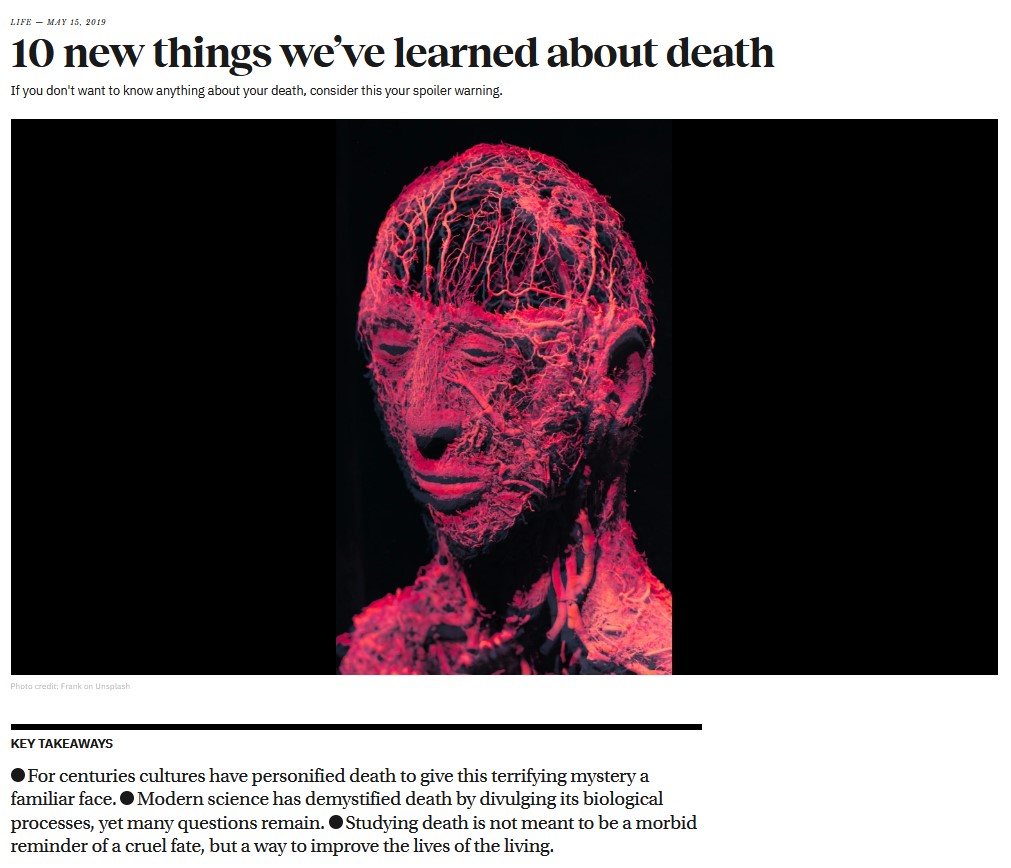
Studying death as “a way to improve the lives of the living”!

That’s a road well worth traveling to the end! Pun intended, of course.

Here’s my take on the subject:

Evolutionary speaking, death is more important than life.
‘Normal’ organisms – except humans, that is, cannot evolve while alive.
As Darwin put it, we have the evolution of the Species, not that of the individuals.
Hence, for evolution to function – for life to survive change, individual organisms must ‘make space’ for the next generations.
We, humans, are the first who can adapt individually. And how do we use that skill? Attempt to live forever?
“And the Lord God said, “The man has now become like one of us, knowing good and evil. He must not be allowed to reach out his hand and take also from the tree of life and eat, and live forever.”
Let’s assume that would be possible. Who would ‘make’ children anymore? Why? To have someone to serve them?
Who would ‘pass the baton’, willingly, knowing they still have a ‘lifetime’ ahead of them?
I could go on forever…

Don’t get me wrong. I’m not looking forward to breathing in my last gulp of air. I’m afraid of that ‘transition’, and even more so of what may happen in the moments before. But I find the whole thing to be perfectly normal!

https://bigthink.com/life/death
https://www.biblegateway.com/passage/?search=Genesis+3&version=KJV

One-Time
Monthly
Yearly

Make a one-time donation

Make a monthly donation

Make a yearly donation

Choose an amount

$5.00
$15.00
$100.00
$5.00
$15.00
$100.00
$5.00
$15.00
$100.00

Or enter a custom amount

$

As much as I love writing, I do have to eat.
And to provide for my family.
Earning money takes time.
If you’d like me to write more, and on a more regular basis, hit the button.
Your contribution will be appreciated!
Another very efficient way to help would be to share my posts.

As much as I love writing, I do have to eat.
And to provide for my family.
Earning money takes time.
If you’d like me to write more, and on a more regular basis, hit the button.
Your contribution will be appreciated!

As much as I love writing, I do have to eat.
And to provide for my family.
Earning money takes time.
If you’d like me to write more, and on a more regular basis, hit the button.
Your contribution will be appreciated!

DonateDonate monthlyDonate yearly

The sole difference between the living and the non-living is the fact that only the living is able to die.

Which death is the prerequisite for evolution!

A good place to start understanding what Covid had done to us is the cemetery.

A man had died. A good man had died.
Of old age. Covid had nothing to do with it.

But his beloved wife, and one of his daughters, could not attend his funeral service. They had tested positive while he was in hospital.

On the other hand…
On my way home, I stopped by to see an old friend. He lives alone and has a rather frail health. No relatives and, due to his relativelly old age, only a couple of able-bodied friends.
It’s a good thing that we have phones. If I’ll ever be quarantined simultaneously with his other friend, he’ll depend exclusivelly on delivery services….