Archives for posts with tag: Climate change

Bullshit!

Back in time, some people had written a book.
And started living by it.
Things went on rather good so more and more people joined the new tradition.

After a while, after things had become so good that some of the people had enough spare time to think, some of these thinkers had noticed that some of the facts contradicted what was written in the book.
Hence some of the people had reached the conclusion that the book was not entirely right.

That even if following ‘the book’ had brought them that far, they no longer had to follow it to the t.
And they had learned to be suspicious of every written word… of all previously held convictions…
They called this new habit ‘science’.

Things went on. From good to even better.
Now many more people had enough time to spare. To think, to play… to read…

Trying to fulfill this new ‘need’, some enterprising people have transformed news gathering and publishing into a show.
Until then, news had to be exact. Hence they were published only after a close scrutiny.
After the ‘transformation’, speed and entertaining value took precedence over trustworthiness.

Furthermore, people less than passionate about knowledge had started to invade the scientific realm.

A study linking autism and vaccines had been published in a prestigious scientific magazine.
And then retracted.

With two consequences.
Some parents decided to ‘risk it’ and a lot of people were left with the impression that science had become unreliable.
That science was no longer above fraud.

““Science is at once the most questioning and . . . sceptical of activities and also the most trusting,” said Arnold Relman, former editor of the New England Journal of Medicine, in 1989. “It is intensely sceptical about the possibility of error, but totally trusting about the possibility of fraud.”Never has this been truer than of the 1998 Lancet paper that implied a link between the measles, mumps, and rubella (MMR) vaccine and a “new syndrome” of autism and bowel disease.

Fast forward to the present day.
When an editor had put together a title pretending that a “herd of 170 bison could help store CO2 equivalent to almost 2m cars, researchers say”.

Really?!?

Let me look closer.
“2m” stands for 2 million, right?
And since a conventional car spews a little over a ton of CO2 each year, that title meant that each of those 170 bison was supposed to bury 11765 tons of CO2 each year. Give or take…
But there’s a second problem.
‘Climate warriors’ are ‘mad’ about cows. We are constantly bombarded with news stating ‘the cows are belching so much methane that the polar ice caps are going to melt during our lifetime’.
What about bison? Which are, for all practical purposes, wild cows… Don’t they also belch methane?
Try reading the article and see if you understand the difference between cows and bison…

Did your homework?
No?

OK, here’s my version.
Bison grazing in the wild are a close system.
The vegetation they feed on ‘sequester’ CO2 from the atmosphere and transform it into cellulose, using energy from the Sun. Through grazing, the bison encourage the vegetation to transform more CO2 into cellulose versus the situation where the bison were not doing their thing.
Some of the extra cellulose gets eaten by the bison and ends up being transformed into the best natural fertilizer known to nature. Which further encourages the vegetation to sequester even more CO2 from the atmosphere.
A cow living on a pasture – and allowed to roam as freely as a bison herd – does more or less the same thing.
But a cow living in a stable is an ‘open system’. It is fed a lot of corn and soy. Transported from afar and which totally changes the chemistry going on inside the cow. Corn and soy accelerate the rate of growth – the reason for feeding them to the cows – but result in the cows producing a lot more methane than when naturally feeding themselves on grass. Further more, the manure thus produced is never returned where the corn and soy had been produced.

The consequences?
While in a close system the result of photosynthesis – sequestered carbon – slowly accumulates in the soil, in an open system the metabolic results of the plants and animals involved are spread around the globe. Add to that the huge amount of (fossil) energy implied in growing the plants and transporting the goods around the planet and you’ll start to understand the difference between bison/cows grazing on a pasture and cows being fed in a barn corn and soy imported from Brazil.

Why didn’t you read this in the article above?
Where did the aberration regarding each bison being able to sequester almost 12 000 tons of CO2 came from?
Why people don’t care anymore about science?

I’m sorry, you’ll have to figure these out by yourself.

“This headline and article were amended on 16 May 2024. Due to an error in the original research, a previous version stated that Carpathian ecosystems browsed by (170) bison could store 2m tonnes of carbon, equivalent to the emissions of 1.88m average US cars petrol a year. The research authors have since retracted these figures, which were due to a coding error. The correct figure is that bison could store 54,000 tonnes of carbon, equivalent to the emissions of 43,000 average US petrol cars.”

To set a wolf to guard sheep
Latin proverb.

A first glance, it doesn’t make much sense to put an oilman in charge of a COP conference.
Nothing more than setting a wolf to guard sheep, right?

On the other hand, shepherd dogs are nothing but ‘converted’ wolves.
Wolves who had somehow figured out that it’s more sustainable to live with the humans than in the wild.
Former wolves who had somehow figured out that’s far more sustainable – for them, to protect the sheep than to prey on them.

OK, the agent driving the process had been human. But the facts remain. Dogs have evolved from wolves.

What are we waiting for?
If the descendants of the wolves had been able to ‘cross over’, why so many reasonable people continue to believe that the ‘Global Warming’ is a hoax?
After all, we’re the ones supposed to be reasonable…
And the way I see it, it’s unreasonable to believe that burning fossil fuel accumulated during millions of years can be ‘sustainable’. Forget about ‘peak oil’ and ‘peak gas’ and remember how hot the Earth was when the first drop of fossil fuel had been set aside by Mother Nature.

We were discussing ‘worst possible scenarios’ on Facebook and somebody mentioned ‘climate change’.
I must add here that the exchange was ‘framed’ by ‘skin in the game‘, a concept used by Nassim Nicholas Taleb in his rather don-quixotic quest for more responsible decision makers.

OK, the whole domain of climate change is riddled with epistemological holes.
Linear models are used to approximate processes we barely know anything about.
‘Starting points’ have been, again and again, been proven wrong.
I could go on for hours.

I’ll make a small parenthesis here and inform you that according to a fresh study things might be far worse than we’ve reckoned. This paper, published by Nature.com, suggests that Earth’s oceans used to be far cooler than we’ve previously thought they were.

In this context, one of the participants made the following remark:
the burden (of proof) should fall on those calling for changes, for the rather obvious reason that we could suggest changes all day long. Only a few can be implemented.

Hard to argue with that, right?

But which changes are we talking about here?

A change in our manner of interacting with Mother Nature?
Costly, indeed, financial wise, but nowadays technologically possible.

Or about the changes we’ve already – unwittingly, most of them, imposed upon our ‘spaceship’?

We’ve dramatically changed the ‘use of land’. Agriculture and transport – yes, roads and railways have a huge impact – have changed the very nature of what’s going on on a considerable portion of the Earth’s surface.
We’ve dramatically changed the composition of the atmosphere. And I’m not talking about CO2 yet. CFCs, pesticides, NOx and SOx gases, etc., etc….
And, last but not least, we’ve reversed a trend which had been going on for hundreds of millions of years. Photosynthesis used to transform atmospheric CO2 into organic matter, some of which has been steadily accumulated as coal and crude oil.

So, about which changes should we worry first?

Or, in SITG terms, whose skin should bear the brunt of change?

Ours or our children’s?


globalnews.ca Storms flood roads, cause train derailment in Texas, which awaits remnants of Patricia

Some people maintain that we are in a middle of a ‘Global Warming’ and that, at least partially, we have brought this on our own heads.
Some others say that this is nothing but bullshit while a third group says that yes, it might be possible that the Earth is slowly heating up but that there is no way to demonstrate that ‘we did it’.

When it comes to what to do about it people are divided among totally different lines.
Some say we need to go on burning fossil fuel because it’s the most cost efficient way of producing energy, some-others that ‘we are sorry but we really need to close the economic gap there is between us and the developed nations’ and a few try to convince the rest that the Earth is the only home we’ve got and that we should do everything in our power to keep it as close to habitable as we can.

Where do I stand on this matter?
I’m not going to enter the dispute that tries to convince us that weather and climate are two different things.
I’m not going to pretend that ‘we did all of it’. Not even the most rabid treehuggers go that far.

All I’m going to do is ask this: Are you aware of the fact that burning things produces CO2 and that is a very effective green-house gas?
Do you know that “Currently, humans are emitting around 29 billion tonnes of carbon dioxide into the atmosphere per year.”? OK, some of it, about half according to some, is absorbed by the so called ‘carbon sinks’. But the rest? And how long before those sinks become saturated?
Furthermore, determining how much CO2 has been added to the atmosphere – or if any at all – is a rather murky business. Simply because of the seasonality of the plant life, volcanic eruptions and a lot of other variables.

That’s why I’m going to take another tack.
During billions of years in Earth’s history plants and animals have transformed atmospheric CO2 into coal, oil, natural gas and limestone. During this period, climate – and the Earth itself – have suffered huge transformations. Do we really think we can undo, even in part, this process – at a very rapid pace – without bearing at least some consequences?

Even some of those who, until very recently, kept saying that they need to close the development gap are having second thoughts and look for alternative methods.

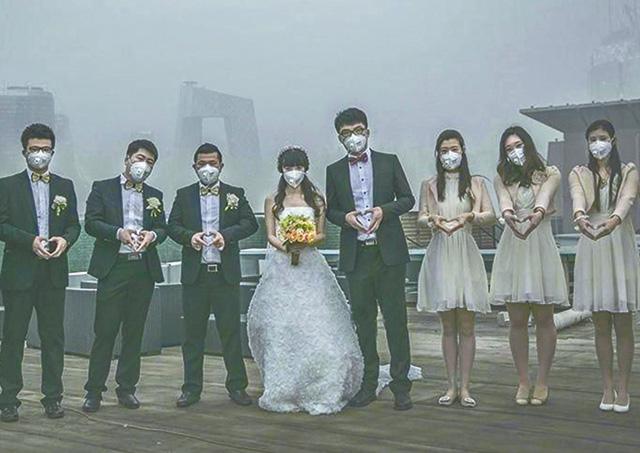
www.chinatoday.com, A wedding ceremony held during heavy pollution in Beijing (20141021)

The humble legume, savior of humanity.(Neil Palmer, CIAT)

What?!?
An agricultural break through that doesn’t involve ‘invasive’ genetic engineering?
Somebody that still cares about biodiversity?

It seems that we still have a fighting chance to survive decently!

http://qz.com/369495/scientists-have-engineered-the-food-that-could-save-a-starving-warming-planet/