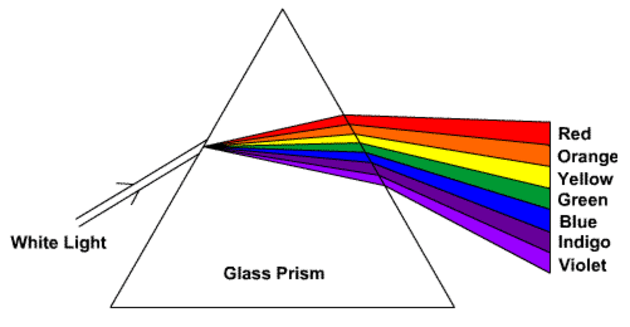
According to Newton, there’s no new colour to be seen. The spectrum he had ‘split’ from what was called white light was continuous. And still is. So, in order for us to see a new colour we should rename one of the already existing ones.
There’s more to light than meets the eye… at the first glance, at least. The way our brain works has something to do even with what we see of this world! The good thing being the fact that once we understand how our brain works, we are capable of by-passing at least some of these limitations.
But what has any of these to do with ‘dimensions’?!?
I’ve argued in my previous post that having evolved as ‘runners’ we basically live in a 2.5 dimensional world. That we are biased against a proper perception of depth. And that we loath to go back and reconsider already entrenched convictions.
In this post I’ll go further and say that dimensions are tools. Gimmicks we have invented to help us make sense of the world. And not only invented but fine tuned to fit our purposes.
We have invented length and breadth when we needed a way to impose taxes on arable land. We have invented weight and volume when trading cereals and wine. We have invented time when needing to pin point our position on a map while sailing around the world. We have radically altered geometry when the old one was no longer useful. We have even learned to adjust dimensions when speed had became fast enough to demand it.
Now, time is ripe for us to reconsider them altogether. Opportunity, space and time. We can make do with only three basic dimensions.
We learn about what we call reality by analyzing the information we acquire through our senses.
We. We, the human people. We, the conscious human people. We, because nobody has ever been able to become conscious – as in aware of their own self, by their own. Alone…
Learn. We are not the only ones who are able to learn. Our dogs learn our ways. And we continuously learn about more and more living organisms being able to learn. And to remember what they have learned. To fine tune their behavior according to the circumstances into which they happen to live.
What we call reality. First and fore-most, reality is a concept. We call it ‘reality’. And many other names… Believers call it ‘god’, scientists call it ‘physical world’ and the scientists who happen to believe are convinced that by studying the reality they will eventually divine the will of the Lord. The believers being convinced that whatever exists, is here because the Lord wished it into existence. So, basically, the main difference between the believers and the nonbelievers is the fact that the believers are convinced that the ‘out-there’, the ‘source of it all’, has a conscience of it’s own. A will of it’s own…
By analyzing. We have been able to build our conscience – our ability to ‘observe ourselves while observing other phenomena’ (Maturana, 2005), because we have a big enough brain, the ability to share complex and meaningful information using language and the ability to put in practice some of our wishes/thoughts through the use of our hands. At a certain point in its evolution, human conscience has become sophisticated enough to need explanations. It was no longer satisfied with mere ‘connections’ – If… then…, it had started to wonder about why-s. ‘Why does this happen as it does?’ ‘Will it happen again tomorrow?’ Using our by then already established ability to speak up their minds, our ancestors shared among themselves these ‘anxieties’. Discussed them around the fire-place. Started to analyze. The reality. What they perceived to be real. The ‘thing’ which continuously generates the circumstances in which we – all of us, have to make do.
Information. In order to analyze, the analyst – each and everyone of us, has to separate the meaningful information from the surrounding noise. In order to do that, we have started by coining the very concept of (useful/meaningful) information. As being different from ‘noise’. The difference consisting, obviously, in us being able to find its use and/or pinpoint its meaning.
We acquire. Information is acquired on an individual basis. For an ‘event’ to become information, it has to be ‘noticed’ by an individual. It has not only to be sensed but also identified as useful/meaningful. Different from ‘noise’. Which process of identification implying methods which had been agreed upon by the members of the community. Music would be a good example of how various groups of people make the difference between sublime/abhorrent and white-noise. While ‘use of language’ is a very poignant example of how people can both share information and mislead one-another.
Senses. Everything that we know, had entered our mind through our senses. Before setting it aside as information or discard it as noise, we have to get in contact with it as a sensation. Or as a thought. A conjecture. A few pieces of information which put together have given birth, inside our individual mind, to new information. To ‘something else’ which passes the threshold into being information. At least according to our own mind…
Which transforms our minds into our famous sixth sense. In the sense that our individual minds are capable of building ‘sensations’ on their own. Starting from information that has already been stashed in our memory. Which brings us to the third reality.
We have – in the sense that we have agreed upon its existence, the surrounding reality. The things we – as in most of us, consider to be real. The mountains we climb, the air we breathe, the pebbles which happen to sneak into our shoes. The reality which is being studied by science. The reality to which we have access through our senses. Our minds and our sense enhancers – scientific instruments, included.
We also have the ‘out-there’. The things we know we’ll never be able to grasp. During our lives! The things our followers might be able to figure out…
And each of us has their own reality. Individually built even if ‘carved’ from the same (type of) material as the reality shared by the rest of us. Individually built even if using more or less the same (culturally accrued) methods. Individually built even if neither of us is alone.
H.M. Romesin, 2005, The origin and conservation of self‐consciousness: Reflections on four questions by Heinz von Foerster
A planned after-thought. Rumsfeld is both wrong and right. There are unknown unknowns but they are no longer unknown since we speak about them… Which actually proofs the limits of our languaging. The imprecision of the manner in which we gather, share and analyze information.
There are two ways in which we may acquire information. The hard way and the reasonable way. By ‘immersion’ or by learning. By ‘getting stronger if lucky enough to survive’ or by making sense of what had happened to others.



 nicichiarasa