Archives for posts with tag: Abraham Maslow

“If the only tool you have is a hammer,
you tend to see every problem as a nail.”
Abraham Maslow
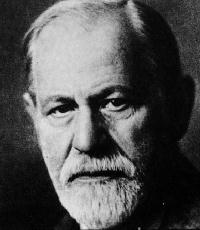
Did you recognize him?
Yes, Sigmund Freud. Dr. Sigmund Freud, as depicted on http://www.marxists.org.

“While the different religions wrangle with one another as to which of them is in possession of the truth, in our view the truth of religion may be altogether disregarded.
Religion is an attempt to get control over the sensory world, in which we are placed, by means of the wish-world, which we have developed inside us as a result of biological and psychological necessities.
But it cannot achieve its end.
Its doctrines carry with them the stamp of the times in which they originated, the ignorant childhood days of the human race. Its consolations deserve no trust. Experience teaches us that the world is not a nursery.
The ethical commands, to which religion seeks to lend its weight, require some other foundations instead, for human society cannot do without them, and it is dangerous to link up obedience to them with religious belief.
If one attempts to assign to religion its place in man’s evolution, it seems not so much to be a lasting acquisition, as a parallel to the neurosis which the civilized individual must pass through on his way from childhood to maturity.”
[Sigmund Freud, “Moses and Monotheism”, 1932]

No, I’m not going to argue with Freud.
I’m not going to compare his opinion on religion with that of Durkheim. Which makes more sense to me. You may find them here, at #e., and compare them yourself. If you wish, of course.

What I’m trying to point out in this post is that reason is over-rated.
That reason is an extremely powerful tool but, like all other tools, the consequences of yielding it depend on the yielder.
On the person using reason in order to get somewhere.
To find the intended meaning…

Which is?

“One of Pareto’s most noteworthy and controversial theories is that human beings are not, for the most part, motivated by logic and reason but rather by sentiment.”

Coming from an engineer – Pareto had started as one, this concept becomes even more noteworthy.
Why would a ‘professional using precision measurements and seeking consistently reproducible results’ focus his attention on sentiment rather than reason?

Because this is the reasonable thing to to?

And one of the reasons for which I tend to agree with him – besides being an engineer myself, is that he had started his studies using the most ‘reasonable’ instrument ever devised by man: “Residing in Florence, he studied philosophy and politics and wrote many periodical articles in which he first analyzed economic problems with mathematical tools.”

So, Pareto had reached the conclusion that human beings are driven mostly by sentiment after rationally analyzing the economic (and political) life.

OK. But what lies behind ‘sentiment’?

Pareto had proposed ‘residues’ as ‘motivation’ for sentiment. His theory is interesting only rather complicated. Almost byzantine. A well written summary can be read here.

What I find fascinating about Pareto’s theory is the rather veiled but certain correspondence which exists between his ‘residues’ and Maslow’s “hierarchy of needs”.

I’ll try to ‘raise the veil’ at a later date, today I’ll just point you towards a very relevant ‘coincidence’.

The psychologist had traveled the same road as the engineer.

Maslow (1943) initially stated that individuals must satisfy lower level deficit needs before progressing on to meet higher level growth needs. However, he later clarified that satisfaction of a needs is not an “all-or-none” phenomenon, admitting that his earlier statements may have given “the false impression that a need must be satisfied 100 percent before the next need emerges” (1987, p. 69).

Both had started ‘deterministically’, trying evidentiate ‘the’ (ironclad?) link between behavior and conditions – and expecting that link to be of a rational nature, only to reach the conclusion that individual sentiment/evaluation is at least as important – if not more so, as reason in the decision process. In shaping human behavior.