


Japanese kids learn what to do when earthquake strikes while Israeli kids learn how to deal with incoming rockets.
When are we, the grown ups, going to learn?
Japanese kids learn what to do when earthquake strikes while Israeli kids learn how to deal with incoming rockets.
When are we, the grown ups, going to learn?
Bacalaureat 2014:
Absolventi de liceu: Aprox. 200 000
Candidati: 161 000Adica vreo 44 000, cam unul din patru absolventi, nici macar nu s-au ostenit sa se inscrie.
Evaluarea nationala (a absolventilor de clasa a 8-a) 2014
Absolventi inscrisi: aprox 160 000
din care 113 250 cu media peste 5 iar
46.700, adica din nou unul din patru, sub 5.
Cu alte cuvinte in 4 ani, din 1995 pana in 1999 locuitorii Romaniei s-au scarbit atat de tare incat au facut cu 40 000 mai putini copii. Apoi acesti copii au crescut intr-o atmosfera atat de incurajatoare incat aproximativ un sfert dintre ei au ajuns la concluzia ca invatatura este o adevarata pierdere de vreme.
Si atunci cum ramane cu ‘ai carte ai parte’?
Ei bine sensul acestei zicale este putin mai complex.
“A avea carte; ai carte, ai parte = a avea acte, în regulă, pentru susţinerea unei pretenţii de proprietate.”
Zicala provine de fapt de pe vremea cand Stefan cel Mare a intarit prin emiterea de ‘hrisoave domnesti’ dreptul de proprietate al mosnenilor care l-au ajutat in lupta asupra pamanturilor pe care acestia le stapaneau din mosi stramosi. Cei care au pastrat inscrisurile au putut sa isi apere posesiunile in fata boierilor hrapareti, cei care le-au crezut niste hartii lipsite de valoare au putut fi izgoniti, cu relativa usurinta, de pe pamanturile lor.
Cu alte cuvinte valoarea ‘diplomelor’ rezida, de fapt, in modul cum sunt ele privite de cei care le poseda. Iar atunci cand oamenii nu mai au ‘incredere’ in ‘inscrisurile’ emise de institutii societatea respectiva se afla intr-un punct de extrema dificultate. Acelasi lucru se intampla si atunci cand oamenilor nu li se mai pare util sa se pregateasca pentru ‘ziua de maine’.
Un alt simptom al acestei stari de dificultate este locul ocupat de fenomenul coruptiei in viata omului ‘de rand’.
Aceasta ‘coruptie’ este atat de prezenta in viata noastra incat a devenit pretext de lupta politica, partidele se arata unele pe altele cu degetul: ‘coruptii tai sunt mai multi/putrezi decat coruptii mei’.
Iar atunci cand astfel de confruntari au loc simultan cu niste evenimente extrem de importante pentru viata noilor generatii, bacalaureatul si inscrierea la liceu, si chiar reusesc sa le eclipseze pe scena publica asta inseamna ca lucrurile au iesit cu totul si cu totul din fagasul normal.
Poate ar fi cazul sa ne uitam fiecare dintre noi in oglinda si sa intelegem o data ca asa nu se mai poate. E adevarat ca niciodata nu e prea tarziu dar de ce sa ajungem pana acolo?
Ca natie.
Pe http://www.edu.ro tocmai au aparut rezultatele finale ale evaluarii nationale a absolventilor de clasa a 8-a iar pe toate televiziunile de stiri se vorbeste doar de Voiculescu.
Coruptia este intr-adevar o problema foarte importanta dar pana la urma este doar un simptom.
Al faptului ca nu ne mai pasa, cu adevarat, de ziua de maine.

Quite a large number of us, regular people, are concerned about ‘survival’. From what to do in order to feed our children to how to protect wealth from being eroded by the inflation.
Some others, more ‘extreme’ or more sensitive, are actively preparing for what is known, by them, as ‘the imminent ending of the world’. There is no consensus on what will bring about this catastrophe – from the odd meteorite falling on Earth before the appropriate measures being taken to the unsustainable way we manage our economy or the environment but this is no deterrent for the hardcore survivalists.
In a way, they are right. After all it doesn’t matter how it happens, the main thing is to be prepared.
And this is exactly were the ‘fun’ part starts.
Most of them concern themselves with learning how to survive out in the open, how to build and stock an ‘anti-atomic’ bunker, how to use firearms, etc., etc… In fact what they do is recreate the medieval ‘castle’ mentality where the world was disputed by strong armed thugs who tried to control as many resources as possible. In time, tired by the slow burning conflict that occasionally burst into open fighting, they ‘invented’ the rules of ‘chivalry’, a framework that provided both a venue for their need to ‘prove themselves into ‘battle’ (the jousting tournaments) and enough social predictability which enabled relative stable economic relations between human ‘settlements’ that were ruled by different land lords.
From that moment on survivability was no longer improved by simply erecting higher and thicker walls but rather by maintaining a workable equilibrium between the members of a certain community – be it group of people, ‘commonwealth of villages’ or federation of states.
Fast forward to the XX-th century and we find out that the survival problem hasn’t been fixed yet. Andre Malraux, a Frenchman who started as a communist writer and ended up as an anti-totalitarian philosopher once wrote that “le vingt-et-unieme siecle sera religieux ou ne sera pas”. A rough translation would be ‘in the XXI-th century people will rediscover religion or they will perish’. Coming from a professed agnostic this continues to create huge controversy as to its real meaning.
A solution to both the riddle and the survival problem might not be so hard to find.
Lets turn to the utmost survival specialists, the Jews. For the first 15 centuries or so they survived living in ‘history’s turn-still’ – Palestine – while for the next 20 they made do even without the benefit of having a place to call their own.
How did they do it?
By fighting each other? No, on the contrary.
By fighting against the people they were living amongst? They would have been wiped out long ago. Even when they were used as escape-goats by reckless and callous temporal rulers the Jews somehow found a way to survive, mainly because enough members of the general population remembered the normalcy of the situation before the pogroms were instigated, normalcy during which the Jews were adept at conserving their traditions yet playing their role as useful members of the wider community.
And, maybe, this is also the key of Malraux’s riddle. Religion is more than following ritual, considerable more than that.
The word itself comes from the Latin ‘reliegare’, ‘connecting to’. It can mean both the connections that appear between members of the same community but also the connections that appear between the community itself and its environment. So it doesn’t really matter if religious teachings are said to have been handed down from a God or are considered to be a distillation of long accumulated tradition. All it matters is ‘have those teachings proven useful?’ Were they helpful enough to their followers so they could cope with whatever history has thrown at them?
Well… in the case of Judaism they did that, for more than three and a half millennia. And nowhere in those teachings one can find ‘if things get rough leave everybody behind and hide someplace waiting for the worst to pass’. Every religion, be it based on a God or not – Buddhism, for instance does not have a godlike figure in its center – teaches its followers that it is a lot easier to survive helping the others than fighting against all others.
Honing individual survival skill is of course important. But we should not forget that crises come and go. What we really need is to learn how to survive the long stretches of apparent stability, during which we allow the build up of immense tensions that end up by tearing apart our livelihood. As it is about to happen.
Initially politics was an activity. “Was” and not “were” because it was something in which every concerned citizen played an part, a collective effort. Oh, I forgot to tell you that this happened in Ancient Greece during what we now call the ‘first stage of democracy’.
Then, after a little less than two millennia, it became an occupation. People who had successful careers behind them were deemed trustworthy by the rest of the community and elected into government positions. The countries which used this ‘democratic mechanism’ thrived: the US, Britain, France, …to name just a few of them.
Lately politics have become a profession. People study it in Universities and engage in it without any prior experience outside the field. I believe you all know what ‘community organizer‘ means, right?
No, I’m not going to discuss this notion right now. The results can be both good or bad, exactly as it happens with almost all human professions: both Mengele and Albert Schweitzer were MDs…
For now I’ll refrain myself to observing that people have less and less tolerance for digression on the part of the politicians.
“Nicholas Sarkozy arrested over corruption allegations”
Gerhard Schroeder, lionized in his time for cutting down to size the German welfare state is now widely criticized for his involvement with GAZPROM.
Silvio Berlusconi is serving time, disguised as ‘community service’, for tax evasion.
Need I go on?
And this is happening in what we call ‘democratic countries’. In other places former rulers are stabbed to death or brought to justice in a cage.
In fact we have indeed progressed, as a species. The last time the French got really pissed off by their leaders quite a few people lost their heads…
The most disturbing thing in all this is that the politicians were supposed to be the ones capable/willing of doing ‘the good thing’ AND professional enough as not to exaggerate in anything they do….
Is there anything to be done about all this?
How about upping the ante?
I keep hearing ‘we need a strong leader’ or ‘we need more true leaders’. Are we really sure about that? Leaders would do almost anything to take us where THEY see fit.
How about politicians acting as ‘administrators’?
Right now politics is played, in a lot of places, as a beauty pageant. Would be rulers (leaders) come up-stage to make promises and we choose the ‘best-looking’ charmer. After a while he unfailingly fails so we ‘boo’ him out of office.
Switzerland, for instance, has another way of doing things. They talk a lot more among themselves, many ideas are put forward and then some of them get to become policies and other get dumped.
When have you last heard about a Swiss political leader or about a Swiss political scandal?
“When God solves your problems, you start to trust him.
When God doesn’t solve your problems…it’s because he trusts you!”
Just found it in my mail, I’m not this wise.
For a relatively tiny continent, Europe has an abundance of divisions. Ethnicity, religion, weather, and even food have divided Europe along common fault lines throughout its history. The chart below, taken from Yanko Tsveltkov’s Atlas of Prejudice 2, is a satirically over-broad depiction of some of the most salient of divisions. It is meant to be overly simplified to the point of absurdity, poking fun at those who hold such blunt prejudices about large swaths of territory, so please do not take offense.
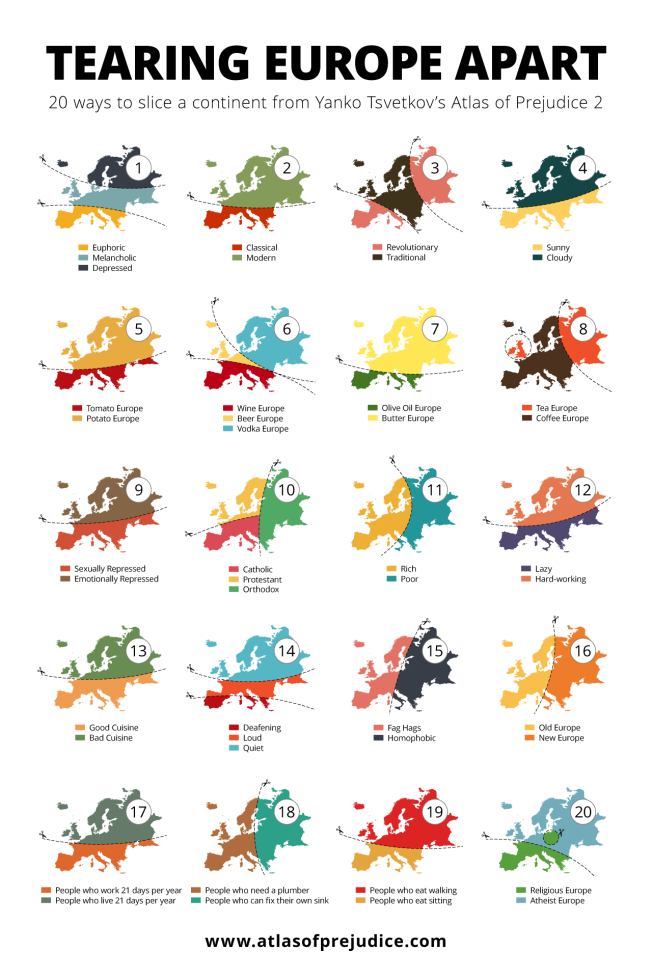 20 Ways to Slice Europe (From “Atlas of Prejudice 2”, by Yanko Tsvetkov, via http://atlasofprejudice.tumblr.com/)
For many of these maps, however, there is a kernel of truth. My mother’s ancestors hail from Greece, and my father’s from England, which are two countries which could not be more diametrically opposed within Europe. Indeed, in the chart below, Greece and England are on different sides in 19 of the…
View original post 192 more words
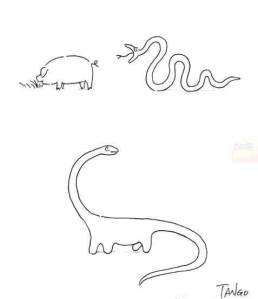
So this is what ‘intelligent design’ is about!
In fact it’s funny even if rather inappropriate since pigs appeared on the face of the Earth long after dinosaurs went extinct.
Thanks to “I fucking love science” for this subject and for the cartoon.
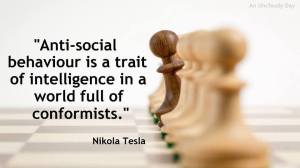
Tesla was a great physicist and a very intelligent man but his wording was rather lousy.
I get the gist of what he wanted to say and I basically agree with him but I don’t think “anti-social behaviour” aptly describes what he had in mind.
The real meaning of ‘anti-social’ is ‘acting against the interests of the group of which the perpetrator is a member”: from stealing to high treason.
What I understand of Tesla’s words are gestures made against ingrained habits which induce social stiffness – social rigidity that inhibits innovation and adaptation.
And in fact all these gestures are pro-social, they are good for the society at large and not at all bad or anti-social.
It is true that today ‘anti-social behaviour’ has been ‘stretched’ to include all actions that disturb ‘social norms, socially sanctioned customs and widely held beliefs’ but this would be true only as long as these ‘habits’ were still useful to the society we are speaking about.
I don’t think Tesla would have condoned theft or any other criminal activity, no matter how anti-social, but he would have applauded, had those things happened during his life, what Copernicus, Giordano Bruno and Darwin had done. Or Martin Luther King.
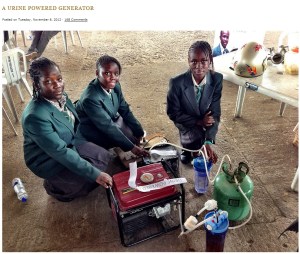
So what do we have here?
Four crafty teenage Nigerian girls have put together an ingenuous rig for a ‘science and technology’ fair.
A well meaning ‘eager beaver’ journalist wanting to help promote their exploit has branded the whole contraption as an ‘urine powered generator’.
An then the hell broke loose:
I’m not in the business of apportioning blame all over the internet but after finding out about this succession of events I started to have serious doubts about who is wrong and who should be ashamed of themselves….
I’m sure that most of you have already understood where I’m headed to but please bear with me.
So OK, the ‘eager beaver’ has indeed stretched the reality a little bit. It’s not an ‘urine powered generator’ but an ingenuous ‘science project’ presented by some teen age students.
So what was it that brought the wrath of the ‘eco-scammer’ on those ‘poor’ girls? Or even on the writer of the original article…
Who, and where, claimed that the contraption produced more energy than it consumed? Yes, those arguments involving thermodynamics and all that scientific mambo-jumbo that he is mentioning inside his article are absolutely correct (“trust me, I’m an engineer”, a real one that is) but perfectly misplaced.
As is the original title but while that title is an innocent exaggeration the second article is a malicious (or myopic?) and undeserved rebuttal.
Getting back to what had started all this, that ‘thing’ is not a ‘generator’ but can be used as an accumulator!
Solar panels produce energy when the sun is up but people need light at night, obviously.
Even more importantly, solar panels produce a type of current (DC) which can be used to ‘split’ water into hydrogen and oxygen and to light a special kind of bulb but for little else. If you want to power a ‘modern appliance’, a refrigerator for instance, you need an inverter – a pricy device that transforms DC into AC.
On the other hand the type of gas powered generator used by those crafty students is relatively cheap and common enough almost everywhere in the world. Adapting it to run on hydrogen is easy, this feat was not even mentioned in the original article.
So the real meaning of what those 4 girls did is that they came up with a way to replace a costly scheme comprising a lot of batteries and an inverter with a gas bottle, an already largely available gas powered generator, an electrolytic cell and two filters.
Not a small feat, by any means!
If you take some time to think about it, of course.
And yes, there are four girls that did this, not three like the ‘eco-scammer’, who probably didn’t even bother to read the original article, wrote insouciantly after merely taking a glance at the photo that came with the inappropriately titled news.
The original story can be read here: http://makerfaireafrica.com/2012/11/06/a-urine-powered-generator/
and the ‘eco-scammer’ rebuttal here: http://www.eco-scams.com/archives/790

 nicichiarasa