
Cica din ce in ce mai multi se muta de la oras la sat.
O fi de bine, o fi de rau…
Sau poate ca motivul pentru care acest lucru are loc este mai important decat directia in care are loc ‘curgerea’?
Cica din ce in ce mai multi se muta de la oras la sat.
O fi de bine, o fi de rau…
Sau poate ca motivul pentru care acest lucru are loc este mai important decat directia in care are loc ‘curgerea’?
Citesc astazi dimineata doua articole din Ziarul Financiar. (Recunosc ca nu prea mai citesc presa, si cu atat mai putin articolele de opinie)
Mai intai “Eu cred in Romania pentru lucrurile pe care le poti face aici” si apoi “Generatia care a facut bani din dezastrul demografic si secarea Romaniei”.
Din primul aflu de ce unii dintre antreprenorii de top ai Romaniei nu au parasit-o (cel putin nu inca) si cam ce ar trebui facut pentru ca din ce in ce mai multi antreprenori sa isi incerce ‘puterile’ aici si nu aiurea iar cel de al doilea imi confirma impresia ca exista o suma de indivizi care au identificat si exploatat extrem de eficient, in Romania, niste oportunitati extrem de favorabile.
La prima vedere am putea spune ca amandoua articolele sunt despre acelasi lucru – oportunitatile din Romania, iar ca singura diferenta dintre ele ar fi ca primul incearca sa sondeze viitorul iar cel de al doilea se uita catre trecut.
Totusi, daca ne uitam mai bine, vom intelege ca autorul celor doua articole, Cristian Hostiuc, a inteles pe deplin si incearca sa ne avertizeze si pe noi – inainte de a fi prea tarziu – ca daca mai continuam asa se va alege praful de tot si de toate.
De fapt in nici unul dintre articole nu este vorba despre ‘resurse’ sau despre ‘oportunitati’ ci despre modul in care acestea sunt utilizate si despre responsabilitatea fiecaruia dintre noi.
De fapt pe nimeni nu intereseaza/n-ar trebui sa intereseze ca o intrega generatie de ‘fosti’ si de ‘conectati’ s-au imbogatit imediat dupa ‘Revolutie’. In schimb, si indiferent daca ne intereseaza sau nu, soarta fiecaruia dintre noi este influentata intr-un mod hotarator de modul in care acestia s-au imbogatit. Nu este acelasi lucru sa construiesti ceva nou si sa te imbogatesti exploatand acel ceva – vedeti ce frumos suna ‘a exploata’ in acest context? – sau sa distrugi ceva ce functiona de bine, de rau, si sa te imbogatesti vanzand fiarele vechi obtinute in urma demolarii.
Hostiuc ne mai avertizeaza ceva. Ca daca o tinem tot asa, daca aplicam generatiei urmatoare metoda pe care Stefan cel Mare o aplica invadatorilor – cea a fantanilor otravite si a pamantului parjolit, vom constata ca tot ce am reusit sa facem este sa ne taiem singuri craca de sub picioare.
Drama comunismului era ca aveam ceva bani in buzunare dar nu aveam ce sa facem cu ei iar drama capitalismului este ca magazinele sunt pline de marfa dar nu mai avem noi bani sa cumparam tot ce ne dorim.
“Guvernatorul BNR Mugur Isărescu îşi punea problema, în public, acum vreo doi ani, cine o să-i plătească lui pensia, uitându-se la generaţia care vine din spate.” Cred ca problema reala a lui “Isarescu” si a colegilor sai de generatie va fi ca in pofida tonelor de bani pe care le vor fi acumulat nu vor avea pe cineva suficient de apropiat incat sa ‘ii stearga la fund’ atunci cand nu vor mai putea face singuri acest lucru.
O sa imi spuneti ca daca ai suficient de multi bani vei reusi intotdeauna sa angajezi pe cineva sa munceasca in locul tau. Da, cu conditia ca banii aceia sa mai valoreze ceva.Adica ca acel ce ii primeste in schimbul muncii sale sa aiba ce sa faca cu acei bani.

The funny thing is that most of us use ‘algebra’ on a daily basis, unwittingly.
And no, I’m not talking about the fact that every modern appliance has a lot of algebra embedded in it during its being designed and manufactured while some of them (the ‘programmable’ ones) continue to rely on algebra while being used…
We all pretend to be logical thinkers, right?
And what else is algebra if not symbols and numbers treated in a logical way while logical thinking means treating ideas in a very algebraic mode?
Read more about this here: http://www.sscc.edu/home/jdavidso/mathadvising/whymath.html
Se spune ca gelozia este o manifestare a instinctului de conservare a speciei, a dorintei individului de a-si transmite genele catre generatia urmatoare.
Eu as spune ca este doar o manifestare instinctuala. Cu alte cuvinte ‘naturala’ la un nivel ‘primordial’.
Iar faptul ca este ‘naturala’ nu o face neaparat dezirabila … sunt multe lucruri pe care stramosii nostrii le considerau a fi naturale dar care nu mai reprezinta ‘avantaje competitive’ in zilele noastre, ba chiar dimpotriva.
Cum ar fi mamele de 12 ani sau diferente enorme de varsta intre sot (cateodata un bosorog bogat) si sotia luata (cateodata aproape pe sus) pentru a ‘improspata’ sangele (degradat prin ‘inbreeding’) al familiei ‘aristocratice’.
Cam asa si cu gelozia asta… in zilele noastre este mai degraba o manifestare de neputinta decat de de orice altceva, instinct de conservare a individului versus instinct de conservare a speciei.
Din cate am observat eu gelozia se manifesta de obicei la cei care nu reusesc sa tina pasul cu partenerul de cuplu SI care se simt amenintati de succesele acestuia, semn ca acel cuplu s-a intemeiat initial ca o ‘alianta’ intre doua persoane care aveau printre teluri o puternica dorinta de a parveni si mai putin ca o uniune intre doi parteneri care mai presus de orice se respecta intre ei…
At some point the significant individual involved in a situation will have to make the relevant decision.
And here comes the difference between a human and a horse.
The horse will wait until it becomes thirsty, no matter how ample opportunities to drink would present themselves before him while the human will first make sure that the water is safe to drink and only then decide what to do: drink pre-emptively, fill a flask, take a nap by the spring…
The point I’m trying to make here is that while animals, no matter how ‘sophisticated’, act according to their instincts (or ‘training’) we humans sometimes act instinctively/emotionally and some other times ‘rationally’ – we ‘identify opportunities’ and try to use them to further our goals.
And here lies the watershed…
Our ‘rational’ decisions can be good or bad and there is no real way to tell before hand which is which. Hence the ‘primum non nocere‘ (“first do no harm”) rule used by the professional healers of this world.
The problem with our rationality is that we never have all the pertinent information at our disposal, enough time to process whatever information we do have nor the wisdom to realize the first two limitations. And this is why we too often proceed as if those two limitations never existed….
Why haven’t we failed miserably until now? (Miserably enough as to never be able to stand up again or to finally learn the lesson?)
Because we relied heavily on ‘tradition’/’religion’. Usually these two are taken together but I prefer to treat them separately. You see, it is true that both of them are nothing but information accumulated in time as a result of the social cooperation that takes place even without us being aware of it but there is a fundamental difference between them.
‘Tradition’ usually has to do with ‘technology’, the way we do things, while ‘religion’ (which comes from the Latin word ‘reliegare’ = ‘connecting to’) is mostly about sharing a common understanding of the world and acting, collectively, according to that ‘Weltaunschauung’.
And here comes the interesting part. Being the member of a certain religious cult/church is nothing but a set of circumstances. Each individual is ultimately/personally responsible for the path he chooses ‘inside’ his religious tradition, for the way he interprets/acts upon the religious teachings he has received during his upbringing.
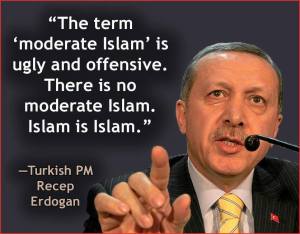
And this is exactly why I am in full agreement with Erdogan: “There is no moderate Islam. Islam is Islam”.
You see, I grew up in communist Romania and in those times we had a saying that went like this: “it’s not the “ism” but the “ist” who causes the trouble!”.
When placed in a certain situation some people act naturally – they drink if they feel thirsty – or they may decide to use whatever opportunity they identify in order to further their goals.
You can study communism in a library or conspire to impose it on people exactly as you can practice Islam in your community or try to impose it by force to all your neighbors.
It’s neither ‘communism’s nor ‘Islam’s fault, it’s the communists who cannot understand that communism doesn’t work and the hard-line Islamists who fail to understand that by acting exactly as the Catholic Inquisitors did during the Dark Ages they’ll eventually drive their flock away from their pulpits.
The real problems arise from the arrogance that blinds those “ists”, individuals so ‘concentrated’ on their self-assumed/assigned goals (no matter if they are well intended, like trying to spread – by force – the wealth around and to – administratively – reduce social inequality, or on the contrary – obsessed with becoming filthy rich at the expense of everybody else and/or accumulating dictatorial power over those around them) that they forget/fail to realize that human rationality is inherently limited. And so they fail to understand that ‘the law of unintended consequences’ will eventually bring them back down to where they belong – with a bang!
There are three sets of social circumstances that these kind of ruthless ‘political actors’ perceive as opportunities: inflamed nationalistic feelings, strong religious beliefs, wide spread social malaise due to economic hardships.
For instance the French Revolution (remember, today is Bastille Day) was fueled by the desperation that ‘doused’, at that time, the French people. They were not only hungry but they also felt abandoned/neglected by their rulers. Marie-Antoinette, the French Queen beheaded during the Revolution, was described as being so callous/ignorant of the real life of her subjects that when informed that her people didn’t have enough bread she interjected: ‘Let them eat cake instead!’
Some historians debate whether this really happened, one of their arguments being that the same words have been attributed to many other historical figures that lived before her but the simple fact that the utterance itself was so widely circulated remains and speaks volumes.
A century later Lenin was able to manipulate the same kind of public sentiment and imposed the Soviet rule over the Russian imploded empire while Ataturk, the leader of the Young Turks, fashioned the freshly minted Turkish nationalism into the glue that held together, until recently, the modern – and secular – Turkish state that succeed the ailing Turkish empire by 1925. It is often forgotten but if we really want to understand Turkey we should always remember that until the late XIX-th century it still was a feudal empire and the social costs of such a short/hasty transformation into a modern nation state were tremendous. Unfortunately in the last decade Erdogan has been working hard, with the unwitting help of the Euro-skeptics who reject Turkey’s efforts to join the EU, to replace secular, and relatively moderate, nationalism with religious zealotry as the backbone of the Turkish republic.
Coming back into Central Europe we have the classic example of how Hitler used nationalistic tensions exacerbated by the economic crises deepened by the unwisely imposed war reparations to implement his demented dream of a Reich that was supposed to last for a thousand years.
The same process is happening again, under our own noses. This time all three ‘components’ are present. The economy of the region is in shambles, arguably because of foreign intervention, nationalistic tensions are rife while religious ones are heated way beyond boiling point.
So why wonder that the al-Baghdadi led Isis uses Islam as a pretext to impose a new dictatorship in a region that has no real need for another one?
Now it’s up to us. Just as our great fathers used the opportunity presented to them at the end of WWII and helped Germany refashion itself, both economically and socially, by including it in the Marshall Plan instead of making it pay for the rebuilding of the war ravaged Europe we should try to help the peoples in the Middle East find their own respective ways instead of impose on them whatever we might think it would be better for them. And I mean real help, not just let/prod them fight each other to exhaustion.
In fact it would serve our interests also.
The Balkans were considered the powder keg of Europe and indeed the tensions accumulated there helped ignite the WWI. After communism imploded those tensions resurfaced precisely because the previous arrangements were imposed, more or less, from ‘above’. Exactly as the map of the Middle East was drawn by Sykes-Picot.
No, I’m not advocating wholesale dismantling of borders, as it happened in ex-Yugoslavia. If they find a way, by themselves, to preserve the present situation we should encourage and help them to do so. But we should never try to impose something on them just because we consider it would serve our (short term at best) interests.
Lebanon might serve as a good example, both to them and to us.
It won’t be simple, every major power has vested interests there, including Russia, but it can, and should, be done. Specially since the the alternative would be horrible.
Ieri. Sau mai bine spus acum o luna si jumatate. (Când gătesc curăț legumele pe cate un ziar. Astazi a venit randul unui Jurnalul Național din 21 mai 2014)

“Pianistul Fabiani Prcsina (11 ani) şi-a pierdut mama acum o lună. Ea a fost ucisă pe trecerea de pietoni de un tânăr aflat la volanul unei maşini de lux. Copilul continuă să cânte şi îi dedică mamei recitalurile….
Tragedia s-a întâmplat în urmă cu o lună, în Joia Mare a Paştilor, când femeia (mama lui Fabiani) se întorcea de la lucru, în chiar ziua ei de naştere. Pe o trecere de pietoni din Petroşani, femeia de 41 de ani şi încă un bărbat au fost spulberaţi de maşina de lux condusă de un tânăr de 21 de ani, care abia îşi recuperase permisul auto după ce poliţiştii i l-au suspendat pentru conducere cu viteză excesivă. Cei doi au murit pe loc. Patru zile mai târziu, de ziua lui, Fabiani îşi conducea mama pe ultimul drum. Copilul nu şi-a mai sărbătorit ziua, în schimb şi-a pus dorinţa ca mama lui să se întoarcă din ceruri. „Fabiani crede că, dacă a înviat Iisus, şi mama sa va reveni acasă“, scria într-un mesaj postat pe Facebook sora acestuia.”
Florin Iaru: “Ideologi si alte lighioane”.
Astazi. Pentru a cumpara legumele despre care tocmai va povesteam ca le curat a trebuit sa ma duc in piata. Acolo ‘m-am impiedicat’ de un 22.
Dorel Sandor: “Mediocritatea clasei politice ameninta Romania.
O evitare permanentă a obstacolelor, a încercărilor și o generare de eșecuri permanente la nivel administrativ și la nivelul atingerii unor ținte și angajamente internaționale. Deci, prin rezultate, ne dăm seama că aceste câteva sute, câteva mii de personaje cu insignă politică sunt departe de performanță, de integritate, departe de asumarea unei misiuni la nivel național sau local.”
In timp ce curam legumele alea ma uitam la televizor.
Realitatea TV: “Suspiciuni de coruptie in ministere. Surse: DNA va incepe urmarire penala penala pentru mai multi ministri”
Dudu Ionescu (ministru de interne taranist, rugat sa comenteze, reproduc din memorie): ‘Toate astea vor continua atata vreme cat vom continua sa nu tinem cont de natura umana. Acum ne comportam ca si cum politicienii ar fi ingeri si ne miram atunci cand acestia ‘cad’. Cata vreme ‘morcovul’ (leafa pe care o primesc acestia) si ‘biciul’ nu vor fi suficient de mari nu se va schimba nimic. E adevarat ca peste tot in lume in administratia publica lefurile sunt un pic mai mici decat in privat dar cei angajati acolo se bucura de o oarecare stabilitate. Aici lefurile sunt mult mai mici decat in pozitiile corespondente din privat iar la fiecare ciclu electoral sunt schimbati majoritatea ‘adminstratorilor publici’. Si ne mai miram ca cei cu adevarat competenti evita cu orice pret sa fie slujbasii statului?’
Sa fi inceput oare curatenia sau e doar inca un episod din nesfarsita lupta politica?
Si de fapt conteaza oare cu adevarat?
In realitate toata tarasenia asta va continua pana cand noi, astia, ne vom da seama de adevarul spuselor lui Basescu (redau din memorie, l-am vazut la televizor acum cativa ani):
‘Sa va fie clar, un ministru sau un factor de raspundere din administratie isi poate face mendrele doar in masura in care este ajutat de cel putin o parte dintre cei din jurul său si in conditiile in care ceilalti intorc privirea.’
I ran across this article published by CNS News.
It is about a meeting organized by Heritage Foundation to discuss the terrorist attack that took place in in Benghazi in 2012.
At some point a young ‘Muslim student’ asked “…how can we fight an ideological war with weapons? How can we ever end this war? The jihadist ideology that you talk about – it’s an ideology. How can we ever end this thing if we don’t address it ideologically?”.
One of the panelists answered her that ‘there might be some 75% peaceful Muslims in the world but this is of no consequence: they follow the lead of the extremists, they don’t make their voices heard and, because of that, ‘the peaceful majority are irrelevant’ ‘. The panelist’s answer was received with standing ovations.
I’m afraid those people are making a huge mistake.
For those of you who don’t have time to read the article I’ll summarize the arguments used by Brigitte Gabriel, the panelist:
– The Germans are known as peaceful people yet the Nazis imposed their agenda and provoked horrible massacres.
– The Russians are normally peaceful people yet the Communists among them caused tens of millions of deaths, among their own people, without significant protest from the general population.
– The same happened in China.
– The otherwise peaceful Japanese allowed the militarists to take power and to start a war (the Pacific ‘portion’ of the WWII) in which another 12 million people found their death, “mostly killed by bayonets and shovels.”
– “On September 11th in the United States we had 2.3 million Arab Muslims living in the United States. It took 19 hijackers – 19 radicals – to bring America to its knees, destroy the World Trade Center, attack the Pentagon and kill almost 3000 Americans that day,” Gabriel said. “So for all our power of reason, and for all us talking about moderate and peaceful Muslims, I’m glad you’re here. But where are the others speaking out?” Gabriel asked.
The people in attendance began to applaud.”
First of all we need to differentiate between the two situations presented here.
The Germans, the Japanese and the “19 radicals” committed acts of international aggression while the Russians and the Chinese allowed themselves to be overrun by ‘misguided’ people.
Not at all the same thing.
On the other hand the German and Japanese examples are extremely interesting. A significant number of historians agree that the WWII was produced, at least in part, by the manner in which the defeated Germany was treated after WWI – they were imposed crippling war reparations which burdened Germany during the Great Depression so heavily as to produce the set of social circumstances that allowed Hitler to accede to power. This lesson was well understood so after the WWII Germany was included in the Marshal plan instead of made to pay for it. As a consequence we had, since then, 69 years if uninterrupted peace in Europe.
Japan was a ‘closed society’ until Commodore Perry forcefully ‘opened’ it in 1854, at first for trade and then to other western influences: Centralized state administration, modern army, modern management and technology, etc. And in those times the Japanese were treated, by the ‘white people’, with a ‘healthy dose’ of disdain, just as all the other non-European nations were. After the WWII all this has changed and nowadays the ‘peaceful majority’ of the Japanese have found a way, with a lot of help received from the Americans, to build a democratic society not at all different from what can be currently found in Western Europe and in North America.
Something rather similar happened with the Chinese. After Nixon went there and started to treat them as partners they basically stopped killing each-other.
But, unfortunately, this change of attitude didn’t come about between the West and Russia after the end of the Cold War. For instance we call the Ukrainian rebels ‘pro-Russian’. Are they of any real service to Russia or to the Russian people? On the contrary… Somehow the old habit of blaming the entire Russian people for actions perpetrated by their leaders survived. Maybe because we can no longer understand the workings of a non-democratic society…since we are so accustomed with censuring our leaders.
So…
My point is that of course we have to defend ourselves from the direct actions of the ‘radicals’ – ‘shoot back’, effectively and efficiently, when ever somebody attacks us. Yet there is something else we dearly need to do, at the same time. Find a way to connect, in a respectful manner, with the ‘peaceful, yet silent, majorities’. They are “irrelevant” only as long as we treat them with the same disdain they are receiving from their own rulers. Even worse, confronted with two different kinds of disdain they’ll naturally prefer the one they are accustomed with – the one displayed by their own rulers – so if we keep packing together radicals with peaceful people and treat them as one the result will be that we’ll have to deal with an ever increasing number of radicalized ex-peaceful individuals. I propose we learn something from our parents, the ones who found a way to change the atmosphere between them and the German and the Japanese people. And since we pretend to be wiser – as all children do – than our parents were, how about doing this without wagging all-out wars? (Unless attacked, off course)


Japanese kids learn what to do when earthquake strikes while Israeli kids learn how to deal with incoming rockets.
When are we, the grown ups, going to learn?
Bacalaureat 2014:
Absolventi de liceu: Aprox. 200 000
Candidati: 161 000Adica vreo 44 000, cam unul din patru absolventi, nici macar nu s-au ostenit sa se inscrie.
Evaluarea nationala (a absolventilor de clasa a 8-a) 2014
Absolventi inscrisi: aprox 160 000
din care 113 250 cu media peste 5 iar
46.700, adica din nou unul din patru, sub 5.
Cu alte cuvinte in 4 ani, din 1995 pana in 1999 locuitorii Romaniei s-au scarbit atat de tare incat au facut cu 40 000 mai putini copii. Apoi acesti copii au crescut intr-o atmosfera atat de incurajatoare incat aproximativ un sfert dintre ei au ajuns la concluzia ca invatatura este o adevarata pierdere de vreme.
Si atunci cum ramane cu ‘ai carte ai parte’?
Ei bine sensul acestei zicale este putin mai complex.
“A avea carte; ai carte, ai parte = a avea acte, în regulă, pentru susţinerea unei pretenţii de proprietate.”
Zicala provine de fapt de pe vremea cand Stefan cel Mare a intarit prin emiterea de ‘hrisoave domnesti’ dreptul de proprietate al mosnenilor care l-au ajutat in lupta asupra pamanturilor pe care acestia le stapaneau din mosi stramosi. Cei care au pastrat inscrisurile au putut sa isi apere posesiunile in fata boierilor hrapareti, cei care le-au crezut niste hartii lipsite de valoare au putut fi izgoniti, cu relativa usurinta, de pe pamanturile lor.
Cu alte cuvinte valoarea ‘diplomelor’ rezida, de fapt, in modul cum sunt ele privite de cei care le poseda. Iar atunci cand oamenii nu mai au ‘incredere’ in ‘inscrisurile’ emise de institutii societatea respectiva se afla intr-un punct de extrema dificultate. Acelasi lucru se intampla si atunci cand oamenilor nu li se mai pare util sa se pregateasca pentru ‘ziua de maine’.
Un alt simptom al acestei stari de dificultate este locul ocupat de fenomenul coruptiei in viata omului ‘de rand’.
Aceasta ‘coruptie’ este atat de prezenta in viata noastra incat a devenit pretext de lupta politica, partidele se arata unele pe altele cu degetul: ‘coruptii tai sunt mai multi/putrezi decat coruptii mei’.
Iar atunci cand astfel de confruntari au loc simultan cu niste evenimente extrem de importante pentru viata noilor generatii, bacalaureatul si inscrierea la liceu, si chiar reusesc sa le eclipseze pe scena publica asta inseamna ca lucrurile au iesit cu totul si cu totul din fagasul normal.
Poate ar fi cazul sa ne uitam fiecare dintre noi in oglinda si sa intelegem o data ca asa nu se mai poate. E adevarat ca niciodata nu e prea tarziu dar de ce sa ajungem pana acolo?
 nicichiarasa