
“Doubt everything” instead of ‘trust the scientist until proven wrong’.
‘Illiberal democracy’, whatever that might mean…
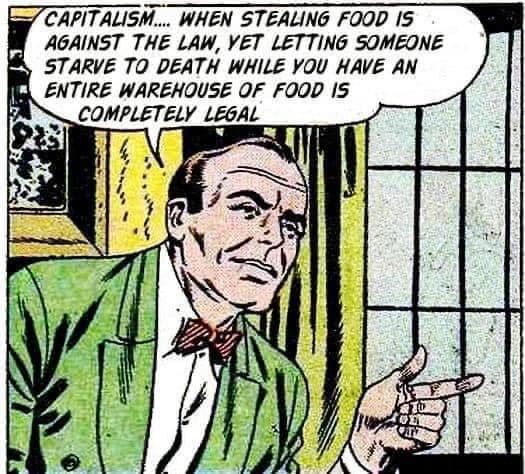
“Abolish capitalism”. As if there was any viable alternative!
What’s going on here?!?
“Doubt everything” instead of ‘trust the scientist until proven wrong’.
‘Illiberal democracy’, whatever that might mean…
“Abolish capitalism”. As if there was any viable alternative!
What’s going on here?!?
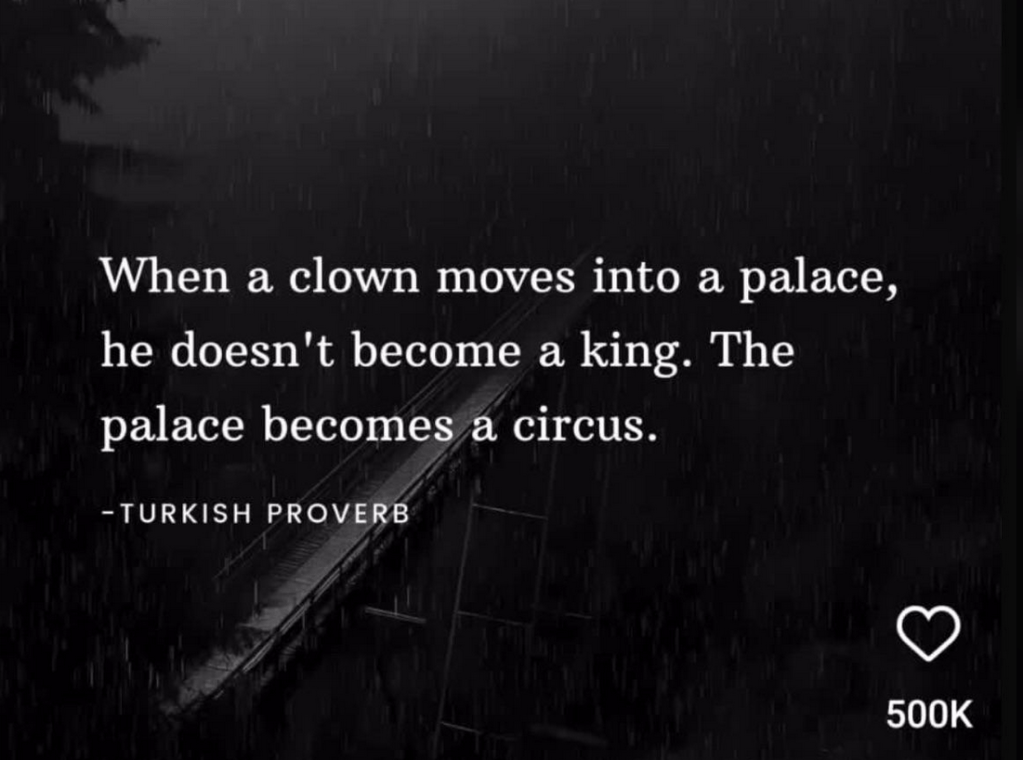
Indeed, but only a clown has enough gumption to tell the king that ‘he’s got no clothes on’!
Furthermore, every respectable palace has both a king and a jester.
The jester overpowering the king doesn’t change the palace into a circus. Only refocuses the attention of those paying attention…
For me, Trump – along with all other ‘strong willed’ politicians –
are more of a symptom than a cause.
And a cause, indeed, but first and foremost a symptom.

One way to figure out the dynamics of what’s going on around/to us is ‘resources, structure, agency’.
For lack of a proper term, I just sequenced the steps of the figuring out process.
For anything to happen, that thing has to start from ‘somewhere’. Some resources are needed at the start of anything.
For anything to happen in a certain manner, that something has to happen inside a ‘space’. Which ‘space’ ‘behaves’ according to a a set of ‘rules’.
For anything to happen, it has to start. To be put into motion. And, at the end, that ‘anything’ – already a ‘something’ – will produce a set of consequences. A ‘feedback’, supposedly carefully taken into consideration by those who had experienced it. And need to move forward.
Coming back to Trump, he couldn’t have happened, say, twenty years ago. The world, America in this case, had to be ready/readied for him. Well, in a sense, America – the American media, to be more precise – had worked hard to make him possible.
So should we blame the media for the advent of Trump?
Hm…
Remember the Apprentice? The show which made Trump famous?
That show was possible, and made Trump famous, because so many Americans watched it. For whatever reasons. By watching the Apprentice, America readied itself for Trump. For President Trump.
Then all those hosting reality-TV shows have a fair chance of becoming President?
After all, Zelensky also started as a TV personality…
Not so fast!
For anybody to become President, there are a few prerequisites.
That guy has to be famous.
That guy has to ‘push the right buttons’. To identify them. And to be willing to push them, regardless of any of the consequences.
Trump was famous enough. And callous enough to make use of some of the prevalent conditions present when he decided to make a run for the Oval Office.
Birtherism was already present. Trump only gave it a louder voice.
Abortion was already a hot issue. Trump only changed his mind about it. From “very pro-choice” in 1999 to “pro-life” in 2011.
But the most important factor which made President Trump possible was public discontent.
MAGA could not become such a powerful slogan if so many people were not already feeling left behind.

Coincidence?

Trumpification?
In a sense, yes. Trump did identify the circumstances prevalent when he made up his mind as opportunities. As resources towards his wishes. Then used the already existing ‘rules’ – and political customs – in his favor.
But can we pretend he had Trumpified politics? Can we pretend he changed the way politics was done in order to serve his purposes?
Or it would be more appropriate to say that a majority – as per how America elects its President – of “We, the People” have allowed him to do as he pleased? For whatever reasons?
It’s for the greater good…
“And the Lord God commanded the man,
“You are free to eat from any tree in the garden;
but you must not eat from the tree of the knowledge of good and evil,
for when you eat from it you will certainly die.””
As you might already know, I grew up under communist rule.
The regime described itself as being democratic and promoting freedom. Freedom for all!
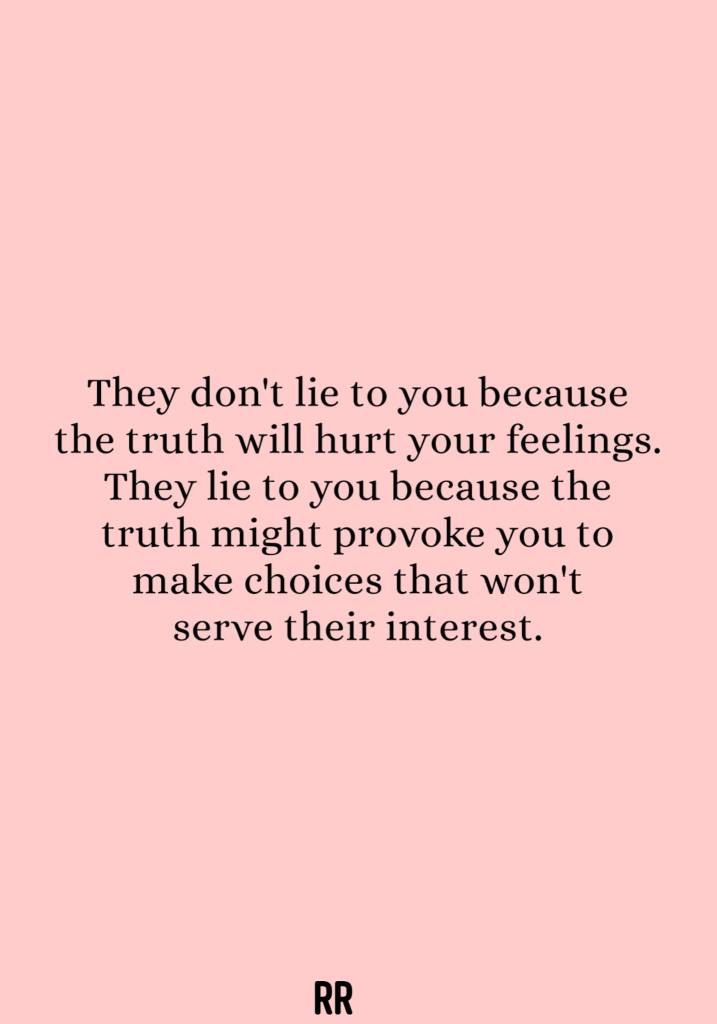
The day to day practice, the life we had to endure, proved those words were blatant lies.
Nobody but the dictator was free and the communist democracy was a sham. As soon as anyone opened their mouth – nobody was crazy enough to open their mind! – however slightly, their words were met with extreme caution!
This way I became accustomed with ‘double talk’ before even knowing the book existed!
In a sense, being aware of the fact that words are able to ‘transport’ anything – from abject lies to sublime – is a step further. For the individual. For a society…
When each individual member of a society doubts everything heard or read, that society does have a problem! Disseminated disbelief precedes dissolution.
When individuals no longer trust each-other, things go south fast. Society wise!
Freedom has three dimensions.
‘Phusical’, personal and institutional.
Phusis is the ancient Greek term for ‘growing’ and ‘becoming’. My point being that some things are free in a naturally occurring manner. Also, the phusical freedom is naturally limited. Birds are free to fly only inside the lower strata of the atmosphere.
Personal freedom resides inside our individual minds. Is learned by each individual as a result of social interaction. Is limited by what each individual internalizes during their ‘potty training’.
Institutional freedom is the cultural product of social interaction in a given historical context. I’ll leave aside the fact that history is heavily influenced by geography.
Back in my communist experience, freedom was ‘make believe/belief’. We pretended to be free – otherwise we would have gone nuts – to the tune of convincing ourselves that life was worth living. Otherwise we would have died trying to escape. Furthermore, we convinced the ‘others’ – the ever present ‘political surveyors’ – that we were at least content with what was going on. With how our lives were unfolding.
Our pretenses were the opportunity on which ‘the party’ – the communist party – had built its edifice.
The opportunity grabbed and put in practice by the dictator. Which dictator was the only one enjoying actual freedom. Institutional, personal and, certainly, a lot more phusical freedom than the rest of us.
Another crass example of double talk is how the Americans use the term ‘liberal’. For the Conservative Americans ‘liberal’ is a cuss-word while the Liberals are proud to be called in this manner but the word does have the same meaning for both of them. It includes everything on the left side of the political spectrum, communists included.
The problem with this whole thing being the fact that the communists – the ones inspired by Marx, anyway – are amongst the most conservative political operators ever. No communist has ever changed anything in Marx’s Communist Manifesto. Or doubted anything written by Lenin. No communist has ever accepted that institutional communism, the one that failed, was far more than a crime. A huge error!
Anything familiar?
And what has any of this to do with the First Lie?
With the first lie, perpetrated by the Founding Father at the very beginning of the most important Book?
Which Book is supposed to be read literally by certain individuals having a certain political orientation?
I really can’t wrap this thing up before noting that the First Lie didn’t hold.
The serpent convinced the woman to eat, she passed the fruit along to her man and thus we’ve all became able to ‘tell good from evil’. To a degree, of course.
And nobody died! Not immediately, as a consequence of them eating that darn fruit.
“And the Lord God said,
“The man has now become like one of us, knowing good and evil.
He must not be allowed to reach out his hand and take also from the tree of life and eat,
and live forever.”
So the Lord God banished him from the Garden of Eden
to work the ground from which he had been taken“.
Do you really care about where your car was built?
No, but I am interested in how it works.
I need that in order to use it properly!
‘Ordinary matter’ is ‘lifeless’. Inanimate.
The rules which ‘shape’ the interactions between pieces/portions of the lifeless matter are the same ‘all over the place’. As far as we know, anyway.
The pieces/portions consisting of ordinary matter are more or less similar. There’s nothing to tell apart one proton from another. One rock from another one. One drop/bucket of water from the rest of the pond.
And there’s life.
‘Technically’, the living organisms are made from inanimate matter.
And, anyway, while ‘ordinariness’ is forever, life is temporary. Individual organisms have a limited lifespan, species evolve and life itself has appeared some time after the ordinary matter.
The rules which shape the interaction between the living organisms and their environment are species specific. Further more, individual sets of data set apart each individual belonging to each species. Which means that each species interacts in a specific manner with their environment while each individual organism does have its own particular ‘manner of doing things’. ‘Inside’ the species specific behavior but nevertheless particular.
Then there’s conscience.
Which conscience is nothing but a concept. Like everything else here.
Which concept, like all other concepts, has been coined by us. By us, conscient human beings.
The point being that we, conscient human beings, attempt to understand conscience by thinking about it.
Somewhat similar to looking inside an eye when attempting to understand sight. Or listening attempting to understand hearing.
Freud came up with the notion that studying what’s wrong, out of the ordinary, might help us to understand ‘normal’. But Freud was a psychologist…
Engineers prefer to ‘look from above’. To extricate themselves from the problem in order to see it ‘whole’. And I’m an engineer…
So, what is conscience?
An individual ability and a space/place.
There is life and there are individual living organisms.
Life goes on regardless of a number of individual organisms passing away. As long as one individual living organism continues to be alive, life itself will continue to exist.
Further more, regardless of how life might have appeared, presently it seems impossible to have life, the kind we have learned to appreciate, with only one species being alive. Let alone with only one living organism…
Same thing with conscience.
Humans become conscient through human interaction. Our ancestors had become conscient way before anybody was thinking about conscience. People who, in various circumstances, have had a limited interaction with other people struggle to develop a functional conscience. A full fledged one…
But humans are not exactly alone when it comes to being conscient.
Not exactly aware of their own selves, but still functionally ‘conscient’.
Being alive, individually speaking, means being able to:
Maintain the ‘structural identity of the organism’. As in keeping the inside in and the outside out.
Manage to breathe, eat, drink and excrete.
Life, as larger process, means successive generations of individual organisms transmitting the pertinent species specific genetic information to the next cohorts.
Maintaining the inside in, the outside out and managing to breathe, drink, eat and excrete means behaving in a conscious manner, albeit in a very limited sense.
This behavior being specific to ‘life’ and life being dependent on species specific information being passed from one generation to another means that human conscience – acceded by individual humans imbibing culturally specific information – is nothing but a particular example, maybe the most evolved one to date, of an otherwise widespread phenomenon. As a matter of fact, people who – for various reasons – are not ‘conscious’ – as in aware of themselves – continue to ‘breathe, eat, drink and excrete’. ‘Incompletely’ and only for a short while, if left unattended, but that’s another matter.
Furthermore, there is a ‘continuum of conscience’ starting from plants and culminating with the human awareness.
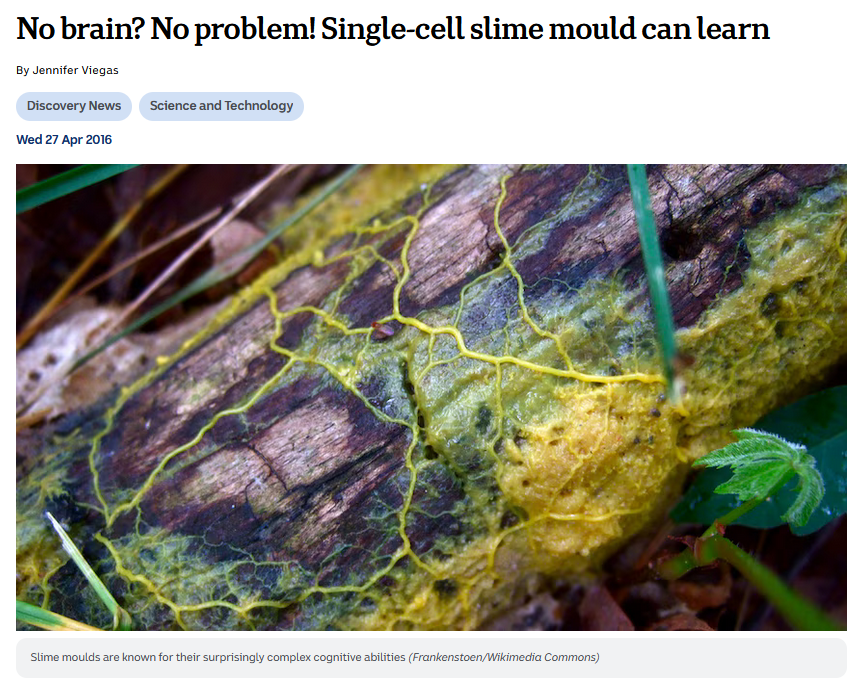
While plants and fungi manage to stay alive, animals display a widely nuanced repertoire of behavior. From the learning slime to our cousins, the apes.
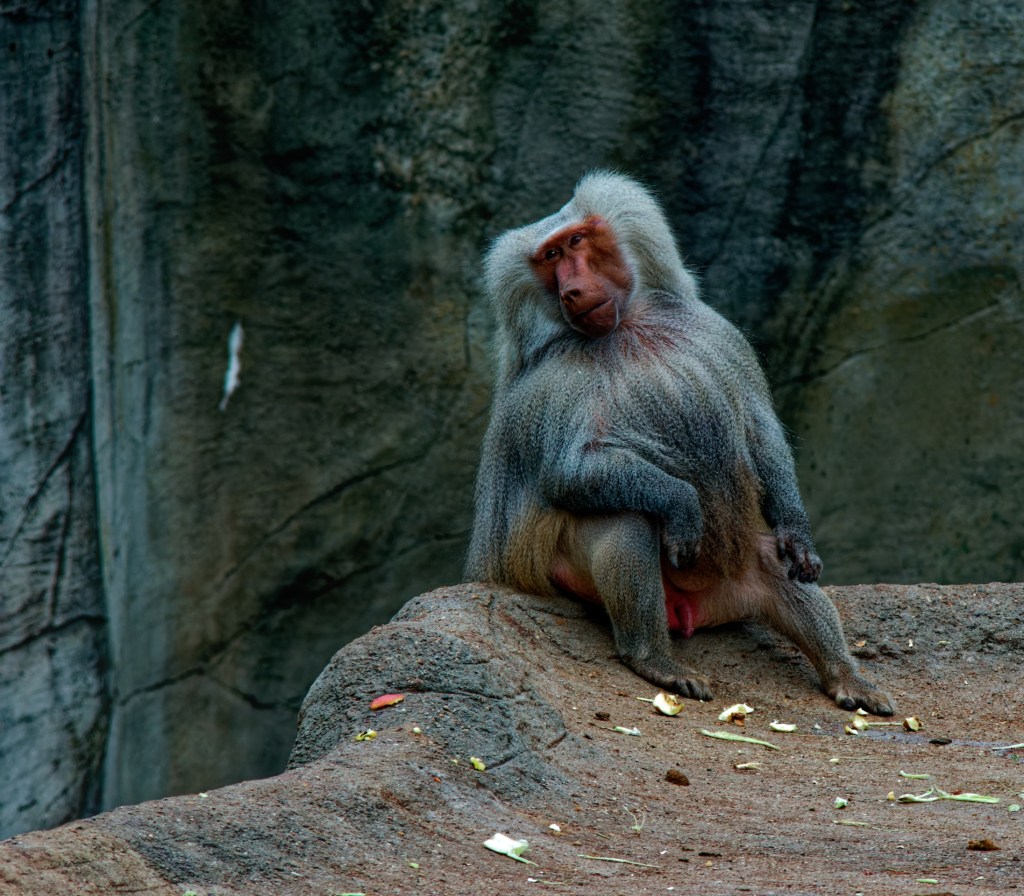
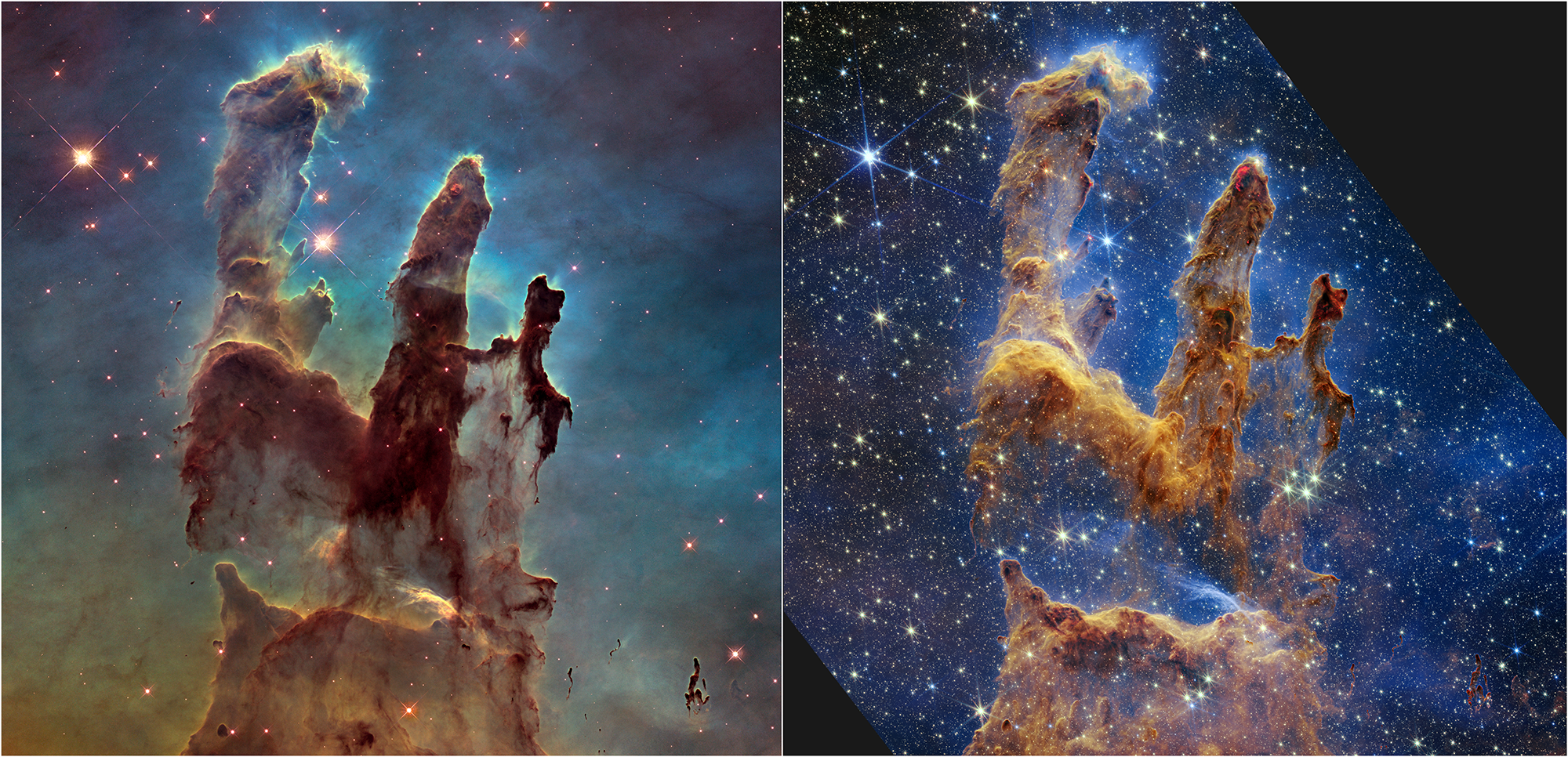
‘Universe’ has no meaning. Other than what we assign to be its meaning…
‘Universe’ is a word we use to encompass everything around us. Whether we know of it or not. Whether we understand (of) it or not.
From ‘where’/’when’ we are in/attempt to perceive this huge environment, things look like ‘this’.
Depending of the wavelength of the light we use to ‘reinterpret’ the picture…
Nota bene, the colours were assigned by a computer app, starting from a series of ‘black&white’ images shot using filters which select short intervals of light-wavelength.
By sheer change, life appeared on Earth. And on who knows, if ever, how many other planets.
Evolution, an impersonal process, playing the odds in the current setting, had engendered the set of circumstances into which we happened to ‘burst’ into existence.
We, for better or for worse, have shaped the planet into what it has become.
Regardless of what each of us believes, religiously speaking, it doesn’t actually matter whether a god did or didn’t do anything. Since each and every religion currently biasing human thinking on Earth speaks about individual responsibility – hence freedom, for you can’t have individual responsibility without freedom – it actually doesn’t matter whether any of the teachings we refer speak about have been induced by an outside agent or have been produced ‘in house’.
Since each of us is individually responsible for our thoughts/actions – hence ‘free’ – then the meaning we assign to the object of our judgement, the ‘Universe’, belongs to us. To each and to all of us.
‘God save us!’
But since we’re ‘free’, we must save ourselves.
And since nobody can be free on their own – freedom has been defined by ‘us’ and put in practice collectively – saving ourselves will be a collective effort.
Or else.
Nota bene!
We are a ‘collection’/community of individual human beings.
We either ‘save’ ourselves maintaining what makes us human – our distinct individual individualities – or we become a hive. Of something else but ‘human’.
Of what we currently understand as being ‘human’…
“It is said
that one man’s terrorist
is another man’s freedom fighter.”
Sami Zeidan, Desperately seeking definition…, 2003

‘Truth’, ‘freedom-fighter’ and ‘terrorist’ are words. On the side where we get in touch with them.
We see/hear them first before they penetrate our minds. If at all…
We think of them and only afterwards they get pronounced by our mouths or typed by our fingers.
On the other hand, ‘propaganda’ – another ‘word’ – is a ‘technology’. A particular manner in which some of us choose to spread out their ideas.
Same thing goes for ‘conspiracy’. A particular manner of doing things. ‘Cloaked’. Hidden from sight and involving a number of vetted participants.
Nota Bene! Those involved in ‘conspiracy theory’ are also vetted.
The ‘theorists’ vet their targeted audience by choosing the subjects of their discourse and by wording it in a certain manner. The members of the ‘public’ ‘vet’ the ‘influencers’ by following them. And themselves – they set themselves apart from the rest – by allowing themselves to be ‘entertained’ by the message they keep returning to.
‘Terror’ itself is also a ‘technology’. A sort of ‘propaganda’ 2.0.
While ‘propaganda’ is a manner of spreading ‘the word’ around – presenting the ‘message’ in an easier to ‘accept’/’digest’ form for the targeted audience – ‘terror’ is a ‘technology’ used to convince an entire population that there’s no alternative. No alternative other than that ‘proposed’ by the terrorist.
A technology used to break the will of those whom the terrorist wants to submit.
And what ‘happened to THE truth’?!?
The truth of the matter is that there is no ‘truth’.
No ‘one size fits all’ kind of truth!
A truth is something we agree upon. In this moment!
Something we agree to consider as being true for as long as nothing meaningful contradicts the generally accepted ‘true thing’.
But what if there’s no longer a ‘we’?
What if those who – for whatever reasons – want to separate us manage to do exactly that?
What if ‘we’ no longer see each other eye to eye regarding not so long ago widely accepted ‘subjects’?
What if ‘we’ – a sizeable portion of us – accept ‘alternative facts’ as being at least as valid as the ones previously accepted as being true?
What if we, too many of us for our own good, start to doubt as a matter of creed?
“Too many of us for our own good”?!?
What happened to ‘doubting as a matter of creed’ being the ‘stepping stone’ for science?!?
Words… so many words, no matter how beautiful…
‘Science’ is, first and foremost, a state of mind. The ‘open’ state of mind which conserves the willingness to change ‘the truth’ according to the newly acquired information, if this new information is convincing enough. If it comes from more than one sources AND if ‘the conclusion’ can be reached again and again. Independently!
Being in a scientific state of mind means keeping the door open for new information.
Questioning everything with the transparent intent to impose a single version of ‘the truth’ is more than propaganda.
It’s a form of terrorism!
“statuuntque latiores terminos scientiae Dei quam potestatis,
vel potius ejus partis potestatis Dei (nam et ipsa scientia potestas est)
qua scit, quam ejus qua movet et agit:
ut praesciat quaedam otiose, quae non praedestinet et praeordinet”
Francis Bacon, 1597
“and they set wider limits for the knowledge of God than for power,
or rather for that part of God’s power (for knowledge itself is power)
by which he knows, than that by which he moves and acts”
Google Translate
“scientia potentia est“
Thomas Hobbes, 1668
E=mc2
Einstein, 1905
In fact, power produces; it produces reality;
it produces domains of objects and rituals of truth.
Michel Foucault, 1991
“They” – as in ‘the knowing people’ – ‘set the limits for the knowledge of God’.
Then it was ‘they’ who had the real power over (their) God…
A little later, another thinker simplified the whole thing into ‘knowledge is power’.
Which, already collective, state of mind morphed into the socio-cultural environment into which Einstein was able to notice that E=mc2. That apparently different things can morph one into the other, given the right circumstances.
Which brings us to Foucault noticing that power produces reality. Including knowledge…
But is there a real difference between ‘power produces reality’ and ‘they set different limits for God’s knowledge than for God’s power’?
In fact, there is.
According to Foucault power is exercised directly.
According to Bacon, people exercise power by ‘fine tuning’ their ultimate tool. Their God. Which god, like all others, acts like an agent. Its powers might be limited – it is able to do/know only as much as those who have faith in it believe it to be able to know/do – but inside those limits it is as free as each of those who believe in it.
And the difference is huge.
As soon as Nietzsche had noticed that ‘God was dead’, ‘reality’ had shattered.
While God was alive, power created one reality. Also known as “God”.
As soon as there was no more God to mediate between reality and those gathering knowledge about it and exercising power while recreating it… reality became many!
And not only many versions of reality are competing for our attention, each of these realities are farther and farther away for the ‘hard’ one. The one harboring Einstein.
Michel Foucault, Madness and Civilization:
“I suppose it is tempting,
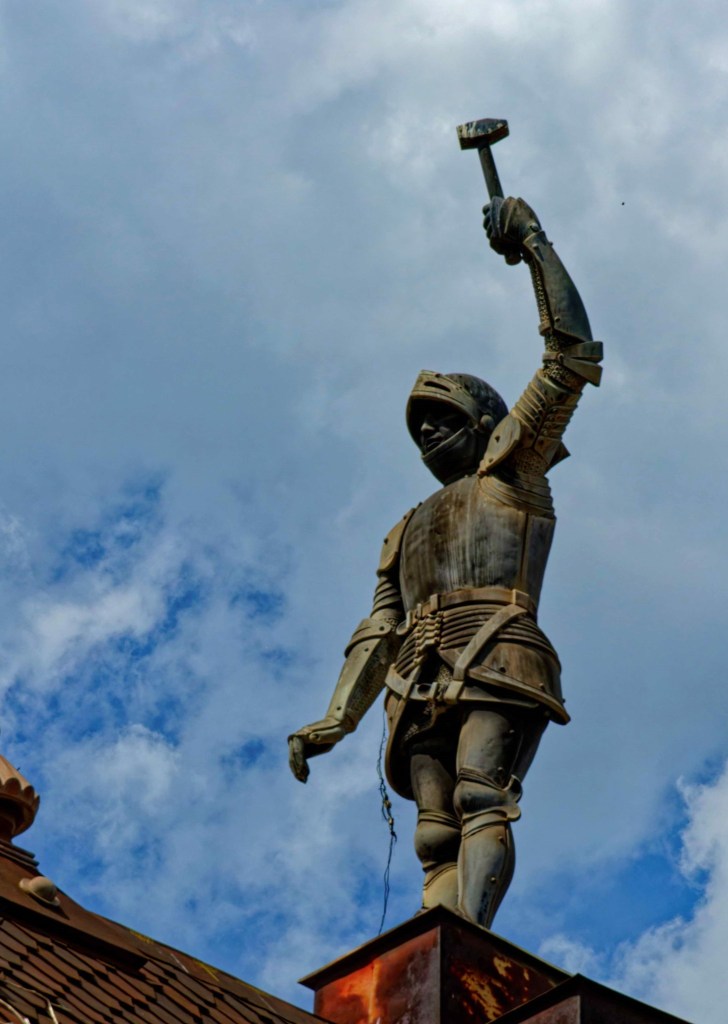
if the only tool you have is a hammer,
to treat everything as if it were a nail”
Abraham Maslow
I write this blog in the hope that ’embodying’ my thoughts will somehow help me.
Help me solve some of the quirky questions which have been haunting me for sometime now.
Why so many people have been convinced that thinking may help them make sense of things?
Why so many otherwise smart people have convinced themselves that thinking ‘in solitude’ would take them to the ‘right’ place?
Why so many seemingly reasonable people have somehow become certain that their version of things was the only one valid? To the tune of trying to impose it to those happening to be around them?
The first answer was easy to find.
Because that’s how we make sense of things.
And because that’s what people do when they have no other alternative.
They start thinking about how to get out of the mess into which they have entered by not thinking! Enough…
The second one was also easy. Ish… specially after I did come up with the question formulated like this.
Apparently, to shield their minds from ‘distraction’. From the mundane ‘minor’ problems which might have wasted their ‘brain power’.
In reality, simply because they could do it. They had a great time doing it – thinking, that was – so they indulged on every occasion they had. And smart as they were, they made it possible for them to have more and more time available for thinking.
And they cut themselves off from the rest of the world because the few people able to partake in the process not always shared the same opinion. Thus otherwise smart thinkers ended up in the company of sycophants…
Having found the answer for the second question opened, wide, the door for the third answer.
No, it wasn’t the presence of the sycophants which convinced the otherwise reasonable thinker that their was the only valid solution for whatever problem they had in mind at anyone time.
Sycophants showering praise were only a ‘favorable circumstance’. A mere opportunity for it to happen.
Unhindered by any outside intervention, the tinkering thinker turned his tool to his own head.
And hammered out all the remaining doubts his mind was still harboring.

 nicichiarasa