Archives for category: The kind of world we live in

bullshit

I’m not a Trump fan. How could I be? Just look at his face!

On the other hand….

“I call it the law of the instrument, and it may be formulated as follows: Give a small boy a hammer, and he will find that everything he encounters needs pounding.” Abraham Kaplan

Or, in this case, convince a journalist of something and he will ‘dress’ the facts to fit his new conviction.

As I said before, I don’t like Trump.
If I didn’t have a lot of trust in the overall resilience of the American democratic system I would be scouring for a big enough rock to hide behind if/when he might ascend to power.
Unfortunately the present most likely alternative isn’t any better.

But that’s another topic.

Let me go back to the present one.

What we have here is a news/opinion outlet which has a clear political option.
OK, I can live with that. I have some opinions of my own and I love to argue and defend them. In private as well as in public.

But I do believe that the quality of the arguments used in a debate are of paramount importance.

Let me analyze the four I mentioned above.

“Within 20 seconds at a press conference on Wednesday, actual Republican presidential candidate Donald Trump went from suggesting that Russian President Vladimir Putin had once called President Barack Obama the n-word to saying he hopes Putin likes him.”

The apparent implication here being that Trump has trouble maintaining logical consistency inside a rather short discourse and that he is rather gullible – “For the record, there is literally zero evidence that Putin ever called Obama the n-word. It’s hard to say where Trump got this idea, but he has a long history of naively restating things he heard from one person — even random people on Twitter.

Hard to argue against this, specially since there is ample video testimony that he really said it.

a shocked again trump

Well… after actually hearing him, things are not so clear anymore.

“Putin has said things over the last year that are really bad things. He mentioned the n-word one time,” Trump said from his resort in Doral, Florida.
“I was shocked to hear him mention the n-word. You know what the n-word is, right?” Trump continued. “He has a total lack of respect for President Obama.”
Putin doesn’t like Obama, Trump told reporters.
“I think he’s going to respect your president if I’m elected, and I hope he likes me,” Trump said.
Earlier in the news conference, Trump claimed he had never met the Russian leader.”

Not a trace of either ‘gullibility’ nor of any logical fracture here. So why not call Trump for what he really is – a callous manipulator – instead of using convoluted makeshift allegations?
normal versus anormal

Absolutely impossible not to agree with everything written here, right?
No matter what side any of us belongs to…but wait!

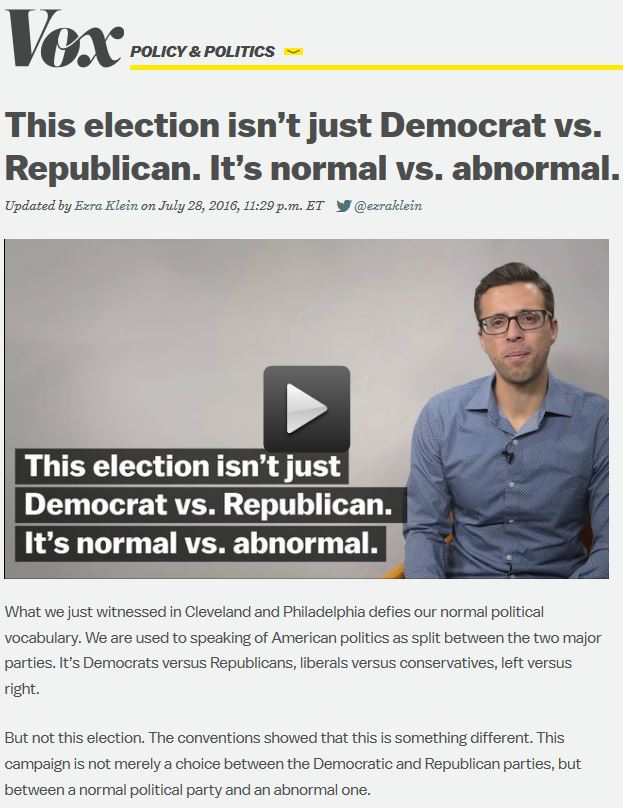
“The Democratic Party’s convention was a normal political party’s convention. …”
“The Republican Party’s convention was not a normal political party’s convention….”

A new cleavage in American politics: normal versus abnormal

America’s main political cleavage is between the Democratic and Republican parties. That split has meant different things at different times, but in recent decades it primarily tracks an ideological disagreement: Democrats are the party of liberal policies; Republicans are the party of conservative policies.

But in this year’s presidential election, the difference is more fundamental than that: The Democratic Party is a normal political party that has nominated a normal presidential candidate, and the Republican Party has become an abnormal political party that has nominated an abnormal presidential candidate.

No, I’m not going to take sides here. Not only because I’m not an American citizen so I’m not entitled to vote. But simply because Democracy relies mostly on mutual respect. You cannot refuse to the other party the very right to exist yet still call yourself a democrat. Pretending that your opponent is ‘abnormal’ means that you’re convinced that your opponent should not exist at all.

The way I see it ‘America’s main political cleavage is indeed between normal versus abnormal’ only it seems that both the  Democratic and Republican conventions, if not the parties themselves, belong to the realm of the ‘abnormal’.

But wait, things are getting even more juicier.

When women speak, people tend to mentally turn up the volume

Women, and women leaders in particular, often get criticized more for how they say something than for what they actually say. They have to walk a difficult line of being assertive but not too aggressive, likable but not too much of a pushover.

Even though women are interrupted more often and talk less than men, people still think women talk more. People get annoyed by verbal tics like “vocal fry” and “upspeak” when women use them, but often don’t even notice it when men do.

The same mental amplification process makes people see an assertive woman as “aggressive,” which gets in the way of women’s personal and professional advancement. Women are much more likely to be perceived as “abrasive” and get negative performance reviews as a result — which puts them in a double bind when they try to “lean in” and assertively negotiate salaries.

These kinds of implicit biases are sexist, but having them doesn’t make someone “a sexist” — or if it does, it makes all of us sexists. It doesn’t matter how smart you are or whether you are a man or a woman; everyone has some implicit biases against women.

And that may be one reason why this is the first time a woman has ever won a major party’s nomination.

OK, so what should people do? Vote for Hillary Clinton simply because she’s a woman?

And no, I don’t have any implicit biases against anybody. I cannot vouch for anybody else but I cannot see myself as ‘abnormal’ so I expect there are others in my situation.
Hence I strongly believe that candidates should be evalued ‘all around’, without any biases based on their gender.

Or race.
Hey Trump, this one is specially for you.

barack is not the cause

I’m afraid that Dara Lind, the author of the article I just quoted above, has got her ‘butterfly’ wrong.
It’s not Obama that inadvertently caused any hurricane.
Do you remember the intensity of the birther campaign that had swept across America both before and after Obama was elected President?

And while it’s clear that Trump was one of the most vocal ‘birthers’  do you know who started the whole thing?

“You know who started the birther movement? Do you know who questioned his birth certificate, one of the first?” Trump asked.

“Hillary Clinton, she’s the one who started it. She started it years before it was brought up by me.”

Trump said he no longer talks about the issue because it always breeds controversy but promised to “raise it against” Clinton in a general election.

OK, we don’t have to take Trump’s word on this, even if he’s quite an authority on the subject – given his passion about the issue.

The last quote is from an article published on the CNN site. Click on it if you want more specifics.
OK, so where does all these leave us?
Scratching our heads while trying to figure out what went wrong around the ‘deep well of anxiety about America losing its culture and values’?
Or rather staring at those who drew from deep within this well and used the proceedings to stoke people’s emotions in order manipulate them? One way or the other?
It seems the he wasn’t the only one. Wannabe presidential candidate and ‘racial provocateur’.
So why keep on hoping that by choosing the ‘lesser evil’ we’ll ever reach the ‘light at the end of the tunnel’?
Why keep on trying to manipulate people one way or another instead of finally calling both ’emperors’ for what they are?

The scientists act on the assumption that their efforts to un-peel the  ‘onion’ will eventually bear fruit and that ‘the truth’ will eventually be found crouching behind the proverbial ‘last skin’.

The artists keep torturing their souls hoping that theirs will be the one blessed with enough sensitivity to feel the ‘ultimate’ experience and with enough talent to be able to communicate it to the rest of us.

The mystics keep entertaining the proverbially faithful ‘grain of hope’ that their soul will be blessed by their Maker with some ‘insider’ knowledge and with enough stamina to make the revelation known to the rest of the flock.

Meanwhile the rest of us, the ‘regulars’, keep altering the ‘onion’ – otherwise known as ‘The Reality’, sometimes beyond recognition.

Let me elaborate.

As of now it seems that there are a hard core reality – the one feverishly pursued by all those mentioned at the start of my post, a multitude of partial images of what that reality looks to each of us – the ones made up by each of us when trying to make sense of our perceptions about the (hard core) reality, usually without being aware that what we look at is a window dressing composed of the numerous patches pinned by by each of us on the original while acting according to what each if us perceived to be (the image of) the ‘reality’.

And it’s exactly this overgrowth that constantly changes the object of perception at which each each of us stares continuously and tries not only to understand it but alto to adapt to it. Constantly forgetting that our efforts not only adapt us to the (perceived) reality but also alter the reality itself, not only the image we perceive of it.

But hold on. I haven’t mentioned the really interesting part yet.
All of the above constitute the ‘innocent’ side of the whole thing. The natural process that would take place if all of us would act ‘up-front’.

In reality some of us have ‘ulterior’ motives.
Some of us consider that their understanding of the world is not only better than that of everybody else but also that they are entitled to act based on that understanding. Without asking permission from and sometimes even against the wishes of those who will bear the brunt of the consequences brought forth by those actions.

That’s why the ‘patches’ pinned by these callous people fit a lot less to the real reality than those attached by the honest ones among us.

And that’s the catch.
The ‘distance’ between the reality of a fact and our perception/action about it produces a certain ‘energy’. If the distance is small the energy corresponding to it is manageable. People can adjust to it and absorb its consequences.
But sometimes the distance is larger than what can be comfortably absorbed and this leads to the formation of social scars. And if successive ‘distanced’ patches are applied without enough healing time in between, then, eventually, wide ‘gaps’ will have to be dealt with.

And since ‘wide’ produces a lot of ‘energy’ and ‘a lot of energy’ leads to massive upheavals…

This ‘lack’ of philosophers can be explained in two ways.

Nobody = among those with enough ‘brain power’ – cares enough any longer about finding the raison d’etre for which we toil on this Earth.

Not enough of the regular people find this subject interesting enough to keep alight the flame of the discussion.

The consequence being that freak ‘intellectual monsters’ have occupied the front stage and drive the ‘unsettled’ among us to utter insanity.

nuts

My take on the matter being that we live in a different world that we used to.
One where both the explanations mentioned above hold almost equal sway.

Thinkers do not touch the subject with the same vigor as a couple of centuries ago because knowledge has become vast enough so that very few people dare to look from one (putative) end to the other.
Commoners do not care much about the subject because they have become rather complacent. Day to day life no longer poses the same challenges as it used to, to the tune that most people, including the not so well of, do not feel such an ‘urgency’ about tomorrow as the one felt by our forefathers.

What we have is a total lack of workable ‘world visions’.

Usually in time of crises new ideas were presented to the public, some of them took roots, and the (local) world enjoyed a fresh start.

For instance when the Athenian democracy reached its crises point Plato came up with a whole concept that influenced the thinking of Europe for the next two and a half millennia.
I’m not going to discuss here the ups and downs of his teachings but the very fact that enough people followed them, and that his ideas survived for so long, means that there was something there. In the ‘cooperation’ between the philosopher and his followers.

The last inflection point happened sometimes in the XIX-ht and XX-ht centuries. Darwin, Hegel, Schopenhauer, Marx (the philosopher and the sociologist, not the political activist), Adam Smith, Durkheim, Max Weber, Einstein, Popper, Kuhn, Maturana…

Now?
Zilch!

Not that people do not think anymore.

Take Nicholas Nassim Taleb for instance. Or Jared Diamonds, Robert Prechter and Neagu Djuvara – to name but four of who shine on my radar!
Yes, each of them had their relative moment of glory but not any near of what each of them really deserved!
Maybe because none of them had actually engaged in an all out effort to redefine human understanding?

Have we become lazy?
This lazy?!?

other countries are laughing at us

Paul Noth, The New Yorker Cartoon

The US is the most religious of the civilized nations.
Yet so many Americans believe that “greed is good” despite greed being scorned by all major religions.
Most of those who do believe that quote Adam Smith when asked about the foundations of their creed:

“It is not from the benevolence of the butcher, the brewer, or the baker, that we expect our dinner, but from their regard to their own interest.”

Unfortunately they don’t take the time to read some more of Smith’s work.

A puppy fawns upon its dam, and a spaniel endeavours by a thousand attractions to engage the attention of its master who is at dinner, when it wants to be fed by him. Man sometimes uses the same arts with his brethren, and when he has no other means of engaging them to act according to his inclinations, endeavours by every servile and fawning attention to obtain their good will. He has not time, however, to do this upon every occasion. In civilised society he stands at all times in need of the cooperation and assistance of great multitudes, while his whole life is scarce sufficient to gain the friendship of a few persons. In almost every other race of animals each individual, when it is grown up to maturity, is entirely independent, and in its natural state has occasion for the assistance  of no other living creature. But man has almost constant occasion for the help of his brethren, and it is in vain for him to expect it from their benevolence only. He will be more likely to prevail if he can interest their self-love in his favour, and shew them that it is for their own advantage to do for him what he requires of them. Whoever offers to another a bargain of any kind, proposes to do this. Give me that which I want, and you shall have this which you want, is the meaning of every such offer; and it is in this manner that we obtain from one another the far greater part of those good offices which we stand in need of. It is not from the benevolence of the butcher, the brewer, or the baker, that we expect our dinner, but from their regard to their own interest. We address ourselves, not to their humanity but to their self-love, and never talk to them of our own necessities but of their advantages. Nobody but a beggar chuses to depend chiefly upon the benevolence of his fellow-citizens. Even a beggar does not depend upon it entirely. The charity of well-disposed people, indeed, supplies him with the whole fund of his subsistence. But though this principle ultimately provides him with all the necessaries of life which he has occasion for, it neither does nor can provide him with them as he has occasion for them.
The greater part of his occasional wants are supplied in the same manner as those of other people, by treaty, by barter, and by purchase. With the money which one man gives him he purchases food. The old cloaths which another bestows upon him he exchanges for other old cloaths which suit him better, or for lodging, or for food, or for money, with which he can buy either food, cloaths, or lodging, as he has occasion.


Had they done their homework they would have had the chance to figure out that Smith was the first to understand that in order to fulfill their self interest people must treat each-other with respect. Otherwise trade would be impossible.
And what kind of division of labor could have been developed among people who despised each-other? Could anyone eat or wear something that had ever been close to, let alone been made by, a pariah – the actual meaning of the word being “untouchable”, a person that soils everything they touch?


The US is the biggest economy in the world. It has enjoyed that status for more than a century now. During that time many American corporations have built huge portfolios abroad and some of them do more business outside the US than inside the borders.


This very week the Republican Party has nominated its presidential candidate. This guy, Donald J. Trump, has managed, in the last six short months, to aggravate almost everybody on this planet. Mexicans, Chinese, the whole Islam… and more than half the American population – he is perceived unfavorably by 59.2% of ‘his’ potential constituents.
Traditionally, the GOP was biased towards businesses and the business people – and fittingly so. So much so actually that G. W. Bush has thrown the traditionally Republican fiscal prudence overboard during his first mandate. Not only that he had reduced taxes but also embarked on a massive spending spree.
During the convention that nominated Trump as candidate Gov. Scott Walker, one of Trump’s most enthusiast supporters, mentioned:


You deserve better! Because America deserves better.

The well connected in Washington are standing behind Hillary Clinton because Hillary Clinton is one of them. They want more of the same.
Donald Trump is standing with the American People.
We want a leader who is not afraid to take on the mess in Washington.


Why is it so hard to figure out that ‘the well connected in Washington’ – exactly those who control those huge American businesses abroad – are doing everything in their power to get rid of Trump? Even if that means backing such an unpalatable candidate as Hillary Clinton? We should not forget that her behavior as Foreign Secretary – in what concerns her manner of dealing with her e-mails – proves a total lack of respect towards rules and regulations.

And what does Gov. Walker mean by ‘the well connected in Washington’? By every measure Donald Trump is one of them. So much so that he gleefully admits it.


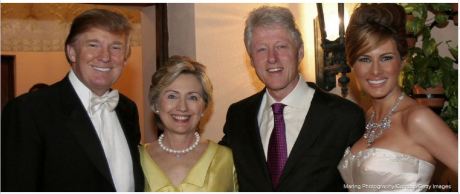
“Hillary Clinton, I said be at my wedding, and she came to my wedding,” the reality-star-turned-politician said at the first GOP presidential debate in Cleveland. “She had no choice because I gave to a foundation.”

trump wedding

Finally, but not last, we have the problem of the ‘failed presidencies’.

Quite a sizeable number of Americans are undecided whether Carter or Obama were the worst American Presidents ever.

The rest of the world remembers Carter as the guy who successfully brokered the Camp David deal while Obama continues to enjoy a good reputation abroad, despite the huge number of drones that were used during his mandate over foreign territories and despite  his failure to shut down Guantanamo, as he had promised.


Had America been a small country, equivalent to Switzerland, for instance, all these would have been of very little importance.
Since the US is not only the biggest economy of the world but also the most powerful nation on Earth, people all over the planet are keeping their fingers crossed about what’s going on there.


trumped up plagiarism

I’m not naive enough to argue that the most powerful man on Earth must also be a very honest one and that not even the slightest shadow must be allowed to tarnish his public image.

After all even his followers portray him as an effective leader who gets things done, not as a virgin knight riding a white horse. Otherwise the ’eminent domain’ incident and all subsequent ones would have already scuttled his political career.

Recent developments show that at least some Americans have started to figure out the real danger posed by his ‘management style’:

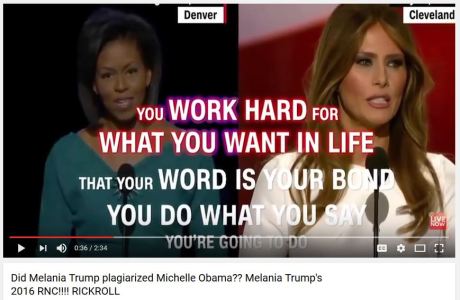
It’s an embarrassing screw up; clearly the passages were lifted, and a half-assed attempt was made to vary them by changing a word or two. Sad thing is, Melania actually did a good job in the delivery. This didn’t have to happen.

It just offers more evidence that Trump can’t/won’t hire competent people. He’s ultimately responsible here. With him as President, we’d probably be subject to these kind of embarrassments on a daily basis. Seems he either hires people who are in way over their head, or hires smart people and then refuses to listen to them. What kind of cabinet would he pick as President? It really doesn’t matter; he probably wouldn’t heed their advice anyway

Unfortunately they also prove that there are some people who don’t give up on him so easily:

Michelle Obama did not write “her” speech. A team of paid political speechwriters did. THAT is Trump’s point with having his wife repeat those words.

PS.
Just read about another possible interpretation of what had happened.

The sentences were probably planted there to make Melania’s speech go viral and drive the left wing crazy.

Very plausible hypothesis, given Trump’s modus operandi, and suggesting that Trump may entertain an even more disparaging opinion on his followers than the one he has already expressed:

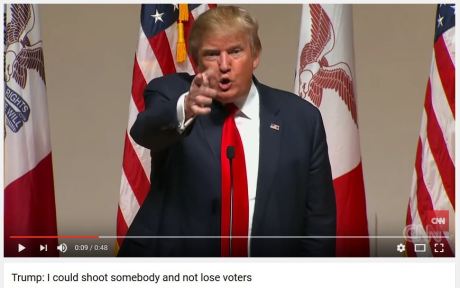
““I could stand in the middle of Fifth Avenue and shoot somebody and I wouldn’t lose any voters,” he said.”

‘I can make my wife do some dirty work for me and still not loose any voters’.

shooting trump

truck-nice

When facing an uncertain future, people are hard wired to search their past.
Some look for things that have gone well and hope that reenacting them will bring back a measure of order in their lives.
Some others look for clues pointing to things that went bad, hoping that making them right will change their prospects.

In this respect I remember how fascinated I was when I first heard about Malraux’s “The XXI-st Century will be religious or will not be at all“.
When trying to understand what Malraux wanted to convey we must remember that he started as a left wing intellectual who, at some point, felt an admiration for Stalin. Later, after he found out what Stalin was really up to, Malraux had given up on Stalinism but never on his atheism. So?

Looking even further back in time we arrive at Emile Durkheim’s Suicide.

Written at the end of the XIX-ht century the book teaches us that while suicide remains a profoundly individual decision those who consider it are deeply influenced, when making the call – one way or another, by the strength and nature of the social ties that connect him to the community to which each of them belongs.
Further into the book Durkheim also discusses the fate of the communities themselves, arguing that a society needs to keep a dynamic balance between social control – that keeps a community together – and a healthy dose of deviance – which might pull at the seams of a society but simultaneously allows it to change when it has to do that in order to survive.

OK, all these are very nice but will you come back to our present? You promised us something about the future and you are leading us further and further into the past. Into a ‘mythological’ past, no less…

One of the most pressing issues that we must face today is the advent of ‘lone wolf’ terrorism. The kind that not only scares us the most but also the one that is hardest to prevent.
Some even try to make us accept the idea that we’ll have to learn to live with it.
“No revelations come from the massacre in Nice. There is nothing to be learned. This is what we live with, what we are getting used to living with. None of it is surprising—that’s the most frightening thing of all.” (George Packer, The Tragic and Unsurprising News from Nice, the New Yorker, July 15 2016)

Well, I strongly disagree with this line of thinking.

What happened in Nice, where a lunatic drove a truck through people gathered to watch fire-works celebrating Bastille Day and killed 86 of them, is proving that both Malraux and Durkheim were spot on. Each in his own right.

In the last twenty or so years, terrorist acts have doubled as suicides. Some perpetrated by ‘simple minded’ youngsters driven to desperation by perceived socio-economic inequities and primed by callous so called religious leaders while others were carefully planned and cold-bloodedly executed by apparently sophisticated members of the middle class.

If we interpret these acts according to Durkheim’s theories we might reach the conclusion that the communities that harbor the terrorists do not function properly. Either the individuals feel so constraint by the existing rules that they cannot find enough breathing space – and snap – or that they cannot find enough social support – and go out ‘with a bang’.

Or both, at the same time.

Let’s remember that those who comited most recent terrorist acts, in Europe and in the Middle East – if we count those who joined ISIS coming from the Western Europe, are second generation Muslim immigrants or new Islamic converts.
I’ll deal with these two categories separately.
The second generation immigrants had a very frustrating experience.
Their parents came from abject poverty, worked hard and, most of the time, fared a lot better in their new countries than any of them even dreamed of on arrival – specially when comparing to the situation in their countries of origin. The youngsters went to school alongside the natives, watched the same television programs and read the same books and magazines. And grew to have the same expectations. But had a lot more difficulties when tried to fulfill them. Because of their skin color, religion, etc., etc. Add to that the nefarious propaganda coming from the Wahhabi preachers and you have an already primed keg of gun-powder waiting for a spark.
But let’s not forget that these people live in otherwise closely knit communities.
And that preparations for terrorist acts do take some time and effort.
How come these preparations go unnoticed and, even more important, unreported?

Can we conclude that whole communities have went past the ‘I don’t care anymore’ point?

A situation for which Durkheim used the term ‘Anomie‘?

Could we consider that not only the immigrant Islamic communities are in an anomic state but also the larger, host ones? For letting the whole situation degrade to such an extent? Not only at home but also at the door steps of Europe?
And please remember the new converts to Islam. What happened to those youngsters – most of them are young people –  that they became so estranged to their native society that emigrated to a totally different realm, not to a different country? A few of them might be explained away by individual ‘deviance’ but such a large number becomes a social phenomenon that begs a different explanation.

Should we accept the situation – and the degradation that would inevitably follow if nothing is done – or should we heed to Malraux’s advice and do our best to find new, and more efficient, communication channels so that we’ll be able to built some much needed trust amongst us? Based on mutual respect, not on MAD force?

Recep Tayyip Erdogan saved his political ass last week-end by urging his “supporters to take to streets in protest of coup

gettyimages-576527614

Supporters of Turkish President Recep Tayyip Erdogan react to a Turkish military tank in front of the Turkish Parliament July 15, 2016 in Istanbul, Turkey.

Which they did and the coup eventually failed.

Leading some observers to salute the maturity of the Turkish democracy:
“The most valuable outcome of last night’s events is that many people who are not AKP supporters stood up for democratic values despite the recent crackdowns on the opposition, and despite the tension and the polarization of the country.” (Erol Önderoglu, Turkey’s Reporters Without Borders representative who is currently on trial on terrorist propaganda charges after participating in a solidarity campaign with a pro-Kurdish newspaper.)

“These people do not support Erdoğan, but they oppose the idea of a military coup. Turkey has a history of very painful, traumatic military interventions, so I was not surprised to see such united opposition to this attempt.” (an academic who wished to remain anonymous)

But ‘not everybody is happy in paradise’.
“Everyone spoke out against the coup last night and that gave me hope” … watching events unfold today this hope has shrunk quickly. Last night there was the possibility that the government would use this to return to a more unifying language, to return to the peace talks, to unite the country. But today it looks like they will use [the coup attempt] simply to consolidate power.” (the same anonymous academic)

What’s going on there? Is Turkey a real democracy?
Or, if we dare to look from the other side, ‘what’s wrong with contemporary democracy’?

Is it enough for elections to be held regularly and the votes duly counted for a country to be called ‘democratic’?

I’m afraid not.
Communist Romania did have regular elections, where a huge proportion of the people rubber-stamped the party line.
Putin is currently serving a third mandate as Russian president, after paying lip service to the Russian constitution and letting Dmitry Medvedev fill in between 2008 and 2012.
No major irregularities were noted at the time of the voting in Russia when Putin was reelected but somehow I cannot consider the process fully democratic.

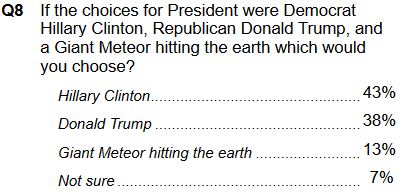
Even in the United States things are no longer what they used to be. Both major parties have put forth candidates that are seen unfavorably by a majority of the people. So unfavorably in fact that 13 % of the registered voters would rather see the Earth being hit by a giant meteor than any of the two as President.

unfavorable trump clinton

Clinton trump unfavorable

clinton meteor

Public Policy  Polling, June, 13, 2016, Raleigh


So, again, what’s going on here?

I’m afraid that what has been known as ‘democracy’ is being slowly eroded to ‘mob-rule’.

You see, in a really democratic situation you get the ‘real deal’ with ‘all the trimmings’ while when having to deal with ‘mob rule’ all you get is some ‘window dressing’.
Or, as the Romanian saying goes, on the outside you are greeted by a white picket fence but once inside you’ll have to deal with a white fanged tiger.

Let me explain myself.
Theoretically democracy is a situation where everybody has some, even if minute, influence over the fate of the community to which he is a part.Practically it means “government by the people; especially :  rule of the majority”.

I’m almost sure that by now most of you have already figured out what I’m driving at.

‘Rule of majority’ can be more dangerous than a regular dictatorship if that majority has been improperly led into voting the way they did.
A ‘dictator’ might be wise enough to know that if he drives the situation way beyond the plausible something will eventually snap but someone callous enough to lie to an entire society doesn’t have such qualms. In fact this is the explanation for why not all authoritarian regimes end up in complete failures.

On the other hand most of them do exactly that while no democracy has failed yet, as long as it maintained its democratic character.

Why? Simple.

Running a complex system – and a country is a very complex system, is a matter of setting goals and avoiding making mistakes.

And while setting goals is important, avoiding mistakes – specially catastrophic ones, is paramount.

If goals are chosen improperly – not bold enough, for instance, or even misguided, that society will experience a ‘hiccup’ but if that society is led into a dead-end then it might never recover. The ‘funny’ thing here being that in many instances the authoritarian leaders were quite good at setting goals but almost always sooner or later ended up in a ditch because they were very poor at avoiding potholes.

But how come democracies are better at avoiding grave mistakes than centralized administrations?
‘Four eyes see more than two’, specially if they look in different directions.
Every authoritarian regime follows the cue of the authoritarian leader and tends to down-play, or even ignore, the rest of the problems. This tendency is accentuated by the fact that those positioned higher on the roster tend to be better insulated from the immediate effects of their decisions. So relatively small mistakes keep piling one atop the other until the heap cannot be balanced any longer.
On the contrary, in a functional democracy – where everybody has a real chance to bring his concerns to the attention of others, mistakes are not only easier to spot but also easier to avoid.
Only this cannot happen as advertised unless the members of a society have a healthy dose of mutual respect. Nobody is going to pay any attention to what is being said by a ‘pariah’. No matter how interesting, or important, that might be.

And this is exactly what happens in a ‘mob-rule’ environment. Nobody listens anymore to what ‘the other’ has to say. People allow themselves to be driven into separate herds and, once there, pay no attention to anybody else but their ‘own’ cattle-driver. Who not only that doesn’t have any respect for ‘his’ herd but usually doesn’t care for anything else but their votes. Reason would ask that he should pay close attention to the well being of his herd but since he is convinced that he can always attract new followers he will usually go for the ‘cheapest’ alternative – taking good care of a flock being more ‘expensive’ than luring some new ‘green horns’.

That’s how people become estranged from one another and end up with their eyes glued to the whip of the cattle driver. That’s how democracy becomes an empty concept.

That’s why an honest count of the ballots doesn’t mean much if the public discussion which preceded the voting wasn’t both free and meaningful.
That’s why reducing democracy to ‘rule of the majority’ is akin to putting the cart before the horse.

The real scope of the whole process being to openly examine as much information as humanly possible before starting to make decisions (vote), not to (artificially) build majorities around (charismatic?!?) political figures. Or should I rather call them by their rightful name? Con men?

I recently read an excellent article about how the ever-growing lack of trust in public institutions, governments and experts included, is generating aberrations like Donald Trump becoming the darling of a sizable proportion of the American Republicans.

collapse of trust in institutions

I’m afraid that all of us have contributed to this.

People who get elected to power use it to fulfill  their own goals yet continue to get elected despite the fact that many of those goals do not add anything to – and too many times even subtract from – the general well being.
People who, for various reasons, vote for those mentioned above.
Media pundits who fill the airtime with their versions of the reality, purposefully crafted to fit their own goals instead of honestly trying to present to the public what they have seen/understood of what had happened.

What’s bothering me most is that all of them are behaving in an absolutely ‘rational’ manner.
In the sense that all of them are convinced they are following the current mantra.
“Make the best of the opportunities at hand”

Given the current ethos – that only the pussies do not grab everything within their reach – each of those in places where they might be given things would act foolishly not to accept those ‘gifts’. If they might find a ‘legal’ way to do it.
And the Supreme Court of the US concurs.

In a unanimous decision, the U.S. Supreme Court threw out the corruption conviction of former Virginia Gov. Bob McDonnell.

“There is no doubt that this case is distasteful; it may be worse than that,” Chief Justice John Roberts wrote for the court. “But our concern is not with tawdry tales of Ferraris, Rolexes, and ball gowns. It is instead with the broader legal implications of the Government’s boundless interpretation of the federal bribery statute.””

What happened was that former Gov. Bob Mc Donnell had accepted various gifts from a certain business man called Williams and then (because of them?) ‘set up meetings, hosted parties and called Virginia officials to discuss  a series of meetings to discuss aspects   related to William’s businesses.

Now, is this an example of corrupt behavior or not?

According to the Government and to the lower courts that have sat on this matter, it is.
According to the Supreme Court, it is ‘distasteful and even possibly more than that’ but not yet corruption. Or, at least, not in the way the Government has presented its case.

“But conscientious public officials arrange meetings for constituents, contact other officials on their behalf, and include them in events all the time. The basic compact underlying representative government assumes that public officials will hear from their constituents and act appropriately on their concerns — whether it is the union official worried about a plant closing or the homeowners who wonder why it took five days to restore power to their neighborhood after a storm. The Government’s position could cast a pall of potential prosecution over these relationships if the union had given a campaign contribution in the past or the homeowners invited the official to join them on their annual outing to the ballgame. Officials might wonder whether they could respond to even the most commonplace requests for assistance, and citizens with legitimate concerns might shrink from participating in democratic discourse.” Chief Justice John Roberts writing on behalf of the court.

The way I see it this is nothing but ‘hiding behind technicalities’.
From a formal point of view the Supreme Court’s decision is absolutely correct.
On the other hand almost everybody speaks out, some very vehemently, against ‘pork barrel politics’.

Yet nobody does anything when occasion arises. Forgetting that this is exactly what we, humans, are supposed to do. Make decisions and assume responsibility for them. Otherwise, if we only look out for pretexts to do nothing when those around us keep making ‘good’ use of whatever opportunities they identify, the whole world will soon become, again, encased in the kind of straight jacket Hitler and Stalin were trying to put on us.

Here’s another example.

Less than a fortnight from now the Republican and the Democratic conventions will likely nominate Trump and Clinton as their respective presidential candidates. Each passionately defended by their followers and viciously attacked by their adversaries.
Yet both almost equally disdained by the general public.

“More time on the campaign trail isn’t improving the image of either major-party presidential candidate, Hillary Clinton or Donald Trump, a new Wall Street Journal/NBC News poll finds.
Some 60% of registered voters held a negative view of Mr. Trump, the presumptive GOP nominee, compared with 58% in May. Some 29% viewed Mr. Trump positively this month.
Mrs. Clinton, the former secretary of state and presumed Democratic nominee, fared somewhat better, with 55% viewing her in a negative light, compared with 54% in May. One-third of registered voters held a positive view of her.” (Peter Nicholas in Wall Street Journal, June 27 2016)

What’s going on here?
Why has any of them been picked up as candidate in the first place?

And why none of their detractors mentions the trait of character that both of them have in common?

The complete disrespect both of them have for ‘comme il faut’.
You see, ‘properly’ doesn’t necessarily mean ‘being a stickler for the word of the law’ but certainly means following the ‘spirit of the law’.
You’d expect as much from the two contenders for the Oval Office, don’t you?

Yet Donald Trump has a history of trying to use the law in order to drive an old woman out of her house so that he could have build a parking lot for one of his casinos while Clinton is being currently investigated for the highly irregular manner in which she used to manage  her e-mails when she served as Secretary of State.

To me this is a pertinent enough explanation for why a majority of the people do not trust that any of them would have ‘the better interests of the country’ in mind if and when any of them will be elected to office.

Making a step further people might soon develop a distrust for the whole concept of democracy – simply because the system was unable to deliver better candidates/alternatives. Not only in America.

And since the idea of democracy starts with trusting your fellow citizen to be able to make pertinent decisions – even if they happen to be contrary to your own ideas on the matter – it is highly likely that we’ll soon live in a very untruthful world.

tainted vote

“It was a fair vote. They may not like the outcome but nobody’s saying that the vote was tainted. Maybe by the misinformation ahead of it … but the actual voting process…”

If there is something to be learned from the current debacle is that democracy is about way more than honestly counting the votes.

In fact, if we resume ourselves to that, we’ll end up tied down in a cage known as ‘mob rule’. Who ever succeeds to stir up more efficiently the public sentiment will rule the day and ‘apres nous, le deluge‘.

In order for the democratic process to be efficient – actually democratic, that is – the electorate must have at its disposal all the pertinent information that is available at that moment. If the electorate doesn’t really care and doesn’t mind that information… that’s it. But the information has to be readily available.

And there’s the catch.

If those ‘in charge’ use the media to spur up public sentiment instead of honestly informing the people about the  situation at hand then we’ll have a beauty pageant instead of a democratic election. Or referendum.

What we really need to remember, fast, is that for a democracy to maintain its function – weed up the really bad leaders/ideas proposed in the public square – we need to add two things to ‘honestly counting the votes’.

‘Mutual respect’ among all members of a given society and a keen enough interest of a majority of the members of that society in the well being of their community.

‘Democracy’ won’t work properly unless the voters respect each-others, and the government they had, themselves, elected. Simultaneously  the government has to treat ‘the people’ with utmost respect, not as if they were hapless children in dire need of close guidance.

At the same time no democracy ever successfully maintained its character unless the ‘leaders’ were constantly remembered of their ‘mortal’ status.

And the Lord God said, “The man has now become like one of us, knowing good and evil. He must not be allowed to reach out his hand and take also from the tree of life and eat, and live forever.”” Genesis, 3:22

The point being that those who think they can make the difference between good and evil need their feet constantly brought back to the Earth.

In Heaven it was God who did that. Here on Earth God works through the hands of Man. Hence we have to take good care of our own fate.
We won’t be able to do that efficiently unless we start respecting each-others, and each-others’ opinions – because none of us will ever be able to know the entire truth so we’ll be better off collectively if we share our knowledge.
For the very same reason – no one can master all the information that floats around us – all those who try to grab too much power must be treated with ‘extreme caution’. Again, this can be done more efficiently in a collaborative, and respectful, manner.

That’s why I’m convinced that the EU needs to be remodeled, not bulldozed.

the brexit hero

“Isn’t it funny?
You know, when I came here 17 years ago and I said that I want to lead the campaign to get Britain to leave the EU, you all laughed at me.
Well, I have to say, you are not laughing now, are you?”


Now let me get something straight.

This guy has been going to work, as an elected official, with one goal in mind. And one goal only.

To undermine the very institution he was working for.

Not to improve it in any way but to simply dismantle it.

I’m not going to discuss here whether he is right about the shortcomings of the EU or not. (He is)

But I am going to question his modus operandi.

OK, he did point out, very astutely, which are the weak points of the European Union.
And then, instead of proposing ways to mend those problems, he did his ‘best’ to make matters even worse.

That was all that he could do in those circumstances. That’s it. Nobody’s perfect.

But why elect a guy like this, time and time again, into a position where he gets to be paid, handsomely, for making trouble?

And no, he wasn’t a ‘whistle-blower’. He never came forth with anything new.
He just kept milling around a few otherwise well known ideas – most of which are absolutely correct – and then turned them on their head, effectively morphing them into ‘seeds of doom’.

And yes, he was the guy “who has repeatedly criticised wasteful EU spending” and then used 58 000 pounds of EU money to cover a security bill “for just five events held in modest venues such as a darts arena in Essex where there was not a single demonstrator.

Now go figure.
There are people out there who consider him to be “The Hero of Brexit”….