Archives for category: The kind of world we live in
Until not so long ago it was possible to buy unlimited coverage against the risks that scared you.
After things became too complicated and fraud a too widespread occurrence even the Lloyd’s gave up and started to introduce caps on insurance policies.
In fact Lloyd’s of London was the only place – that I knew of – where risk was understood, at least in part, in a ‘functionalist’ manner.
Risk is something that can be seen in two ways.
As yet another opportunity for making profit or something that has to be mitigated for the profit of the entire community.
Let me deal with the latter ‘option’ first.
Somehow I don’t buy it that Bismarck was primarily motivated by the well-being of the workers.
But what the German industrial barons of the day needed in order to catch up with the British ones – the Albion was the industrial power house of that time, o tempora…- was more and more people willing to leave the relative safety of the country-side and come to the city to work in the newly built factories.
In order to appreciate the huge difference between these two situations we must remember that in those times families were a lot larger than they are now and that their members used to help each other in times of need. But this could happen only if the members of the same family remained in close vicinity and worked on very flexible schedules – agriculture or family owned shops. You cannot go help your ailing mother if you work in shifts and live two hundred miles away from her.
So, in order to ‘lure’ more and more people out of the fields, and in a very short time, Bismarck had to offer them a ‘safety net’.
OK, let’s accept the idea that, maybe, there are some risks that the society, as a whole, should concern itself with.
But how to fulfill this ‘social need’?
How to identify which risks should be dealt with in a collective manner and which should be left alone. Then how to manage the whole process?
‘State-wide’ or through privately owned/operated initiatives?
Does it really matter?
I don’t think there is a universally valid recipe here.
The Bismarck’s social insurance system worked in Germany.
Lloyd’s has functioned almost seamlessly for 3 centuries. In England.
Both systems, one centered mostly on profit and the other on the safety of those who took part in it, worked because they spread out both the risks and the profits.
Current systems, where only the risks are being mutualized while the benefits tend to become more and more centralized – by ‘design‘, by corruption or both – are no longer functioning properly.
Take ‘Obama Care’, for instance. Most people, including Donald Trump, agree that something has to be done about ‘public health’ but the whole thing isn’t yet working properly.
Instead of fighting among ourselves on whether the state/government should have anything to do with risk management how about considering for a moment where our current infatuation with ‘profit‘ has brought us?

People are very passionate when discussing about their future and their rights.
As they should be.

Children are a very strong ‘avatar’ for our future while the rights to live and to freely dispose of our bodies two of the most important rights.

And this is where things get really complicated.

Some people advocate mandatory vaccination against the most dangerous diseases.
Some people advocate women’s absolute freedom to have an abortion – a few of them extending this right up to the last moment of the pregnancy.

Other people believe that vaccines are mostly benefiting the big pharma and choose not to immunize their children.
Other people believe in the absolute right of the fetus to live – so much so that some of them would even ban all contraceptive methods.

The ‘interesting’ thing here is how this four categories of people intersect each-other.

A lot of the people who advocate women’s right to have abortions also advocate the mandatory vaccination of children while a lot of people who consider abortion a mortal sin also consider vaccination to be inspired by the devil.

Now let me get this straight.
You have the right to ‘kill’ your baby inside the womb but you should not be allowed to let them die of a preventable infectious disease?
You are to defend a fetus, at all costs and against all consequences for the mother, as long as they inhabit the womb only to let them catch whatever preventable infectious disease might come across their path?

Consistency is over-rated?

We really need to restart using our common sense?

gambit noun [C] (CLEVER ACTION)

– a clever action in a game or other situation that is intended to achieve an advantage and usually involves taking a risk:

 – specialized games a way of beginning a game of chess, in which you intentionally lose a pawn (= game piece) in order to win some other form of advantage later

I borrowed this definition from Cambridge Dictionary, the on-line version.
You have already noticed, I’m sure, the accent on cleverness, the ‘intent to achieve an advantage’ and the relative downplay of the risk that is only ‘usually’ involved.

A more nuanced definition of the concept would mention that the person who uses this tactical maneuver has to get out of their psychological  comfort zone in order to perform it properly.
The whole thing involves offering a valuable bait which, once taken, might produce consequences favorable to the party that is ‘spending’ it.
Since the favorable consequences are not sure – otherwise it would have been a bribe, not a gambit – but the expenditure is certain the guy who initiates this has to thread very carefully. Hence the need for the bait to be really valuable. Valuable enough for the taker to take it and valuable enough so the giver would be really careful when performing the maneuver.

We have witnessed three gambits in close succession.

Britain’s David Cameron promised a Brexit referendum in an attempt to win the 2015 general election. He won the election but lost the referendum.

Quite a large number of Americans, fed up with what has been going on in their country, have pinched their noses and elected Trump into the Oval Office. The deal is not going exactly as they have planned it – Clinton is not going to be charged, the ‘swamp’ is more likely being repopulated rather than drained in earnest – but the jury is still out on this one.

Italy’s Matteo Renzi tried to cash in on his popularity and stream-line the constitution – a move which would have given more powers to the central administration. He has just lost the referendum, is about to resign – as promised and his losing the gambit has opened a wide venue for the opposition 5 Stars Movement led by a comedian – Beppe Grillo.

Need a moral to this?
Gambit works fine when playing chess. That’s a special kind of game where all the pertinent information is out there on the table and the sole variable is the opponent’s mind/will.

Real life, a.k.a. politics, is a completely different game. There are lots of stakeholders, instead of the two chess players, while most of the pertinent information is jealously guarded by each of the stake-holders – along with most of their real intentions.

If we add here the ‘detachment’ of the players – Trump and Cameron are both independently wealthy while Renzi is rather inexperienced – we’ll soon arrive at the conclusion that we’d be better off with some unadventurous, bland even, politicians.

Tallow = “the white nearly tasteless solid rendered fat of cattle and sheep used chiefly in soap, candles, and lubricants“.

bite-the-bullet

The mutiny (India, 1857) broke out in the Bengal army because it was only in the military sphere that Indians were organized. The pretext for revolt was the introduction of the new Enfield rifle. To load it, the sepoys had to bite off the ends of lubricated cartridges. A rumour spread among the sepoys that the grease used to lubricate the cartridges was a mixture of pigs’ and cows’ lard; thus, to have oral contact with it was an insult to both Muslims and Hindus. There is no conclusive evidence that either of these materials was actually used on any of the cartridges in question. However, the perception that the cartridges were tainted added to the larger suspicion that the British were trying to undermine Indian traditional society. For their part, the British did not pay enough attention to the growing level of sepoy discontent.

tallowed-five-pounder

The new £5 notes contain tallow, a substance made from animal fat Credit: AP

“…a trace of tallow in the polymer pellets used in the base substrate of the polymer…”
“As the tweet was shared, social media users expressed their disgust at the news.
“New £5 note isn’t vegan. Was everyone’s 2016 New Year’s resolution to do ridiculously insane stuff like adding meat to money?” “

What are we to learn from these two (separate ?!?) incidents?

That we have not yet learned how, or when, to use tallow?

Or that we have reached, again, such a level of generalized discontent that people might use whatever plausible pretext in order to vent their accumulated grievances?

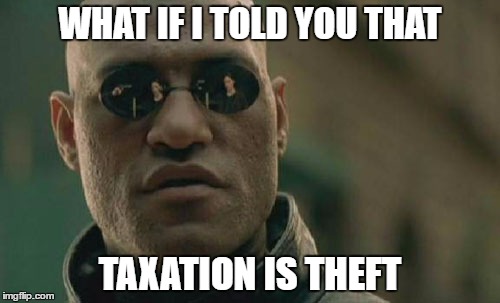
taxation-is-theft

Americans voting in the last elections had four options.

Two authoritarians, one libertarian and a “greenhorn”.

I really like Dr. Stein but her lack of ‘high level’ political or business experience made her an unlikely choice.

The authoritarians have generated much hype but so little real enthusiasm that many voters have chosen to stay home.

voter-turnout

In this situation, with so many voters – who had shown up in 2004 and 2008 – dissatisfied with the mainstream parties, how come the libertarian candidate – who had both a solid experience, as a two term Governor, and a reasonable electoral platform did not manage a better score?
He did ‘rake in’ a little over 4 million votes – more than trebling his 2012 result – but he is still shy of the 5 % needed to qualify the Libertarian Party for federal funding in the next campaign.

Could it be that the libertarians need to ‘clean up their act’?

Judging by the antics performed by the current winner some ‘pundits’ might counsel them to ‘increase the pressure’ but I don’t think that that would be a wise thing to do.
Yes, today’s 2016 President-elect did display a rather unusual behavior for a presidential candidate, and ‘won’, but I’m afraid this was due to a certain set of ‘co-incidents’ rather than the American political scene undergoing a massive upheaval.
Trump is, we must admit that, a great ‘comedian’.
He does have a huge fortune – and presently enough  Americans are sufficiently obsessed with ‘financial success’ to forgive his rather unorthodox ways of amassing that fortune.
And we must not forget that there is a sizable number of Republicans so eager to regain power that they did tolerate his antics – precisely because they have perceived him as a ‘winner’ AND because he has successfully led them to believe that he will uphold their values.
Therefore I’m afraid that Trump’s performance would not be that easy to reproduce nor do I think that America should really go down this path.

Coming back to the Libertarians, they present to the general public such a wide spectrum of ideas that the ordinary American voter is actually bewildered.
For instance, everybody hates paying taxes but give them up altogether?

The business tycoons – those who successfully avoid paying taxes, as private individuals  or through their corporations – won’t give up this system simply because being able to avoid paying taxes constitutes a huge competitive advantage. Actually it would be rational for them to try to increase the ‘fiscal burden’ that weighs down everybody else but them.
The ‘man in the street’, the one who pays little to none income tax but who contributes hugely to the GDP formation simply because he buys the stuff sold by the business tycoons, won’t give them up because he knows that taxes pay for the roads he uses to go to work, for whatever emergency health care he gets, for his children’s schooling, for his meager pension, etc., etc….
It so happens that only the middle class would have any direct, even if highly debatable, benefit if the state would give up collecting taxes. They have private medical insurance, they send their children to private schools, they don’t rely on public pensions in order to have a decent retirement, and they think they have enough money to pay the tolls whenever they’d need to use the roads.

I’m not going to discuss here the practicality of the arrangements proposed by the ‘anarchists’ – private fire-fighters and private police, among others.

What grabbed my attention was the concept of ‘voluntary taxes’.

I work with the Catholic Church (on a consulting basis) and all payments are voluntary. If people don’t like what the church is doing, they either stop participating or stop donating. Similar idea for the government. If it performs a useful function at a friendly cost, people would support it.

This makes a lot of sense, doesn’t it?

OK, I won’t bother reminding you what would have happened up to two or three centuries ago to the brave enough guy who decided to stop paying the tithe.

But I will mention the fact that there still are countries in Europe who continue to collect taxes in the name of the church.

And, because of that – where possible, many people leave their churches.

Which reminds us that in modern days belonging to a church is optional.
People who actively engage in church life constitute a subset of the entire population, a subset of people who have selected themselves into this (mental)state.

Living (somewhere) is (not yet) fully optional.
Really?!?
No matter how hard someone tries it is possible that they will never get to live where they wish. Sometimes the natives don’t accept them or they die trying to get there.
On the other hand there are ‘places’ that don’t allow their inhabitants to leave – North Korea and Eritrea are the first two examples that cross my mind. Romania also used to be such a place.
In this sense taxes somewhat resemble Schrodinger’s cat. They are optional – for those who choose to join a certain group, to remain in a certain country or to join one – and are forcefully levied from those who cannot, no matter how hard they try, to leave the place where they have to live.
To compound the situation usually the countries who allow their citizens to leave also determine in a rather democratic manner the amount of taxes that have to be paid by those who choose to remain while in those who act as a prison for their inhabitants it is the local ruler who imposes the fiscal burden unto his subjects.
Now, isn’t it rather strange that this idea, “taxation is theft”, is making furors in the freest country on Earth?
One can leave America at will and most Americans have enough money to live like ‘princes’ almost anywhere on Earth. Not as safely nor enjoying the same degree of civilization… no wonder that very few of them actually leave while so many ‘aliens’ try to get in there…
But why don’t they reform the tax system AND the (wasteful?) way the taxes are being spent, instead of dreaming of a tax-less world?
And how come they don’t realize that in a ‘voluntary’ situation the ‘rational’ think to do would be to save your money, leave the other to pay whatever they want to and benefit from whatever spoils are there to be enjoyed ‘for free’?
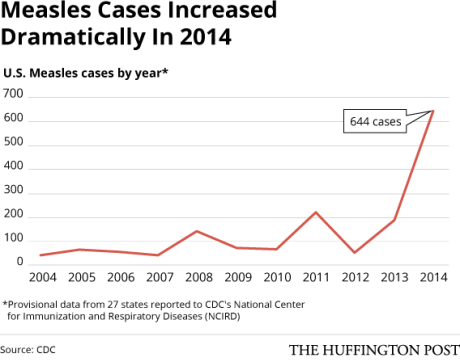
After all this is already happening with vaccines.
Many diseases have all but disappeared from the ‘civilized’ world. So much so that ‘rational’ people have begun to stop vaccinating their children.
‘What’s the use to submit my children to a risk, however small, if all the other children are being vaccinated?’
For how long do you think this ‘rationale’ is going to work?
measlesincrease2
You will tell me that people have grown doubtful about vaccines only after a scientific study was published in a peer reviewed magazine…
Well, people believe what they want to believe.
Even the defenders of Dr. Wakefield do not pretend that he is against vaccination as a principle but only that he still is, to this day, preoccupied with the safety of the ‘triple vaccine’ (MMR) involved in the initial paper.
He did not advise his patients to stop vaccinating, but instead to vaccinate for these three diseases with single vaccines, rather than the combo.
See what I mean?
Far from being rational – people are seldom rational beyond their field of expertise and sometimes fail to be so even in that realm – we are nevertheless convinced that we consistently behave in a reasonable manner.
And this conviction of ours makes us easy prey for the spin doctors who constantly stalk us.
We need to admit that our rationality is bounded before the reasonable libertarians, like Gary Johnson, will have a real chance of stepping into the lime light.
Until then the authoritarians will divide the spoils amongst them.
Not before staging a heated, but fake, fight for our benefit.

socialism-for-dummies-explained

What’s going on here has nothing to do with what the bona-fide socialists were about (long time ago they tried to reduce the imbalances produced by the ‘savage capitalism’ that was roaming freely in those days) and a lot to do with what’s currently going on in so many contemporary societies.

What’s left for us to do is to find out who is the ‘socialist’ here.

Those two bone headed morons who are fighting over who to be in control of that ladder?
And who are crying now because both halves have become useless?

Yes, that was what they were fighting for!
If all they wanted was to leave the pit it wouldn’t have mattered who did it first…

Or, maybe, the ‘serpent’ who offered to help those two divide the ladder amongst them?

And who, by doing precisely that, made sure that his control, over his ladder – which was not shown, remained unchallenged?

But what has any of this anything to do with socialism? At all?

Did anybody whisper ‘monopoly’?
Back there?

Anyone?

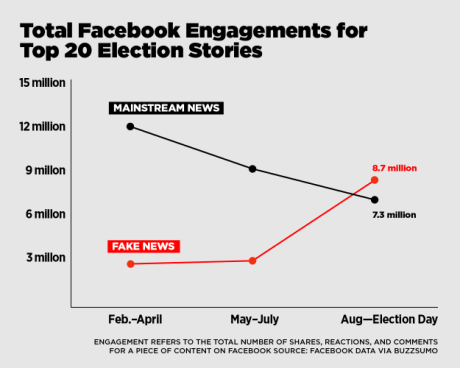
fake-vs-real-news

“When Silverman (the author of the study that produced the chart quoted above) confronted Facebook with this data, the social media giant argued that…”

Why would anyone confront Facebook with something like that?

Facebook is happy that we, the users, share anything at all on our walls for others to read.

This is how Facebook makes its living. They sell add space on top on whatever we choose to share on our walls. From a mercantile point of view Facebook shouldn’t really care whether what is shared by its users is legit or not, they simply must enforce the rules – no pornography, no open incitement to hate, no bullying, etc., etc…

We do the sharing, we bear the responsibility for our acts.
And it is we who will, eventually, experience the full consequences.

shark2-625x352

Over reliance on ‘tradition’ and over reliance on ‘science’ (a.k.a. rational thinking).

The individual prone to falling victim to the first method is convinced that:

They has adequately framed the problem.
– The answer, to that particular problem or to one close enough so that the old answer is still usable,  has already been found and recorded in the collective archive currently known as ‘tradition’.
– They is smart enough to identify the correct answer inside that huge wealth of  rather haphazardly accumulated knowledge.

The individual prone to falling victim to the second method is convinced that:

– They has adequately framed the problem.
– The answer to that particular problem can be reached scientifically.
– They is smart enough to identify the correct answer using the scientific tools currently at their disposal or to develop new ones, if necessary.

If, on top of all this, that individual, in no matter which of the two situations described above, is so convinced of the adequacy of “their” answer as to be prepared to impose it on others, even against their will – or without telling them before starting the implementation of “the answer”, then all hell will break loose – sooner or later.

By now you have probably figured out why these two methods are ‘only apparently different’.

In fact both of them are nothing but variations of the ‘inflated ego syndrome’.
This theory has been proven by the fact that all the dictators that have ever ‘ruled the Earth’ have always been convinced they were ‘rational people’, regardless of all of them either pretending to had been ‘blessed by God’ or explaining their ‘arrival’ as a ‘natural consequence’ of Marx’s scientific/dialectic materialism and/or Nietzsche’s Will to Power.

The people suffering from this syndrome can be identified by the manner in which they react to every input they receive. If their response is either ‘No, you’re wrong about this’ or ‘Yes, I was thinking along the same lines’ but never ‘Thank you for this fresh and very interesting perspective’ then you are dealing with someone harboring a very ‘inflated’ – and usually also very jealous – ego.

This kind of people are usually very good at spearheading change but allowing any of them  to acquire any considerable amount of power is, to say the least, suicidal.

Most of my right wing friends – and some from the left, are fretting about taxes and angry about the fact that they, the taxes, are ‘forcefully’ collected by the democratically elected government.

In their interpretation, the majority dictates, by the power of their numbers, the amount of taxes that the ‘fretters’ have to pay. The rationale being that ‘the poor’ help themselves, ‘democratically’, to the hard-worked, or other-wise rightfully owned, private property of the wealthy.
This rationale is a little fallacious – I see taxes as a form of ‘protection fee’, received by the state/government for maintaining a functional environment where everybody, including the wealthy, can take care of their lives and businesses – but this is a different subject.

Others warn us that “The Most Intolerant Wins” and that we must not, in the name of tolerance, tolerate any form of intolerance.

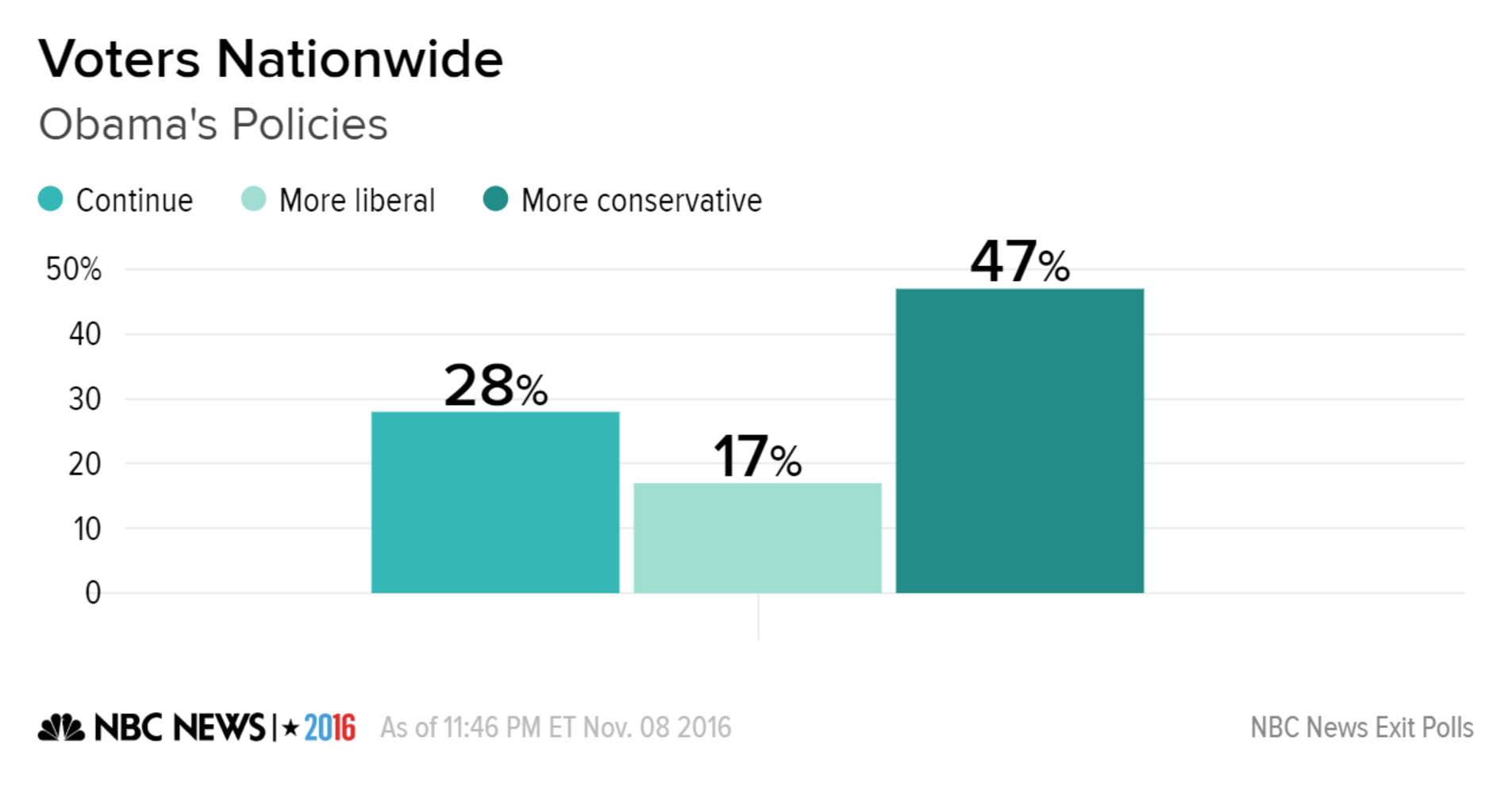
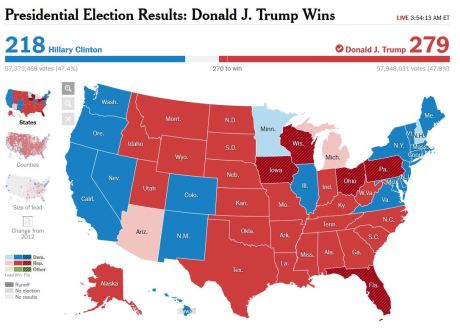
Isn’t it funny that under the current law a minority of Americans, composed significantly of ‘less educated, lower middle class people’, have imposed, upon themselves but also to the entire planet, a right wing President who has wowed, among others, to lower the taxes?

popular-vote

education-and-income

Any complaints?

PS.
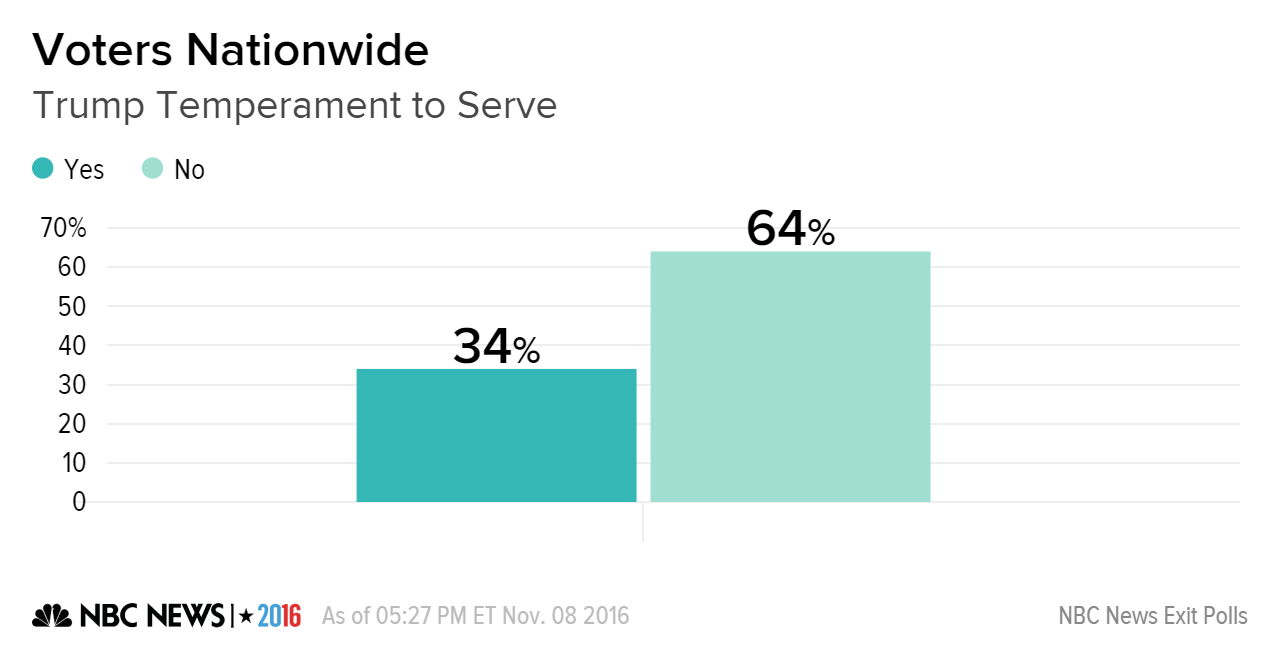
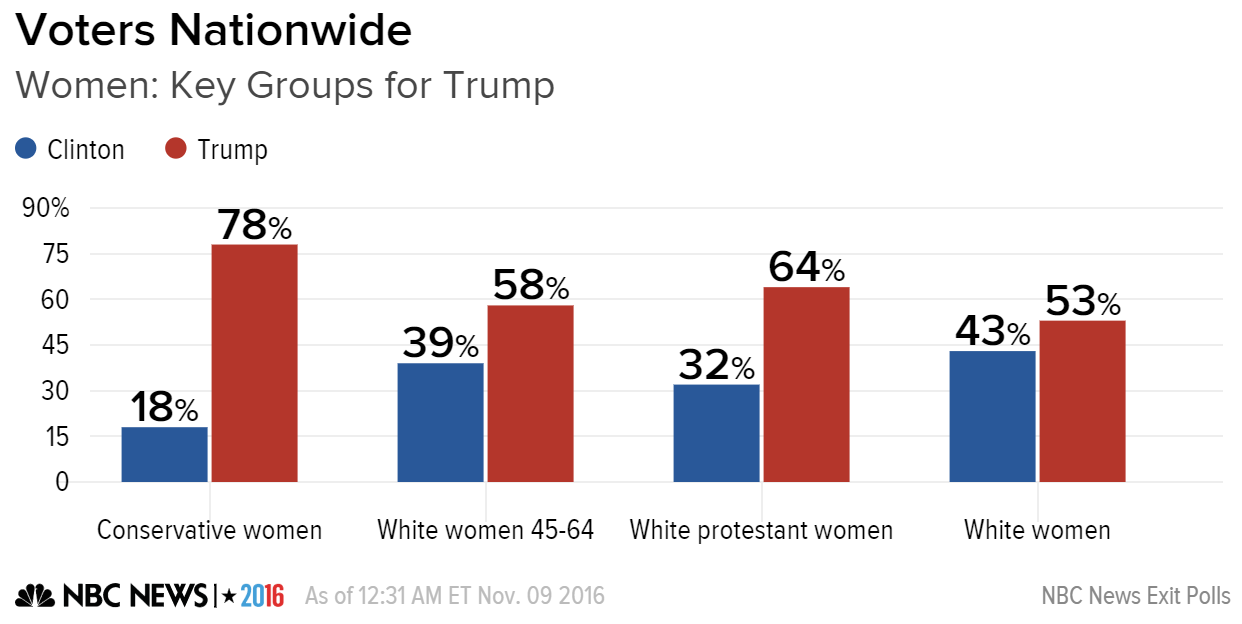
Even stranger is the fact that 18% of Trump’s supporters said they didn’t thought he was qualified for the job but that they had ‘nonetheless voted for him, as did 20% of those who felt he did not have the necessary temperament.‘.

Further more “Of people who gave their opinion of the candidate they voted for, 41% strongly favoured them, 32% had reservations and 25% said they disliked the opponents.”


trump-nbc-favorability-trump

trump-temperament-nbc

1478656414_trump_treatment_of_women

womens-votes

evangelicals-votes

white_catholics-votes

clinton-honesty-nbc

whether-to-continue

direction-of-the-country

trump-wins

New York Times, Elections 2016

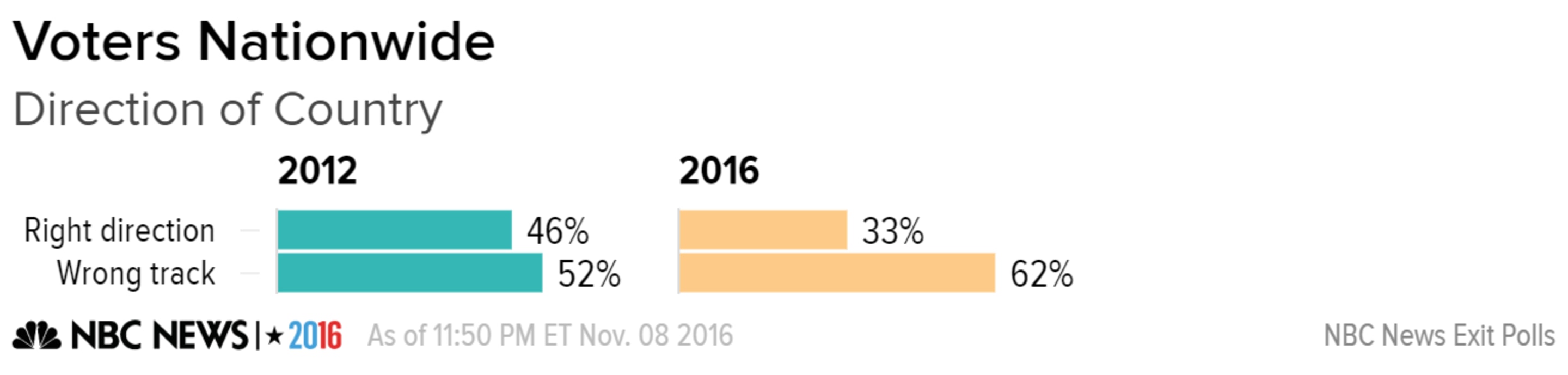
Like always, the dispirited enough to stay at home have given a carte blanche to the  desperate enough to ‘jump into the unknown’!

And no, this is not exclusively about the ordinary voters!
They’ve already sent plenty messages stating clearly that they’ve had enough.
But those whose job was to make things work had chosen not to hear.
Then, when it had become plenty obvious that the boil had been festering for long enough, most of them had stepped aside – leaving at the forefront of the ‘operating table’ a ‘surgeon’ whose long resume was anything but capable of generating trust and a ‘willing’ and ‘enthusiastic’ ‘wannabe’ with no experience.

And now they are trying desperately to find an ‘honorable way out’…


the-final-countdown


“We’re leaving together,
But still it’s farewell.
And maybe we’ll come back
To earth, who can tell?
I guess there is no one to blame
We’re leaving ground (leaving ground)
Will things ever be the same again?

It’s the final countdown.
The final countdown.”

the-final-countdown-2