Archives for category: religion

ltcm

As a teenager I’ve been reading a lot of detective novels. It was then that I learned the phrase that gives the title of this post.

“In fact, the phrase, which is occasionally used in its loose English translation ‘look for the woman’, expresses the idea that the source of any given problem involving a man is liable to be a woman. That isn’t to say that the woman herself was necessarily the direct cause of the problem, as in Shakespeare’s Macbeth for instance, but that a man has behaved stupidly or out of character in order to impress a woman or gain her favour.”

It seems that nowadays people have given up chasing women and started to ‘follow the money’ trek.

Russia says Turkey ‘shot down plane for IS oil’.

The secret bribes of big tobacco.

Coruption in sport: Nebiolo named in ISL bribes scandal.

FIFA: A timeline of corruption.

Volkswagen: The scandal explained.

Cash, visas and talks: key points of EU-Turkey pact on refugees.

Some people might say that corruption has reached an unacceptable level.
Right and wrong. Right in the sense that corruption has indeed reached an unacceptable level and wrong in the sense that NO amount of corruption is ever acceptable, but this is beyond the point of this post.

To some other people the recent developments might suggest that there is no way out of the current situation, where corruption “is no longer a practice but has become a pervasive culture”.

On the contrary. The fact that more and more corruption cases are continuously brought to the surface is not, in any way, a proof that corruption has reached new ‘heights’ but a powerful suggestion that more and more people have become fed up with this phenomenon and no longer disposed to turn a blind eye to what is happening in their presence.

enron

Let me elaborate on some concepts first.

We have religion and we also have religions.

Regardless of whether religion comes from the Latin ‘religare’ or not it is obvious for the concerned observer that inside what is commonly known as ‘culture’ there is a tightly knit set of traditions which constitutes the common ground where all members of the community that share those convictions come to meet and ‘find the time of the day’.
Emile Durkheim, one of the founding fathers of sociology, has written a whole book on this subject – The Elementary Forms of Religious Lifeand John Faithful Hamer, one of his disciples, has summed up brilliantly the whole idea: “Religion is largely a function of sociology, not theology.”

Only each community has evolved in its own distinct environment. Hence, even if for each community ‘religion’ plays the same role, there are no two religions that are similar. Simply because each of them consists, as I’ve said before, of a certain set of traditions whose main goal is to help the community make the most of the environment into which it has to make do. And since each environment is different from the next one…

And now we have arrived at the second role played by religion. To offer a certain degree of solace and certitude to the individual believer. Just as nobody can make it out by himself – regardless of whatever the anarchist libertarians might think/preach – all of us need some assurance about the world having some kind of congruence. Some of us find it in science, some others in stories which involve a God or a team of Gods and yet others in a godless narrative about how to behave in order to find, eventually, a way out of this Earthly ‘Valley of Tears’.
In order to offer that solace each individual religion has developed a certain ritual. Just as rigorous performance of calisthenics provides a certain physical well being by performing a religious ritual individuals forge a strong connection with the same minded people belonging to the same flock. That’s why some people believe that ‘religion’ comes from ‘religare’ – the Latin word for ‘binding’.

Let me now put two and two together.

We have religion as a set of guiding traditions and we also have religion as a ritual which is performed in order to bind people together so that they no longer feel alone and helpless.
Putting things this way it’s easy to observe that there are some people who are firm believers in those guiding traditions but who, for various reasons, do not feel the need to constantly reenact the ritual; others who are more or less skeptic about the traditions but who are convinced that their world would come apart if the ritual would no longer be performed and still others who are both firm believers in ‘their’ traditions and staunch performers of the ritual attached to those traditions.

From a more practical point of view the non ritualistic ‘firm believers’ will live and let live even if they are convinced the others will rot in hell while those who attach great importance to the proper performance of the ritual will try to impose it as widely as they (even im)possibly can.
So, if we need to reduce their militancy it would be easier to reduce their perceived insecurity/helplessness than to try to change their ‘religious’ convictions. Maslow taught us that it’s relatively easy to lift an individual from the base of his famous pyramid to a more comfortable level while history has taught us that it takes a lot of time to change a time-honored tradition.
Also, by helping them to overcome their perceived helplessness we’ll also help them notice the fact that each religion offers a great degree of autonomy to its followers.
BTW, that’s why many would be dictators insist on religious-like values (nationalism is also a religion), on the corresponding rituals being faithfully respected AND simultaneously do their worst in order to reduce their followers – the ordinary members of the community they intend to dominate – to a state of abject dependency. The most poignant example being Pol Pot’s Cambodia but this has happened, to various degrees, in all communist states. But not exclusively.

girls chose ISIS

mothers of ISIS

Just another proof that so many of us, theists and atheists alike, make the same mistake, unknowingly.
Basically there is no way to determine whether the world has been made by a god or even if one exists at all yet both sides try to prove their point by invoking what each of them thinks he did or should have done:
“I know there is a god because he told me so – ‘we all have a close and personal relation with God’ “
“Why the almighty god would allow…”
What about trying another tack?
How about keeping our intimate convictions to ourselves?
Do you know what all religions have in common?
‘Love thy neighbors as if they were your brothers’!
At some point the atheist said that each of us interpret the notion of god according to the culture into which each of us has been raised.
How about each of us taking a step further – as in out off the bubble into which we isolate ourselves – and notice that we have a lot of things in common and very few differences?
So, in reality what’s keeping us from truly respecting our neighbors?
Our pride, maybe?
Did I tell you that this is the second thing that most religions have in common?
That pride is considered by most as the hardest obstacle on the road to redemption?

Here in the West we have a ‘healthy’ mistrust in almost everything, including the press.

Yes, some of the media outlets have indeed became manipulative or basically empty of meaning.
We shouldn’t forget though that we, the public, have contributed to this situation. We are the ones who buy/follow this kind of media. And, above all, we allowed them to condition us into following ‘our’ media outlets. When was the last time any of you watched a show or read an article coming from a media outlet which doesn’t belong to ‘your political affiliation’?

Meanwhile out there some brave journalists operate in less than ideal conditions:


Hürriyet’s editor-in-chief Sedat Ergin

“You raided our home at midnight with stones and sticks. You stayed there for hours. You chanted, “You dog Doğan, do not test our patience.” You chanted “Re-cep Tayyip Er-do-ğan” slogans and “God is great.”
There are some people who push a button. There are groups who are ready to act when the button is pushed. How did this happen? Let’s track it step by step.”

To me this just another proof that what is going on in the world right now has very little to do with ‘religion’ per se and almost everything to do with the individuals who manipulate our religious sentiments for their own benefits.

And we let them get away with it. Includingly by pretending that the media is not to be trusted and then believing, indiscriminately, everything that comes out of ‘our’ media outlet (loudspeaker).

Could it be that the raiders were pissed off not only by Hurriyet’s constant criticism towards Erdogan but also by this article?

Why do we bash the West but not Saudi Arabia?

Bashing ‘religion’ has become a pastime…

But did you know that it was a catholic priest that came up with the Big Bang Theory

and that Darwin was at least as interested in religion as he was in the theory of evolution? OK, in time he had become agnostic, like I am, but that doesn’t mean he wasn’t religious.

A real scientist knows that knowledge is infinite and that he has no chance of mastering it all.
A truly religious person believes that there is something ‘above’ him and that his partaking in that something produces a strong bond between those who share that belief.
The person who barely reads one book, or more, and thinks that he knows it all is a fundamentalist, not at all a religious person.
A scientist can be a religious person and a religious person can be a scientist but neither a scientist nor a truly religious person can ever become a fundamentalist.
Religion is, above all, about respecting the others. So much so as to be able to cooperate with them.
Being convinced that you are in possession of the whole truth and that (most of) the rest of the world is wrong is the dead opposite of being religious.

The way I see it, the God we, humans, speak so often about is our creation, not all the way around.
There might be a real one out there, of course, but there is no sure fire way of knowing that until he chooses to convince us.
If, when and by which ever method it will see fit.

The problem arises from the fact that even after we invented ourselves the concept of God, and derived from this concept some very wise precepts, we still don’t follow, consistently enough, our own advice. Just as the man says in the video.

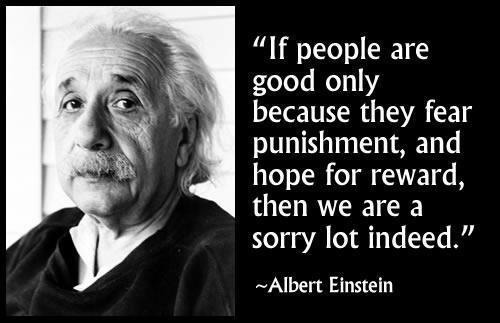
Do we really need to be under constant threat in order to behave?

“Muslim Marine Murderer’s father sexually assaulted wife and beat son”

A Facebook friend of mine shared this Daily Mail article with the following comment:
“Sad… well educated, accomplished, but lost spiritually… perfect for being radicalized…”

I was haunted by this ever since Mohamed Atta and his gang of terrorists forced us to consider it.

What made them snap?

It couldn’t be their religion.
First of all mainstream Islam, like all other bona fide religions, does not condone senseless murder.
Secondly only a very small minority of the Islamic immigrants become ‘radicalized’.
Thirdly, some of them even turn on their own people.

What if they use religion, Islam in this case, as a pretext for destruction rather than a way to connect with the others? As religion was meant to – reliegare, in Latin, means ‘connecting to’.
What if for them religion is more about ritual than about true spirituality?

I’ve slowly reached the conclusion that what these guys are doing can be interpreted as a form of ‘assisted suicide’. They are pissed off by what has happened to/around them, they blame it on the ‘society’ and they just want out. So they commit suicide and exact vengeance at the same time.

Maybe we need to pay closer attention to what the classics have taught us.

Emile Durkheim, Suicide.:

“Suicide is used by Durkheim as a means of demonstrating the key impact of social factors on our personal lives and even our most intimate motives. The book succeeds brilliantly, both as a technical study of suicide and as a fundamental contribution to this broader issue. Students of sociology will continue to be required to study this book, which will remain on the sociological agenda for many years yet to come.” Anthony Giddens.