Archives for category: religion

truck-nice

When facing an uncertain future, people are hard wired to search their past.
Some look for things that have gone well and hope that reenacting them will bring back a measure of order in their lives.
Some others look for clues pointing to things that went bad, hoping that making them right will change their prospects.

In this respect I remember how fascinated I was when I first heard about Malraux’s “The XXI-st Century will be religious or will not be at all“.
When trying to understand what Malraux wanted to convey we must remember that he started as a left wing intellectual who, at some point, felt an admiration for Stalin. Later, after he found out what Stalin was really up to, Malraux had given up on Stalinism but never on his atheism. So?

Looking even further back in time we arrive at Emile Durkheim’s Suicide.

Written at the end of the XIX-ht century the book teaches us that while suicide remains a profoundly individual decision those who consider it are deeply influenced, when making the call – one way or another, by the strength and nature of the social ties that connect him to the community to which each of them belongs.
Further into the book Durkheim also discusses the fate of the communities themselves, arguing that a society needs to keep a dynamic balance between social control – that keeps a community together – and a healthy dose of deviance – which might pull at the seams of a society but simultaneously allows it to change when it has to do that in order to survive.

OK, all these are very nice but will you come back to our present? You promised us something about the future and you are leading us further and further into the past. Into a ‘mythological’ past, no less…

One of the most pressing issues that we must face today is the advent of ‘lone wolf’ terrorism. The kind that not only scares us the most but also the one that is hardest to prevent.
Some even try to make us accept the idea that we’ll have to learn to live with it.
“No revelations come from the massacre in Nice. There is nothing to be learned. This is what we live with, what we are getting used to living with. None of it is surprising—that’s the most frightening thing of all.” (George Packer, The Tragic and Unsurprising News from Nice, the New Yorker, July 15 2016)

Well, I strongly disagree with this line of thinking.

What happened in Nice, where a lunatic drove a truck through people gathered to watch fire-works celebrating Bastille Day and killed 86 of them, is proving that both Malraux and Durkheim were spot on. Each in his own right.

In the last twenty or so years, terrorist acts have doubled as suicides. Some perpetrated by ‘simple minded’ youngsters driven to desperation by perceived socio-economic inequities and primed by callous so called religious leaders while others were carefully planned and cold-bloodedly executed by apparently sophisticated members of the middle class.

If we interpret these acts according to Durkheim’s theories we might reach the conclusion that the communities that harbor the terrorists do not function properly. Either the individuals feel so constraint by the existing rules that they cannot find enough breathing space – and snap – or that they cannot find enough social support – and go out ‘with a bang’.

Or both, at the same time.

Let’s remember that those who comited most recent terrorist acts, in Europe and in the Middle East – if we count those who joined ISIS coming from the Western Europe, are second generation Muslim immigrants or new Islamic converts.
I’ll deal with these two categories separately.
The second generation immigrants had a very frustrating experience.
Their parents came from abject poverty, worked hard and, most of the time, fared a lot better in their new countries than any of them even dreamed of on arrival – specially when comparing to the situation in their countries of origin. The youngsters went to school alongside the natives, watched the same television programs and read the same books and magazines. And grew to have the same expectations. But had a lot more difficulties when tried to fulfill them. Because of their skin color, religion, etc., etc. Add to that the nefarious propaganda coming from the Wahhabi preachers and you have an already primed keg of gun-powder waiting for a spark.
But let’s not forget that these people live in otherwise closely knit communities.
And that preparations for terrorist acts do take some time and effort.
How come these preparations go unnoticed and, even more important, unreported?

Can we conclude that whole communities have went past the ‘I don’t care anymore’ point?

A situation for which Durkheim used the term ‘Anomie‘?

Could we consider that not only the immigrant Islamic communities are in an anomic state but also the larger, host ones? For letting the whole situation degrade to such an extent? Not only at home but also at the door steps of Europe?
And please remember the new converts to Islam. What happened to those youngsters – most of them are young people –  that they became so estranged to their native society that emigrated to a totally different realm, not to a different country? A few of them might be explained away by individual ‘deviance’ but such a large number becomes a social phenomenon that begs a different explanation.

Should we accept the situation – and the degradation that would inevitably follow if nothing is done – or should we heed to Malraux’s advice and do our best to find new, and more efficient, communication channels so that we’ll be able to built some much needed trust amongst us? Based on mutual respect, not on MAD force?

5eg5cq4_llox-4hqq6q6r-cwzhlmn9igl6ermaorfgy

For the last 3500 years humankind has been busy writing Laws.

Which can be grouped in two main categories.
Natural laws and man made (normative) laws.
According to this classification while all laws have been written by Man those belonging to the first category are active regardless of Man being aware of their existence and those who belong to the latter come to life only as long as Man chooses to enforce them.

Another classification could be ‘phusical’ laws – ‘phusis’ being an ancient Greek term for ‘grown naturally’, all things that came to be in a ‘natural’ manner – ‘statistical’ laws and, again, ‘normative’ laws.

Both these classifications depend on how much influence Man has over how the laws work, besides the obvious fact that the wording, in all cases, belong to Him. To Man, of course.

The difference between them being that while the first sees Man as an individual making decisions by himself the second takes into consideration the fact that Man cannot function properly outside of a community.

Before going back to discuss some more about both classifications I have to note that laws are important mainly because they define areas of opportunity.
People are, from a functionalist point of view, self aware decision makers. But since none of them has an infinite amount of knowledge at his disposal nor an infinite capacity to process what ever information he has on a subject, people find it very useful to have the reality around them partitioned into ‘safe’ and ‘enter at your own risk’ areas.
In this respect it doesn’t matter whether the law itself belongs to either of the 5 categories. The consequences of the law are the same. Those who are aware of its existence have a lot easier job at discerning the safe from the potentially dangerous places than the ignorant ones. What each of them does after finding that out is another matter.

Coming back to the first classification, ‘natural’ versus ‘normative’ laws, let me elaborate a little about what ‘natural’ means in this situation.
It is obvious that the law of gravity, the one formulated by Isaac Newton, belongs here.
It started to produce consequences as soon as ‘mass’ came into existence – regardless of who, if anyone, made the necessary ‘arrangements’ and regardless of anyone being aware of its very existence or not.
But how about the law against killing another human being?
Animals belonging to the same species occasionally do kill each-other so this doesn’t seem to be an all encompassing natural law.

On the other hand history has compellingly taught us that communities where individuals are treated fairly by their peers fare a lot better than communities where some of the members kill (some of) the others. In a Darwinian sense the communities who do protect the lives of their members have an evolutionary advantage over those who don’t.
In this sense the ‘do not kill’ law becomes ‘phusical’. It is both ‘man made’, hence ‘normative’, and acts regardless of people being aware of its existence.

And no, this is not the same thing as ‘ignorance of the law offers no excuse‘.
As I said before, the first classification, ‘natural’ versus ‘normative’ considers Man mainly as an individual – who cannot hide himself under the cloak of ignorance and who has to bear the consequences of his acts, if apprehended – while the second classification, ‘phusical’, ‘statistical’ and ‘normative’, considers Man as an individual member who both depends heavily on his community and contributes decisively to the well being of the place where he lives.

In this respect ‘do not kill’ becomes a ‘statistical’ law. If enough individuals refrain from killing other people and if the community successfully puts in place and operates a protection mechanism  to guard the lives of its members, without otherwise stifling the ingenuity of its people, that community will fare better than those who either fail to protect their members or protect them so jealously that transform them into hapless puppets unable to fend for themselves. Those who are interested to find out more about the equilibrium between protection and freedom of expression might want to check Crime and Deviance, Functionalist Perspective.

By now you must have noticed that ‘statistical’ laws are both ‘objective’ – in the sense that they will produce consequences even if people are not aware of/do not care about their existence, and ‘normative’ – in the sense that those consequences do depend, heavily, on how people act.

So. Does this make me a staunch defender of ‘normative’ laws?

Not at all. Just as Durkheim noticed long ago telling people what to do will only stifle their ability to adapt. To cope with change.

That’s why I strongly feel that ‘normative’ laws, the few that are really necessary, must be written in a ‘negative’ way. Do not kill, do not rape, do not discriminate, do not steal are quite different from ‘all of us have to be maintained alive’, ‘we must assign an armed guard to every nubile woman’, ‘we must write millions of pages of rules to cover every possible act of discrimination’, ‘we must arm ourselves to the teeth in order be able to defend our property against all odds’.


About 8 years ago a girl meets a guy and they get married.

After four months her family intervenes and helps her get out of a dysfunctional relationship.

He starts another one, has a son, and later kills 50 people in a gay bar some time after a gay couple kissed each-other in front of his child.
“They were kissing each other and touching each other and he said, ‘Look at that. In front of my son they are doing that.”

Isn’t this whole thing very descriptive of the situation we are facing now?

Her family noticed something was wrong – he was abusing her – and helped her out.

Eight years later – after having another relationship, after being investigated by the FBI and issued a gun permit – he snaps and kills 50 people.

Where was his family? His friends? His neighbors? His co-workers?

“In other words, Mateen who according to preliminary reports, had been on a terrorist watchlist, and who still managed to obtain weapons thanks to his various licenses and permits just last week, was employed by one of the world’s largest security companies”.

More than 100 years ago, Emile Durkheim, a French sociologist, discovered that suicide, while being a very personal decision, is heavily influenced by the strength and quality of  the social relations that connect the concerned individual to the rest of the society.

I’m not going to argue now that most acts of terrorism, specially the ones perpetrated in the last 20 or 30 years, are of a suicidal nature. They are but this is a somewhat different problem from what I have in mind right now.

What I’m afraid of is that we, in the West, are killing ourselves.

As a society.

We have stopped caring about the guy next door to the tune of no longer being able to notice that he has become crazy and is about to start shooting.

Left and right.

Us.

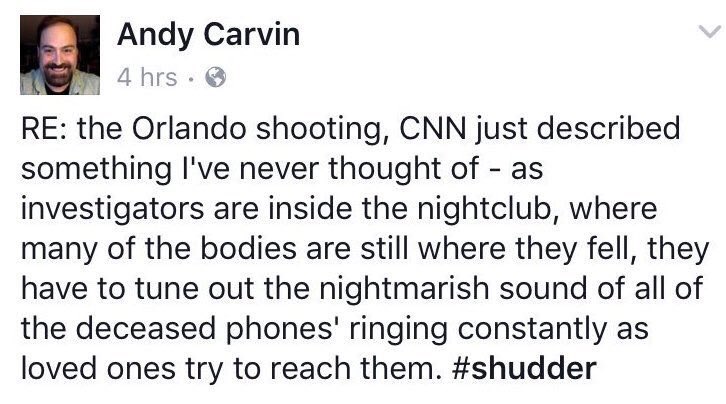
Let’s wake up, before there will be no one left to answer the phones.

phones ringing

Shortly after becoming aware of his own awareness Man figured out that, from then on, his real job will be to attach meaning to everything that was, is and will be happening around him.

The very same moment He freaked out – because of the enormous responsibility that had just fallen upon his head – and invented god to help Him.

There is, of course, no way of knowing for certain whether a real God had interfered, in any way, shape or form, in our evolution.
The fact that so many of us think the world can be explained ‘through itself’ – that there is enough information available to construct a plausible narrative about what went on since the Big Bang – is the real proof of nothing more but the huge cockiness harbored by our inflated egos.
OK, nothing more but a long held tradition suggests that God exists for real only this is no factual demonstration about the nonexistence of God.

On the contrary. The very fact that the tradition held for so long means that God had a real contribution to our life.

It doesn’t really matter whether that God was real or contrived by us.

And the fact that so many of us use their respective gods as pretexts to commit heinous acts sends no other message than that those who commit such crimes have no real understanding about what God really means.

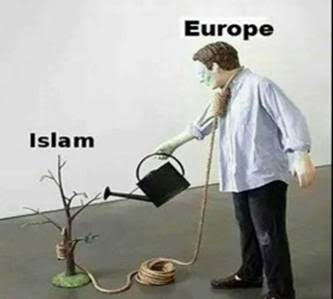
Islam Europe

I’ve just found this cartoon in my e-mail.
It was captioned: “The Winning cartoon in an organized competition.”

I instantly remembered some very wise words I’ve read long time ago:

Do not be deceived: God cannot be mocked. A man reaps what he sows.
Whoever sows to please their flesh, from the flesh will reap destruction; whoever sows to please the Spirit, from the Spirit will reap eternal life.
Let us not become weary in doing good, for at the proper time we will reap a harvest if we do not give up.
Therefore, as we have opportunity, let us do good to all people, especially to those who belong to the family of believers.”

“Beware! Whoever is cruel and hard on a non-Muslim minority, or curtails their rights, or burdens them with more than they can bear, or takes anything from them against their free will, I (Prophet Muhammad) will complain against that person on the Day of Judgment.”

All religious teachings, all of them, maintain that ‘a man reaps what he sows’. It doesn’t really matter if the ‘result’ will come as a sentence delivered by a divine judge or if it will be just another bead in the string representing the life story of an individual.
I, for one, don’t see much difference between ‘fate’ and ‘karma’.

Then how come we keep acting as if we’ve never been warned?

“In my two visits to Auschwitz, the Nazi concentration camp in Poland, I learned that holocausts and genocides do not occur in a vacuum. Rather, there is almost always a vicious campaign of incitement directed against the target group preceding them. What is troubling today, with the recent uptick in anti-Semitic and Islamophobic incidents worldwide, is that extremists and zealots are not the only ones inciting their followers. In a number of Arab countries, Muslim children are taught ideas that distort the true meaning of the Quran and hadith too.”

o-gay-prophet-570

Love, more powerful than hate.

As you can very easily infer from the title, I define myself as being an agnostic.
I’m reasonably satisfied with the scientific explanation about how the world came to be but I cannot rule out any intervention from an out-side agent during the process.

Hence my unwillingness to commit myself to any of the extreme positions.

And hence my conundrum.

A significant portion of the theist believers are convinced that God, their God, is behind everything that takes place on the surface of the Earth. And beyond.

All scientific materialists are convinced that everything takes place according to some immutable and implacable ‘natural laws’.

Then how come any of them has enough gumption to contradict any of the others?

How come a religious believer can say to another ‘your God is false’ if he is convinced that nothing in this World can happen without the knowledge and approval of his own one? Isn’t this a form of censorship towards his own God?
How come a religious believer can say to an atheist ‘you are going to rot in Hell’?
Last time I checked all Gods were very jealous, all religious teachings I know are clear about this: ‘You do your job and let Me do the judging.’ Then how come so many zealots feel free to usurp the place of their Gods and pass judgement on their peers?

How come so many of the atheists feel free to poke fun at the believers?
According to their own creed, religion is a natural thing. It does exist, isn’t it?
And by its mere existence it necessarily observes the very natural laws the atheists so staunchly defend. As if any of them needs any defense, let alone to be imposed upon the others…

When are we going to accept that religion, any of them, is nothing but an environment, not a yoke?
Just a place with some rules, not some kind of a prison?
That the final responsibility for our acts belongs to us, regardless of any God watching or not over our fates?

Here on Earth, anyway.

Oscar Hoffman, an excellent Professor of Sociology at the Bucharest University, kept telling us, his students:

“For a proposition to be ‘true’ it is not enough for it to be ‘logical’, it also has to make sense from the epistemological point of view.”

Rather hard to swallow, specially for young individuals… and since most students tend to be … well… at least young at heart… it wasn’t simple for us to follow him.

Here’s a story that might help.

“A young man knocks on the door of a great Talmudic scholar.

“Rabbi, I wish to study Talmud.”

“Do you know Aramaic?”

“No.”

“Hebrew?”

“No.”

“Have you ever studied Torah?”

“No, Rabbi, but I graduated from Harvard summa cum laude in philosophy, and received a PhD from Yale. I’d like to round out my education with a bit of Talmud.”

“I doubt that you are ready for Talmud. It is the broadest and deepest of books. If you wish, however, I will examine you in logic, and if you pass the test I will teach you Talmud.”

“Good. I’m well versed in logic.”

“First question. Two burglars come down a chimney. One emerges with a clean face, the other with a dirty face. Which one washes his face?”

“The burglar with the dirty face.”

“Wrong. The one with the clean face. Examine the logic. The burglar with a dirty face looks at the one with a clean face and thinks his face is clean. The one with a clean face looks at the burglar with a dirty face and thinks his face is dirty. So the one with the clean face washes.”

“Very clever. Another question please.”

“Two burglars come down a chimney. One emerges with a clean face, the other with a dirty face. Which one washes his face?”

“We established that. The burglar with the clean face washes.”

“Wrong. Both wash. Examine the logic. The one with a dirty face thinks his face is clean. The one with a clean face thinks his face is dirty. So the burglar with a clean face washes. When the one with a dirty face sees him washing, however, he realizes his face must be dirty too. Thus both wash.”

“I didn’t think of that. Please ask me another.”

“Two burglars come down a chimney. One emerges with a clean face, the other with a dirty face. Which one washes his face?”

“Well, we know both wash.”

“Wrong. Neither washes. Examine the logic. The one with the dirty face thinks his face is clean. The one with the clean face thinks his face is dirty. But when clean-face sees that dirty-face doesn’t bother to wash, he also doesn’t bother. So neither washes. As you can see, you are not ready for Talmud.”

“Rabbi, please, give me one more test.”

“Two burglars come down a chimney. One emerges with a clean face, the other with a dirty face. Which one washes his face?”

“Neither!”

“Wrong. And perhaps now you will see why Harvard and Yale cannot prepare you for Talmud. Tell me, how is it possible that two men come down the same chimney, and one emerges with a clean face, while the other has a dirty face?”

“But you’ve just given me four contradictory answers to the same question! That’s impossible!”

“No, my son, that’s Talmud.”

OK, but where’s the promised link?

Well, who wrote the Talmud in the first place?

A countless number of people who have figured out there’s no such thing as a definitive answer for any question?
That books should be written to help other people develop their minds, not to ‘mold’ them?
That books should be read as an exercise for the ‘thinking muscle’, not in (vain) search for ‘the absolute wisdom’?

Still looking for that link?
Keep reading, only take greater care when choosing them books.

(another version of the same story ends up like this:

“Goldstein is desperate. “I am qualified to study Talmud. Please give me one more test.”

He groans, though, when the rabbi lifts two fingers. “Two men come down a chimney. One comes out with a clean face, the other comes out with a dirty face. Which one washes his face?”

“Neither one washes his face.”

“Wrong. Do you now see, Sean, why Socratic logic is an insufficient basis for studying Talmud? Tell me, how is it possible for two men to come down the same chimney, and for one to come out with a clean face and the other with a dirty face? Don’t you see? The whole question is “narishkeit”, foolishness, and if you spend your whole life trying to answer foolish questions, all your answers will be foolish, too.”

May we all have the wisdom to ask, and answer, the wise questions!)

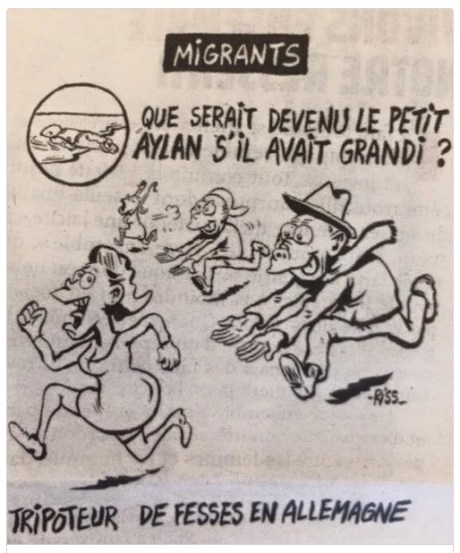
tripoteur de fesses en allemagne

‘J’ai etait Charlie’ when the barbarians tried to silence it.
Not because I agreed with everything that was published there but because I believe that it’s unacceptable to try to kill somebody – unless that somebody tries to murder you, of course.

Having said that I must confess that I find it harder and harder to understand what’s going on in Charlie’s mind.

“Charlie doit être là où les autres n’osent pas aller. Pour cette couverture, je voulais dépasser telle ou telle religion et toucher à des choses plus fondamentales. (…) En affirmant les choses clairement, ça fait réfléchir. Il faut bousculer un peu les gens, sinon ils restent sur leurs rails”

(Charlie must go where others do not dare to. For that I’m willing to leave behind specific religious ideas and reach deeper levels. … By speaking frankly (about a subject) one can convince the others to take the matter into consideration. Sometime you need to jolt people (outside their comfort zone) otherwise they’ll stay put on their tracks).

OK, I can agree with that. Even if I think that some of the ‘jolts’ are distasteful, to say the least,  the principle is correct.
But there is a small problem here. If the jolt is too powerful the target will not get just outside its comfort zone – and into the ‘thinking mode’ – but directly into a full-fledged rage. A state of mind which rejects reason and sends the brain into a frenzy, looking for arguments with which to annihilate the original message.

2233252_136_charlie

This, for instance, might be considered rude but it’s impersonal enough to prod some individuals into considering whether following blindly into someone’s steps  – just because that someone pretends to have God’s blessing – might be a wise thing to do.
In fact this message works precisely because it offers food for thought. Each of the viewers might interpret it according to their own ‘Weltanschauung’ but the ultimate responsibility for the interpretation lies with the viewer, not with the cartoonist.

This is why I can’t agree with the cartoon about Aylan.
There is no option there. The message is clear. Aylan would have grown up to be a sex-molester, no doubt about that – at least in the eyes of the cartoonist.

And this just isn’t fair.
Because killing hope is a lot worse than actual murder.

Yes, we need to take great care about how we help the migrants to find a place among us. No doubt about that.
The point being that corralling them into a ghetto won’t solve anything. On the contrary.

“When it comes to assimilating new arrivals, Europe could learn a thing or two from America, which has a better record in this regard. It is not “culturally imperialist” to teach migrants that they must respect both the law and local norms such as tolerance and sexual equality. And it is essential to make it as easy as possible for them to work. This serves an economic purpose: young foreign workers more than pay their way and can help solve the problem of an ageing Europe. It also serves a cultural one: immigrants who work assimilate far more quickly than those who are forced to sit around in ghettos. In the long run most children of migrants will adopt core European values, but the short run matters too.” (The Economist, Migrant Men and European Women, Jan 16th, 2016)


050c31042a04e93467298c7458c219af4cbcc6-wm

For some time now I’ve been wondering how come so many people who define themselves as being Christians – “Again I tell you, it is easier for a camel to go through the eye of a needle than for a rich person to enter the kingdom of God.“, Matt 19:24 – are so passionately defending the very concept of (private)”property”.

Could it be that Marx was right after all: “Private property is the result of alienated labor.” ?!? And so many of us have been wrong for so long?

“The right to private property is the social-political principle that adult human beings may not be prohibited or prevented by anyone from acquiring, holding and trading (with willing parties) valued items not already owned by others. Such a right is, thus, unalienable and, if in fact justified, is supposed to enjoy respect and legal protection in a just human community.”

Trying to understand the source of this dichotomy I adopted a two pronged strategy. First I looked up the word itself and then I tried to deepen my understanding of the entire concept.

It’s absolutely obvious that ‘property’ comes from ‘proper’.
‘Proper’, in its turn, has two basic meanings: ‘fit for use‘ and ‘pertaining to one individual‘. The first one has evolved into ‘propriety’, “the state or quality of being correct and proper” while the second has become ‘property’, “thing owned“.

So, do all these etymological arguments make it any easier for us to accept that respecting each others’ right to private property is what introduced a certain degree of functionality in the human society?

‘But aren’t you contradicting yourself?
At the beginning of your post you suggested that ‘property’ might not be as good as advertised and now you say that the ‘right to private property’ is ‘good for you’?
Will you make up your mind, for Christ’s sake?’

Now, that I’ve reached the conceptual stage of my analyses, I must bring to your attention the fact that a right is nothing but an opportunity while each (piece of) property is a thing – even those  which are not of a ‘substantial’ nature. ‘Intellectual property’, for instance, is a ‘measurable thing’ even if you cannot put your finger on it while the ‘right to intellectual (or any other kind of) property’ is (an infinite) something which patiently waits for (a rightful) somebody to make (proper) use of it.

Maybe this is what Christ tried to tell us in the first place. That it’s not property itself that stands between us and our salvation but our (improper) attitude towards it. That it’s not the object of our property that is the problem but how we make use of our right to private property.
After all Christ told the “young rich man” “If you would be perfect, go, sell what you possess and give to the poor, and you will have treasure in heaven; and come, follow me.” (Matt 19:21). ‘Go sell, give and THEN follow me’, not ‘come help me ABOLISH the very right to private property’, as Marx used to preach to his followers.

To understand the difference between what Christ and Marx said about this subject let’s see how these two relate to the notion of ‘Man’.

In Christ’s book God took a lump of dirt and ‘made Man in His own image’ while in Marx’s narrow materialistic vision “it is not the consciousness of men that determines their existence, but, on the contrary, their social existence that determines their consciousness.”

Basically both of them start with the same ‘materiel’ – the mundane ‘star dust’ that Mendeleev distributed throughout his table – but what a difference at the end of the ‘assembly line’!

adamevebefore

Being made ‘in His Own image’ not only means that all Men (and Women) are created equal but also that each of them shares in His Divine Nature. Hence the origin of our free will, of our ability (‘right’, opportunity) to be saved. Compare this to how Marx described the human society:

“The Communists, therefore, are on the one hand, practically, the most advanced and resolute section of the working-class parties of every country, that section which pushes forward all others; on the other hand, theoretically, they have over the great mass of the proletariat the advantage of clearly understanding the line of march, the conditions, and the ultimate general results of the proletarian movement.

The immediate aim of the Communists is the same as that of all other proletarian parties: formation of the proletariat into a class, overthrow of the bourgeois supremacy, conquest of political power by the proletariat.

The theoretical conclusions of the Communists are in no way based on ideas or principles that have been invented, or discovered, by this or that would-be universal reformer.

They merely express, in general terms, actual relations springing from an existing class struggle, from a historical movement going on under our very eyes. The abolition of existing property relations is not at all a distinctive feature of communism.”

articlefiles-mv003370610000-96750_bd

As somebody who has lived for 30 years under communist rule let me translate this from ‘Newspeak‘ into plain English:
‘History suggests that those who figure out the inner workings of this world  have, from time to time, the opportunity to take over the show. Now is one of those moments. The ‘fat cats’ have been so greedy lately that the regular people are growling under the very heavy yoke that has been placed on their shoulders.  That’s why we have the opportunity to unsettle the ‘old’ from their positions and to plant our fat asses in their comfortable chairs.
And the first thing we must do in order to achieve that goal is to abolish the right to private property. People are so fed up with what was going on lately that they’ll go along. They have grown to hate so much the ‘greedy plutocrats’ that most of them won’t notice that in the (revolutionary) process they’ll lose the very last shrouds of personal autonomy they still have. Without the right to dispose of the results of their own labor they’ll be at our mercy’.

Who was right between the two?

Well… Both, unfortunately.

The communists did run the show, at least for a while. And we all know to which results.
On the other hand it seems that in the longer run miss-using the right to private property is indeed a powerful drawback. The already too long sequence of economic crises caused, ultimately, by nothing else but our own greed has indeed given birth to a generalized state of psychological malaise.

I don’t know about what’s gonna happen in the next world – or if it exists at all – but I’m sure that if we don’t learn, fast, how to use, properly, the right to private property things will become too hot for our own good in this one.

The only one we are sure about.

Further reading.
During my research for this post I found this very interesting take on the same subject:

“Zwolinksi argues that libertarians are right to support private property, but also that private property is more complicated than we sometimes think.”

20090421-ceci-nest-pas-une-pipe-rene-magritte

As a child I was introduced to the chicken and egg paradox by my grandmother – a very wise woman, despite (because?!?) the fact that she had very little formal education.

As I grew up I found out that even the adults are passionate about it. Just Google it if you don’t believe me. Last time I checked the search engine had come up with 26 million (26 000 000 000) entries….

Then I was introduced to a slightly more interesting version of it.
Who is responsible for what is going on around us.
“Who created the World”, that is.

Apparently we have three three camps.

The theists, of various denominations – some of whom would cut each-other’s throats attempting to convince the ‘others’ that their God is the true one, believe that an outside agent is wholly responsible for the ‘Big-Bang’ and all its consequences. Or, at least, for ‘jump-starting’ the process.
The atheists, some of whom are ‘rabid’ enough to be as obnoxious as some of the theists, who blame it all on Lady Luck.
And the agnostics, like myself, who cannot make their minds one way or another.

Now, and I hope you won’t mind, I’m going to enumerate some facts.

  • We, the humans, are the ones who came up with the Big-Bang theory.
    Which is nice. It offers a generous canvas on which we might eventually thread a lot of ‘science’, but doesn’t, in any way, shape or form, offer even the slightest opportunity for the most imaginative amongst us to propose the flimsiest hypothesis about what started the whole process.
    Hence those of us who follow a far longer tradition feel free to consider that a Divine interference is the sole rational explanation. For everything that hasn’t yet a ‘scientifically proven’  one. As if science ever offered us a definitive answer to anything…
  • The Big Bang Theory was initially devised by a Catholic priest, Georges Lemaitre, as yet another attempt to understand God’s ways.
  • No matter what the various prophets and religious teachers have told us, all books – including the ‘holy’ ones – have been written by people. They might have been inspired by (a ?!?) God, there is no way of telling what happened in the minds of the writers, but all those books have been written by human hands.
  • We, the humans, are the ones who consider this problem to be a very important one.

So important, in fact, that even a newspaper otherwise busy with economic and political issues occasionally looks (up ?!?) at it.

In its Christmas Day edition the Wall Street Journal published “Science Increasingly Makes the Case for God” by Eric Metaxas.
Basically he author tells us the story of how Sagan started the hunt for ‘Extraterrestrial Intelligence’ and how the seemingly simple task ended up in a cul-de-sac.
While Good Old Carl thought “that there were two important criteria for a planet to support life: The right kind of star, and a planet the right distance from that star” in time “our knowledge of the universe increased” and “it became clear that there were far more factors necessary for life than Sagan supposed”.
So many in fact that some of us, Eric Metaxas included, now believe that “Probability said that even we shouldn’t be here”.

In this context I’d like to bring to your attention the words uttered by Lord Kelvin in 1895 – by that time already elected president of the Royal Society: “Heavier-than-air flying machines are impossible.”

“Yet here we are, not only existing, but talking about us existing here.”

Do you see the pattern?

The usual claptrap, because something can’t be explained, it must be God.” (Mark Baxter’s comment on my FB wall) Or outright impossible, I might add, following Lord Kelvin’s example.

In other words ‘if WE cannot figure it out then it either doesn’t exist or has been made by God’.

But who made ‘God’ in the first place? And why?

Are we even aware that what we call ‘God’ is nothing but an image?
I’m not going to delve far into such intricacies like reminding you that no Orthodox Jew would ever pronounce the ‘true’ name of God but this is a powerful indication that our Elders were aware of the difference between reality and our ability to figure it out.

So why do we keep making this mistake? Why do we still try to ‘invent’ an ‘outside agent’ whenever we don’t have enough information about how something came to be?

That outside agent might very well exist, of course. Someplace, ‘out there’…. Or not. For all we know some things might happen just by pure chance. However improbable that might seem. To us!

We cannot determine, as of now at least, either way.

Then why insist? Any way?

Some of you will tell me, quite appropriately,  that ‘believing’ has brought us where we are now.
That ‘faith’ has guided us through the dark nights when we would have otherwise lost our hope. That following the ‘ten commandments’ has kept us from killing each-other much more ‘passionately’  than we’ve done it.

But now that we’ve understood what religion has done good for us, what’s keeping us from behaving ‘as if’?
Without ‘God’, or whatever name you want to use for the reality that harbors us at its bosom, having to ‘strike’ us down from time to time?