Archives for category: Psychology

Ieri. Sau mai bine spus acum o luna si jumatate. (Când gătesc curăț legumele pe cate un ziar. Astazi a venit randul unui Jurnalul Național din 21 mai 2014)

fabiani

“Pianistul Fabiani Prcsina (11 ani) şi-a pierdut mama acum o lună. Ea a fost ucisă pe trecerea de pietoni de un tânăr aflat la volanul unei maşini de lux. Copilul continuă să cânte şi îi dedică mamei recitalurile….
Tragedia s-a întâmplat în urmă cu o lună, în Joia Mare a Paştilor, când femeia (mama lui Fabiani) se întorcea de la lucru, în chiar ziua ei de naştere. Pe o trecere de pietoni din Petroşani, femeia de 41 de ani şi încă un bărbat au fost spulberaţi de maşina de lux condusă de un tânăr de 21 de ani, care abia îşi recuperase permisul auto după ce poliţiştii i l-au suspendat pentru conducere cu viteză excesivă. Cei doi au murit pe loc. Patru zile mai târziu, de ziua lui, Fabiani îşi conducea mama pe ultimul drum. Copilul nu şi-a mai sărbătorit ziua, în schimb şi-a pus dorinţa ca mama lui să se întoarcă din ceruri. „Fabiani crede că, dacă a înviat Iisus, şi mama sa va reveni acasă“, scria într-un mesaj postat pe Facebook sora acestuia.”

Florin Iaru: “Ideologi si alte lighioane”.

“Aşadar, dacă binele e ameninţat atât de rău din ambele părţi, un spectator admirând comédia ar putea spune cu îndreptăţire: „Să piară toţi!“. Comic e faptul că ambele tabere se agită în numele democraţiei, a progresului, a valorilor. Toţi apără un principiu. Şi, în acelaşi timp, sunt surzi la diversitatea fundamentală a naturii umane. Unul e de stânga, altul de dreapta, unul e tradiţionalist, altul, modernist, unul e trist, ultimul, şi mai trist. Sentimentul că fiinţa celuilalt nu te lasă să respiri, să trăieşti, că o conspiraţie a imbecililor, a serviciilor secrete îţi ameninţă viaţa domină România. Nu poate avea cineva o idee a lui, un sentiment, o părere. Nu. E a stăpânului, a mogulului, a ruşilor, a lui Băse, a lui Ponta. Nimic nu e întâmplător. Grupurile se fac şi se desfac şi, mare ciudăţenie – cei care erau duşmani neîmpăcaţi devin prieteni la toartă, iar cei care se pupau în bot la guvernare şi în Parlament şi-au jurat moartea. Dacă iubeşti câinii, vrei să-mi omori pisica. Dacă îţi place roşul, eşti comunist. Dacă visezi, eşti nebun. Dar întotdeauna, eşti al cuiva. Un plan dement, ca o ciupercă atomică, umbreşte România. În numele ei se ascut cuţitele, se ghintuiesc ghioagele. Din păcate, planul ăsta are un nume trist: paranoia!”


Astazi. Pentru a cumpara legumele despre care tocmai va povesteam ca le curat a trebuit sa ma duc in piata. Acolo ‘m-am impiedicat’ de un 22.

Dorel Sandor: “Mediocritatea clasei politice ameninta Romania.
O evitare permanentă a obstacolelor, a încercărilor și o generare de eșecuri permanente la nivel administrativ și la nivelul atingerii unor ținte și angajamente internaționale. Deci, prin rezultate, ne dăm seama că aceste câteva sute, câteva mii de personaje cu insignă politică sunt departe de performanță, de integritate, departe de asumarea unei misiuni la nivel național sau local.”

In timp ce curam legumele alea ma uitam la televizor.
Realitatea TV: “Suspiciuni de coruptie in ministere. Surse: DNA va incepe urmarire penala penala pentru mai multi ministri”
Dudu Ionescu (ministru de interne taranist, rugat sa comenteze, reproduc din memorie): ‘Toate astea vor continua atata vreme cat vom continua sa nu tinem cont de natura umana. Acum ne comportam ca si cum politicienii ar fi ingeri si ne miram atunci cand acestia ‘cad’. Cata vreme ‘morcovul’ (leafa pe care o primesc acestia) si ‘biciul’ nu vor fi suficient de mari nu se va schimba nimic. E adevarat ca peste tot in lume in administratia publica lefurile sunt un pic mai mici decat in privat dar cei angajati acolo se bucura de o oarecare stabilitate. Aici lefurile sunt mult mai mici decat in pozitiile corespondente din privat iar la fiecare ciclu electoral sunt schimbati majoritatea ‘adminstratorilor publici’. Si ne mai miram ca cei cu adevarat competenti evita cu orice pret sa fie slujbasii statului?’

Sa fi inceput oare curatenia sau e doar inca un episod din nesfarsita lupta politica?

Si de fapt conteaza oare cu adevarat?
In realitate toata tarasenia asta va continua pana cand noi, astia, ne vom da seama de adevarul spuselor lui Basescu (redau din memorie, l-am vazut la televizor acum cativa ani):
‘Sa va fie clar, un ministru sau un factor de raspundere din administratie isi poate face mendrele doar in masura in care este ajutat de cel putin o parte dintre cei din jurul său si in conditiile in care ceilalti intorc privirea.’

I ran across this article published by CNS News.

Unusual Answer from Panelist Receives Standing Ovation at Benghazi Coalition Meeting.

It is about a meeting organized by Heritage Foundation to discuss the terrorist attack that took place in in Benghazi  in 2012.
At some point a young ‘Muslim student’ asked “…how can we fight an ideological war with weapons? How can we ever end this war? The jihadist ideology that you talk about – it’s an ideology. How can we ever end this thing if we don’t address it ideologically?”.
One of the panelists answered her that ‘there might be some 75% peaceful Muslims in the world but this is of no consequence: they follow the lead of the extremists, they don’t make their voices heard and, because of that, ‘the peaceful majority are irrelevant’ ‘. The panelist’s answer was received with standing ovations.

I’m afraid those people are making a huge mistake.

For those of you who don’t have time to read the article I’ll summarize the arguments used by Brigitte Gabriel, the panelist:
– The Germans are known as peaceful people yet the Nazis imposed their agenda and provoked horrible massacres.
– The Russians are normally peaceful people yet the Communists among them caused tens of millions of deaths, among their own people, without significant protest from the general population.
– The same happened in China.
– The otherwise peaceful Japanese allowed the militarists to take power and to start a war (the Pacific ‘portion’ of the WWII) in which another 12 million people found their death, “mostly killed by bayonets and shovels.”
– “On September 11th in the United States we had 2.3 million Arab Muslims living in the United States. It took 19 hijackers – 19 radicals – to bring America to its knees, destroy the World Trade Center, attack the Pentagon and kill almost 3000 Americans that day,” Gabriel said. “So for all our power of reason, and for all us talking about moderate and peaceful Muslims, I’m glad you’re here. But where are the others speaking out?” Gabriel asked.
The people in attendance began to applaud.”

First of all we need to differentiate between the two situations presented here.
The Germans, the Japanese and the “19 radicals” committed acts of international aggression while the Russians and the Chinese allowed themselves to be overrun by ‘misguided’ people.
Not at all the same thing.
On the other hand the German and Japanese examples are extremely interesting. A significant number of historians agree that the WWII was produced, at least in part, by the manner in which the defeated Germany was treated after WWI – they were imposed crippling war reparations which burdened Germany during the Great Depression so heavily as to produce the set of social circumstances that allowed Hitler to accede to power. This lesson was well understood so after the WWII Germany was included in the Marshal plan instead of made to pay for it. As a consequence we had, since then, 69 years if uninterrupted peace in Europe.
Japan was a ‘closed society’ until Commodore Perry forcefully ‘opened’ it in 1854, at first for trade and then to other western influences: Centralized state administration, modern army, modern management and technology, etc. And in those times the Japanese were treated, by the ‘white people’, with a ‘healthy dose’ of disdain, just as all the other non-European nations were. After the WWII all this has changed and nowadays the ‘peaceful majority’ of the Japanese have found a way, with a lot of help received from the Americans, to build a democratic society not at all different from what can be currently found in Western Europe and in North America.
Something rather similar happened with the Chinese. After Nixon went there and started to treat them as partners they basically stopped killing each-other.
But, unfortunately, this change of attitude didn’t come about between the West and Russia after the end of the Cold War. For instance we call the Ukrainian rebels  ‘pro-Russian’. Are they of any real service to Russia or to the Russian people? On the contrary… Somehow the old habit of blaming the entire Russian people for actions perpetrated by their leaders survived. Maybe because we can no longer understand the workings of a non-democratic society…since we are so accustomed with censuring our leaders.

So…

My point is that of course we have to defend ourselves from the direct actions of the ‘radicals’ – ‘shoot back’, effectively and efficiently, when ever somebody attacks us. Yet there is something else we dearly need to do, at the same time. Find a way to connect, in a respectful manner, with the ‘peaceful, yet silent, majorities’. They are “irrelevant” only as long as we treat them with the same disdain they are receiving from their own rulers. Even worse, confronted with two different kinds of disdain they’ll naturally prefer the one they are accustomed with – the one displayed by their own rulers – so if we keep packing together radicals with peaceful people and treat them as one the result will be that we’ll have to deal with an ever increasing number of radicalized ex-peaceful individuals. I propose we learn something from our parents, the ones who found a way to change the atmosphere between them and the German and the Japanese people. And since we pretend to be wiser – as all children do – than our parents were, how about doing this without wagging all-out wars? (Unless attacked, off course)

Quite a large number of us, regular people, are concerned about ‘survival’. From what to do in order to feed our children to how to protect wealth from being eroded by the inflation.
Some others, more ‘extreme’ or more sensitive, are actively preparing for what is known, by them, as ‘the imminent ending of the world’. There is no consensus on what will bring about this catastrophe – from the odd meteorite falling on Earth before the appropriate measures being taken to the unsustainable way we manage our economy or the environment but this is no deterrent for the hardcore survivalists.
In a way, they are right. After all it doesn’t matter how it happens, the main thing is to be prepared.
And this is exactly were the ‘fun’ part starts.
Most of them concern themselves with learning how to survive out in the open, how to build and stock an ‘anti-atomic’ bunker, how to use firearms, etc., etc… In fact what they do is recreate the medieval ‘castle’ mentality where the world was disputed by strong armed thugs who tried to control as many resources as possible. In time, tired by the slow burning conflict that occasionally burst into open fighting, they ‘invented’ the rules of ‘chivalry’, a framework that provided both a venue for their need to ‘prove themselves into ‘battle’ (the jousting tournaments) and enough social predictability which enabled relative stable economic relations between human ‘settlements’ that were ruled by different land lords.
From that moment on survivability was no longer improved by simply erecting higher and thicker walls but rather by maintaining a workable equilibrium between the members of a certain community – be it group of people, ‘commonwealth of villages’ or federation of states.

Fast forward to the XX-th century and we find out that the survival problem hasn’t been fixed yet. Andre Malraux, a Frenchman who started as a communist writer and ended up as an anti-totalitarian philosopher once wrote that “le vingt-et-unieme siecle sera religieux ou ne sera pas”. A rough translation would be ‘in the XXI-th century people will rediscover religion or they will perish’. Coming from a professed agnostic this continues to create huge controversy as to its real meaning.

A solution to both the riddle and the survival problem might not be so hard to find.

Lets turn to the utmost survival specialists, the Jews. For the first 15 centuries or so they survived living in ‘history’s turn-still’ – Palestine – while for the next 20 they made do even without the benefit of having a place to call their own.
How did they do it?
By fighting each other? No, on the contrary.
By fighting against the people they were living amongst? They would have been wiped out long ago. Even when they were used as escape-goats by reckless and callous temporal rulers the Jews somehow found a way to survive, mainly because enough members of the general population remembered the normalcy of the situation before the pogroms were instigated, normalcy during which the Jews were adept at conserving their traditions yet playing their role as useful members of the wider community.

And, maybe, this is also the key of Malraux’s riddle. Religion is more than following ritual, considerable more than that.
The word itself comes from the Latin ‘reliegare’, ‘connecting to’. It can mean both the connections that appear between members of the same community but also the connections that appear between the community itself and its environment. So it doesn’t really matter if religious teachings are said to have been handed down from a God or are considered to be a distillation of long accumulated tradition. All it matters is ‘have those teachings proven useful?’ Were they helpful enough to their followers so they could cope with whatever history has thrown at them?

Well… in the case of Judaism they did that, for more than three and a half millennia. And nowhere in those teachings one can find ‘if things get rough leave everybody behind and hide someplace waiting for the worst to pass’. Every religion, be it based on a God or not – Buddhism, for instance does not have a godlike figure in its center – teaches its followers that it is a lot easier to survive helping the others than fighting against all others.

Honing individual survival skill is of course important. But we should not forget that crises come and go. What we really need is to learn how to survive the long stretches of apparent stability, during which we allow the build up of immense tensions that end up by tearing apart our livelihood. As it is about to happen.

Initially politics was an activity. “Was” and not “were” because it was something in which every concerned citizen played an part, a collective effort. Oh, I forgot to tell you that this happened in Ancient Greece during what we now call the ‘first stage of democracy’.

Then, after a little less than two millennia, it became an occupation. People who had successful careers behind them were deemed trustworthy by the rest of the community and elected into government positions. The countries which used this ‘democratic mechanism’ thrived: the US, Britain, France, …to name just a few of them.

Lately politics have become a profession. People study it in Universities and engage in it without any prior experience outside the field. I believe you all know what ‘community organizer‘ means, right?

No, I’m not going to discuss this notion right now. The results can be both good or bad, exactly as it happens with almost all human professions: both Mengele and Albert Schweitzer were MDs…

For now I’ll refrain myself to observing that people have less and less tolerance for digression on the part of the politicians.

“Nicholas Sarkozy arrested over corruption allegations”

Gerhard Schroeder, lionized in his time for cutting down to size the German welfare state is now widely criticized for his involvement with GAZPROM.

Silvio Berlusconi is serving time, disguised as ‘community service’, for tax evasion.

Need I go on?

And this is happening in what we call ‘democratic countries’. In other places former rulers are stabbed to death  or brought to justice in a cage.

In fact we have indeed progressed, as a species. The last time the French got really pissed off by their leaders quite a few people lost their heads…

The most disturbing thing in all this is that the politicians were supposed to be the ones capable/willing of doing ‘the good thing’ AND professional enough as not to exaggerate in anything they do….

Is there anything to be done about all this?

How about upping the ante?

I keep hearing ‘we need a strong leader’ or ‘we need more true leaders’. Are we really sure about that? Leaders would do almost anything to take us where THEY see fit.
How about politicians acting as ‘administrators’?
Right now politics is played, in a lot of places, as a beauty pageant. Would be rulers (leaders) come up-stage to make promises and we choose the ‘best-looking’ charmer. After a while he unfailingly fails so we ‘boo’ him out of office.
Switzerland, for instance, has another way of doing things. They talk a lot more among themselves, many ideas are put forward and then some of them get to become policies and other get dumped.
When have you last heard about a Swiss political leader or about a Swiss political scandal?

“When God solves your problems, you start to trust him.
When God doesn’t solve your problems…it’s because he trusts you!”

Just found it in my mail, I’m not this wise.

rocking the boat

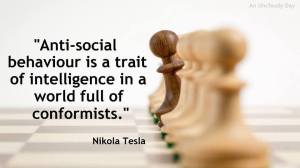
Tesla was a great physicist and a very intelligent man but his wording was rather lousy.

I get the gist of what he wanted to say and I basically agree with him but I don’t think “anti-social behaviour” aptly describes what he had in mind.

The real meaning of ‘anti-social’ is ‘acting against the interests of the group of which the perpetrator is a member”: from stealing to high treason.
What I understand of Tesla’s words are gestures made against ingrained habits which induce social stiffness – social rigidity that inhibits innovation and adaptation.
And in fact all these gestures are pro-social, they are good for the society at large and not at all bad or anti-social.

It is true that today ‘anti-social behaviour’ has been ‘stretched’ to include all actions that disturb ‘social norms, socially sanctioned customs and widely held beliefs’ but this would be true only as long as these ‘habits’ were still useful to the society we are speaking about.

I don’t think Tesla would have condoned theft or any other criminal activity, no matter how anti-social, but he would have applauded, had those things happened during his life, what Copernicus, Giordano Bruno and Darwin had done. Or Martin Luther King.


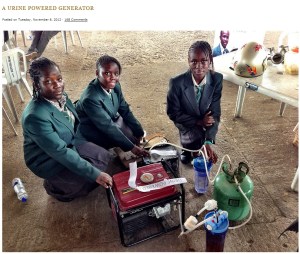
urine powered generator

So what do we have here?

Four crafty teenage Nigerian girls have put together an ingenuous rig for a ‘science and technology’ fair.

“The system works like this:

Along the whole way there are one-way valves for security, but let’s be honest that this is something of an explosive device…”

A well meaning ‘eager beaver’ journalist wanting to help promote their exploit  has branded the whole contraption as an ‘urine powered generator’.

An then the hell broke loose:

It is all over the Internet and news, three Nigerian school girls have invented a urine-powered generator that can produce electricity for 6 hours from a single litre of urine!

Really? Sadly, no.

I can’t find an original source for this story, where did it come from? [was it here?] Are there really some Nigerian school girls with a urine-powered generator or is this just a hoax? Either way, all those journalists that repeated the story really should be ashamed of themselves, it is so obviously wrong and/or untrue.”


I’m not in the business of apportioning blame all over the internet but after finding out about this succession of events I started to have serious doubts about who is wrong and who should be ashamed of themselves….

I’m sure that most of you have already understood where I’m headed to but please bear with me.

So OK, the ‘eager beaver’ has indeed stretched the reality a little bit. It’s not an ‘urine powered generator’ but an ingenuous ‘science project’ presented by some teen age students.
So what was it that brought the wrath of the ‘eco-scammer’ on those ‘poor’ girls? Or even on the writer of the original article…
Who, and where, claimed that the contraption produced more energy than it consumed? Yes, those arguments involving thermodynamics and all that scientific mambo-jumbo that he is mentioning inside his article are absolutely correct (“trust me, I’m an engineer”, a real one that is) but perfectly misplaced.
As is the original title but while that title is an innocent exaggeration the second article is a malicious  (or myopic?) and undeserved rebuttal.

Getting back to what had started all this, that ‘thing’ is not a ‘generator’ but can be used as an accumulator!
Solar panels produce energy when the sun is up but people need light at night, obviously.
Even more importantly, solar panels produce a type of current (DC) which can be used to ‘split’ water into hydrogen and oxygen and to light a special kind of bulb but for little else. If you want to power a ‘modern appliance’, a refrigerator for instance, you need an inverter – a pricy device that transforms DC into AC.
On the other hand the type of gas powered generator used by those crafty students is relatively cheap and common enough almost everywhere in the world. Adapting it to run on hydrogen is easy, this feat was not even mentioned in the original article.

So the real meaning of what those 4 girls did is that they came up with a way to replace a costly scheme comprising a lot of batteries and an inverter with a gas bottle, an already largely available gas powered generator, an electrolytic cell and two filters.

Not a small feat, by any means!
If you take some time to think about it, of course.

And yes, there are four girls that did this, not three like the ‘eco-scammer’, who probably didn’t even bother to read the original article, wrote insouciantly after merely taking a glance at the photo that came with the inappropriately titled  news.

The original story can be read here: http://makerfaireafrica.com/2012/11/06/a-urine-powered-generator/
and the ‘eco-scammer’ rebuttal here: http://www.eco-scams.com/archives/790


no piggy back

For some 30 years now the western press is periodically awash with news about the impending doom that is going to engulf China. If not now then soon, very soon.

While I’m not particular fond of the Chinese communists – every political force that enjoys monopolistic control over the space where it resides eventually becomes too rigid and looses ability to cope with the day to day challenges – I must give them what is theirs.

By drawing from the rich experience of the Imperial China the current rulers have learned something. Don’t push it unnecessarily hard, don’t appear to be callous when there is no need for such thing. Not because it would be immoral or anything like that but because it is ‘a mistake’ to do such a thing.

In most countries if something like that would have happened it would have meant that the ordinary people were getting fed with the callousness of the government officials and that generalized riots will follow. Like what happened in Tunisia at the start of the Arab spring.
In  China when ever something like this grabs the attention of the public eye the ‘Party’ springs into action and promptly punishes the perpetrator instead of trying to shield him/cover up for him. This way the ‘Party’ preserves it role in the society and makes sure it remains relevant.

So please put those doom scenarios on hold, at least for as long as things like that will continue to be severely sanctioned by the ubiquitous ‘Party’.

Click here http://www.dailymail.co.uk/news/article-2666147/No-free-rides-Chinese-government-worker-sacked-picture-emerges-riding-employees-flood-avoid-getting-wet.html if you want to read the whole story and thanks Veooz http://www.veooz.com/news/WHHU7ev.html for the picture

There is a intense debate going on in some circles about this subject.
Some think that vaccines are poisonous because some of them contain traces of mercury.
Some others believe that autism can appear, at least in part, as a reaction to certain vaccines.

No real proof has ever been presented for any of those assertions yet the storm is raging on.

Here is my take on this.

Basically we have two kinds of infectious diseases that can be prevented through vaccination.
Some that have high mortality rates or survivors are left with permanent damages: small pox, polio and rabies come to my mind right now.
Others that are milder or just a nuisance, for most people at least. Measles, mumps, chickenpox… Of course, there are people who develop serious consequences from having one of these, for instance mumps can be a real problem if had at an older age and chickenpox is really dangerous for pregnant women, but on the whole this second category is less dangerous than the first.
Now what I would really like to know is would anyone seriously consider not vaccinating their children for the first category of diseases IF MOST OF THE GENERAL POPULATION HADN’T ALREADY BEEN VACCINATED?

I know that there are some religious extremists who try to disrupt immunization against polio in their countries. This only fuels my dilemma: what does it really mean to be a rational human being?

Image

Stirea asta face turul internetului de vreo doua zile insa abia astazi mi-am dat seama cu adevarat de semnificatia gestului facut de Inalt Preafericitul.

Toata tarasenia este profund ‘anticonstitutionala’, adica nesocoteste/batjocoreste niste obiceiuri adanc inradacinate in ritual.

Toti stim ca in mod “normal” agheasma este imprastiata asupra celor ce urmeaza a fi sfintite cu ajutorul unei legaturi de busuioc.
Fiecare dintre noi are cate o explicatie pentru acest lucru:
-Credinciosul autentic invoca traditia.
-Cei cu oarecari cunostinte in domeniul plantelor medicinale stiu ca busuiocul este un puternic dezinfectant.
-Paganilor le place pentru ca miroase frumos.

Eu unul inteleg de ce a folosit Daniel un trafalet, ca doar nu era sa se apuce sa stropeasca haotic cu apa, oricat de sfântă, intr-un studio TV  plin de aparatura electronica extrem de scumpa.
Problema este ca actiunea sa deschide larg poarta indoielii:

Oare ce alte traditii mai este dispus sa incalce intai statatorul bisericii autocefale romane?

Incotro isi conduce turma, catre mântuire sau către mântuială?