
Boy… do I see it coming?
Yes!
So what?!?
Like the man just said, it’s our duty as human beings to act as such.
And here is the other side of the story:
A tour bus stops at a waterfall. Some of the tourists mill around while a woman takes “the opportunity to go freshen up and change clothes. When she reboarded the bus, the rest of the passengers didn’t realize it was her. Instead, they became alarmed that she’d gone missing.”
The driver waits for a an hour before alerting the police and then a search party is organized. The coast guard joins in and the whole thing goes on for hours.
Meanwhile ‘the missing person’ was actually helping the search efforts. At some point she figured out it was her that everybody was looking for and informs the police.
Simon Brew, the writer of this article, has a very pertinent piece of advice: “It’s always worth properly counting the number of people on a tour bus. No matter what they happen to be wearing.”
OK, that makes a lot of sense.
Still… what I find extremely interesting about this entire development is that the people on the bus, not the driver, had noticed that a person is missing but no one had observed that a ‘new’ one had come aboard…
How much time had those people spent together before this had happened?

OK, the picture I used above was shot in a commuter train – where passengers just want to get to their destinations – but in a tourist coach people tend to regain their seats after a short stop and to remember their neighbors.
So how come those vacationers did notice that somebody didn’t come back but didn’t observe the stranger?
Both the next 3D printer and Deutsche Bank derivatives portfolio were designed by us, the human people.
When are we going to get our act together?
“We research and develop groundbreaking, cost-effective robotic technology with which we can 3D-print beautiful, functional objects in almost any form,” wrote MX3D on the project Web page. “The ultimate test? Printing an intricate, ornate metal bridge for a special location to show what our robots and software, engineers, craftsmen and designers can do.”
And why do we need the pope to remind us that the Earth is the only home we’ve got?
Oh, I forgot. Right now we are still under ‘the spell’, we have somehow convinced ourselves that having money, loads of it, trumps every thing else.
We’ll get over it, sooner or later. Francis Bacon has already warned us, all we need is to remember.
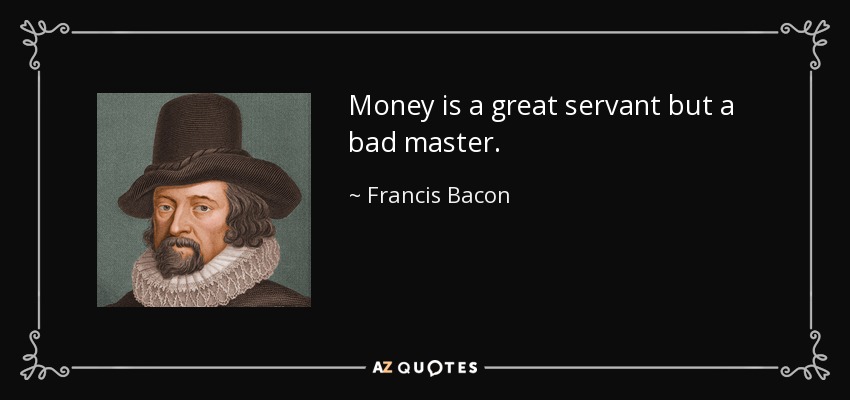
Or, even better, we can ask ourselves:
What is money, instrument or goal?

‘Democracy’ comes from ‘demos’, the Greek word for ‘people’.
Basically a democratic society is a social arrangement where the people is in charge. Through representatives, as in most cases, or even directly – the Swiss organize referendums whenever they have something really important to decide.
‘Republic’ comes from Latin. ‘Res publica’ means ‘public matters (=issues)’ so a republic can be seen as a social arrangement where everything is out in the open.
Would it make any sense for the public to know everything that is going on if they don’t have any say in the matter? Could democracy work if people are kept in the dark?

So.
In communism the state (in fact the rulers) decide everything – who does what and who gets what.
In socialism there is not much difference from the previous state. (I can vouch for both propositions, I’ve lived under both regimes)
‘Anarchy’ means no rules. If you happen to have two cows you need to defend them constantly, by your own, against anyone who covets them. Remember, anarchy means ‘no rules’ whatsoever. You cannot cherry-pick. I like this rule (property rights are fundamental for me) so this one stays in place while the the rules that I don’t like will be discarded.
As in ‘I won’t respect but the rules I like and I’ll hold everybody else to respect mine’.
That would be an absolutely one sided anarchy. If you’d be able to enforce such an arrangement it would be perceived by everybody else as the most authoritarian regime ever and Stalin would be jealous of your accomplishments.
As I said before ‘democracy’ means people having their say about how things are settled in a that particular society. If people respect each-other you have real democracy. If people band together to decide, against the will of the owner, about the fate of those fabled two cows we can no longer speak about true democracy. That would be ‘mob rule’, just another form of ‘anarchy/authoritarianism’. One ‘organized’ by a ruler who is a callous spin doctor skilled enough in his trade to make a considerable portion of the population follow him, usually against their better interests.

I was just speaking about the mutual respect that exists among the members of a truly democratic society…. I have a distinct feeling that those who promote this meme think of themselves as being ‘the true democrats’… I’m not a religious person myself, not in the classic sense of the word anyway. But I won’t ever think of a religious person as being ‘ignorant’ based solely on his creed and I’ll never refer to him using such a word, regardless of his level of education. One of the reasons being that if I ‘indulge’ in such a barbarism he’ll never listen to me again.
Why should he? To get some more abuse from me?

Now lets get this straight.
Mutual respect is absolutely essential for democracy.
There can be no such thing as mutual respect among individuals whose goals are mutually exclusive.
This meme actually doesn’t make much sense. No matter how well armed the lamb is, a determined wolf would eventually sink its fangs in the lamb’s sweet flesh so a rational lamb would do his best to shoot the wolf at the first opportunity. What kind of democracy are we speaking about here?

Most governments don’t get this. You can stretch it only that far. At some point, no matter how authoritarian the regime, people will take to the street.
This doesn’t mean that democracy will automatically be installed after a public uprising, far from it. The Arab Spring is only the latest example.
It only means that people have it in themselves to try to improve their lot. If they find a way to do this together then the sky’s the limit.
And this is a fact. Only the democratic America successfully landed a man on the Moon. The Soviet Union was the first to start this game but wasn’t able to keep up.
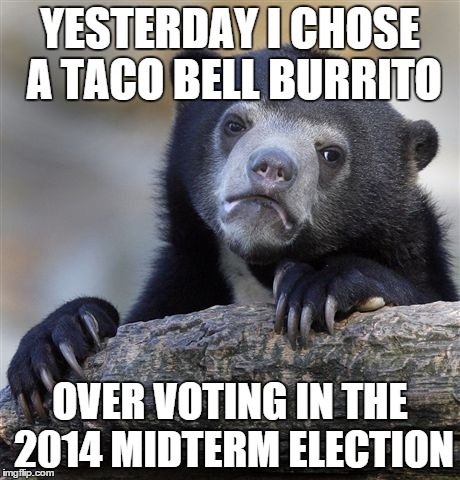
Yeah? And what are bragging about here?
About not finding a candidate to suit your wishes AND not doing anything about this situation?
How about running yourself? Or at least going there and annulling your ballot…
If you do not vote at all the political establishment will consider that you are either content with what is going on or so despondent as to not care anymore. So why should they even consider your plight? In which direction should they change their behavior in order to suit your needs if you don’t express them when you have the chance?

Really? Is he indeed unable to make distinction between democracy and mob rule?
‘Democracy in and of itself is not necessarily a good thing’…
I’m afraid he didn’t get the gist of it!
Real (=functional, stable over long periods of time) democracy IS good while mob rule IS bad. Period.
So, any chance for this cute fellow to have nailed it?
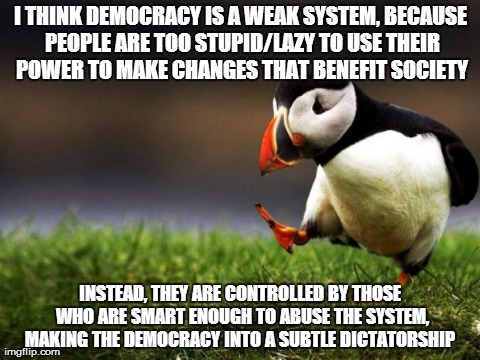
Close but there is space for improvement so I’ll try to rephrase this.
A democratic system invariable becomes weak/unstable if the general public becomes complacent and the power is grabbed by short-sighted but arrogant and callous spin doctors who, by eviscerating the true nature of democracy, transform the concept into an empty shell. This way the democratic process becomes a beauty pageant and an erstwhile democracy becomes a subtle dictatorship.
The strangest part of all this is that exactly those who should have known better – the professional politicians and some members of the academia – are the first to fall into the trap.
Efficient Market Hypothesis, eh?
The proponents of this hypothesis posit that all participants to the market are perfectly rational and that they all have enough pertinent information about what is going on as to be able to reach reasonable business decisions.
Now consider this: ‘ten percent of the egg producers being wiped out results in a up to 85% hike in retail prices’.
Quite reasonably, don’t you think?
As for efficiency… maybe for the owners of the surviving ‘egg producers’…
Deflation ‘for dummies’.

That’s one way to look at it.
Sometimes it might indeed resemble a punishment but please remember the many times when common sense prevented us from making huge mistakes that might have ruined our lives.

 Deutsche Bank is sitting on more than $75 Trillion in derivatives bets — an amount that is twenty times greater than German GDP.
 nicichiarasa