Archives for category: Psychology

In general this manner of relating to the surrounding reality is hailed as being ‘good for you’.

And it usually is but only as long as those involved remain inside the realm of reason:

“Three convicts were on the way to prison. They were each allowed to take one item with them to help them occupy their time while incarcerated. On the bus, one turned to another and said, “So, what did you bring?”

The second convict pulled out a box of paints and stated that he intended to paint anything he could. He wanted to become the “Grandma Moses of Jail”. Then he asked the first, “What did you bring?”

The first convict pulled out a deck of cards and grinned and said, “I brought cards. I can play poker, solitaire, gin, and any number of games.”

The third convict was sitting quietly aside, grinning to himself. The other two took notice and asked, “Why are you so smug? What did you bring?”

The guy pulled out a box of tampons and smiled. He said, “I brought these.”

The other two were puzzled and asked, “What can you do with those?”

He grinned and pointed to the box and said, “Well according to the box, I can go horseback riding, swimming, roller-skating….”  

The current spate of dissent on this subject has been spurred by this guy, Angus Deaton, being presented with The Sveriges Riksbank Prize in Economic Sciences in Memory of Alfred Nobel

“A Nobel prize in economics implies that the human world operates much like the physical world: that it can be described and understood in neutral terms, and that it lends itself to modelling, like chemical reactions or the movement of the stars. It creates the impression that economists are not in the business of constructing inherently imperfect theories, but of discovering timeless truths.”

I’m afraid that the author had been so disgusted by the obvious mistakes that have been committed by so many of the supposedly reputable economists of this world that he has become amenable to throwing out the baby along with the bath water.

First of all we must remember that “Science is wrong. By definition.” All theories are imperfect and there is no such thing as ‘timeless truths’.
Ever since Karl Popper introduced the idea of ‘falsifiability’ as the litmus test for determining if any piece of information has any scientific value and Berger & Luckmann noticed “The Social Construction of Reality” it had become apparent both that science is being updated constantly – hence always ‘wrong’, or at least incomplete – and that people are ‘doing science’ on purpose – hence any discussion about reality being ‘described and understood in neutral terms’ is unrealistic, to say the least.

Coming back to Popper, Hermann Bondi had declared that ‘There is no more to science than its method, and there is no more to its method than Popper has said.’
True enough but as any ‘scientific declaration’ this is highly ‘updatable’.

In fact Science is, above all, a human enterprise. It’s a human that picks up – or devises – which method to use in a certain situation when he wants to find out something about a certain subject. Furthermore that method is applied by human individuals, not by robots. The same as those who had chosen it or by others, doesn’t make much difference. And, at the end of the cycle, some other people will evaluate – and sometimes try to replicate – the results.

So the mere fact that a certain set of results could not have been replicated by a certain team of evaluators doesn’t mean that much, by itself. This has been silently acknowledged by Andrew C. Chang and Philip Li in a paper published by the Federal Reserve in 2015: “Is Economics Research Replicable? Sixty Published Papers from Thirteen Journals Say ”Usually Not””. The couple admitted they needed some help from the original authors to replicate the results in a few instances and in some-others they didn’t have access to the same computer software as the first publishers.

But the most interesting fact is that in no instance the authors have been able to positively determine that the results published in any of the analyzed papers are inconsistent with the data presented by the original authors and/with the method invoked. In all instances when they failed to replicate the original results that happened because the original authors didn’t present at all the initial sets of data, they were incomplete or the method/sofware used to  process that data was incomplete, altogether missing or proprietary. And all this despite in some cases the papers being published by journals specifically requesting that all data/methods/software being made available at the moment of publication.

In this situation I find the conclusion reached as being both correct and highly objectionable. And above all lacking any scientific value.
“Because we successfully replicate less than half of the papers in our sample even with assistance from the authors, we conclude that economics research is usually not replicable.”

Yes, it seems that too many papers published by presumably reputable journals are not replicable. But that is due exclusively to the journals themselves not observing their own rules or by some of the authors acting less than ‘over the table’. This phenomenon has nothing to do with ‘economics’ being less of a science than, say, physics and everything to do with humans being… well… human!

Let me go back to where I started, to Joris Luyendijk claim that “Don’t let the Nobel prize fool you. Economics is not a science.”
The author ‘illustrates’ his claim by remembering the infamous LTCM – a hedge fund set up by, among others, a couple of economists who had received a … you guessed it… a ‘Nobel prize for economics’ less than a year before the hedge fund went bust. Kind of ironic, isn’t it?
But the problem remains. The fact that LTCM went bust doesn’t prove anything except the fact that its management was completely inadequate.
The point is that trying to assert that ‘economics’ is not a science only because some guys used a couple of economic theories and failed, abysmally, is akin to claiming that physics is not a proper science because no weather bulletin is 100 percent accurate. Or that biology is not a full blown science because medicine has not yet found a cure for cancer. Or to claim that chemistry is bogus simply because Big Pharma is ripping us off.

At the end of their paper Chang and Li offer some very pertinent advice about how things could be vastly improved. Their main idea being that everything must be ‘above the table’ – both the raw data and the method/software used to process it must be made available for whomever wants to replicate the results. In fact this exactly what science, real science, is about. People have to be able to check thoroughly whatever the proponents of a theory are trying to ‘peddle’. This is the only way for a theory to be proved true or false. Or incomplete so further research might be declared necessary.

Similarly, at the end of his article Joris Luyendijk points his finger at the real culprit.
In reality economics, as a space where people try to gather information, is different from, say physics, only because we, the people, approach them with different attitudes.
Time has taught us, repeatedly, that every-time we’ve tried to deny the obvious we ended up with a bloody nose. The problem is that not all of us are, yet, able to recognize the obvious.
No one in his right mind will pretend, nowadays, that the Earth is flat. Meanwhile some people still pretend that vaccines may induce autism. They don’t. But some of the ‘anti-Vaxxers’ continue to pretend this even after a study partly funded by themselves demonstrated that there is no link between the two.

As suggested by Luyendijk and demonstrated by these examples the real culprit for what is going on, not only in the economic field, is our arrogance.
Arrogance that has led to the survival of what is known as ‘tehnocratic thinking’ despite more and more people learning of the role ideology plays in our decision making.

After all what can be more arrogant than pretending that you have ‘scientific reasons’ for what you do, despite the obvious fact that every one of us acts according to his own ideology?

I’m not going to pretend now that there are good and bad ideologies. I obviously think they can be classified but I cannot pretend that my classification is the correct one.
But I can pretend, and you should too, along with Joris Luyendijk, Andrew C Chang and Philip Li, that each of us should honestly state its point of view along with his opinion when ever discussing something.

After all each of us having an ideology is a reality while pretending that any of us can act as if it doesn’t is a rather pathetic lie.

To conclude I’ll have to keep the promise I’ve made at the beginning of all this and ‘update’ Bondi’s statement about Popper:
‘There is no more to science than its method and there is no more to its method than Popper has said’ but we should always bear in mind that science is exclusively ‘performed’ by human individuals.


Somebody on FB has captioned this image as ‘socialism for dummies’.

I’m afraid he hasn’t got a clue about what real world socialism is truly about.

What we see here is pure and unadulterated stupidity.
We could have been speaking of socialism if the guy wielding the saw would have taken command of the situation, climbed up the ladder, took it up with him and left the other two jerks looking up at him and wondering what had happened to them.

That would have been a bona fide socialist exploit!

“Jack goes to his friend Mike and says, “I’m sleeping with the pastor’s wife.
Can you hold him in church for an hour after services for me?”

The friend doesn’t like it but being a friend, he agrees.
After the services, he starts talking to the pastor, asking him all sorts of stupid questions, just to keep him occupied.
Finally the pastor gets annoyed and asks Mike what he’s really up to.
Mike, feeling guilty, finally confesses to the pastor… “My friend is screwing your wife right now, so he asked me to keep you occupied.”

The pastor smiles, puts a brotherly hand on Mike’s shoulder and says… “You’d better hurry home now.
My wife died five years ago.” “

Found on HotRodders.com

A FB friend of mine shared this old video with the following caption:

“He is the only president in the world to do this, and defend the workers’ labor RESPECT”

And this was my reaction to this:

“Are you that sure that he did this in order to ‘defend worker’s labor’? Or in order to present himself as the (God) ‘father of the nation’? Or maybe, just maybe, he needed the aluminum produced at that factory?

And even if he was animated by the purest ideals, the mere fact that he acted like he did – in a dictatorial manner – is extremely malignant for the rest of the society.
What will stop, from now on, the oligarchs from following his example – act dictatorially on their own feuds? Fright from being reprimanded by the ‘big boss’?
Are you sure this is what you wish for? A society drenched in fright?
I’m not defending the Deripasca’s of this world. Each of them would do exactly as Putin does, if he’d have enough power.
The point of all this being that our only defense against the arbitrary is to stop lionizing individuals who act in this manner.
I know it’s hard to do that when their actions coincide with our  short term wishes. It would help to keep in mind that on the longer term their manner of running things will eventually induce terminal fragility into our livelihood.

OK, VW couldn’t figure out how to balance the ever stricter polution norms with the public demand for simultaneously more powerfull  and cheaper to run/cleaner diesel engines so they decided to fake it. And it seems they were not the only ones to do that.

This development poses some questions.

– What were they hoping for? Did they really think that something like this could have gone unnoticed for ever?
– What were the regulators thinking? That it’s possible to solve pollution by simply changing some norms?
“Moore’s Law” (“overall processing power for computers will double every two years” has been valid, for a while, in a very young technological field.
Internal combustion engines have been around for more than a century, they are rather old. Everybody knows that it is hard to teach new tricks to an old horse yet we tried to clean exhaust gases well beyond the reasonable instead of radically changing the technology. Computers seemed to be able to help, but only for a while…

Could this be just another ‘application’ of the Peter Principle? “Managers rise to the level of their incompetence?” GM was, sometime ago, the No. 1 Automobile Company. It recently went through a painful bailout. Toyota, the next champion – its methods were studied at the most prestigious management schools – was hugely embarrassed lately by a technological failure.
OK, you might argue that what went on at VW was an ‘upfront’ fraud, not at all an ‘honest’ mistake. Indeed but still a mistake, even if a potentially catastrophic one. Mainly for the shareholders, of course, but also for the rest of us.
A certain dose of distrust towards established authority is healthy for the society, as a whole, while too many proofs of the established figureheads behaving callously generate a diffused disrespect for the law which is really bad for everybody.

In fact what happened at VW is exactly what people tend to do when they do not see any way out of a certain situation.
When they don’t really think that anything bad can happen to them, regardless of whatever they do.
Or both.

So. Is there anything to be learned from here? Except for the oldest lesson history keeps teaching us: ‘reaching the top is easy, staying there is the really tough job’?
Maybe.
Toyota says that transparency, “both inside and outside the company“, is a good way towards avoiding this kind of mistakes. “You have to be able to listen to your customers, not just hear them.

Just another proof that so many of us, theists and atheists alike, make the same mistake, unknowingly.
Basically there is no way to determine whether the world has been made by a god or even if one exists at all yet both sides try to prove their point by invoking what each of them thinks he did or should have done:
“I know there is a god because he told me so – ‘we all have a close and personal relation with God’ “
“Why the almighty god would allow…”
What about trying another tack?
How about keeping our intimate convictions to ourselves?
Do you know what all religions have in common?
‘Love thy neighbors as if they were your brothers’!
At some point the atheist said that each of us interpret the notion of god according to the culture into which each of us has been raised.
How about each of us taking a step further – as in out off the bubble into which we isolate ourselves – and notice that we have a lot of things in common and very few differences?
So, in reality what’s keeping us from truly respecting our neighbors?
Our pride, maybe?
Did I tell you that this is the second thing that most religions have in common?
That pride is considered by most as the hardest obstacle on the road to redemption?

So. A fourteen year old builds a clock from spare parts, takes it to school and ends up in jail. And, frankly, I have some doubts about his skin color, name or even religion playing a determinant role in the process. They did set a certain framework for what had happened but I’m afraid that sooner or later this kind of harsh reaction to everything out of the bland ordinary might become a norm, involving people of all extractions. Instead of an exception.
If you don’t believe me check here:

“Here’s how a Texas school explained arresting a 14-year-old Muslim boy for making a clock”

But what’s the link to the ‘butterfly effect’?!? “the sensitive dependence on initial conditions in which a small change in one state of a deterministic nonlinear system can result in large differences in a later state”?!?

After all, a society is indeed a nonlinear system but could we consider it as being deterministic?

For short periods of time and in certain conditions, yes!. I’ll come back to this shortly.

First I’d like to give you my interpretation of the butterfly effect. You see, for a system to be sensible to such a minute influence as a butterfly landing on it, that system has to be in a very unstable configuration. A playing cards castle compared to the Golden Gate bridge.  While the second can withstand gale-force winds without even noticing them the first would indeed crumble if a butterfly landed on it.

So, what happened to the American society, as a whole, to become so sensitive? How come a teenager gets a suspension, instead of some small praise, for building a clock and bringing it to school?

Society, as a non deterministic system, was supposed to be able to overcome trauma – like the one inflicted by terrorist attacks.
Eventually it will.
Only this doesn’t happen on its own. Society is made of individual people, it can do anything only if those men and women decide to put that something in practice.
And there’s the catch.

Daniel Kahneman, Thinking, Fast and Slow, 2013, explains that our minds have two intertwined thinking systems. One which is more or less deterministic – we instinctively pull out our hand when we touch a hot stove while nobody thinks very much when riding a bike, after they got familiar with it. And a second sistem which embodies in earnest our humanity – our ability to think reasonably and to be creative.
The first system, the more or less instinctive one, has evolved to help us survive the intense moments of our lives, when we don’t have enough time to make elaborate decisions. The second one is for those times when the immediate danger has subsided, when we have the resources to evaluate what really happened and to prepare for what the future might have in store for us.
Using the information provided by Kahneman it becomes easy to understand that a society where a significant portion of its members use predominantly the first manner of reacting to the outside challenges is a deterministic, hence predictable, system, while a society where people take the time to think for themselves is a lot more flexible one.

The difference between those two situations being not only the amount of fear that exists in that society but, maybe the more important aspect, the manner in which the significant agents in that society react to that fear. If they approach it with calm and evaluate it sensibly is one thing, if they try to use that widespread emotion for their own, narrow, purposes the result is completely different.
The whole system might become so unstable as to be unsettled by a landing butterfly.
Or by a teenager bringing a makeshift clock to class.

I believe that you’ve already watched the video before starting to read so I’m not going to discuss about what’s going on there.

The point I’m trying to make is that all rights come with a huge responsibility attached to them.
No, not the one to take that right to it’s ultimate consequence:

Every right has to be exercised with the utmost discretion and consideration.
Or else:

And no, this would be funny only if it wasn’t already tragic:

“Publicly, law-enforcement officials have been reluctant to link the movement’s antipolice rhetoric to the spike in violent crime. Privately, they have been echoing South Carolina Gov. Nikki Haley, who said in a speech last week that the movement was harming the very people whose interests it claims to represent. “Most of the people who now live in terror because local police are too intimidated to do their jobs are black,” the governor said. “Black lives do matter, and they have been disgracefully jeopardized by the movement that has laid waste to Ferguson and Baltimore.””

“Dame Athene Donald, who is Professor of Experimental Physics at Cambridge University, believes more “creative” toys such as Lego and Meccano, which are more likely to be given to boys than girls, should replace traditional “girls’ toys,” reported The Telegraph.”

Isn’t this nice? A scientist that shares her beliefs with us… how about some facts, for a change?

Don’t get me wrong, I basically agree with her only she’s got her horses behind the cart.

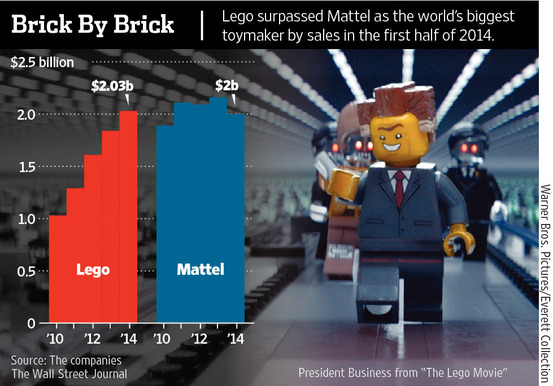
First of all Dame Athene Donald shared this, otherwise sensible, piece of advice – “ditch Barbie for Lego” – a full year after “The Lego brick has toppled the Barbie doll—at least for now—in children’s affections.”
Secondly the parents influence their children’s future in a lot more ways than by the choice of toys that are presented to their offspring. That choice is indeed a very good indicator about the attitude of the parents but only that, an indicator – not at all a ‘sentence’.

Here is Professor Donald’s main argument: ““We introduce social constructs by stereotyping what toys boys and girls receive from the earliest age,” she went on. “Girls’ toys are typically liable to lead to passivity — combing the hair of Barbie, for instance — not building, imagining or being creative with Lego or Meccano.””
So combing hair, or dressing a doll, leads to passivity while playing with Lego necessarily leads to becoming a creative adult… Yeah… sure… That’s why fashion and cooking, two domains otherwise closely connected to the womenfolk, involve a huge amount of creativity while most manufacturing jobs – still performed predominantly by men – are mostly about following procedures…

So yes, I fully agree with her conclusion – ““We need to change the way we think about boys and girls and what’s appropriate for them from a very young age.”” – but I’m afraid that she arrived there led by her activism rather than by ‘scientific’ reasoning.

And since I’m very afraid of all forms of activism I’d rather follow the advice offered by Claire Gillespie, the author of the article that prodded me into writing this post:“Don’t pigeonhole little girls into typically “female” interests and subjects. Don’t pigeonhole little boys into typically “male” interests and subjects. And give all children the time and freedom to explore all their options, without forcing them to go down the arts or sciences route from a young age.”