Archives for category: Psychology

First and foremost language is perceived as a communication medium.

As such it needs clarity and consistency, otherwise information could not have been reliably exchanged and or preserved through its use.

But language is used for many other purposes than for simply ‘translating’ raw data. Where to find a certain object or how to execute a certain task.
We use it to convey sentiment – the way we are affected by the raw data that has become known to us, and to communicate our particular understanding of things. Our point of view about what has happened around us.
Furthermore we use it to convince people. To do things or to accept our points of view.

All these different uses involve a considerable amount of negotiation.

Regarding immediate goals – the things we are negotiating about, but also some that is taking place ‘under the table’ and involves the continuous fine tuning of the instruments used during the negotiating process. The words themselves.

These negotiation instruments – the language itself, in fact, have to be constantly re-calibrated for two rather obvious reasons.
For starters, the reality around us – and our understanding of it – is changing constantly.
Secondly, every negotiation involves a degree of ‘shade’. In fact that ‘shade’ is exactly the space where ‘change’ happens, where the positions of the two negotiators overlap and where the two can swap ideas.
If words would be rigidly precise than we’d have to invent new ones every time reality changes, no matter how minutely. Also whenever our understanding about things deepens, no matter how shallowly.
Simultaneously, too much ‘linguistic precision’ would kill not only poetry and our ability to convey our real feelings to other human beings but would also gravely impair our ability to influence each-other. Could you imagine how our life would be if a polite intervention would sound exactly like an SMS message of if a marriage proposal would be similar a requisition order?

More about how the linguistically mediated interplay between us has brought about our own self-awareness can be found here:

Humberto Maturana, The Origin and Conservation of Self-consciousness.


section 172

Yoshida Kenko, Tsure-Zure Gusa

I just can’t make up my mind about this.
Is it the figment of an idealist monk’s imagination, the factual description of how things happened in Medieval Japan or a wise advice coming from a great teacher?

Us electoral sinopsis, re-edited

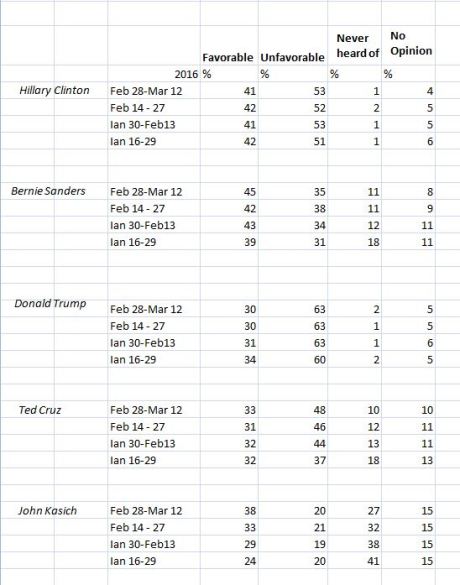
Favorability: People in the News, Gallup, April 2, 2016

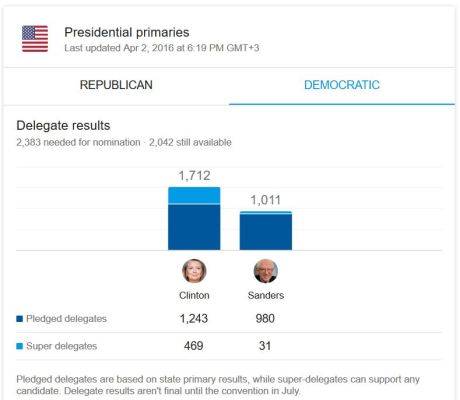
Clinton vs Sanders, April 2, 2016

Source: AP

So, it looks like that the concerned Democrats – those who bothered to show up for the preliminaries, and specially the ‘super delegates’, are going to send Hilary Clinton to compete on the national stage, despite her constant ‘negative favorability’ and despite the fact that Sanders is constantly improving his chances – both favorability and ‘never heard of’ scores are slightly better now than they were at the start of the year. Furthermore, Sanders is the one who can ‘grow naturally’ – simply by making himself known – while Clinton needs to convince the voters that their erstwhile opinion about her was mistaken. An almost impossible feat, given the length of her public career…

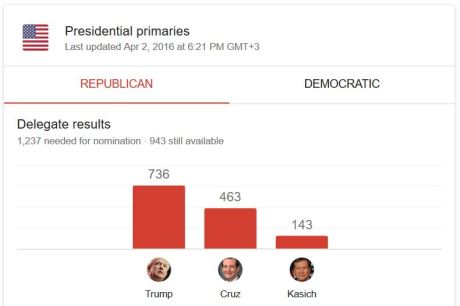
republican pack, April 2, 2016

Source: AP

On the Republican side things are even stranger.
Trump gathers more and more delegates while his ‘negative favorability score’ becomes slightly even ‘more negative’, Cruz gets a second lease on life despite his ‘unfavorable’ score increasing dramatically while Kasich, the least favored by the hard core Republicans, climbs nationally from +4% to + 18% in 4 short months. And if you look closely almost all new opinions on him, those that have been developed during the last 4 months, have been in his favor.

One of my Republican friends said “I can’t speak for the other candidates, but people support Cruz because they believe in what he believes, and feel that sometimes it’s more important to stand up for what’s right, rather than what’s popular.“.
OK, I can understand that. The despondent and/or exasperated use Trump as a banner for their state of mind while the hard core, value toting, Republicans hope that by backing Cruz they will somehow bolster those values.

But let’s see what some ‘significant Republicans’ have to say about the matter.

Scott Walker, Governor for Wisconsin and ex candidate, being interviewed on WTMJ’s Charlie Sykes Show:
““If you’re someone who is uneasy with the frontrunner, right now there’s really only one candidate—I think if you’re just looking at the numbers objectively, Ted Cruz, Sen. Cruz, is the only one who’s got a chance other than Donald Trump to win the nomination,” Walker said in the Wednesday interview on WTMJ’s Charlie Sykes Show. “Statistically, my friend Gov. Kasich can not.””

Then there is Lindsay Graham, Republican Senator for South Carolina and ex candidate who endorsed Jeb Bush when dropping from the race:
“Graham said there are other candidates he likes better, but he doesn’t think they can win. “I prefer John Kasich; Cruz is not my first pick by any choice,” the South Carolina senator explained. “But I don’t see how John Kasich can mount the opposition that Ted Cruz can to stop Donald Trump from getting 1,237” (the number of delegates needed to secure the nomination).
Graham has made it abundantly clear that he really doesn’t like Cruz at all. In January, he said Cruz has “exhibited behavior in his time in the Senate that make it impossible for me to believe that he could bring this country together,” adding that choosing between him and Trump is “like being shot or poisoned — what does it really matter?” Last month, he joked about Cruz’s general unpopularity among his colleagues, saying, “If you killed Ted Cruz on the floor of the Senate, and the trial was in the Senate, nobody would convict you.””

The way I see it, these guys, the Republican ‘apparatchiks’, are more concerned about derailing Trump than with promoting the more suited candidate among the trio. Suited for Presidency, that is.

sansele candidatilor

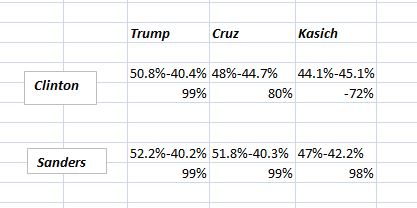
source: Huffpost Pollster

So, according to the polls compiled by Huffington Post, Sanders would lick the entire Republican field – if allowed to compete, while the Republican candidates are stacked, at least for now, according to the ‘who has the least chances on the national front’ criterion.

?!?

Does any of this make any sense? Any at all?

Here’s my Republican friend again: “In the case of Clinton, despite her unfavorability in the polls, there’s a sense in the Democratic Party that it’s her “turn.”
Some others think she is ‘in cahoots’ with the ‘big business’… “Family charities collected donations from companies she promoted as secretary of state“… Coming from Wall Street Journal this is a powerful allegation indeed…

But at least in this camp things are unfolding, lets say, ‘naturally’. The guys with vested interests (the super delegates, for example) are acting according to those interests while the rank and file Democrats are slowly (too slowly, maybe?) finding out what’s going on.

What really baffles me is what’s happening on the Republican side.

Some of the rank and file have adopted ‘the Donald’ as their mascot despite the obvious fact that he doesn’t belong, at all, in politics. He might have been a successful business man – read chock full of money, but the way he made that money disqualifies him from holding office. Does ‘eminent domain‘ ring any bells with you? Not to mention his antics on the public stage: “Excuse me”, ‘I’m the best thing that could happen to America!’
Are all these people delusional or are they so fed up with what’s currently going on in America that they can’t see the trees because of the forest (is on fire)?

Some others have gone ‘back to basics’ and try to revive what they consider to be the ‘sound Republican values’ – I’m speaking now about those who support Ted Cruz, if you didn’t figure that out by yourselves.
But what are these ‘hard core Republican values’?
How come some of Cruz’s followers are blaming Lincoln for being the first ‘statist’ in American history – not for abolishing slavery but for imposing that measure by force to the unwilling Southern States.
And how come those values have come to be embodied in someone so ‘popular’ among his Senatorial colleagues that “If you killed Ted Cruz on the floor of the Senate, and the trial was in the Senate, nobody would convict you.” ?

And isn’t it strange that so many Republicans are so mesmerized that they are willing to give up almost any chance of electing a Republican President?
OK, I can understand that way of thinking being used by ‘lay people’. But what is the real meaning of ‘pundits’ rallying behind the ‘value laden’ Cruz when it is obvious that Kasich is in a way better position on the national front?

Could it be that these pundits are more concerned about their own careers than with the fate of the Republican party? And even about the Republican values?
Farfetched?
Are you sure? Don’t you see that by energizing their constituencies into a frenzy they are simply building Republican (local) fortresses for their own use, leaving the rest of the (national) Republicans out to dry?

more stuff

Well, I was under the impression that Conservatism was about maintaining a common way of life, not about conserving privileges.

I still believe that.

st_2015-12-09_middle-class-03


Middle income or middle class?

The terms “middle income” and “middle class” are often used interchangeably. This is especially true among economists who typically define the middle class in terms of income or consumption. But being middle class can connote more than income, be it a college education, white-collar work, economic security, owning a home, or having certain social and political values. Class could also be a state of mind, that is, it could be a matter of self-identification (Pew Research Center, 2008, 2012).”

OK, so even those who rely heavily on money as an indicator for who belongs to the middle class concede that there are other connotations to the concept.

Let’s consider the situation from a functionalist point of view. As in how the members of  various social strata react to the day to day challenges of the normal life.

‘Day to day’ meaning not only ‘normal’ things – waking up and brushing your teeth – but also things that we wish will never happen, although all of us know they are ‘normal’ occurences. A car accident, a broken leg or even having three children in one go when you were praying for one.

Usually the wealthy take them in one stride, those belonging to the middle class manage to cope – sometimes welcoming some help from their friends, relatives or even insurance company, while the really poor almost certainly sink under the burden. But not always.
Sometimes even the wealthiests loose it when faced with adversities they were not accustomed with while some of the poorest find it in themselves to rise from the ashes.

Then how about setting a slightly different system of ‘classes’: the extremely resilient, the ‘middle class’ and the very fragile?

As a rule of thumb it’s true that a certain amount of wealth does miracles when some resilience is needed so, roughly,  these two classifications look more or less the same, but, on a qualitative rather than quantitative level, we are speaking of two different things here.
When we are speaking of ‘money’ we are dealing mainly in ‘resources’ while when we’re speaking about resilience we have to take into account the attitude of the concerned individuals. It is true that the above mentioned attitude is, more often than not, heavily influenced by the affluence of the respective individuals but the function is hardly a direct one.

Based on these considerations – and on my personal experience of dealing with people, I’m going to propose the following synopsis.

The ‘resilient’ are those convinced they are able to cope, more or less on their own, with almost everything life can throw at them. Unfortunately some of them grow ‘spiritual callouses’, simply because they have never experienced any real hardships.
Or because they have over-compensated after dealing with those hardships, sometimes after succeeding to do so without receiving significant outside help.

The ‘fragile’ are those who, by lack of material resources, spiritual stamina or both,  behave more like leafs driven by the wind than like masters of their own fate – as every human being should.

By now you’ve probably figured out that  ‘my middle class’ is composed of individuals who have a certain degree of resilience but who, on the other hand, are perfectly aware that there are things on this world that they wouldn’t be able to face on their own.

In a sense, possession of money – or other resources, ‘encourages’ an individual to reveal his true nature.
If a person is naturally inclined to grow ‘callouses’ then being ‘insulated’ from the outside world by a thick wad of money will provide him with enough space to let those callouses grow but if his skin is ‘in the game’ then those callouses will be constantly shaven while interacting with his peers.
But if the stakes of the game are very meager – and the insulation provided to the players by their respective possessions is practically nonexistent,  then instead of growing callouses most of the players will be rubbed raw during the intercourse. Mind you, neither  the ‘stakes of the game’ nor the ‘individual possessions’ need to necessarily be of a strictly material nature.

In conclusion, the ‘callously resilient’ will tend to mind to their own – simply because their sensitivity towards the outside world is dampened by their callouses, the ‘fragile’ will tend to mind to their own raw wounds while those belonging to the ‘middle class’ will be the only ones really interested in maintaining the well being of the social organism. The one to which they ‘knowingly’ belong.
Because they are the only ones with enough time/energy/resources on their hands to consider the matter, the real interest to do so and the willingness to put some effort into this endeavour.

pent up anger

As you can very easily infer from the title, I define myself as being an agnostic.
I’m reasonably satisfied with the scientific explanation about how the world came to be but I cannot rule out any intervention from an out-side agent during the process.

Hence my unwillingness to commit myself to any of the extreme positions.

And hence my conundrum.

A significant portion of the theist believers are convinced that God, their God, is behind everything that takes place on the surface of the Earth. And beyond.

All scientific materialists are convinced that everything takes place according to some immutable and implacable ‘natural laws’.

Then how come any of them has enough gumption to contradict any of the others?

How come a religious believer can say to another ‘your God is false’ if he is convinced that nothing in this World can happen without the knowledge and approval of his own one? Isn’t this a form of censorship towards his own God?
How come a religious believer can say to an atheist ‘you are going to rot in Hell’?
Last time I checked all Gods were very jealous, all religious teachings I know are clear about this: ‘You do your job and let Me do the judging.’ Then how come so many zealots feel free to usurp the place of their Gods and pass judgement on their peers?

How come so many of the atheists feel free to poke fun at the believers?
According to their own creed, religion is a natural thing. It does exist, isn’t it?
And by its mere existence it necessarily observes the very natural laws the atheists so staunchly defend. As if any of them needs any defense, let alone to be imposed upon the others…

When are we going to accept that religion, any of them, is nothing but an environment, not a yoke?
Just a place with some rules, not some kind of a prison?
That the final responsibility for our acts belongs to us, regardless of any God watching or not over our fates?

Here on Earth, anyway.

grandson of sweetie pie

Grandson of TV’s Miss Sweetie Pie gunned down in St. Louis. (AP)

“St. Louis police say they found Andre Montgomery dead at a home Monday night. A second man was taken to a hospital in critical condition with gunshot wounds.
Police say that after someone shot Montgomery, the second man ran upstairs to help him. A third man who was in the home saw the second man carrying a gun and shot that man because he feared for his safety.”

So.
A guy invites some people in his home.
Judging by the way in which they interact they don’t know, or at least don’t trust, each-other.

Somebody – not necessarily from among the invited guests, shots the host.
Somebody else – presumably alerted by the noise, draws a gun and hurries to assist the victim.
A third person, fearing “for his safety”, draws his gun and shots the good Samaritan, simply because he was carrying a weapon.

Is there anything to be learned from here?

OK, by somehow removing all privately owned firearms in America, personal safety, on average, would be somewhat improved. But since something like that would be very unlikely to happen let’s concentrate on something more plausible.

How about taking grater care about who enters your home?

And something else.
Ever since reading about this I cannot stop thinking about the similarity between cars and guns.

Both are tools and both are dangerous. Yet almost everybody has the right to buy one.

But no-one is entitled to use a car without a license while so many people advocate that everybody should be allowed to carry guns, everywhere.

37 000 people dead and 2.35 million people injured or disabled as a consequence of road accidents. Per year.

32 000 people dead by fire arms. Per same year. 60% of them being suicides while roughly 34% are classified as homicides.
On top of this another 67 000 people are injured, per year, by fire arms.

Some could say that there is not any significant difference between the two situations and, as a consequence, a carry permit would not change much.
Are you sure about that?

Currently most guns do not follow their owners when they leave their houses – for various reasons. This is why I’m afraid that if more and more people would chose to carry their weapons, things would become a lot more complicated.

Not because people are bad or ill intended.

Simply because most ‘civilians’ are not trained to asses dangerous situations in an effective manner nor the necessary skills to use their weapons safely.

You see, defending your home – everybody else but you and your family becomes an enemy in this scenario, is very different from trying to help in a complex setting. When people might freak out at the sight of yet another gun.

That’s why not all those who own a gun should ‘drive’ them around without a license.

After all, how safe would you feel when driving in a country where no driver’s license is necessary and where DUI is not forbidden?

cz0qnrnwaaibsy2

First, some very condensed history.

Humankind evolved in Africa and then migrated around the word.

During its African childhood Man had never encountered Winter. OK, he did have to face barren desserts, dry seasons, inundations,  wild-fires, earthquakes, you name it…but none of these even comes close to watching the light of the day becoming shorter and shorter, the weather becoming colder and colder and the food becoming scarcer and scarcer.

Remember, at that time Man was a hunter-gatherer who had no notion of stashing food or any interest in astronomy. Simply because there is no real scope for hoarding large reserves of food in Equatorial Africa and no real scope for astronomy since at the Equator there are no seasons to speak of.

Now, try to imagine the horror experienced by the migrants who had climbed the Anatolian plateau for the first time and, after a while, felt the snow melting on their faces and the frost biting at their bare feet. All this while the sun kept sinking lower and lower towards the horizon.

Was it possible that those migrants did start thinking about the end of the world?

Were they pondering on whether they had entered the realm of a strange god who was trying to get rid of them by cooling the entire (or at least the ‘visible’) Earth and by making the food extremely scarce?

Did they try to placate that god? Through prayers and offerings?
Was that the very reason for which Abraham came back to Canaan after having “tarried for seven years at Harran“?

Were they extremely elated when noticing that the light of the day was becoming longer and longer? Did they throw a party to thank that God for listening to their prayers, soon after noticing that the winter solstice had passed – even before knowing what a solstice was?

And this is why in most cultures that have developed in the temperate regions of the Earth people celebrate, under various guises, the rebirth of the world that takes place right after the winter solstice.

That is why, after a while, Christians have started to celebrate Christmas on the 25th of December.

But, if you remember, those migrants didn’t take the whole thing as a gift but as a trade.
They prayed, made offerings and the God kept his side of the bargain.
Same thing here. Christ had to offer himself so that the world could be redeemed.

In time another habit had evolved. When I was a small child, even in communist Romania, Saint Nicholas was serious business. People used to eschew any formal links between Saint Nicholas – presented as an opportunity to educate the children – and Christmas. That’s why Saint Nicholas was tolerated by the authorities – and we, the kids, could discuss openly at school the presents that had miraculously appeared during the night in our socks, carefully prepared the evening before, while Santa Claus had disappeared altogether – having been replaced by a Santa-Freeze who came on the New Year’s Eve instead of during the Christmas Night.
And now I’m wondering how many of you remember that Saint Nicholas brought presents only to the good children and that those who misbehaved during the year got either a rod or a few lumps of coal instead of the candy so keenly expected by everybody.

In fact Saint Nicholas is way closer to reality than Santa Claus. He doesn’t give anything for free.
Not that he doesn’t love us.
He really does and that’s why he doesn’t indulge us with undeserved gifts.
So that we don’t become frustrated later in life when we’ll have to work, hard, for any whim we might have. Not to mention the effort to feed our belies, clothe our backs and make sure our children make it safely to adulthood.

That’s why I think it’s time for us to cut the crap. Santa Claus might be a nice gimmick for the big retailers who came up with the whole concept.
But look at what he brought to the rest of us.
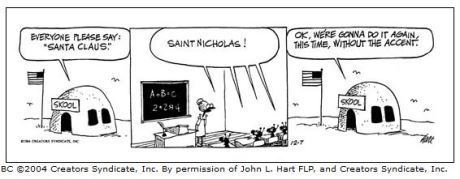
saint nicholas

Yeah, I know.
“If I couldn’t have the nice childhood I dreamed about at least my children should have it.”
Only ‘nice childhood’ is one thing while ‘spoiled rotten’ is quite another one.

And ‘spoiled rotten’ can be achieved along many routes.

One of them being the one described above. Hard working parents, who consciously spoil their children, trying to compensate, through their kids, the hardships  experienced during their childhood.
Another one being followed by the parents who are so busy that they basically don’t get to know their children. And who try to compensate the time not spent with their kids by showering them with gifts. The end result being the same.

After the children have become young adults, with no marketable skills, no exercise at self control and after never trying hard at anything, the shit hits the fan:
‘We have done our best yet we’ve raised a couple of ‘good for nothing’ bummers!’

Well, your ‘best’ wasn’t good enough and, mostly, it’s your fault. Not theirs!

Just as most of our ancestors didn’t need to till the soil before migrating to the Middle East – simply because they had enough to eat even without having to work/plan hard for it, our children won’t develop the necessary skills nor the necessary mindset if we insulate them from the right stimuli. In fact, if we insulate them from the real world.

After all, our ancestors might have been ‘the children of the Humankind’ while ours are simply ‘children’ but, in the end, ‘children are children’.

“When the last tree has been cut down, the last fish caught, the last river poisoned, only then will we realize that one cannot eat money.”

Some people attribute this quote to the Apache Leader known as Geronimo.

Quoteinvestigator.com says it is highly probable that it belongs to a guy called Alanis Obomsawin.

But what is more important?
Who said it or what we make of it?

Dede Suryana

Mother breast feeding a baby

How come some people are absolutely disgusted
whenever something like this takes place in their presence

while most are perfectly OK with

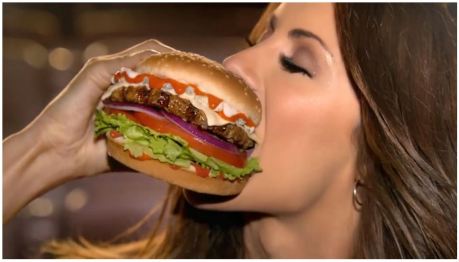
Eating burghers

oliver_hardy___zenobia[1]

I’m not a huge fan of the EU but I have a mostly positive opinion about it.

This morning my stance on this matter was about to change, dramatically.

I had found in my email a link towards a newspaper article, in Romanian, which said ‘the European Court for Human Rights in Strasbourg had ordered that starting with March 1 2016 people in Europe are no longer allowed to baptize their under-aged children‘.

Hard to believe something like that, isn’t it?

Are you really sure about that?

Now try to read articles like this – which are reasonably ‘well’ written, using the right lingo and having enough details thrown in to make them sound credible – through the eyes of a guy already worried by the so much hipped ‘migrant invasion’. Who was already pissed off by the various rules and regulations handed over from Brussels and acquiesced by the local, and supposedly sovereign, governments without any fuss.

Most people do not have the exercise of doubting everything they read, specially if the message comes from somebody they trust – a friend, for instance, or if the site where they read it seems legit.
OK, a certain proportion of them – not all, will exert some discretion if money is involved. That’s why phishing has a limited, yet certain, impact.
But when a particular piece of information apparently confirms an already entrenched stereotype – the bossiness of the EU, for instance – quite a large number of readers will fall for it.

Yesterday evening I was reading a comment added by Nassim Nicholas Taleb on his own Facebook wall: What social media finally did: destroy the press. It is more organic to get information from word-of-mouth, which it accelerated.
Corroborate that comment with a quote from an excellent article published by the same guy on Wired.com: “I am not saying here that there is no information in big data. There is plenty of information. The problem — the central issue — is that the needle comes in an increasingly larger haystack.” (Nassim N. Taleb, Beware the Big Errors of ‘Big Data’, Wired.com, 08.02.2013) and things start to gain some perspective.

What we’re dealing here is the famous lack of symmetry that currently bothers the strategic planners who presumably shape the future of the humankind.

In the ‘good ole’ days’ – when we had writers, publishing houses (newspapers, magazines, you name it) and ‘specialized’ readers, things were a lot simpler.
The writers had a certain notoriety and most of them didn’t want to jeopardize it by publishing bullshit.
Publishing houses didn’t dare to publish bullshit – except for those that did it on purpose, because most of their readers would no longer have bought their papers.
The specialized readers – those who usually bought a certain kind of magazines or books – were able to recognize most bullshit when they saw it, simply because they had some experience in the fields that used to elicit their interest.

Bullshit was being pushed in those days too, for sure. But it was a specialized job, that had to be done carefully.
And in that era, for bullshit to be effective, you had to have very ‘favorable’ circumstances.
Communism didn’t take hold but in very poor countries and fascism only in war torn Italy, Germany and Spain.

Nowadays, “…any simpleminded partisan with a political ax to grind can find an online community of like-minded whack-jobs who’ll be happy to provide him with plenty of ideological ammunition (e.g., bogus stats, pre-fab arguments, etc.). Before long, what was once a more-or-less harmless, single-issue troll has morphed into something far more monstrous and formidable: a veritable Swiss-army knife of bullshit, a perfect storm of bad ideas, a walking Wikipedia of stupid.” (John Faithful Hamer, From Here (2016) )

And since it’s very hard to police the Internet – even harder if we are determined to preserve the ‘freedom of expression’, we are in a very delicate position.

Is there anything to be done about this? Considering that there will never be a real shortage of ‘simpleminded partisans with political axes to grind’?

I think there is.

I started this post by mentioning three related concepts.

Freedom, responsibility and discretion.

We should not tamper with Freedom. Basically this is everything we’ve got, our most precious achievement.

So, we are left with ‘responsibility’ and ‘discretion’.

How is it that most sites manage to stay on line?

They are either sponsored by somebody or they sell advertising space, right?
Who provides that money? Who buys those advertised products? Who spreads around the news about those sites?

Who reads those bullshit laden articles and swallow them hook, line and sinker, simply because some of the (seemingly legit) arguments presented there happen to be consistent with our previously held convictions?

So, if you wish that your kids will be able to live in a better world, stop distributing bullshit through social media, stop buying things advertised on bullshit peddling sites – or, even better, stop going there altogether, and, above all, learn your kids to think with their own heads.

Even if that means they’ll end up contradicting us. As long as they’ll do it in a respectful enough manner – the second most important thing we’ll have to teach them about, all will be OK.


Update. A friend of mine, thanks Lucian, has done some digging over the Internet and found out where all this has started from:

baptising