Archives for category: Psychology

“Hey! sweet ghapama
Whoever eats it is satiated
Hey! dear, sweet ghapama
Whoever doesn’t eat it, understands nothing!!”

Harout Pamboukjian

Theory has it that if you know your goal and remain focused you’ll get there.
‘Meritocracy’. That’s the name of the pretense…

Practice demonstrates that in order to ‘get there’, one needs ‘opportunity’.

The reality of the matter is simple.
Deceivingly simple and harsh as hail. Or hell… take your pick!
If you stay focused on a sensibly chosen goal you will cover a considerable distance. BUT ONLY AS LONG AS the opportunity field you are toiling will not change much. Too much for you to cope with.

There are three sides involved in this. Or dimensions…
Choosing the goal. Staying focused. Conservation of the playing field.

Staying focused is an individual thing. Something to be learned, for sure, but having more to do with the personal innards of each individual than with the community to which they belong.
Choosing the goal is, say, 50%-50%. Each individual is torn between their personal preferences and the various fads piled on them by families/society.
Conserving the playing field is the responsibility of the society. It’s the consequence of each individual doing their thing but the ultimate responsibility rests on the society as a whole.

What happened?
Simple.
Too many of us have stayed focused. On our individual goals. Set according to the prevailing fads circulating while we were young.
We’ve been so focused on our goals, on our respective individuals goals, that we didn’t notice the change. The fact that we’ve been changing the world. The narrowness of our focus prevented us from seeing anything else…
From understating that our goals were out of touch to start with. Not as important as they seemed at the beginning. And that pursuing them was detrimental. For us, for the society at large and for the environment.
Understandably, we’ve become frustrated. Angry…
In denial!

Some enterprising people have noticed the whole thing.
And have figured out that anger can be weaponized.
Used to herd us. To convince us to stop thinking about our fate. And to chase their goals instead…

One doesn’t need much to drive a herd.
A lure to entice, a red rag works perfectly, and a scare to hurry the reluctant.
Presently, globalization is the red rag of choice and the immigrant is the most efficient scare.

I’m of mixed extraction. Armenian and Romanian.
During the last 25 years, some 4 million Romanians have left the country. Most of them are still citizens and some of them continue to vote. To cast votes when the Romanian state organizes elections. Lastly, a majority of the Romanian emigrants currently living in the Western Europe have voted for anti-globalist and anti-immigrant parties. AUR (gold, in Romanian) and SOS.
And there are more Armenians living abroad – some 8 million, than the 3 million inhabiting Armenia proper.

Before wrapping up, I need to add that, as far as I know, the Armenian people have evolved in situ. Various foreign powers have sometimes controlled the territories inhabited by Armenian people but there were no known significant population influxes into the area. Until the Turkish speaking tribes up-rooted and overwhelmed the Armenians living in the flatter zones but that is another subject.
So.
We have an ancient people living in its original areal.
And one of the most cherished dishes of that people is Ghapama. Roasted pumpkin stuffed with rice and spiced with cinnamon.

Pumpkin is currently cultivated in Armenia. But it was brought there from America…
Rice and cinnamon don’t grow in Armenia! Never did…

Why are we so afraid of globalization?
Why have we allowed the scaremongering social-entrepreneurs to lure us?!?

Only because we are frustrated?
Angry enough to forget about ourselves?!?
Each situation comes with possibilities.
Which of them happen, and in which order, determine the ‘future’.

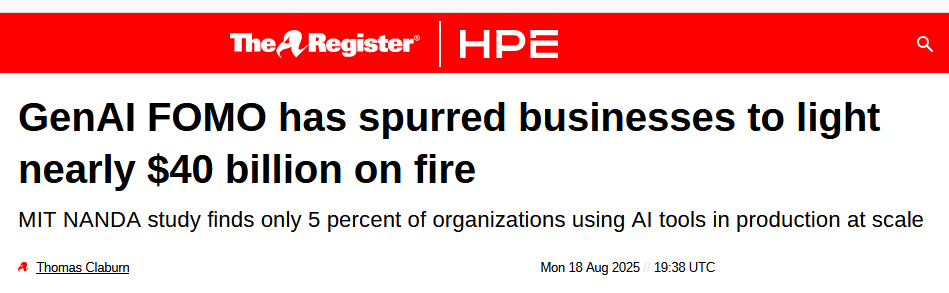
As of now, AI – plain vanilla, generative and even agentic – is nothing but a tool.

A tool used by us to peruse what ever information it has access to. Information already ‘generated’ by us…
A tool used to organize, and present, said information according to algorithms. Algorithms learned from us…
A tool used to solve tasks we have set for it. According to our needs, whims and, above all, our ability to relate with the surrounding reality.

And now we’re scratching our collective head.
Wondering why the result isn’t that different from the one we get when using our own heads…

https://www.theregister.com/2025/08/18/generative_ai_zero_return_95_percent

https://www.theregister.com/2025/08/19/us_government_ai_procurement

So, when Popper doesn’t tolerate intolerance,
he is being mean?

Intolerance is something no one should tolerate.

From where I’m looking, intolerance is like a pebble in your shoe. You may walk for a while, without removing the pebble, but the damage will be there. For certain.

And if you persevere, the damage will be permanent.

Your question is a tricky one. Popper is not necessarily mean when refusing to tolerate intolerance.
He would have been mean only if he used unkind words when trying to convince the intolerant to change their hearts.

“Dans tous les cas,
la seule « condition » est de le faire
dans les limites de ce que permet la loi”

Aurel, dessinateur de presse au Canard enchaîné

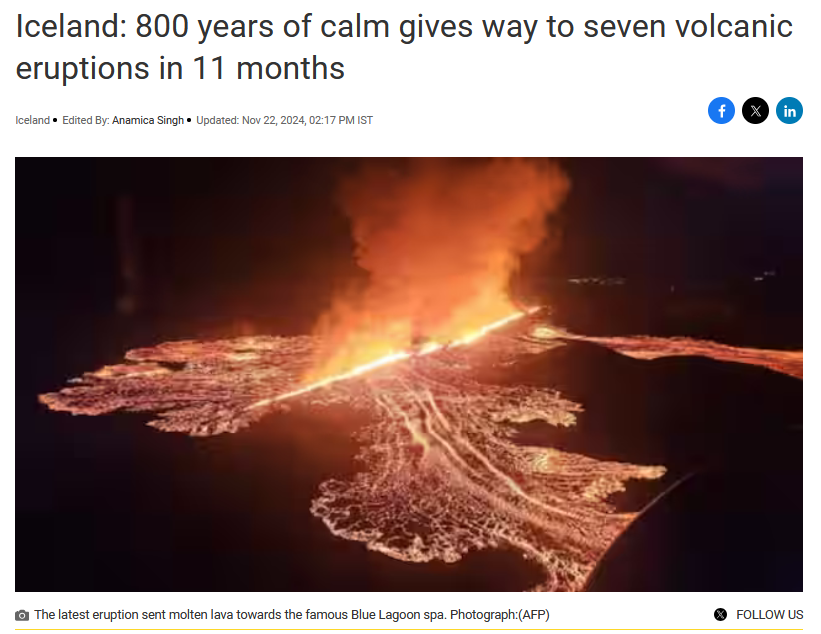
Would you poke fun at a volcano?
No? Because it doesn’t make any sense?
But would you poke fun at people who, 800 years ago, prayed to a ‘volcanic god’ asking for ‘mercy’?
Why? Only because (we currently know that) ‘it doesn’t work like that’?!?

OK, forget about the volcano.
Would you make fun of Shoah? Also known as the Holocaust.
No, because it’s illegal? Otherwise you would have mocked a tragedy?!?

It’s not illegal to fall down.
And impossible to ‘ignore’ gravity. Just as impossible as it is to ignore a volcano!
We laugh our eyes out when clowns pretend to fall.
Nobody laughs at a volcano.
Hence it is us who choose what is funny and what isn’t. Just as it is still us who choose whether to obey the law or not. We’re talking about the human laws here, not about the natural ones…

Which brings us closer to the gist of this post.

For the believers, God is everything. Both the entire world and their reference point. Without their God, the world loses its meaning. Without their God, the believers lose their bearings.
Making fun of God, of any god, is no different from making fun of a volcano.

‘You’re making absolutely no sense. No sense whatsoever.
A volcano is a real thing. Sometimes too real, even. While God, all gods, …
Nonsense. Absolute nonsense!’

Do you have faith in vaccines?
Why? Because they work? Because they save a lot of lives?
Despite vaccines being rather expensive and despite the fact that some guys have become obscenely rich as a consequence of people needing vaccines, and other medicines, in order to survive, right?
Have you ever made fun of vaccines? Of obscenely rich people, no matter how they got their money?

Do you understand how religion works?
How religion actually works… Psychologically, sociologically, etc.
No more than you understand vaccines?
Or you just consider religion to be a hoax while vaccines are a scientific fact?
Why? Because you have been told so by reputable people? By people in whom you have absolute trust?

So.
You trust doctors to the tune of allowing them to mess up with your immune system.
And you trust those thinkers who try to convince us not only that God doesn’t exist but also that religion is the “opiate of the masses“. “An ideological tool that legitimates and defends the interests of the dominant, wealthy classes in the population.” According to Marx, that was. Karl Marx. The guy advertising the advent of the communist happiness uber alles…

Let’s backpedal for a while.
You’re OK with vaccines and hate the fact that some people get way too much money for selling those vaccines. You’re OK with the idea of making fun of rich people but not of vaccines. Because vaccines save lives while obscenely rich people are… well… obscene!

Let’s get back to religion.
Making fun of vaccines doesn’t make sense. To you. To us, actually. Because they’re not funny. Because they are a scientific fact. And because they save lives.
Making fun of God also doesn’t make sense. For the believers. For those who truly believe in God.

For those who have a different understanding of the world than we do.

What would you think about people who dismiss vaccines?
The scientific concept of vaccination, not a specific vaccine.
You consider them…?
From your point of view, their reference point is way out of this world? That they have lost their bearings?
That they actually deny the reality? Your/our reality?

That’s exactly what also happens when people make fun of God. Of any god.
Those who believe in God – in the particular god which is the target of the joke but also in all other gods – feel queasy. ‘Sea-sick’. Their world and their bearings are being put into jeopardy. Which puts them into a very difficult position.
There are only two ways out of their conundrum.
To consider the jester as being clueless. As having no idea.
Or to consider the jester as an ‘agent provocateur’. To consider the whole thing as being an insult.

You have a concern and you want to express it? As the law allows you to do?
How about doing it in a considerate manner?
In an efficient manner! In such a way as to get through…
Insulting people, or being considered clueless, doesn’t help if you want to be heard by the other side.
If you want the other side to listen, carefully, to what you need to say.

A marginal benefit is the additional benefit received by a consumer, producer, or society
due to the consumption or production of an additional unit of a product.

When do you stop cleaning something? How do you determine it is clean enough?

When do you stop cleaning the living room? When there’s no more visible dirt, right?
When do you stop cleaning an operating room? You follow the procedure and you check using the appropriate methods and apparati, right?
When do you stop cleaning the operating room where your child will have their life-saving surgery? I’m afraid the surgeon will have to drive you out of the room. You’ll never declare it clean enough….

My point being that we’re rational only as far as there’s nothing personal involved in the choice we have to make.

And as soon as we’re personally invested in the whole thing, we suddenly start to rationalize.
To find rational arguments which favor the position we’ve already adopted. The decision we’ve already made.

My child deserves the best!

Which is true, of course. For as long as we really know what’s good for them…

What capitalism has to do with any of this?!?

Well, most of the ‘hoarders’ rationalize their habit by ‘blaming it’ on their children.
“I have to take care of their future”.
In their attempt to control the future, the hoarders convince themselves that amassing capital will shield them, and their children, from insecurity.

Which is partially true. If the hoarded capital is sustainable…

“I am 82 years old, I have 4 children, 11 grandchildren, 2 great-grandchildren and a room of 12 square meters.
I no longer have a home or expensive things, but I have someone who will clean my room, prepare food and change my bedding, measure my blood pressure and weigh me.
I no longer have the laughter of my grandchildren, I don’t see them growing, hugging and arguing. Some come to me every 15 days, some every three or four months, and some never.
I don’t bake cakes, I don’t dig up the garden. I still have hobbies and I like to read, but my eyes quickly hurt.
I don’t know how much longer, but I have to get used to this loneliness.”
“Author unknown”

Every time I read something like this over the internet – more and more often – I remember that it was us.
We have raised our children into what they are today.

We have amassed vast amounts of financial capital – fiat money – believing that our children will be grateful.
We had not been there when they were growing up. We had not been there when they were learning things.
And now we are the ones who don’t understand why there are no more bonds between us. Between us and our children. Why our children see the world differently from how we do it…

Is it to late?

1. Revelation
2. Widespread destruction or disaster

Unsettled.

Not in the sense that I feel unsettled in my ‘beliefs’.

In the sense that the world is coming apart. We allow ourselves to be led further and further away from our brethren and, together, from the ‘hard’ reality.

The key concept here is ‘rabbit holes’, not ‘conspiracy theories’.

Each of those theories are nothing but a highly redacted version of the truth, draped in psychological gimmicks. Dangerous but survivable.

It’s the fact that once hooked, those so disposed become unable to see/perceive/accept that no truth is complete or ‘everlasting’. That we need to adapt our beliefs to the ever-changing reality.

On the other hand, it was us who have built this world. The one we currently inhabit.
We have inherited the world and fine-tuned it according to our own wishes. To fit our own desires.

We are also the ones who have to sleep in the bed of our own making.
We are the ones to continue the project.
Or take it apart…

We have arrived at the moment of reckoning.
Like each and every other generation before us.

After all, one cannot build something new before taking apart the old.
This is the only constant truth.

It hurts me to accept that I have been wrong. That my understanding was incomplete or inaccurate.
Yet I have to acknowledge that before starting to build a new, hopefully better, version of the truth.
And I cannot do this alone.

Going forward, I can ‘circle the wagons’, along other like minded people, and attempt to defend the old truth.
Or I can, accompanied by a ‘motley crew’, attempt to see behind the curtains.

To leave behind the ‘safety’ of the rabbit holes and see with our own, very diverse, eyes what lies behind the make-belief shrouds woven by the conspiracy theorists.

Do you really care about where your car was built?
No, but I am interested in how it works.
I need that in order to use it properly!

‘Ordinary matter’ is ‘lifeless’. Inanimate.
The rules which ‘shape’ the interactions between pieces/portions of the lifeless matter are the same ‘all over the place’. As far as we know, anyway.
The pieces/portions consisting of ordinary matter are more or less similar. There’s nothing to tell apart one proton from another. One rock from another one. One drop/bucket of water from the rest of the pond.

And there’s life.
‘Technically’, the living organisms are made from inanimate matter.
And, anyway, while ‘ordinariness’ is forever, life is temporary. Individual organisms have a limited lifespan, species evolve and life itself has appeared some time after the ordinary matter.
The rules which shape the interaction between the living organisms and their environment are species specific. Further more, individual sets of data set apart each individual belonging to each species. Which means that each species interacts in a specific manner with their environment while each individual organism does have its own particular ‘manner of doing things’. ‘Inside’ the species specific behavior but nevertheless particular.

Then there’s conscience.
Which conscience is nothing but a concept. Like everything else here.
Which concept, like all other concepts, has been coined by us. By us, conscient human beings.
The point being that we, conscient human beings, attempt to understand conscience by thinking about it.
Somewhat similar to looking inside an eye when attempting to understand sight. Or listening attempting to understand hearing.

Freud came up with the notion that studying what’s wrong, out of the ordinary, might help us to understand ‘normal’. But Freud was a psychologist…
Engineers prefer to ‘look from above’. To extricate themselves from the problem in order to see it ‘whole’. And I’m an engineer…

So, what is conscience?
An individual ability and a space/place.

There is life and there are individual living organisms.
Life goes on regardless of a number of individual organisms passing away. As long as one individual living organism continues to be alive, life itself will continue to exist.
Further more, regardless of how life might have appeared, presently it seems impossible to have life, the kind we have learned to appreciate, with only one species being alive. Let alone with only one living organism…

Same thing with conscience.
Humans become conscient through human interaction. Our ancestors had become conscient way before anybody was thinking about conscience. People who, in various circumstances, have had a limited interaction with other people struggle to develop a functional conscience. A full fledged one…

But humans are not exactly alone when it comes to being conscient.
Not exactly aware of their own selves, but still functionally ‘conscient’.

Being alive, individually speaking, means being able to:
Maintain the ‘structural identity of the organism’. As in keeping the inside in and the outside out.
Manage to breathe, eat, drink and excrete.
Life, as larger process, means successive generations of individual organisms transmitting the pertinent species specific genetic information to the next cohorts.
Maintaining the inside in, the outside out and managing to breathe, drink, eat and excrete means behaving in a conscious manner, albeit in a very limited sense.
This behavior being specific to ‘life’ and life being dependent on species specific information being passed from one generation to another means that human conscience – acceded by individual humans imbibing culturally specific information – is nothing but a particular example, maybe the most evolved one to date, of an otherwise widespread phenomenon. As a matter of fact, people who – for various reasons – are not ‘conscious’ – as in aware of themselves – continue to ‘breathe, eat, drink and excrete’. ‘Incompletely’ and only for a short while, if left unattended, but that’s another matter.

Furthermore, there is a ‘continuum of conscience’ starting from plants and culminating with the human awareness.
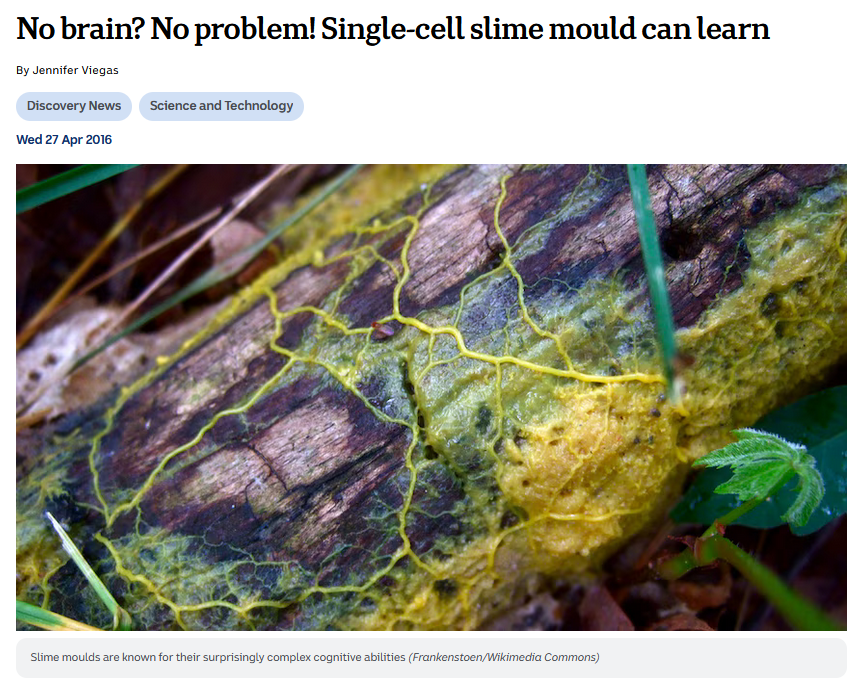
While plants and fungi manage to stay alive, animals display a widely nuanced repertoire of behavior. From the learning slime to our cousins, the apes.

A hamadryas baboon, Hagenbeck Tierpark, 2009

https://constructivist.info/1/3/091.maturana

“According to their records, Hilda is 81,
but she says recently her family killed a pig to celebrate
her “100th birthday or something like that”.”
“Many Tsimanes never reach old age, though.
When the study began,
their average life expectancy was barely 45 years – now it’s risen to 50.
“But for Hilda, old age is not something to be taken too seriously.
“I’m not afraid of dying,” she tells us with a laugh,
“because they’re going to bury me and I’m going to stay there… very still.””

Big Bang 1.0 had been inconspicuous. There was nothing there to vibrate so sound could not travel. Also, there was no space so light had nowhere to travel to. On top of everything else, there was nobody there/then to notice.
What am I talking about? There even weren’t any ‘there’ nor ‘then’ at ‘that moment’…

Not for us, anyway!
Hence ‘Big Bang’ is a rather blatant misnomer.

Big Bang 2.0, the currently unfolding one, is an increasingly flashier event.
It began when we have started to talk. And developed conscience as a consequence. According to Humberto Maturana.

The first thing our ancestors had discovered was that they were heavily dependent.
On each other and on what we currently call ‘nature’.
Not having any of what we consider to be ‘scientific knowledge’ they didn’t know much about how things worked.
But they learned, slowly, to use fire.
How to make tools. And how to improve their dwellings.
All these things – fire, tools and protection from the elements – were auspicious circumstances for the first qualitative transformation of the genus. Not only our direct ancestors – Homo Sapiens – but also their cousins – Homo Neanderthalensis – had started to consider ‘the future’.

‘What is going to happen to me/us?’

This question, ‘am I going to eat this much/tasty again?’, demands three things.
A full belly, some time off and a (proto)conscience. At least some self awareness.
The fact that our ancestors, both the Sapiens and the Neanderthalensis, buried their dead and used tools to build/carve ‘jewelry’ strongly suggests that both of them did have a certain awareness/preoccupation about their own condition.

We don’t know whether they were ‘religious’ people.
What we do know is what people very close to what was going on then were doing until recently. And some continue to do. Populations which until have been ‘discovered’ were living like our ancestors used to do. They used to thank their totems for the food they hunted. And they erected ‘altars’ to celebrate the movements of the Sun.
Which strongly suggests that ‘what am I going to eat tomorrow?’ was far more important to them than ‘how much longer am I going to live?’.

The way I see it – following Maslow’s cue – people who live in rather ‘undeveloped’ communities don’t have enough ‘time’ to think about ‘death’.
They are accustomed to it – death is a lot more present in their life than it is in ours – and they still haven’t solved the ‘basic needs’. Not to the tune of reaching the ‘re-actualization’ stage.
They do think about tomorrow but they do it in far more practical terms than we do it.

They are not afraid of death as they are of dying of hunger. Painfully. Or both.

It was us, the ‘civilized’ people, who have become afraid of dying.
Concerned about ‘redemption’.
Thirsty for ‘meaning’.

Which ‘meaning’ brings me back to where this post has started.
One of the experiments which have convinced Rosenblatt et all to develop the ‘Terror Management Theory’ involved a number of municipal judges. Half were ‘primed’ by making them think about death while the others were left ‘unprimed’. The primed ones had imposed tougher bonding conditions to similar fictional suspects.
The experimenters posited that death was so important to them that thinking of it changed the conclusions they derived from the information available to them. Which is more or less correct.
Yet this experiment suggests something even more interesting. To me, at least.

Death is, besides a biological phenomenon, a cultural construct. An artifact.
And the fact that the judges had to be primed in order to be influenced by ‘death’ is a strong suggestion that they were rather influenced by the artifact than by the biological phenomenon.

We do know that we’re gonna die.
But we don’t constantly think about it. Our mere mortality isn’t a constant presence in our mind.
For it doesn’t make sense. It doesn’t help any. A waste of brain power which brings no real benefit.

What we do think – those of us who have a full belly and enough spare time, only during some of that spare time – is ‘what’s all this fuss about?’

What’s the meaning of all this?
Of all this man-made terror which is creeping on more and more of us…

“I suppose it is tempting,
if the only tool you have is a hammer,
to treat everything as if it were a nail”

Abraham Maslow

I write this blog in the hope that ’embodying’ my thoughts will somehow help me.
Help me solve some of the quirky questions which have been haunting me for sometime now.

Why so many people have been convinced that thinking may help them make sense of things?
Why so many otherwise smart people have convinced themselves that thinking ‘in solitude’ would take them to the ‘right’ place?
Why so many seemingly reasonable people have somehow become certain that their version of things was the only one valid? To the tune of trying to impose it to those happening to be around them?

The first answer was easy to find.
Because that’s how we make sense of things.
And because that’s what people do when they have no other alternative.
They start thinking about how to get out of the mess into which they have entered by not thinking! Enough…

The second one was also easy. Ish… specially after I did come up with the question formulated like this.
Apparently, to shield their minds from ‘distraction’. From the mundane ‘minor’ problems which might have wasted their ‘brain power’.
In reality, simply because they could do it. They had a great time doing it – thinking, that was – so they indulged on every occasion they had. And smart as they were, they made it possible for them to have more and more time available for thinking.
And they cut themselves off from the rest of the world because the few people able to partake in the process not always shared the same opinion. Thus otherwise smart thinkers ended up in the company of sycophants…

Having found the answer for the second question opened, wide, the door for the third answer.
No, it wasn’t the presence of the sycophants which convinced the otherwise reasonable thinker that their was the only valid solution for whatever problem they had in mind at anyone time.
Sycophants showering praise were only a ‘favorable circumstance’. A mere opportunity for it to happen.

Unhindered by any outside intervention, the tinkering thinker turned his tool to his own head.
And hammered out all the remaining doubts his mind was still harboring.

I also believe that people – well, some of them – are able to change their minds if presented with the right arguments at the right time, in the appropriate manner and in auspicious circumstances.

People are not robots. And, for certain, not rational!

We are rationalizers. We use rational arguments to fortify our already held conclusions. And the more we love those conclusions, the further we go in our quest to find the ‘right’ arguments in our favor.
But given enough time and if the arguments which contradict our convictions are presented in an un-injurious way, we might be persuaded.

And here’s the catch.

For quite a while now, some of those familiar with how rationalization works have used their knowledge about the innards of our minds to further their own goals.
Nothing wrong with that?

Are you familiar with ‘divide et impera’?
That’s the strategy used by every would be dictator to breed trouble in the population they planed to take over.
Divide and conquer. Make your followers despise everybody else. To the tune of transforming ‘the others’ into sub-humans.
Make your followers believe they are ‘special’ while the others, all of them, are nothing but vermin.

‘And what’s wrong with believing yourself to be rational?!?’

It’s not wrong. Only delusional.

Making your mind up only after carefully considering all of the available ‘arguments’ means having a scientific attitude.
You know? Science, the fad currently popular among many of us…

The problem with the scientific attitude being the fact that this attitude has been developed in the context of hard facts. The scientific attitude has been ‘minted’ by those studying physics, chemistry, biology… fields where every minute transgression becomes evident in real time! Where people could not ‘fall in love’ with their own conclusions. For the simple reason that those conclusions had to be changed along with the new facts continuously discovered in the process of learning.

The concept of rationality had been minted late in the development of human thought.
Sometimes during the XVIII-th and the XIX-th centuries. When philosophers had started to concern themselves with ‘how we think’ on top of ‘what we should be thinking’.
When philosophers – and lately psychologists – have started to understand how we reach/build meaning.

Some of those philosophers have reached rather strange conclusions.

Nietzsche posited that ‘God is dead’ while Marx rationally convinced himself, and others, that there was a way – and only one way, his – to make everybody happy.
Nietzsche opened the gate and Marx led us through.

And now, that we’re dwelling in no-God’s land, everything is up for grabs.

Including reason…
What is here to prevent us from using our knowledge of how mind works in order to further our own, personal, goals?

Goethe did warn us.
The Sorcerer Apprentice made the very same mistake. Overconfidence in his own ability to ‘play the rules’. To fidget with reality.
The difference between Goethe’s poem and what we’re currently doing is the fact that Goethe’s was a work of fiction while we’re playing with our own future.

I’ll wrap up highlighting the extreme perversity of the message.
‘I have a mental illness…’
Loosely translated, this means that everybody who doesn’t follow those arguments to the same conclusion where I have arrived myself must be (also) mentally ill.
And now, that we’ve reached the conclusion that at least one of us is ‘crazy’, it no longer matters who is on the ‘wrong’ side of the fence!

We both are!
We no longer see eye to eye. Each of us is convinced that the other is sick.
Unworthy!

We’re both ready to be taken over.

The only way out is to start listening, respectfully, to what the other has to say.
‘Respectfully’ means, first and fore-most, ‘don’t mess with GIGO‘!