Archives for category: politics

As in mob rule?

A British historian that went by the name of Lord Acton observed more than a hundred years ago that
“All power tends to corrupt; absolute power corrupts absolutely.”

Judging by what historians keep writing and the politicians keep ignoring this observation tends to be pertinent.
Click on the highlighted quote to see some of his arguments in Ben Morrell’s interpretation.

Somewhat unhappy with this vision, a sci fi writer, Frank Herbert, contradicted the historian:
“Power attracts pathological personalities. It is not that power corrupts but that it is magnetic to the corruptible. Such people have a tendency to become drunk on violence, a condition to which they are quickly addicted.”

In fact it’s more like a completion than a contradiction but I’ll have to leave it at that because both are dead now and way past such mundane preoccupations.

Recently, things having not been properly set yet, a team of Swiss scientists lead by John Antonakis decided to sink their teeth in the matter. They gathered a group of people, ‘measured’ all sides of their personalities – including their honesty – and then involved them in a game of ‘lets play dictator’.
“The findings showed that those who measured as less honest exhibited more corrupt behaviour, at least initially; however, over time, even those who initially scored high on honesty were not shielded from the corruptive effects of power.”

OK, so Acton was right altogether, ‘power’ does corrupt. The problem is that Antonakis never tried to verify Herbert’s hypothesis. If he was right then the honest people stand no chance at becoming powerful enough to become corrupted because the already corruptible are fighting dirty to get on top, something the more honest would not do, at least not from the very beginning. Seen this way the very competition for power selects the people who get on top based on how corruptible they are.

Luckily things are not that simple. Really smart guys, no matter how corruptible, figure it out – sooner rather than later, that by ‘stealing’ too much/misbehaving really bad  they destroy the entire structure upon which their very existence, let alone power, depends.

So how come really bad dictators do come into existence?
From Lenin to Hitler, from Ceausescu to Pol Pot and nowadays from Putin to al-Baghdadi.

Here Antonakis’ findings fit in perfectly.
Participants “were given complete control over deciding pay-outs to themselves and their followers. The leaders had the choice of making prosocial or antisocial decisions, the latter of which resulted in reduced total pay-outs to the group but increased the leader’s own earnings.”

The key concept here is ‘complete control’. In fact this ‘dictator game’ is no game at all. It’s nothing but a solitaire. It has rules, certainly, but it’s up to the ‘player’ himself to decide whether to respect them or not. If the rest of the people concerned – those who suffer the consequences of the ‘game’, have no say in what is going on then they don’t count. And are not able to help, either. The final outcome will depend exclusively on the honesty of the ‘player’. And we haven’t, as yet, made any mention about skills…

Besides the very important insight Antonakis also offers us a valuable piece of advice:
” “We think that strong governance mechanisms and strong institutions are the key to keeping leaders in check,” concludes Antonakis. “Organisations should limit how much leaders can drink from the seductive chalice of power.” “

It’s a very good starting point. Add to it a renewed insistence on initial honesty – it helps, just as the study showed, coupled with intense surveillance and continuous feed back from the stakeholders and things might improve dramatically.

After all ‘governance mechanisms’, ‘strong institutions’ and ‘organizations’ are nothing but words. Powerful and meaningful words indeed but ‘words’ cannot do anything by themselves. They have first to be pronounced by pertinent persons and then diligently put into practice.

And this would mean that ‘power’ won’t belong to anyone in particular, not even to ‘the people’.

Keep tuned for the difference between real democracy and ‘mob rule’.

‘Selective focus’ is a technique used by skillful photographers to grab the attention of the viewer by opening the lens at its widest and focusing it on the most interesting part of the picture. This way everything else is left ‘out of focus’ and more or less blurry so the viewer concentrates his attention on the clear part it. Nowadays, when most pictures are taken using smartphones or pocket cameras this is no longer possible because the lenses in those cameras are too short for this technique to work. There are computer that can mimic this but it’s not the same thing.

The point is that if we are not really careful our attention can be grabbed by glitzy but insignificant aspects of the reality while the more mundane but infinitely more important ones remain hidden in full view.

Here for instance.

Selective focus

Frankly I don’t care about how they live, that doesn’t concern me. Not in the least.
The problem is that by being so few they induce a lot of fragility in society.
Empires and other totalitarian regimes fail inevitably because they are run by very few people while more democratic countries survive/thrive for longer periods of time because they make better use of whatever human potential they have.
By allowing more people to have their say democracies have a way bigger pool of potential solutions for the problems they have to face while totalitarian regimes have to make do with only the very few solutions envisaged by those who happen to be at the top when a particular problem has to be dealt with.


wind back history

Humankind is a vast and extremely diverse collection of human individuals grouped in various ‘nations’.
Each of these nations have evolved in certain geographical and historical circumstances and, because of that, is different from all others.

Still, there is one thing all of them have in common, one thing that has happened, in various degrees, to all surviving nations.

Statistically, individual members of all nations have constantly grown more and more autonomous.

True, this was not a linear development. Actually it was not even consistent, from time to time some nations have reverted, for longer or shorter periods, to states where individual autonomy was curtailed but on the whole personal autonomy has constantly increased.
And another thing. Those instances when the ‘march’ towards more individual autonomy was halted or reversed coincided with historical hiccups: civil wars, economic hardships, natural disasters, external aggression… things like that. Never in the entire history of man has this process been halted without that stop being caused by some forceful event, just because an individual or a collection of individuals have decided so.

Franco transformed Spain into a dictatorship only after being helped by external military forces.
Hitler became ‘Fuehrer’ in the special set of circumstances created by the inept way in which the allies treated Germany after WWI combined with the Great Depression.
Lenin transformed Russia into the biggest gulag on Earth helped by circumstances produced by the same WWI while Mao rose to power in the aftermath of WWII.

In our days Putin has been able to tighten, again, the screws on Russia mainly because of the corruption and greed that sapped from within the Russian society while the ‘Western World’ has become, almost overnight and completely against the natural course of nature, an immense Big Brother set only after some nuts declared war on the civilized world under the pretext of Islam.

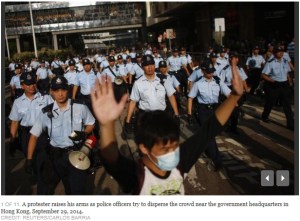
What is going on now in Hong Kong is a first. An entire community, and not a small or insignificant one, is having its freedoms curtailed simply because some people gathered around a table have decided so.

This morning I came across a Stratfor analysis.
Two brief excerpts:

“This influence, especially among Sunni locals in not just Iraq but also Syria, will be critical if Turkey is going to be able to manage the jihadist threat long after the United States declares mission accomplished and moves on.”
“Not only does Turkey feel that it will have to deal with the mess in Syria long after other stakeholders have moved on, it also knows that the United States expects Turkey to manage the Syrians as well as other regional matters. Turkey has not forgotten how, during the days of President Turgut Ozal, Ankara cut Iraq’s export pipeline in 1990 at the behest of the United States in the run-up to the 1991 Gulf War but was later left with the aftermath as promises of aid disappeared with the subsequent change of U.S. administrations. This bitter experience informed Turkey’s 2003 decision to refuse Washington access to Turkish territory for a northern invasion of Iraq. At the same time Turkey is deeply worried about being caught between Saudi Arabia and Iran, who are engaged in a vicious proxy sectarian war.”

Am I wrong in detecting here a fresh understanding?
About the need for genuine effort to tie all loose ends that were caused while solving a problem before declaring that problem solved?

You can read the whole article here, it is well worth the effort:

Turkey Must Tread Carefully Against Islamic State is republished with permission of Stratfor.”


Acuma ca unul dintre jurnalisti s-a hotarat sa dea cu batul in balta s-a gandit si un filozof ca trebuie neaparat sa ia pozitie.

Si cum sa faci ca mesajul tau sa fie cat mai ‘percutant’?
Sa spui pur si simplu ce ai pe suflet: ‘Nu cred ca Ponta este potrivit pentru a fi presedintele Romaniei!’ si sa lasi eventuala autoritate morala de care te bucuri sa isi faca efectul?
Pueril…
Nu mai bine starnesti o disputa publica? Te iei de cineva foarte cunoscut si, de preferinta, cat mai pasnic – ca sa nu mai trebuiasca sa faci fata vre-unui eventual contraatac.
Beligan e bun? Perfect!

Puterea talentului dvs., puterea mintii dvs. nu va satisfaceau. Ca si acum, voiati sa fiti in preajma celeilalte puteri, oricit e ea de trecatoare prin comparatie cu puterea prestigiului dvs. profesional. Voiati, ca si acum, sa fiti mai curind pe scena stabilor, decit pe aceea a colegilor dvs.”

Foarte interesant. O fi facut cineva socoteala cate functii publice a ocupat Plesu si sub cate culori politice?

Minima moralia…

PS 1. Nici mie nu-mi place Ponta. Dar asta nu este motiv sa ma apuc sa-mi pun poalele in cap.

PS 2. Uite ca socoteala din targ nu se potriveste cu cea de acasa. Intelectualitatea, sau macar o parte din ea, nu mai accepta pasivitatea in care au incercat diversi ‘atotputernici si a-toate-stiutori’ sa o inghesuie:

“Este firesc ca într-o societate deschisă să existe pluralism de idei, de opinii și de opțiuni de orice natură și este la fel de firesc ca oamenii, în special cei care reprezintă repere pentru societate, să accepte și să respecte faptul că cineva gândește și se manifestă altfel decât ei”

Interesant. “Un grup de actori si cantareti” ii explica unui filozof cum sta treaba cu diversitatea de opinii…


Un ziarist se declara ofiter acoperit.

Si acum incep dilemele.

O fi fost, n-o fi fost… si in orice caz, ce l-a apucat?
E sincer sau l-a pus cineva?

Ce interese sunt in joc si nu cumva ranile produse victimelor colaterale (prestigiul armatei, gradul de incredere al populatiei in mass media) se vor dovedi a fi extrem de periculoase, in final chiar si pentru cei care poate ca vor castiga ceva pe termen scurt?

Ce e de facut?
Punerea lui sub acuzare pentru ‘diseminare de informatii confidentiale sau secrete de stat’ nu constituie cumva cea mai buna confirmare a spuselor sale?


Pe net tot umbla poza aia cu ‘1984 nu era menit sa fie un indreptar pentru dictatori’:

Cred totusi ca ar trebui sa luam in considerare si romanul mai putin cunoscutului dar mult mai ‘perenului’ Josef Toman:


Chiar asa?!? Dar copiii, nepotii… daca de ceilalti oameni nu ne mai pasa poate macar de urmasii nostrii sa avem grija… cand vine puhoiul e greu de spus cine mai scapa si cine nu… degeaba le construim cuiburi in varful copacului daca viitura duce tot dealul la vale…


buda publica.

Just received this in my mail.
Please take a second look.

Now tell me what’s forcing the voters to use the ground level cabin?

Ayn Rand utopia

“A community made up of American ex-pats deep in the South American hills of Chile – far away from America’s annoying taxes, healthcare mandate, and legal abortions — was supposed to be a libertarian paradise of rugged individualism. Instead it cost many of the people who bought into it almost everything, and now is buried under lawsuits — a reminder that everything that glitters is not inflation-proof, Ron Paul-backed gold.

It seems pretty obvious that basing one’s society on a single work of (poorly written) fiction is folly, but for many adherents of Ayn Rand and her seminal book of Objectivist allegorical grandstanding, Atlas Shrugged isn’t just any book. It’s about as close to the Bible that many libertarians have — apart from the Bible, of course.”


To me this looks more like an Umberto Eco novel than anything else… layers upon layers of information connected solely by what human individuals living in one of them think about what is going on in the next one…
– Ayn Rand grew up in Russia and wrote in and about the US… OK, she might have had some interesting ideas but so did a lot of other controversial thinkers. Karl Marx and Nietzsche, among others. Would any of you become a dedicated follower of any of these two? I had to live in a Marxist society for the first 30 years of my life and I wouldn’t recommend it…
– The guys that came up with this… scheme… have as much in common with libertarianism as Bernard Madoff has with bona fide capitalism…
– Investing, money or time, into something without due diligence is not a very libertarian thing to do either…
– Etc., etc….

After all an utopia, even one supposedly based upon Ayn Rand’s ideas, is nothing more than another … man made dystopia.

9/11

A day of mourning and remembrance.

My son was two years old at that time and doesn’t have any personal recollections of that moment yet has a rather clear understanding of what happened. Some wackos somehow crashed three airplanes into three of the most important buildings in America and, by doing so, simply changed the world.

I still remember vividly having my eyes glued to the TV screen. All those people jumping from the windows. So much desperation. One question still haunts me to this day. What made those wackos do what they did? What made them so ‘desperate’ as to … OK, they must have had some ‘predisposition’ of sorts… not every desperate person does what they did … only in a normal world really desperate people get noticed by their community and are treated accordingly. They get help and/or are rendered harmless to the others.

So our real problem is why hadn’t the wider community noticed that particular kind of ‘desperation’, and its intensity, and why hadn’t something been done about it. Another thing. There is something else that the wider community has failed to notice.
That the closer community, exactly those people who in normal circumstances notice and stop this kind of tragic occurrences, helped the perpetrators instead of blowing the whistle.

And it seems we continue to not understand what had really happened.

A ‘war on terror’ has been declared.
Only there is a small problem here.
Nobody can fight ‘terror’, just as nobody can fight the blue color.
The only thing we can do, as warriors, is fight terrorists. And if we limit ourselves to fighting them we perversely confirm their mantra – ‘we are under attack, we are weak so the only thing we can do is use ‘terror’ as weapon’.

Maybe thirteen years of this is enough.

The reality is that we are far more powerful than they are. This situation offers us a lot more options than they have.
Among these options is that in parallel with defending ourselves we might try to separate the active terrorists from the communities that support them. In order to do this we must recognize that those communities do have grievances. Some make sense, some don’t but if we disconsider all their grievances, wholesale, we do nothing but validate what the extremists are preaching: ‘those “white” people simply don’t care about any of us’. That’s why so many members of the communities among which the terrorist are usually hiding turn their heads when they see a terrorist act being prepared. Most of them wouldn’t participate directly – because of fear or maybe they abhor violence, as any normal human being does – but being convinced that ‘the “white” people don’t care about them’ makes them wonder ‘why should I care if the “white” people ‘gets it’?’

There is no shortage of people crazy enough to do horrible things. Just watch the 5 o’clock news. There is no way to change that. What we can do is give enough positive reasons to the communities to ‘call 911’ instead of turning away their heads. And sometimes gloat.

PS. ‘Positive reasons’ doesn’t mean ‘bribe them’. That might help a little but would not solve the situation. What we need to do is to convince them, and even some of our people too, that being different doesn’t mean being less human. After that things will become way simpler. No normal human being is comfortable seeing how his FELLOW human being is killed or otherwise hurt.

Tomorrow will be a full century since the ‘Miracle of the Marne’, a battle from the WWI during which the French managed to stop the seemingly invincible German army at some 35 miles from Paris. Apparently the Germans erroneously appraised the state of the French army and lost a huge opportunity while the French had shown a lot more stamina and determination than they were credited for.

Also there are some chances that tomorrow will be remembered as the first day of peace in Eastern Ukraine after many month of (un)civil war.

What I would like to do now is take a fresh look at what we know as ‘wars’. Hot, cold, asymmetric, commercial, trade…you name it.

There are two interesting definitions that I would like to share with you:
“War is the continuation of politics by other means.”  This one belongs to Claus von Clausewitz, the mastermind behind the German strategic thinking during the second half of the XIX-ht century. The most immediate impression one gets from reading it is that war, per se, is a legitimate tool when it comes to solving problems. You try ‘diplomacy’ first but if that doesn’t work there is always the option of “WAR”.
“War is only a cowardly escape from the problems of peace.” A XX-ht century hippie tree hugger? Not exactly… Another German, a writer this time, who had witnessed the WWI as a mature thinker – Thomas Mann, 1875 – 1955. I don’t know when had Mann come up with his definition but it is quite the opposite from the one proposed by his fellow countryman. On the other hand I cannot fail to observe that while in von Clausewitz time Germany was on the rise as a military power during Mann life it had suffered two humiliating defeats.

To be continued.