Archives for category: Politically induced fragility

Israel has been backed up by the US ever since it was established.
They didn’t enjoy an unconditional carte blanche but the amount of help was  very consistent and, above all, very dependable .

Until a few days ago.
Nowadays Netanyahu, Israel’s PM, feels like he has been thrown in front of a bus by the departing President of the US, Barack Obama. Because the US ambassador, Samantha Powers, had abstained herself, instead of exercising her veto, about a resolution calling for Israel to “immediately and completely cease all settlement activities in the occupied Palestinian territory, including East Jerusalem.

Ever since Israel has been reestablished by his original inhabitants Russia’s rulers have tried to use this situation in their advantage. Egypt, Syria, Iraq, and lately Iran, have received backing from Kremlin in their fight against Israel. By meddling into this conflict Russian rulers were simply trying to get international stature.

Recently Russia’s ambassador to the UN had used his veto power to block a resolution asking for the ceasing of the bombardments in Aleppo. Yet another proof that Russia’s leaders do not care about how they become respected on the international stage, as long as that respect is manifest. As in ‘the world listens when they speak’.

During the Obama administration the US refrained itself from such drastic measures. The US has refused – for now, at least – to re-engage in the brinkmanship game with the Russian leaders. Effectively denying the latter the kind of status they so strongly desire.

Israel has just become yet another collateral victim in this conflict.
Just as the Arabs have been for the last three centuries.
Caught, at first, in the middle of the endless colonial wars between England and France on one side and the Ottoman empire on the other. And later in the cold conflict between Russia and the US.

Some people believe that “racial prejudice” is “the natural human inclination … to identity (sic) with members of one’s own tribe, race or ethnic group” and “Post-racial multiculturalism is the exact but equally extreme and insane opposite of Nazi racial ideology“.

Compare this to “Religion, which should foster sisterhood and brotherhood, which should encourage tolerance, respect, compassion, peace, reconciliation, caring and sharing, has far too frequently — perversely — done the opposite. Religion has fueled alienation and conflict and has exacerbated intolerance and injustice and oppression. Some of the ghastliest atrocities have happened and are happening in the name of religion. It need not be so if we can learn the obvious: that no religion can hope to have a monopoly on God, on goodness and virtue and truth“.

What’s going on here?

Where does all this ‘confusion’ come from?

Let me start from the ‘bottom’ of it.

“No religion can hope to have a monopoly on God, on goodness and virtue and truth”.

While I fully agree with Desmond Tutu on the gist of his words I must contradict him on something very important.

Religions cannot hope at all. About anything. Anyway you look at them. No matter which definition you use, religion – all of them – is something that people do together. A common effort.
It is the individuals who are the actual doers. Who love and hate. Or hope, in this case.
Who pretend that their religion is the only true one. Or understand, as Desmond Tutu did, that each religion is yet another manifestation of God.

“Religion has fueled alienation and conflict and has exacerbated intolerance and injustice and oppression.”

Again, it was individual ‘religious’ people who have done all of those things, not religion per se.
All sacred texts have been written by human people. I can even accept that the first manuscript of each religion was directly inspired by God. Only each of them have been copied a thousand times over. And heavily editated.
Then came the individual human people who have read those texts, interpreted them, passed them on and acted upon those interpretations. Upon their convictions, actually.

And this is how “Some of the ghastliest atrocities have happened and are happening in the name of religion”. Not because of ‘religion’ but ‘in the name of religion’.
Simply as a consequence of how certain people have chosen to interpret/use religious teachings.

And not only ‘religious’ teachings.

People are able to interpret – and use in their own (perceived) advantage, every bit of information that comes their way. And now, that we have started to understand more and more about how our brain is working, the manners in which we use that information have become more and more ‘convoluted’.

“Post-racial multiculturalism … began as an understandable overreaction to Nazi racial ideology…before being consolidated by academics into an instrument of socio-political intimidation, rewards, punishments, manipulation and control, a modern, secular replacement for the power-political role of medieval church ideology.”

So.
It was the academics/priests who have done the damage. Not their religion nor the information they had at their disposal.

But why?
How come people whose religions – all of them do this – are adamant about ‘respect your neighbor’ become involved in wars?  Sometimes even in ‘religious’ wars ….
How come academics, whose very job are to teach their students to think autonomously, use their ‘rank’ in order to subdue ‘their’ file?

Could the religious warriors have something in common with the intransigent academics?

How them sharing the unbreakable conviction that they own the truth?
Forged inside the ‘echo-chambers’ where they have grouped themselves according to their specific beliefs? (No matter whether those beliefs are of a religious or ‘rational’ nature…)

Only after I had reached this point in my discourse I was able to fully appreciate Desmond Tutu’s words: ‘Religion … should encourage tolerance, respect, compassion, peace, reconciliation, caring and sharing’.

He doesn’t say anything about giving up on your own kind.
Or about leaving your roots behind.

All he actually says is ‘Be very careful. If all of you will accept to see only the same side of things you will become a herd. And while there is indeed ‘safety in numbers’ all herd members are ultimately headed for the abattoir’.

Diversity isn’t something to be forcefully, hence falsely, celebrated. Or imposed on others.

What we need to preserve, and celebrate, is our ability to ‘walk around’ the things that we encounter. To entertain, and discuss among ourselves, different – even conflictingly different – versions of what we see around us. This ability would only enhance our chances to solve the problems we’ll certainly be faced with.

‘Culture’ is nothing but layer upon layer of place-specific information which have accumulated in time while ‘religion’ is how a certain group of people have learned, again in time, to cooperate in a certain environment.
It doesn’t matter whether that ‘environment’ has been created by a God, has evolved according to Darwin’s theory or both.
What really matters is how we react – conditioned by our cultures and by our religious upbringing – to what is happening to us. Both individually and collectively.

In this sense, each culture we manage to preserve will only add to our chances of long term survival. As long as we’ll learn to sincerely respect each-other, of course.
Again, both individually and collectively.

PS.
A comment on my FB wall, “True religion is God entering history and the lives of humans and revealing Himself. All other religions are man’s attempt to explain the world around him in terms of god or attempts to control lots of other people in the name of some god“, helped me to understand that “There is ‘religion’ – the shared attitude that helps us to cooperate, and there are religions – specific ways that individual communities have traveled in order to attain that attitude.
And something else. What if ‘God entering history’ and enough of us reaching the shared understanding that it is far better to cooperate amongst us – love thy neighbor – than to fight each-other are the same thing?
How to put this understanding into practice? In the various, and continuously changing, circumstances we have to face?

How about this being the very reason for us having so many religions/cultures?

gambit noun [C] (CLEVER ACTION)

– a clever action in a game or other situation that is intended to achieve an advantage and usually involves taking a risk:

 – specialized games a way of beginning a game of chess, in which you intentionally lose a pawn (= game piece) in order to win some other form of advantage later

I borrowed this definition from Cambridge Dictionary, the on-line version.
You have already noticed, I’m sure, the accent on cleverness, the ‘intent to achieve an advantage’ and the relative downplay of the risk that is only ‘usually’ involved.

A more nuanced definition of the concept would mention that the person who uses this tactical maneuver has to get out of their psychological  comfort zone in order to perform it properly.
The whole thing involves offering a valuable bait which, once taken, might produce consequences favorable to the party that is ‘spending’ it.
Since the favorable consequences are not sure – otherwise it would have been a bribe, not a gambit – but the expenditure is certain the guy who initiates this has to thread very carefully. Hence the need for the bait to be really valuable. Valuable enough for the taker to take it and valuable enough so the giver would be really careful when performing the maneuver.

We have witnessed three gambits in close succession.

Britain’s David Cameron promised a Brexit referendum in an attempt to win the 2015 general election. He won the election but lost the referendum.

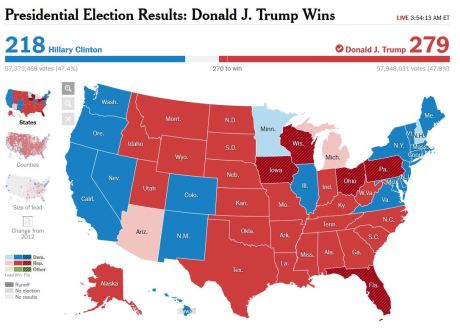
Quite a large number of Americans, fed up with what has been going on in their country, have pinched their noses and elected Trump into the Oval Office. The deal is not going exactly as they have planned it – Clinton is not going to be charged, the ‘swamp’ is more likely being repopulated rather than drained in earnest – but the jury is still out on this one.

Italy’s Matteo Renzi tried to cash in on his popularity and stream-line the constitution – a move which would have given more powers to the central administration. He has just lost the referendum, is about to resign – as promised and his losing the gambit has opened a wide venue for the opposition 5 Stars Movement led by a comedian – Beppe Grillo.

Need a moral to this?
Gambit works fine when playing chess. That’s a special kind of game where all the pertinent information is out there on the table and the sole variable is the opponent’s mind/will.

Real life, a.k.a. politics, is a completely different game. There are lots of stakeholders, instead of the two chess players, while most of the pertinent information is jealously guarded by each of the stake-holders – along with most of their real intentions.

If we add here the ‘detachment’ of the players – Trump and Cameron are both independently wealthy while Renzi is rather inexperienced – we’ll soon arrive at the conclusion that we’d be better off with some unadventurous, bland even, politicians.

‘He just says what he has to say in order to get himself elected. Once he will get there he will do like all the others, he will mellow down. Besides that, the system of checks and balances is too strong for one man to upset it.’

The first, and most obvious, problem with this line of reasoning is ‘why on Earth have we grown so accustomed with being lied that we find it acceptable’? Why do we brush aside so easily the lies professed by ‘our’ candidate – along with many other indiscretions, while we meticulously and vehemently point out those committed by the ‘opposition’? Weren’t we supposed to be making ‘rational choices’ when it comes to who governs the country?

The sad fact that there isn’t much to choose from doesn’t exonerate us from the consequences of our mistakes.

But our laziness has yet another – and even more malignant, ‘after-growth’.

By voting for a candidate who promises rather ‘unsavory’ things in order to get elected we not only encourage him to ‘make good’ those promises but we actually ask him, imperatively ( 😉 ), to do his ‘best’ in order to achieve as many of those promises as he possibly can.

Hoping that once elected he will ‘forget’ about (some of) them is both near-sighted and ‘double-standard’.


trump-nbc-favorability-trump

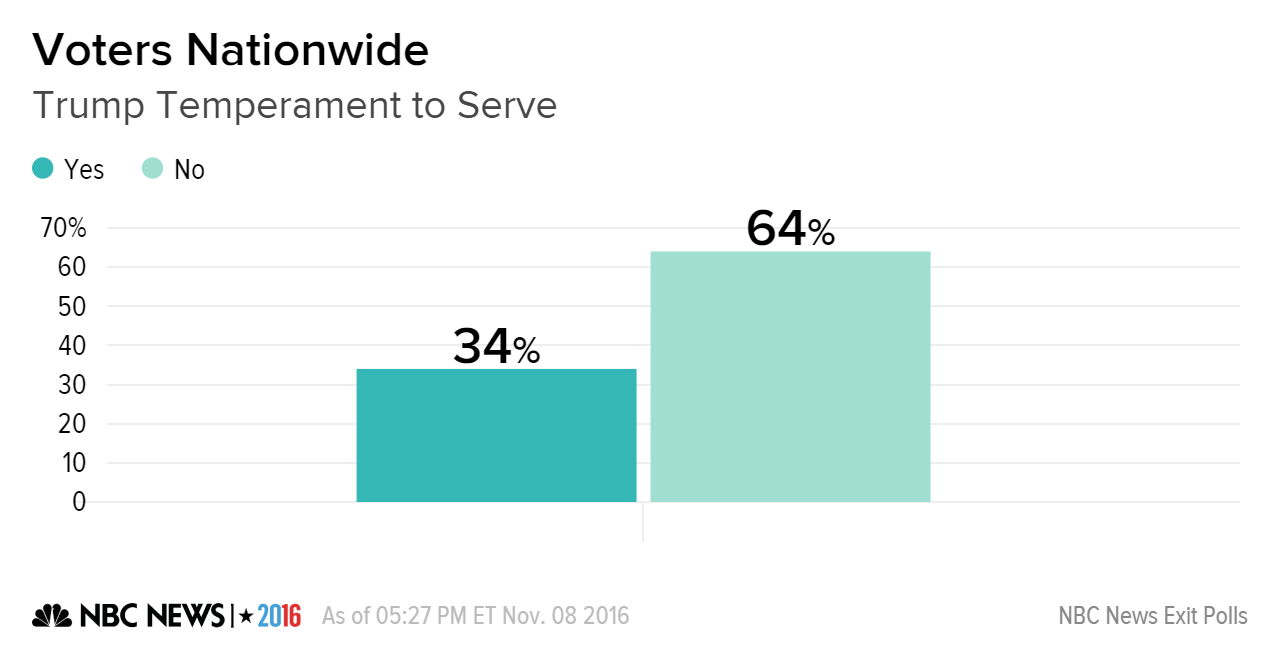
trump-temperament-nbc

1478656414_trump_treatment_of_women

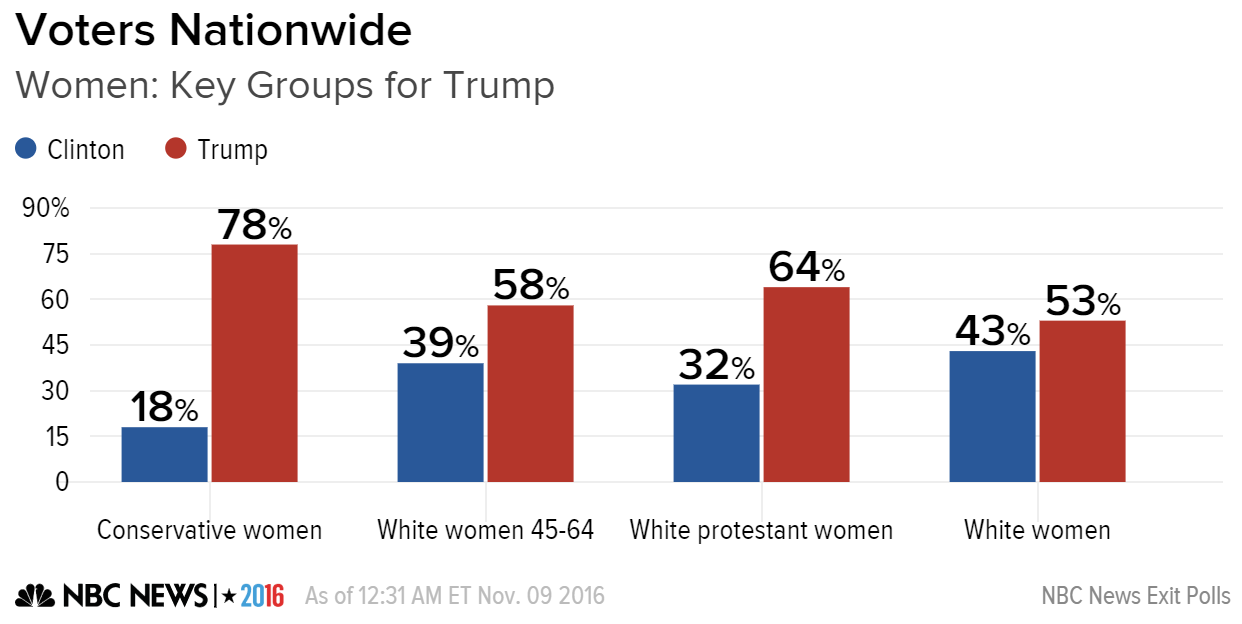
womens-votes

evangelicals-votes

white_catholics-votes

clinton-honesty-nbc

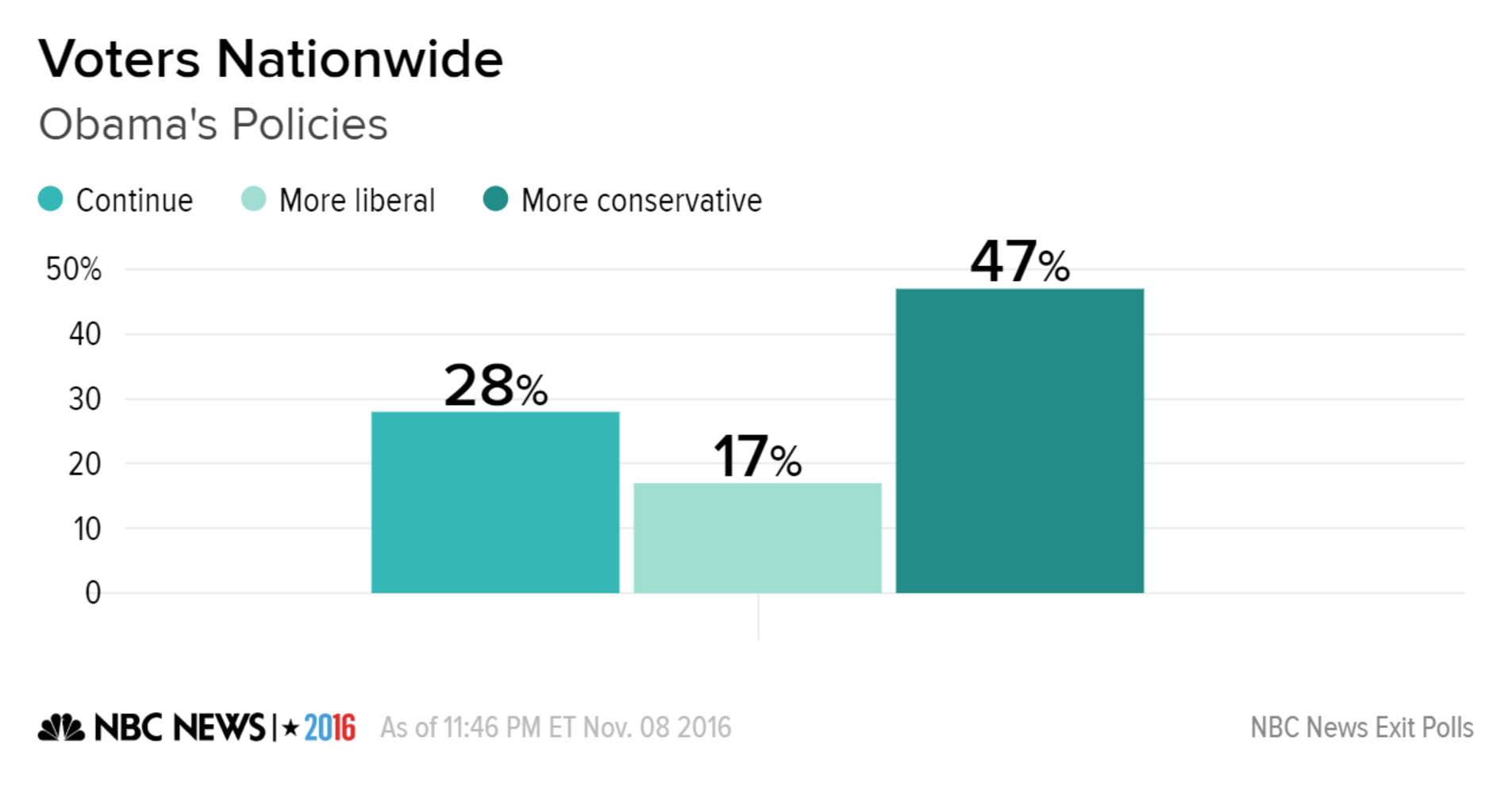
whether-to-continue

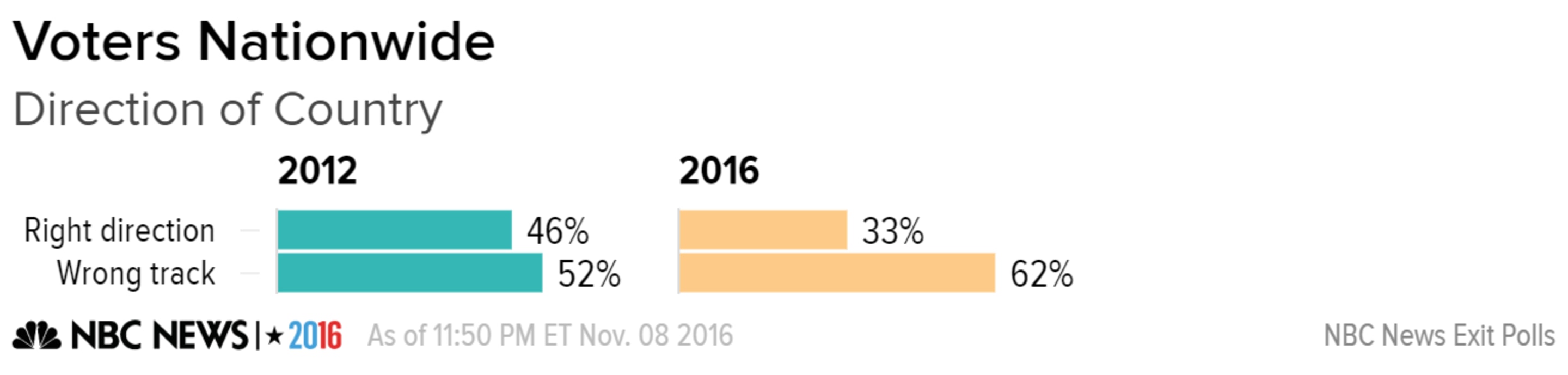
direction-of-the-country

trump-wins

New York Times, Elections 2016

Like always, the dispirited enough to stay at home have given a carte blanche to the  desperate enough to ‘jump into the unknown’!

And no, this is not exclusively about the ordinary voters!
They’ve already sent plenty messages stating clearly that they’ve had enough.
But those whose job was to make things work had chosen not to hear.
Then, when it had become plenty obvious that the boil had been festering for long enough, most of them had stepped aside – leaving at the forefront of the ‘operating table’ a ‘surgeon’ whose long resume was anything but capable of generating trust and a ‘willing’ and ‘enthusiastic’ ‘wannabe’ with no experience.

And now they are trying desperately to find an ‘honorable way out’…


the-final-countdown


“We’re leaving together,
But still it’s farewell.
And maybe we’ll come back
To earth, who can tell?
I guess there is no one to blame
We’re leaving ground (leaving ground)
Will things ever be the same again?

It’s the final countdown.
The final countdown.”

the-final-countdown-2

the-most-corrupt

“Clinton is the most corrupt person ever to seek the Presidency… she is protected by a rigged system” said the paragon of free trade who attempted to use eminent domain in order to evict an old lady from her house so that he could spare a few hundred thousand bucks… and who later bragged about ‘women allowing him to “grab them by the pussy” simply because of his status’.

His competitor, whose slogan reads “Stronger Together”, is a former Secretary of State who has been accused  by both the State Department and the FBI of ‘gross negligence’ and ‘extreme carelessness’ towards important matters of national interest.

89797467_emailclinton

“Mrs Clinton failed to comply with rules on record-keeping, the inspector general found, and used private email for official business without approval.”

So, one of them thinks the system is rigged only when it cannot be twisted to suit his own interests while the other believes ‘togetherness’ can be build around someone who completely disregards the existing rules…

I’ve been asking myself, for some time now, ‘what’s going on there‘?
How come so many intelligent people have allowed themselves to be sucked in this extremely dirty game of deception?

In fact the answers are so obvious that I’ve lost interest in them.
(“The 2016 presidential election has seen a strange flip-flop with respect to conservative and liberal voters. In many ways, even though Trump is the nominee on the right, he is running to the left of Hillary on many issues. Hillary represents the status quo mainstream, usually denoted as the Republican nominee position, while Trump is the obvious “change agent” of the election. Both Hillary and Bill Clinton have been seen by many government officials as being more conservative than liberal, even though they use the Democratic platform to advance their hold on power.”)

But what consequences will arise from this mess?

Is Putin going to be the sole real beneficiary of this electoral process?
Because, regardless of the outcome of the vote, America has made such a fool of herself that she has already lost much of the huge respect the rest of the world had for her?

But what if, again regardless of the immediate outcome, enough Americans will eventually wake up from their slumber and bring things back on their right track?

Don’t count America out just yet.
Hitler and the Japanese militarists  have been only a few of those who had fallen into this trap…

On the other hand too many trips to ‘the brink’ are not ‘good for your health’. The Western part of the Roman Empire had fallen apart in almost similar conditions while its Eastern half had been able to post-pone  its own agony only by becoming a dictatorship.


quote-the-philosophers-have-only-interpreted-the-world-in-various-ways-the-point-however-is-to-change-karl-marx-250986

Change it into what? And on what grounds?

I had spent the first 30 years of my life under communist rule and I’ve witnessed, first hand, the debacle produced by a bunch of people trying to transform the world according to their own liking. And it’s not only that they had brought a lot of misery to an awful lot of people but they also brought it upon their own heads. They, and their families, have been indeed living a lot better than the rest of the people but a lot worse than the ordinary people living in the free world. Not to mention the fact that many of them ended up really bad, some of them at the hands of their own insatiable, Minotaur-like, leaders and some others during and immediately after the regime change.

I’m writing this post after watching Jon Haidt’s excellent lecture “Two incompatible sacred values in American universities“, delivered at Duke’s Departement of Political Science on October 6, 2016.

The point of Haidt’s conference being that each university should clearly declare its ‘telos’ as belonging to one of these two clear cut options:

the-point-of-a-university_dxo

Don’t bother to search the quote attributed to John Stuart Mill.

It is only an interpretation belonging to Haidt himself, who had inferred it from one of Mill’s famous quotes excerpted from  “On Liberty”:
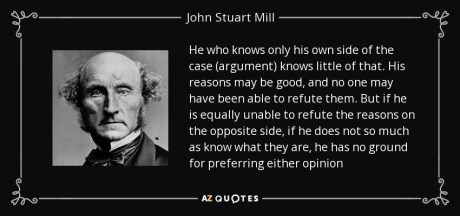
quote-he-who-knows-only-his-own-side-of-the-case-argument-knows-little-of-that-his-reasons-john-stuart-mill-125-0-0981

So, what should it be?

Change or Truth?

Before proceeding any further I strongly suggest that you take some time and listen to Haidt’s excellent arguments.

Now I’d like to discuss a little about ‘Change’ and ‘Truth’.

What both Marx and Haidt have in mind when they speak about ‘change’ is both ‘purposeful’ and ‘centralized’.
When they say ‘change’ they mean an ‘effort towards increased social justice’, effort whose parameters would be determined by the wise men (and women) delving in the depths of the University’s libraries and which would be implemented without fail, preferably with a sanction from the higher authority.

I had already mentioned, at the beginning of my post, where such ‘change’ would lead anyone  attempting to put it into practice.
And Haidt gives us an excellent explanation for why anybody who will ever attempt such a thing would eventually fail. (I told you to watch his conference…It may be long but every minute of it is packed with very interesting things!)

So why is Haidt challenging us to make this choice instead of giving us a clearer piece of advice?

Well… maybe you should ask him that… I’d hate to believe that he, in his own words, ‘has become afraid of that too many of his students might feel that he is so distanced from what is generally accepted that too few of them would follow him’.

So what should we do?
Some of us should embark on a ‘sterile’ search for the (absolute) truth and then, after eventually finding it, nurse it quietly in our lap but refrain from an even minutely more drastic action while others should attempt to implement change based on already ‘over the hill’ principles?

I’m afraid that would be a dangerous road to follow.

There is no such thing as an ‘absolute’ truth that might be nursed in our lap and even if there was such a thing we are not able to find it – individually or even as a group. There’s plenty evidence about that in Haidt’s discourse.
And then what would be the use of the whole enterprise if we are not planning to use the results of our quest, whatever those might be?

And here lies the crux of the matter.

I’m sure Haidt knows what I’m going to tell you now and I’m very sorry that most of your teachers have never mentioned at class this very interesting story.

Marx was not the first revolutionary thinker of his time.
OK, you already know that. There were a certain number of French intellectuals whose writings have set the stage for the 1789 Revolution.
What is less known is that John Stuart Mill himself had been groomed by his father “as the future leader of this radical movement”, whose aim was supposed to be “social reform based on utilitarianism” with the goal of attaining “the greatest happiness of the greatest number“.

The only difference between James Mill (the father) and Karl Marx being that Mill didn’t advocate the the forceful confiscation of the ‘means of production’.
Otherwise both were faithfully following Plato’s dictum:
Until philosophers are kings, or the kings and princes of this world have the spirit and power of philosophy, and political greatness and wisdom meet in one, and those commoner natures who pursue either to the exclusion of the other are compelled to stand aside, cities will never have rest from their evils, –nor the human race, as I believe, –and then only will this our State have a possibility of life and behold the light of day. Such was the thought, my dear Glaucon, which I would fain have uttered if it had not seemed too extravagant; for to be convinced that in no other State can there be happiness private or public is indeed a hard thing“.

Well, the problem with this line of thought is that it doesn’t work.
Again, Haidt has already presented a solid case about this and I’m not going to re-count his arguments.

So, since there is no such thing as an absolute truth to be discovered, one way or another, and no priest-kings on any white stallions that might come to our rescue, what shall we do?

Simple.
Follow Haidt’s, and John Stuart Mill’s, advice and take it one small step further.

The point of a university is to understand the world because only if you commit to truth, I believe, can you actually achieve justice.

We need to understand, and accept, two things:
Change has to be allowed to come naturally, not pushed forward simply because we are momentarily convinced that ‘The Truth’ had downed on us,
And that (social)justice is a process which has to be implemented on an ‘as needed’ basis, not an independent goal?

In fact Mill’s personal destiny is eloquent enough for what happens when somebody tries to breed a ‘perfect’ Priest-King.
“But in 1826, Mill began to suffer from a severe depression, which he attributed to his excessive analytical training and the resulting impairment of his emotional capacities. Reading the romantic poetry of Wordsworth and Coleridge helped Mill to overcome this mental crisis. It also inspired him to form a more complex view on human flourishing than the Benthamite utilitarianism of his father’s generation, with its dogmatic rationalism and unidimensional concept of pleasure.”

And this is why Haidt is absolutely right when he tells us that we need to expose ourselves to a lot more than what we are already familiar, and comfortable, with.
And this is why Heidegger kept warning us that truth as conformity between our words, or even our understanding, and the reality of the fact that we try to understand, and describe to others, is a Fata Morgana which consistently eludes us and that the only way to get any closer to her is ‘unhidennes’.

In this sense there is nothing better than an open mind, both towards our innermost thoughts and to the people living, and thinking, around us.

A mind open enough as to be able to simultaneously attempt to implement whatever changes become necessary in the light of the newly discovered truths AND accept the possibility that those ‘newly discovered truths’ might be incomplete or even altogether false.

Does all this seem rather schizophrenic?

Then let me rephrase the question I started with.

What’s the use of ever trying to understand anything if we’re not going, ever, to change our behavior as a consequence of anything we might come to figure out and on what basis is anyone to attempt any change if he never tried to understand anything above what he already knew long before he even started to think about any change?

As I was ready to close this post I stumbled upon the thought that maybe Haidt meant to apply in the academic world a principle that has been proved invaluable in the political life.

‘Separation of powers’.

Some universities would busy themselves with finding ‘the truth’ while others would attempt to find ways to put ‘it’ into practice.

Leaving aside the fact that this would smack too much of Marxism for my taste I’ll have to remind you that the separation of powers has become necessary in the political realm only because the government has an effective monopoly on power and we need to make it so that it cannot abuse this situation.

No university has any monopoly on truth and/or change.
Furthermore, not even the Academia, as a system, has been able to implement such a monopoly. Not for lack of trying, but that’s another subject.

So, instead of acquiescing to such efforts – by accepting certain universities as official ‘truth seekers’ and others as ‘path finders’/’change implementers’, we’d better ask each and all of them to clean up their acts.

And open up their collective minds.


ballancing-act

As long as we haven’t yet managed to find alternative energy sources to cover all our needs we still need to transport oil and natural gas from one place to another.
How we do this is the result of the continuous struggle between the ‘tree huggers’ and the ‘global warming deniers’.
north-dakota-protest1
Without the tree huggers our planet would be a lot dirtier that it already is
shutterstock-133485692jpg-0443e596dea017ff
while without the ‘deniers’ it would offer us a life a lot less comfortable than the one with which we have already been accustomed.
uncomfortable
It’s our job – yes, ‘ours’, the ones whose asses are still comfortably glued to the proverbial fence – to maintain a reasonable equilibrium.
vaideeni_interior

stephenhawkinghistory_web_1024

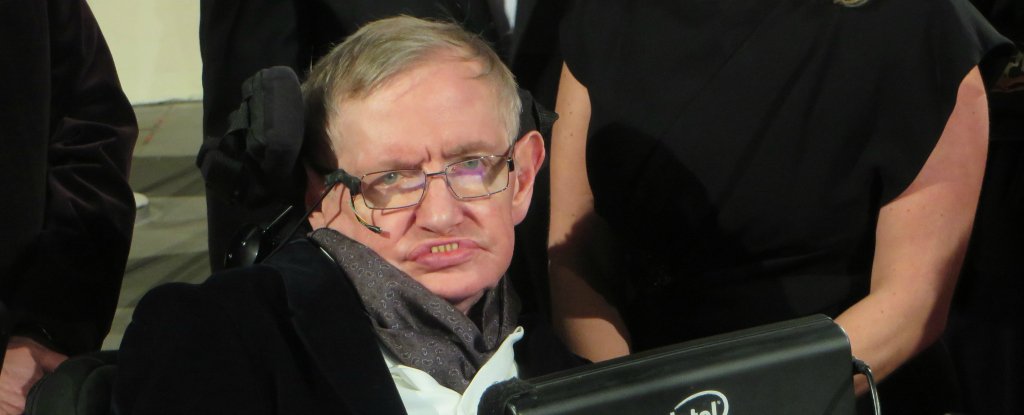
“We spend a great deal of time studying history, which, let’s face it, is mostly the history of stupidity.” (Stephen Hawking speaking at the Cambridge University)

Really?

First of all what we call ‘history’ is not what had happened but a story comprising the subjects some of us had chosen to write about, in the manner they saw fit to do it.

Secondly, until very recently most people had a very vague – and heavily biased – idea about what had happened in their past.
Only in the last two hundred years or so a very small number of people have started to study what had happened in their past in a value neutral manner and, unfortunately, their efforts are still being disparaged by many and ignored by a vast majority.

Coming back to Hawking’s words, I must admit that we, as a species, have done indeed a lot of stupid things.
But, as a whole, the sum of our deeds is far from being negative.

After all… we’re still here, aren’t we?

And, despite the huge amount of misery that is still being experienced by a lot of us, we are doing better than our great parents used to do.

So it is hard for me to agree with Hawking on this subject.

He is right about one thing though.
We are currently doing a very stupid thing indeed.
Our ancestors had the excuse that historical information was very scarce.
This is no longer the case.
While they could have claimed ‘innocence’ when re-enacting an error that had already been committed we no longer have that luxury. We should have known better since it is a lot easier for us to learn than it was for our great-parents.
We really need to stop ignoring the lessons we have at our disposal.

And there’s something else which further complicates the situation.
We have become so powerful that our mistakes can have far worse repercussions than any of our ancestors ever had.

So while I don’t think our history is that full of ‘stupidy’ as Hawking believes it to be I share his concerns about the stupid things we may be making in the future if we don’t wake up and start learning from the stupid enough mistakes we have  already done.

As I said before, we make our own history.
We do the things that will constitute tomorrow’s history and we write the story of things that constitute our past.
Let’s not do, nor write, a ‘stupid’ one.

Abraham Maslow, the initiator of ‘humanistic psychology’, has been described as being “concerned with questions such as, “Why don’t more people self-actualize if their basic needs are met?” and basically why don’t people try to reach their full potential.”

“To over simplify the matter somewhat it is as if Freud supplied to us the sick half of psychology and we must now fill it out with the healthy half. Perhaps this health psychology will give us more possibility for controlling and improving our lives and for making ourselves better people. Perhaps this will be more fruitful than asking “how to get unsick”. (A. Maslow, Toward a Psychology of Being,)

In a sense Maslow follows in the footsteps of J.J. Rousseau.

“Although, in this state [civil society], he deprives himself of some advantages which he got from nature, he gains in return others so great, his faculties are so stimulated and developed, his ideas so extended, his feelings so ennobled, and his whole soul so uplifted, that, did not the abuses of this new condition often degrade him below that which he left, he would be bound to bless continually the happy moment which took him from it for ever, and, instead of a stupid and unimaginative animal, made him an intelligent being and a man” (J.J. Rousseau, The Social Contract)

In more than one sense.

Both consider that society presents its members with almost endless opportunities for self em-betterment, both wonder how come so few make good use of those opportunities and both have been accused of things they have never done.

Rousseau has been falsely accused of being the father of the ‘Noble Sauvage’ – and the quote above proves his complete innocence, ‘stupid and unimaginative animals’ can be mistaken for ‘noble savages’ only by those ‘abused’ by their ‘new condition’ – while Maslow’s detractors – who have failed to scientifically validate all aspects of ‘the hierarchy of needs’ – are questioning the scientific nature of Maslow’s ideas instead of reconsidering their own positions. (The truth being that Maslow had stated upfront that “I yield to the temptation to present it (his notion of a ‘Psychology of Health’, which includes the concept of ‘self-actualization’) publicly even before it is checked and confirmed, and before it can be called reliable scientific knowledge“)

Unfortunately it is rather obvious that while Maslow has successfully detailed what it takes for an individual to ‘ripen’ into the situation of being able to ‘reconsider its own self’, he failed to reach as far as Rousseau was able to. While the latter deplored the fact that ‘the abuses of his new condition often degrade him below that which he left’ the first blindly entertained the notion that self-actualization is necessarily a positive process.

I’ll use only two examples to illustrate my theory, even if by doing so I’m presenting myself as a target for the ‘science-nazi’.
First take a glance at those who founded/were involved in running LTCM. All of them had very respectable careers behind them at that moment. Why did they feel the need to get involved in such a risky business? For those of you unfamiliar with the financial world LTCM was a hedge fund which had to be bailed out in 1998 after losing $4.6 billion, a huge amount of money for those times.
Then tell me what drove Bernard Madoff, an already very successful ‘operator’ in the financial market  to transform the wealth management branch of his company into a huge Ponzi scheme that eventually lost some $18 billion of actual money ($65  billion if the fabricated gains are added to the total)? Not to mention the fact that he involved his family into the daily operation of his company, leading to his brother being sentenced to 10 years in prison and one of his sons committing suicide… – the other one died of lymphoma a few years after Madoff had been incarcerated.

Could it be that this ‘self-actualization’ business depends on two things, the character of the individual involved and the kind of interaction that exists between him and the community of which he is a member? Meaning that if the ties are weak the character of the individual becomes the dominant factor?

And since nobody’s perfect…

“It is not power that corrupts but fear. Fear of losing power corrupts those who wield it and fear of the scourge of power corrupts those who are subject to it.” (Aung San Suu Kyi, Freedom from Fear)

But also

All governments suffer a recurring problem: Power attracts pathological personalities. It is not that power corrupts but that it is magnetic to the corruptible.” Frank Herbert, Chapterhouse: Dune

I’ll end up saying that it’s not the governments that have a ‘recurring problem’ but the peoples themselves. By definition governments come and go, it’s the peoples that stay behind and must suffer the consequences of ‘self-actualizations’ went wrong.