Archives for category: Mutual Respect

ganditorul

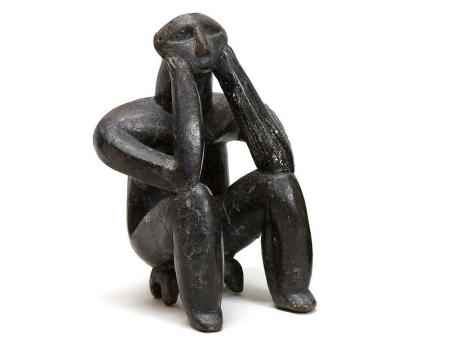
OK, this guy’s stool has four legs… nobody’s perfect…

A few days ago, while talking with a good friend of mine – Lucian Stefanescu, we convened that God has a lot in common with a chair.
Three legged, four legged… take your pick.

Let’s imagine we are part of a thought experiment.
One which allows us to travel through time.

Some ten or twenty thousand years ago, neither ‘God’ nor ‘chair’ existed at all.
The concepts, I mean.

In those times, people were just as able to sit as we are now. And they probably did it. On rocks, on logs…. which ever happened to be around when they felt the need/had the time to rest their feet….
Until somebody had the bright idea of picking up a big enough boulder, carried it to the fire and sat on it. Effectively inventing the very concept of chair.

Same thing goes for God.
I have no way in which to ascertain whether God exists outside our minds or not. Or who of our ancestors had come up with this idea. Or when.
The point being that our faith in Him has been enough for God to produce so many consequences. For our version of God to become real. To shape the very world we’ve built for ourselves.

You see, ten thousand years ago, in pitch black darkness, no one could have stumbled upon a chair while walking through the cave they called home. They could have stumbled upon rocks which happened to exist over there… but not upon any chairs.
Until some of the rocks had been used as such!
Nowadays… it’s not so unusual to trip over a chair. Even in broad daylight. Simply because we’ve build so many of them.

Same thing goes for God.
Ten thousand years ago, we didn’t have the concept yet.
Now, we have to deal with the consequences of us having already ‘killed’ Him.


SPOKEN

According to Britannica.com, language is “a system of conventional spoken, manual, or written symbols by means of which human beings, as members of a social group and participants in its culture, express themselves. The functions of language include communication, the expression of identity, play, imaginative expression, and emotional release.

Since we’re already dealing in conventions, I’m going to ask you to consider this:
How about we redefine language as ‘any manner in which information is transported across space and or time between two entities which have the possibility to interpret, act and or otherwise intervene on/influence the message, the situation described by the message or both at the same time’?

You’ll surely notice that the second definition is more inclusive that the first, of course. And you’ll also notice the differences. Which aren’t that dramatic, after-all…

– ‘Conventional’…
‘Classic’ languages – English, Chinese, French, Urdu, German,  etc., are more the result of ‘natural evolution’ than of any ‘straightforward’ convention… while Esperanto, the most conventional of the spoken languages, didn’t make it too far.
In this sense, the ‘natural’ languages – those which have evolved ‘on their own’, without any intentional intervention from those who use it, are not that far away from the ‘classic’ languages. Birds have ‘vocal’ manners of sending distress and ‘sexual’ signals; monkeys and apes also; even social insects, ants and bees, dispose of an entire array of chemicals, sounds and gestures used to convey freshly gathered information from one individual to another.

– ‘by means of which human beings, as members of a social group and participants in its culture, express themselves’.
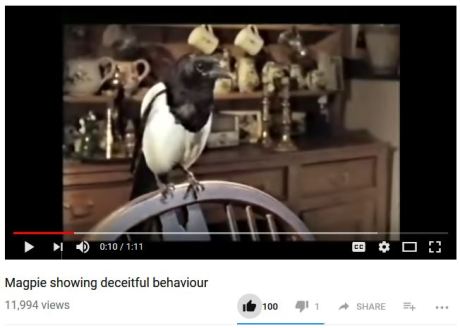
Really? What’s all this brouhaha about ‘expressing one’s self’? A call for help, ‘expressed’ in any way, shape or form, remains a call for help… regardless of the manner in which it has been expressed. Articulated language, Morse code, sign language or a simple sob. Same thing is valid for a warning call. Most of the times, the caller does it ‘instinctively’ and not to gain any ‘social points’ by ‘expressing’ their care for the rest of the ‘cultural community’ ‘conversant’ in the language used to make the call. The magpie in the video above is one of the exceptions, not the rule. Otherwise, the whole signaling ‘industry’ would have been abandoned long ago… due to the very evolutionary forces which have made language what it is today.

Don't cry wolf

– ‘The functions of language include…”
Isn’t this funny?!? ‘The functions of language include…’ How about ‘some of functions we, users of language, have been able to identify are… “.
Or even ‘some of the uses we’ve been able to put language to are …’?

Quite a lot of confusion… isn’t it?

But language was supposed to make things clearer, not muddier… right?

Tell that to those dogs… the ones sent chasing ghosts by the fake distress calls ‘jokingly’ (?!?) emitted by the magpie in the video at the top of my post…

So…

– ‘Spoken’ language.
Or should I call it ‘extemporaneous’? The way I see it, most ‘spoken’ language is uttered on the spur of the moment… or used to be, anyway.
Nowadays, spoken words can be carefully prepared long time in advance… even made to ‘faithfully’ mimic an impromptu message…

– ‘Written’ language.
While ‘spoken’ messages’ have been used, extemporaneously, for a huge amount of time – and not only by humans, as I mentioned earlier, ‘writing’ has been a late invention. Ours.
Or, at least, this is how we like to believe…
The most important characteristic of ‘written’ – as opposed to ‘spoken’, being ‘verba volant, scripta manent’. ‘Spoken words fly away, written words remain’!
The earliest scripts, both cuneiform and hieroglyphic, were used to ‘transport’ information through time. At first, to conserve data rather than what we currently call ‘complex information’. Inventory and ‘identity’ rather than information which may – or even has to, be interpreted in order to make sense. The early cuneiform clay tablets contained ‘cargo manifests’ and only later some of them had been used to ‘conserve’ the Story of Gilgamesh.

– ‘Operational’ language.
Aren’t you tired of that magpie yet?
Have you even watched the video?
Did you notice how the dogs reacted to the fake distress calls? For the umpteenth time, probably…
For the purposes of the present post, it doesn’t matter whether the magpie actively/conscientiously makes fun of the dogs or just acts out of some sort of an instinctive boredom… something akin to the bright spots we sometimes see when ‘confronted’ by a pitch-black environment. It also doesn’t matter whether the dogs are actually fooled every-time they go out to chase the invented fox or they do it because they experience the same kind of boredom like the one which ‘fuels’ the magpie.
For me, all that counts is the consistent manner in which the target reacts to the message transported through the use of this particular kind of language. It is this kind of consistency which determines the ‘operational’ nature of certain languages.

And now, let’s get to the ‘fun’ part.

The calls emitted by the magpie can be construed as being ‘spoken’, right?
They are of a ‘vocal’ nature, are fleeing by definition – unless someone records them using some artificial devices… yet they are also ‘operational’… since the dogs faithfully execute what they are ‘told’ to do…
Now, if we think of it, most natural languages are ‘operational’ indeed.
Ants and bees use them to direct ‘practical’ action, not to ‘express themselves’…
Calls used by most animals relate to avoiding danger, signaling food or ‘expressing’ sexual ‘desire’… and have little or no connection with anything else.
In this respect, the magpie is an exception, not the rule. And even here, the message is ‘formulated’ ‘operationally’. Simply because magpies don’t ‘know’ any other kinds (uses) of language.

We, humans, have bucked the trend only in the sense that we’ve developed kinds of languages lax enough to allow ‘thinking’.

I’m sure that all of you have noticed that when considering the pros and the cons to something you think using a language, right?
A language ‘lax’ enough to accommodate ‘what if’!

Something which doesn’t ‘fit’ in the ‘language’ used by most nursing babies to ask for more milk…

Basically, ‘doing business’ means obtaining sustenance by being useful to other people.
As opposed to hunting/picking/growing your own food, building your own shelter and using pelts to cover your back.

‘Doing business’ obviously implies trading. Raw materials are being transformed to fit the needs of the intended customers, transported to where they are needed and offered to those who might buy them.

For this process to take place, ‘business’ needs far more than entrepreneurs, customers raw material and workforce.

It needs a suitable environment.

It needs roads, markets – not only ‘stable’ but also safe, and – maybe the most important thing, it needs the right kind of ‘popular sentiment’.
For business to work as intended, people need to have faith in each-other.

Yep, faith!

Who would eat in a restaurant without trusting that the cook hadn’t spit in the soup?
Who would buy a car to drive their children to school without actually believing that the car had been built as it should have been?
Who would even drive on a two way road without believing that the drivers going in the opposite direction will stay on their side of the road?

And do you really think that German farmers of yore – who had enjoyed a relative safety while working their own land, living at the bosom of an extended family and being personally acquainted with all the members of the community,  would have gladly come to the ‘unknown’ city to become industrial workers  during Bismark’s ‘reign’ without the ‘safety net’ extended by the Chancellor?

Taxes are the manner in which we pay for all these.
But they are much more than this.
The willingness of the people to pay taxes means that they have faith that the money will be well spent. That they have faith that those in charge will spend the money wisely and that, in the end, those in charge will be held accountable.

Whenever any of the parties involved in this deal – or both at the same time, no longer trusts the other to do its part of the deal – or tries to use their position to access undue benefits… things go south. Way south.

Just as it happens in any other deal.

The state of being calm and not easily worried or excited.

Many human beings praise themselves for being able to ignore emotion when trying to make decisions. And the more important a decision is, the harder they try to ignore their own feelings about the matter.

People with antisocial personality disorder (ASPD) can be witty, charming, and fun to be around — but they also lie and exploit others. ASPD makes people uncaring. Someone with the disorder may act rashly, destructively, and unsafely without feeling guilty when their actions hurt other people.

Modern diagnostic systems consider ASPD to include two related but not identical conditions: A “psychopath” is someone whose hurtful actions toward others tend to reflect calculation, manipulation and cunning; they also tend not to feel emotion and mimic (rather than experience) empathy for others. They can be deceptively charismatic and charming. By contrast, “sociopaths” are somewhat more able to form attachments to others but still disregard social rules; they tend to be more impulsive, haphazard, and easily agitated than people with psychopathy. ASPD is uncommon, affecting just 0.6% of the population.

Am I the only one here baffled by how little free space is left between these two definitions? By how little leeway we have between the constant pressure to ‘act rationally’ and becoming a ASPD patient?

On a more practical level – now that I’ve noticed this, I’m even more baffled by our duplicity. As a species, I mean.
‘Concerned Citizens’ insist that ‘conflict of interests’ should be avoided at ‘all costs’ – lest it generates even higher ones, while some ‘thinkers’ consider that it is possible for humans to actually put aside their personal feelings.

Daniel Kahneman, among others, has done a brilliant job in describing many of the intricate ways of our thinking processes. Which are nothing but continuous tugs of war between emotional pulsions more or less kept in check by rational processes.
Basically, most of those concerned with human decision making have reached the conclusion that we’re not rational thinkers but rationalizing agents.

Hence my ‘nagging question’:

What keeps a cool-headed rationalizing agent from becoming a ASPD patient?
Specially given the constant social pressure towards ‘coolheadedness’…

OK, some people are better at rationalizing than others… but that would tend to help them at remaining undetected rather than not becoming affected…
Frans de Waals – again, among others, posits that, ‘statistically’,  altruism/empathy is an inbred feature of many animals, all primates included. Given this concept, ASPD would be rather simply explained as an ‘organic’ deficiency. Due to a ‘wiring error’, those affected by ASPD display less ‘phenotypically’ expressed altruism/empathy than the ‘average’ members of the society.

Bingo!

phenotype. (fē′nə-tīp′) n. The observable physical or biochemical characteristics of an organism, as determined by both genetic makeup and environmental influences. The expression of a specific trait, such as stature or blood type, based on genetic and environmental influences.

It seems that ‘what you get’ is not solely determined by the genetic information inherited from the parents but also by the specific environment in which the given genetic information gets to express itself.

For the rest of the living realm, things are relatively simple. Lady Luck is the sole ‘director’ in these matters. A really lucky organism gets to spend its life in a more suited environment than a less lucky one.

For humans… things are a tad more complicated.
Besides the fact that each of us enjoys a relative autonomy – some call it freedom of will, we also contribute enormously to the environment in which we get to live. And no, I don’t want to talk about pollution or man-made global heating.

The thing I have in mind right now is usually called ‘culture’.

Daniel Kahneman, Thinking Fast and Slow, 2013
Frans de Waal, The Bonobo and the Atheist, 2014


What do we want?

Money.

When do we want it?

Now.

How do we get it?

By being efficient.
‘Give as little as you possibly can while taking as much as you can possibly grab.’

And who’s going to get the job done?

Huh?!?

Capisci?

For those who have managed to conserve enough naivety, politics is a team job.

For them, ‘political power struggle’ is an oxymoron. A figure of speech.

Unfortunately, those who have lost their political naivety (innocence?, virginity?) have given up all table manners and have introduced the concept of ‘RealPolitik’.
At first in the international arena and then, using the back door, on the domestic stage.

To what consequences?

When Bismark had coined the concept of RealPolitik, the major players in the international arena were following an already ancient mantra. Divide et Impera.

If ‘naive’ politicians attempt to convince their partners, the ‘real ones’ have only one goal in mind. Theirs.
While the ‘naive’ start any interaction by listening to what the others have to say, in an attempt to learn before starting to build a solution – one designed to fulfill the widest possible array of expectations, the ‘realists’ will use every trick up their sleeves to impose ‘their’ solution. The one which best fits ‘their’ interests and which has been devised without/before any proper consultation with the rest of those who will bear the consequences of that solution being implemented.

Some of the politicians whose naivety has been chipped during constant contact with the social reality eventually ‘wise’ up and reach the point where they accept manipulation as a ‘valid’ political tool. They start to hid part of the truth, to promise a tad more than what would be realistically possible… but at least they continue to pay lip service to the notion of ‘liberal democracy’.
The hard core ‘realists’ are way more ‘straightforward’. They burn bridges and give up any pretense of ‘window dressing’. ‘Struggle’ is no longer understood as a figure of speech.

Political struggle descends into the ring. Or, more exactly, the entire Agora becomes a battle field. The whole ‘arrangement’ devolves into a ‘dog eats dog’ situation.

To the glee of the ‘realists’ outside the border. Who can hardly wait for those ‘inside’ to start fighting in earnest. So that the outsiders might, yet again, put ‘divide et impera’ to work.

A knife can be used for buttering toast, slicing steak and, occasionally, for slitting  throats.
A gun can be used to hunt dinner, defend a homestead or shoot a rival.
Bare hands can knot laces, caress a woman or choke the life out of an innocent.

What makes us, humans, sometimes transform tools into weapons?

We are astonished when we learn about other animals being able to make and use tools.
Which is good. ‘Astonished’ is the opposite of ‘insensitive’. A.k.a. ‘brain dead’.

How about we, humans, learning from the rest of the animals how to solve whatever issues we have amongst us without  killing each-other?
You are aware that humans and chimpanzees are the only animals who systematically murder adult members of their own species, right?

But what instance is powerful enough to transform tool into weapon?

Human consciousness?

Is this a ‘fatality’?
The simple fact that each of us is consciously aware of the differences between ‘I’ and ‘all the rest’ means that whenever ‘survival instincts’ kick in our humanity necessarily vanishes? Entirely?
And ‘love thy neighbour as thyself’ becomes ‘dog eats dog’?

We would have already been dead by now… all of us…
Our ancestors must have discovered a way to balance our propensity to ‘stick with your own kind’ with with our need to learn new things and meet new people!
Or is it that some of us continually come up with fresh reasons for ‘war’ while we, the rest, are too lazy to do anything about it? Despite everything history has ever taught us…

The Baby Boomer experience hasn’t been the same across the world but, due to globalization, you, the next generations, share much more, experience wise, than what we did. Frustration, that is.
Having said that, I don’t think that blaming us, your ‘parents’, for everything you have to put up with, will solve much.

First of all, let me explain what I mean by Baby Boomers having experienced different things across different parts of the world.
Actually, it is fairly obvious that the American Baby Boomers had it differently than the Western European ones and that the Eastern Europeans had the almost opposite experience from the first two.
The American Baby Boomers had been raised by the absolute victors of the WWII, the Western European ones by those who had been saved – from both war and the subsequent misery, by the Americans while the third category had been ‘eased into the world’ by people freshly fitted with the communist yoke.

Yet the X-ers and the Milennials have a very common Weltanschauung, on both sides of the Atlantic.

The Internet explains only half of what’s going on. Yes, the ‘coordination’ that bind all the X-ers and the Millennials has happened through the Internet but is due to the entire Euro-Atlantic region being under the same ‘spell’.

And You, X-ers and Milennials, blame us, Baby Boomers, for the present situation.

Which, in a way, makes a lot of sense.

As a matter of fact, I, and many around me, used to put a lot of blame on our parents for the damages inflicted on all of us by the onset of communism in Romania.

Then I realized three things.

That it could have been far worse.
That each generation has to face the mistakes committed by previous one but tends to brush aside the accomplishments  inherited from their parents.

The biggest of which, Baby Boomer accomplishments, being the fact that we have somehow managed to keep ‘cool’ the WW we have inherited from our parents.

OK, unlike our parents, we’ve somehow ‘lost the peace’… that’s on us, indeed.
Those who had won the WWII  had been wise enough to help the nations which had happened to be on the losing side.  Which process didn’t take place – not on the same scale, anyway, after the fall of the Iron Curtain.
Those who had lost the WWII had been wise enough to learn something from being fooled into following the fake prophets that had brought them so much misery. And to assume their part of the blame. Again, this has yet to happen in the former communist countries.

And the third thing that I’ve learned is that no generation, however enlightened, will ever be able to stray very much from the previous one. It can, sometimes, understand and avoid a few of the mistakes committed in the past but will always be ‘tugged back’ by the ‘ways of the past’.

Is there any way out of this historical ‘vicious circle’? Preferably one that will conserve the benefits brought about by the virtuous circle spinning in parallel with the vicious one?

I’m afraid there’s no ‘one size fits all’ remedy.
Each generation has to open their collective mind and select what to take over and what to fix from what they have inherited from their parents.
Specially now, when so much of the whole world is almost in ‘sync’.

The oldest surviving civilized nation, China, calls itself Zhongguo.
The Middle Kingdom. ‘In the middle’ of the barbaric people that surrounded her but also at middle distance between Heaven and the rest of the Earth. The aforementioned barbarians.

And, according to Confucius, it was the emperor’s job to ‘keep things as they should remain’.

Which makes sense. After all, the whole kingdom was the exclusive property of the emperor. And whose job is to watch over one’s property?

Well, things went on long enough for those involved to believe this was the natural order of things.
Until the whole arrangement was upset by a small number of people which had come, more or less ‘under their own steam’, from the other side of the world. And who were, at that time, a lot less civilized than the Chinese.

How can be explained something like this?
OK, the Aztec and the Inca empires might have been primitive relative to the Spanish invaders. They might have prevailed over the small number of invaders by brute force but they had been overcome by the sheer novelty and the apparent sophistication of the assailants.
But China had been in contact for centuries with the rest of the ‘civilized’ world! And way advanced than the rest. Both culturally and economically.

So, what had happened?
How can something like this be explained?

We might try to take the ‘historical route’. And observe that, exactly as Confucius and Laozi had told us, China’s destiny had been tightly linked to the ability of those in charge – the emperors, to manage the empire. From the paleolithic migrations until the Mongol invasion in 1271, nothing from outside had any significant impact over the Chinese hinterland. But the fortunes of those living in that hinterland had oscillated from the misery induced by almost constant ‘live conflict’ during the Warring States period to the various prosperous eras. The Han, Tang and Song dynasties, to mention just a few of them.
The same principle had been valid also for what went on while foreign dynasties had been in power. As long as the ‘managers’ were doing their jobs, things continued to improve. As soon as the helm was grabbed by an incompetent leader… all hell broke loose.

But is the emperors’ incompetence enough to explain what had happened during the XIX-th century? The most advanced, and numerous, nation on Earth had been subjugated – for all practical purposes, by a bunch of drug pushers pretending to act in the name of the far away, and far weaker, British King?

Or we can take the sociological route.
Along which we’ll notice that the ‘drug pushers’ were only nominally subjects of the British Empire. Which empire was behaving imperially only towards the exterior while inside it was already a democracy!

Sounds familiar?

Ancient Athens, the first known democracy, had dominated the Eastern Mediterranean for as long as it had retained its democratic character and had failed, abysmally, each time it had reverted to tyranny?
Ancient Rome had established a huge empire as a democratic republic and collapsed four short centuries after becoming a totalitarian empire?
And so on…?

And what might be the difference between a totalitarian empire and a democratic one?
On the face of it, a democratic empire sounds like an oxymoron… yet there’s plenty of such examples in our history…

As you might guess from the title of this post, the ‘famous’ middle class was both the engine and the explanation for the ease with which the ‘democratic’ empires had been established. And yes, the Spanish and Portuguese ones can be explained in the same manner. At that time none of the Iberian monarchies was yet behaving in the absolutist manner they had pursued as soon as the looted precious metals had started to pour in…

But what makes the middle class so special?

Nassim Nicholas Taleb would tell you that the middle class has enough skin left in the game to really care about the outcome and I’m going to add that the middle class is simultaneously distanced enough from the fray to act in a reasonable enough manner.

Let me put back, for a short while, my historian’s cap.

Most of us consider that the middle class is a late appearance. That most of the time, humankind had been divided in two. The haves and the have-nots. The powerful and the meek.
Well, I’m not so sure about that…
For the first 60 000 years after we had learned to speak – which had made us really human, we had been living in small packs. Led by the more powerful male member of the group – if we consider that our ancestors used to behave like our Chimpanzee cousins, or ‘self managed’ in a more or less democratic manner if our ancestors had used the model followed by our other cousins, the Bonobos.
Or we could look at how the surviving ‘primitives’ lead their lives. None of the Hadzabe, Yanomami or Inuit, who have survived in the most difficult conditions on Earth, have a hierarchical social structure.
Primitives?!? Maybe… but not because of their social arrangements. After all, they are freer than most of us.
And what is it that we, proudly modern people, value more than our individual freedom?

Money? I’m going to let this rest… for a while.

Let’s go back to our ancestors.
Who, by all indications, had been living as ‘extended middle class societies’. Without any 0.1% and without people who went to bed hungry while the rest of the gang had been gorging themselves.
Let’s remember now that during those times we had actually transformed ourselves from apes to humans. And if you consider this to be a small feat, just try to teach a bonobo to speak. Then remember how many people who had been born in poor and backward countries are now successful business people or scientists. After passing through a thorough educational process, true! Only that educational process is in no way accessible to any bonobo…
Don’t disparage the long evolution we had graduated from, as a species, while living in ‘extended middle class societies’.

‘But you haven’t explained what you mean by middle class! Most of us see the middle class as those people who make a certain amount of money each year and you keep speaking about primitive people… who have absolutely no use for any money…!’

OK.
For good or for bad, our present society consist of three categories of people.
The haves, the in-between and the dirt poor.

I’m not going to assign numerical values to any of these.
Taleb’s Skin in the Game criterion is far more useful in this situation.

The haves qualify only after they have no skin left in the game. In the sense that they have so much ‘money’ that come hell and/or high water they feel safe. What they make of this world is heavily influenced by the thick ‘insulation’ which separates them from the rest of the world.
The dirt poor – or the lumpen proletariat, in Marx’s terms, have all their skin in the game. In fact, they are the famous ‘Boiling Frog’. They have no way of leaving the kettle so…

In a sense, both haves and the dirt poor are  prisoners. Neither can leave their respective cell blocks. Simply because the dirt poor have no way to go anywhere while almost none of the haves would be able to survive ‘outside’.
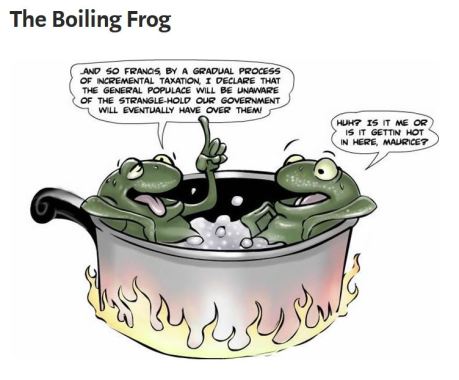
the boiling frog

Wesley Chang, The Boiling Frog, Medium.com

Which leaves us with the middle class.
Who have some resources stashed away – or enough credit available, to weather some crises. But not enough to last them for their entire remaining lives.
Which makes the middle class the only really interested people in the long term well being of the entire society. The only ones really interested in maintaining the freedom of the market as the main economic engine. The only ones really interested in maintaining democracy as the main manner of avoiding catastrophic mistakes perpetrated by the too powerful autocrats.

Or, from a psychological point of view, we can look at the haves/dirt poor as being stuck in an immobile state of mind while the middle class are the only open minded members of the society.
In fact, I prefer this last approach.
You see, until recently the American Dream was relatively accessible. With some luck, a ton of determination and a fair amount of brain power, the sky was the only limit. Belonging to any of those three categories, haves, middle class and dirt-poor was as much about the state of mind of those involved as it was about actual economic conditions.
The haves were free to consider the big picture, the dirt poor could contemplate brighter perspectives while the middle class were doing their thing. Keeping the whole show afloat.

I’m afraid we have reached an inflexion point. A watershed mark, if you prefer.
For whatever reason – I’m not ready to tackle this subject right now, we’ve become so preoccupied with something in particular that we’ve lost sight of everything else.

Including the middle class.

Exactly those which were supposed to maintain their cool heads and open minds.
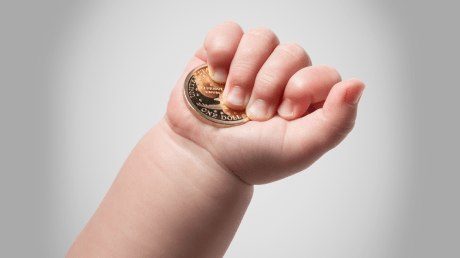
part of the problem

Matthew Stewart,
The 9.9 Percent is the New American Aristocracy,
The Atlantic

I’ve ended my previous post by saying that we, humans, are tempted to see almost everything as a potential tool.

And the present one by asking myself ‘to what avail?’.

What are we trying to accomplish?

I kept telling you that we, humans, haven’t invented much. That everything we do has already been experimented by our predecessors. Plants and animals…

Well, one of the things that we did invent was ‘intent’. As in ‘premeditation’.

We don’t know whether plants are driven by anything else except their ‘vital spirit’.
Same thing is valid for ‘inferior animals’ (those which don’t have brains) while the superior (a.k.a. brained) ones seem to be driven by what we call emotion.

Including us!

No matter how much we pride ourselves about our ability to reason, we’re still driven by emotion.
Actually, we’re not even close to being rational!
At best, we rationalize our emotional impulses. Before or even after we put them into practice.
Dan Ariely and Daniel Kahneman, among others, have already settled this point.

Then why am I talking about ‘premeditation’?!?

And who said ‘premeditation’ is necessarily rational?

It is planned, OK, but …

You see, the real difference between us and the rest of most other animals is our ability to ‘watch ourselves watching the world‘. As if something inside each of ourselves is able to send a probe somewhere ‘outside’ and then examine its own individuality as an outside observer. I didn’t say an impartial observer, just an outsider. However biased.

I won’t elaborate on how we got here, Maturana had already done that. Brilliantly. I’m far more interested in the consequences of each of us being able to observe their own selves ‘from outside’, keeping in mind that our rationality is heavily bounded – Simon Herbert and others, and that we’re mainly driven by emotions.

The very first thing that each of us observes about their-selves is the overwhelming fragility which defines us.

And this is why we search solace in religion. In no matter which one of them, atheism included. There is ‘safety in numbers’, you know…

Our goal, professed or not, is to find inner peace.
No matter whether you call it salvation, redemption, nirvana, self acceptance or whatever else, what you crave is peace.

The sentiment (illusion?) that you are safe.

At least for a moment.

How long is that moment going to last?

Well, that depends on how you got there!
And who accompanies you…