Archives for category: Frames of mind

“The best laid schemes o’ mice an’ men / Gang aft agley”
(The best laid schemes of mice and men / Often go awry.)
Burns, To a Mouse.

Robert Burns destroyed the burrow of a mouse while plowing his piece of land and, feeling sorry for the misery he had brought to the animal, asked for forgiveness by writing a poem.

How many of those who wheel and deal in this world have ever apologised in earnest after making a mistake?

Then how come we, those who bear the brunt of their mistakes, still look up to them? As if they were Gods?

I hate crowded malls and supermarkets.
As a consequence I make it so that I seldom have to buy anything during the weekend. And when I do I wake up early and I beat the crowd to it.

Not today. It so happened that I started late so I had to experience ‘weekend shopping’ at full intensity. Farmers market, a hypermarket, a discount store and a supermarket. All in under two hours – it’s a relatively small city, those places are not so far away from each other and I know exactly where each item I need is shelved in each store.

And now the reasons for my current post.

– Why on Earth would a pensioner chose to buy anything during the weekend rush except for the things that have to be absolutely fresh. For instance fish or lettuce?
OK, I can understand that some of them were shopping for the Sunday dinner but still… they could have done that on Friday morning when the shops are empty and they don’t have to wait at the cashiers desk or to navigate the heavy trolleys through a dense crowd…

– We are raising a very strange generation of kids. The shops were full of parents who were obviously quite disconnected from their children. My guess being that the kids spend the week at the kindergarten/school/after school (or with a nanny) and the parents ‘take over’ only during the weekend.
In those two short hours I witnessed innumerable interactions that suggested to me that the parents had no clue about their children and that the children practically didn’t know/trust their parents.


armed citizens
Terrorism needs three things in order to produce victims.
Some disgruntled/deranged individuals to perpetrate the actual crimes.
Some callous individuals who for various reasons organize/support the disgruntled/deranged.
A large enough section of the community which is too tired/despondent/discouraged to care about what’s going on in its close vicinity – that’s where the terrorists (hit men and the support network) hide while preparing a hit and where the support network will try to sink itself afterwards.
Since it is practically impossible to corral all the deranged and to smoke out all the schemers beforehand the only really viable strategy  remains to make it so that the general public no longer assists catatonically to whatever is happening in its close vicinity. Until it’s so late that even drawing a gun is no longer very helpful.

I don’t even think that arms are such a must.
They might come handy in certain occasions but what we really need is a much more active attitude. A calm and considerate one but firm enough to impose respect.


forgiveness

Some say that God created the world, a long time ago, and that’s why he is the only one who can forgive.
Some others remember how the elders taught them that keeping a grudge is far worse than having an ulcer. It will eat you alive, like a cancer.

I, personally, don’t know anything about God creating the world. I wasn’t there at that time so…
What I do know is that playing God is extremely dangerous. Not only for the impersonator but mostly for those around him. Exactly those who were amused at first by his performance – enough so that they encouraged him to continue, only to find out later how annoying the show will soon become AND that the exit door had been paddled shut behind their back, while they were happily clapping after the first gigs.
At the very end, after the impersonator had left the scene – by his own will or simply carried out, he will end up shouldering the whole blame – as he should, of course.
But I can’t stop wondering how much suffering could have been avoided if the crowd were just a tad more circumspect?

Not making very much sense, do I?

OK, first take a look at this:

No mercy

Then watch this:

go hard

Do you really think this is funny? Well… more than 38 000 of the almost two and a half million who watched this say they enjoyed it and only two and a half thousand became worried enough to express their feelings.

Most of you have not experienced how it is to live under dictatorship so I’ll use another metaphor.

You are probably quite familiar with this guy:

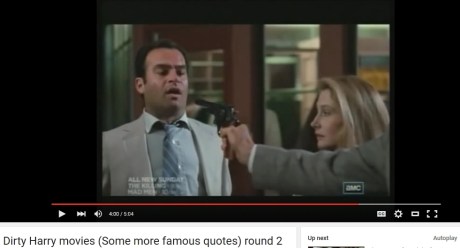
dirty harry

He was lionized during the ’70’s and the ’80’s for impersonating a no-nonsense cop who cut through the red tape and got things done.

Mostly by shooting the bad guys.

Don’t get me wrong.

They didn’t get anything else than they actually deserved.

What I find really troublesome about Dirty Harry is the casualness with which he killed people. And his over-reliance on guns. On brute force, that is. “Go ahead, make my day.”

It is true that at that time people were exasperated with the daily occurrence of violent crime and were desperate for a way out of that situation. I’m not going to offer you statistics or stuff, you can look them up yourself. I’ll just tell you that the Romanian television was having an almost daily news bulletin presenting the latest violent acts committed Stateside. It was all part of the propaganda, of course, but the facts were real. And plenty enough to make me wonder, I was a teenager at that time, what on Earth is going on there?

That wave of violence has subsided, as we all know. Some say it happened because of ‘broken windows policing’, some ‘freakin’ others ‘blame’ ‘Roe vs Wade’ for it while I suspect that all of the above had something to do with it but that the main ‘culprit’ was the economic upsurge that followed the ‘stagflation’ period.

Nowadays we find ourselves in another economic and psychological down-turn. With a twist though.
The recent economic troubles were brewed at home while then it started with the Oil Crisis. Much of the violence no longer starts as a robbery but has a psychological motivation – disgruntled and socially disconnected young people commit multiple acts of homicide, either by indiscriminately shooting their victims or by blowing themselves up, along with a huge amount of explosives, in densely populated areas.

And how do we respond to this fresh wave of violence?
By turning a blind eye to heavy policing? By digging fresh trenches that further divide our already highly polarized society? By another wave of over reliance on guns?

“I said it was only me and, hands still raised, slowly descended the stairs, focused on one officer’s eyes and on his pistol. I had never looked down the barrel of a gun or at the face of a man with a loaded weapon pointed at me. In his eyes, I saw fear and anger. I had no idea what was happening, but I saw how it would end: I would be dead in the stairwell outside my apartment, because something about me — a 5-foot-7, 125-pound black woman — frightened this man with a gun. I sat down, trying to look even less threatening, trying to de-escalate. I again asked what was going on.”

Go ahead, click on that quote and read the entire article. My post won’t go anywhere.

What’s the connection between what happened to Kyle Monk, the Dirty Harry movies and Putin?

For starters all those involved were …human individuals.
Kyle’s neighbor who called the police and who, when asked by Kyle ‘why did you do it’, chose to end up the conversation with “I’m an attorney, so you can go f— yourself.”
All of the nineteen policemen who played a role in this drama – and who treated a 125 pound, scantily clad, woman as if she were an armed and dangerous criminal were also human individuals.
The heads of the public administration, those who adopt and enforce policing policies are also human individuals.
The financial wizards who engineered the recent crisis belong to the same species as we do.

We, the guys who admired Dirty Harry for his toughness, are the parents of the hapless generation who blows itself up or mindlessly shoot their colleagues in campuses.

We are also the guys who are amused when bored magazine writers attribute to Putin such silly quotes as ‘it’s my job to send them to Him’.

And it’s us who applaud the Putins of this world. Only to find out, on our own skin but too late to be able to do anything about it, that the ‘hug of the bear’ is not that comfortable as it seemed from a distance.

you're Callahan


I happened to stumble upon this image on somebody’s FB wall.
gore2bvidal

And then it hit me.

Waging war is simple.
Even winning one is relatively simple if one has enough resources.
Winning the peace afterwards is the real challenge.
America did very good jobs at winning the peace after WWII and the Korean War but very poor ones afterwards.
Here’s Gore Vidal elaborating on the subject:
gore vidal

Let me elaborate on some concepts first.

We have religion and we also have religions.

Regardless of whether religion comes from the Latin ‘religare’ or not it is obvious for the concerned observer that inside what is commonly known as ‘culture’ there is a tightly knit set of traditions which constitutes the common ground where all members of the community that share those convictions come to meet and ‘find the time of the day’.
Emile Durkheim, one of the founding fathers of sociology, has written a whole book on this subject – The Elementary Forms of Religious Lifeand John Faithful Hamer, one of his disciples, has summed up brilliantly the whole idea: “Religion is largely a function of sociology, not theology.”

Only each community has evolved in its own distinct environment. Hence, even if for each community ‘religion’ plays the same role, there are no two religions that are similar. Simply because each of them consists, as I’ve said before, of a certain set of traditions whose main goal is to help the community make the most of the environment into which it has to make do. And since each environment is different from the next one…

And now we have arrived at the second role played by religion. To offer a certain degree of solace and certitude to the individual believer. Just as nobody can make it out by himself – regardless of whatever the anarchist libertarians might think/preach – all of us need some assurance about the world having some kind of congruence. Some of us find it in science, some others in stories which involve a God or a team of Gods and yet others in a godless narrative about how to behave in order to find, eventually, a way out of this Earthly ‘Valley of Tears’.
In order to offer that solace each individual religion has developed a certain ritual. Just as rigorous performance of calisthenics provides a certain physical well being by performing a religious ritual individuals forge a strong connection with the same minded people belonging to the same flock. That’s why some people believe that ‘religion’ comes from ‘religare’ – the Latin word for ‘binding’.

Let me now put two and two together.

We have religion as a set of guiding traditions and we also have religion as a ritual which is performed in order to bind people together so that they no longer feel alone and helpless.
Putting things this way it’s easy to observe that there are some people who are firm believers in those guiding traditions but who, for various reasons, do not feel the need to constantly reenact the ritual; others who are more or less skeptic about the traditions but who are convinced that their world would come apart if the ritual would no longer be performed and still others who are both firm believers in ‘their’ traditions and staunch performers of the ritual attached to those traditions.

From a more practical point of view the non ritualistic ‘firm believers’ will live and let live even if they are convinced the others will rot in hell while those who attach great importance to the proper performance of the ritual will try to impose it as widely as they (even im)possibly can.
So, if we need to reduce their militancy it would be easier to reduce their perceived insecurity/helplessness than to try to change their ‘religious’ convictions. Maslow taught us that it’s relatively easy to lift an individual from the base of his famous pyramid to a more comfortable level while history has taught us that it takes a lot of time to change a time-honored tradition.
Also, by helping them to overcome their perceived helplessness we’ll also help them notice the fact that each religion offers a great degree of autonomy to its followers.
BTW, that’s why many would be dictators insist on religious-like values (nationalism is also a religion), on the corresponding rituals being faithfully respected AND simultaneously do their worst in order to reduce their followers – the ordinary members of the community they intend to dominate – to a state of abject dependency. The most poignant example being Pol Pot’s Cambodia but this has happened, to various degrees, in all communist states. But not exclusively.

girls chose ISIS

mothers of ISIS

Information is like bricks while knowledge is like buildings.
One can make his own bricks from the available mud and then proceed to build his own hut.
Inevitable all bricks made by man will have something in common – after all they are made from the same material, for the same purpose, by individuals belonging to the same species, but will also vary considerably – depending, among others, on the skills of the makers and on the quality of the available mud.
Inevitably the houses will also have something in common – again, they are made for the same broad purpose by individuals belonging to the same species – but they will vary more widely than the bricks do because they have to fulfill a wider selection of purposes in a variety of climates. (All bricks are made to be used as building blocks but buildings are used for many more purposes than simply sleeping in them.)
In conclusion information is something that was gleaned by an individual from his environment while knowledge is a patchwork put together by the same individual using the pieces of information he has acquired previously.
Also please note that while all information is gleaned using one’s senses this process can be a direct one – the senses probe the reality in a direct mode, the observer watches birds in his back yard, or it can be mediated by an information source – the passionate reads, using the ‘same’ eyes as the observer, a book about the same birds.
And any consideration about the difference between information and knowledge would be incomplete if we forget to mention ‘sensations’.
Which are nothing but the raw material – the mud, if you like – from where our brain extracts what we call ‘information’ – which, in its turn, will end up being attached, by the same brain, to the patchwork commonly known as knowledge.

Somebody shared a picture on FB and I finally understood the strange relationship between the American People and their Government.

“One of the things taken out of the curriculum was civics,” Zappa went on to explain. “Civics was a class that used to be required before you could graduate from high school. You were taught what was in the U.S. Constitution. And after all the student rebellions in the Sixties, civics was banished from the student curriculum and was replaced by something called social studies. Here we live in a country that has a fabulous constitution and all these guarantees, a contract between the citizens and the government – nobody knows what’s in it…And so, if you don’t know what your rights are, how can you stand up for them? And furthermore, if you don’t know what’s in the document, how can you care if someone is shredding it?”

The quote belongs to, obviously, Frank Zappa. I found it in an article written by Kevin Courrier and published in CriticsAtLarge.com.

What grabbed my attention was not the fact that a musician is so passionate about politics but the huge confusion that sits at the bottom of his political weltanschauung.
The American Constitution, any constitution for that matter, is not at all a contract between the government and the people but a contract that binds together the citizens that inhabit a country. The government, any government, is ulterior to the signing of that contract so it cannot be a part of that contract.

OK, I can understand how that confusion came to be only I cannot understand how it could survive for so long.
For more than two centuries, that is.
As we all know the US were, at first, British colonies. For the last nine centuries or so Britain was run more or less according to Magna Charta – which is indeed a sort of contract between the Monarchy and the British people. But that is valid for Britain. It is the Great Britain that traces its ‘essence’ back to the idea of a divinely sanctioned Monarch who owned, entirelly, the whole country and who autocratically ruled over all the aspects of its life. And that at a certain point in history the Monarch agreed to sign a contract with his subjects, promising to treat them fairly.

But at an ulterior point in the history of the British Empire the American people had decided that they didn’t want anymore to be subjected to any worldly authority so they had sent the British Governor packing. From there on the essence of the American state was no longer the persona of the Monarch but ‘We, the People’.

That’s why the American Government is, by right, nothing more than an employee of the American People while the British one is a servant – or an employee – of the Monarch.

Let me put it a little differently. America is like a huge corporation while the citizens are its shareholders. The people own the country and the Government who runs it is the Board of Trustees. The people are the employers and the members of the government are the employees.
In Britain the Monarch is the ‘owner’, the people are ‘tenants’ and the government is the administrator of the whole business. The government is employed by the owner and payed by the tenants – who have a say because they are paying the rent, otherwise known as ‘taxes’.

Then how come, two hundred years after the Constitution that settles the conditions of ‘incorporation’ was adopted so many Americans still see the Government as being different from the ‘people’? Could it be that Zappa is right? That too few people have understood that “this nation, under God, shall have a new birth of freedom—and that government of the people, by the people, for the people, shall not perish from the earth.”?

I know, I know… These words are not from the American Constitution – they are widely attributed to Lincoln. But they describe perfectly its spirit, even if some people accuse Lincoln for being a dictator – because he didn’t allow the South to seccede, as if this decision was his to make… You see, the confusion is deep indeed. When people are passionate about something they tend to pick up from the entire picture only the pixels that fit their view of the world…

We the People of the United States, in Order to form a more perfect Union, establish Justice, insure domestic Tranquility, provide for the common defense, promote the general Welfare, and secure the Blessings of Liberty to ourselves and our Posterity, do ordain and establish this Constitution for the United States of America.”

Then why so many of the ‘we the people’ still believe that the constitution is a contract between them and their Government?
Or maybe Zappa was (half) right after-all? Civics should indeed be brought back …

PS
Coming back to ‘Government of the people, by the people, for the people’ some people attribute these words to John Wycliffe and still others to Thomas Cooper.

In general this manner of relating to the surrounding reality is hailed as being ‘good for you’.

And it usually is but only as long as those involved remain inside the realm of reason:

“Three convicts were on the way to prison. They were each allowed to take one item with them to help them occupy their time while incarcerated. On the bus, one turned to another and said, “So, what did you bring?”

The second convict pulled out a box of paints and stated that he intended to paint anything he could. He wanted to become the “Grandma Moses of Jail”. Then he asked the first, “What did you bring?”

The first convict pulled out a deck of cards and grinned and said, “I brought cards. I can play poker, solitaire, gin, and any number of games.”

The third convict was sitting quietly aside, grinning to himself. The other two took notice and asked, “Why are you so smug? What did you bring?”

The guy pulled out a box of tampons and smiled. He said, “I brought these.”

The other two were puzzled and asked, “What can you do with those?”

He grinned and pointed to the box and said, “Well according to the box, I can go horseback riding, swimming, roller-skating….”  

The current spate of dissent on this subject has been spurred by this guy, Angus Deaton, being presented with The Sveriges Riksbank Prize in Economic Sciences in Memory of Alfred Nobel

“A Nobel prize in economics implies that the human world operates much like the physical world: that it can be described and understood in neutral terms, and that it lends itself to modelling, like chemical reactions or the movement of the stars. It creates the impression that economists are not in the business of constructing inherently imperfect theories, but of discovering timeless truths.”

I’m afraid that the author had been so disgusted by the obvious mistakes that have been committed by so many of the supposedly reputable economists of this world that he has become amenable to throwing out the baby along with the bath water.

First of all we must remember that “Science is wrong. By definition.” All theories are imperfect and there is no such thing as ‘timeless truths’.
Ever since Karl Popper introduced the idea of ‘falsifiability’ as the litmus test for determining if any piece of information has any scientific value and Berger & Luckmann noticed “The Social Construction of Reality” it had become apparent both that science is being updated constantly – hence always ‘wrong’, or at least incomplete – and that people are ‘doing science’ on purpose – hence any discussion about reality being ‘described and understood in neutral terms’ is unrealistic, to say the least.

Coming back to Popper, Hermann Bondi had declared that ‘There is no more to science than its method, and there is no more to its method than Popper has said.’
True enough but as any ‘scientific declaration’ this is highly ‘updatable’.

In fact Science is, above all, a human enterprise. It’s a human that picks up – or devises – which method to use in a certain situation when he wants to find out something about a certain subject. Furthermore that method is applied by human individuals, not by robots. The same as those who had chosen it or by others, doesn’t make much difference. And, at the end of the cycle, some other people will evaluate – and sometimes try to replicate – the results.

So the mere fact that a certain set of results could not have been replicated by a certain team of evaluators doesn’t mean that much, by itself. This has been silently acknowledged by Andrew C. Chang and Philip Li in a paper published by the Federal Reserve in 2015: “Is Economics Research Replicable? Sixty Published Papers from Thirteen Journals Say ”Usually Not””. The couple admitted they needed some help from the original authors to replicate the results in a few instances and in some-others they didn’t have access to the same computer software as the first publishers.

But the most interesting fact is that in no instance the authors have been able to positively determine that the results published in any of the analyzed papers are inconsistent with the data presented by the original authors and/with the method invoked. In all instances when they failed to replicate the original results that happened because the original authors didn’t present at all the initial sets of data, they were incomplete or the method/sofware used to  process that data was incomplete, altogether missing or proprietary. And all this despite in some cases the papers being published by journals specifically requesting that all data/methods/software being made available at the moment of publication.

In this situation I find the conclusion reached as being both correct and highly objectionable. And above all lacking any scientific value.
“Because we successfully replicate less than half of the papers in our sample even with assistance from the authors, we conclude that economics research is usually not replicable.”

Yes, it seems that too many papers published by presumably reputable journals are not replicable. But that is due exclusively to the journals themselves not observing their own rules or by some of the authors acting less than ‘over the table’. This phenomenon has nothing to do with ‘economics’ being less of a science than, say, physics and everything to do with humans being… well… human!

Let me go back to where I started, to Joris Luyendijk claim that “Don’t let the Nobel prize fool you. Economics is not a science.”
The author ‘illustrates’ his claim by remembering the infamous LTCM – a hedge fund set up by, among others, a couple of economists who had received a … you guessed it… a ‘Nobel prize for economics’ less than a year before the hedge fund went bust. Kind of ironic, isn’t it?
But the problem remains. The fact that LTCM went bust doesn’t prove anything except the fact that its management was completely inadequate.
The point is that trying to assert that ‘economics’ is not a science only because some guys used a couple of economic theories and failed, abysmally, is akin to claiming that physics is not a proper science because no weather bulletin is 100 percent accurate. Or that biology is not a full blown science because medicine has not yet found a cure for cancer. Or to claim that chemistry is bogus simply because Big Pharma is ripping us off.

At the end of their paper Chang and Li offer some very pertinent advice about how things could be vastly improved. Their main idea being that everything must be ‘above the table’ – both the raw data and the method/software used to process it must be made available for whomever wants to replicate the results. In fact this exactly what science, real science, is about. People have to be able to check thoroughly whatever the proponents of a theory are trying to ‘peddle’. This is the only way for a theory to be proved true or false. Or incomplete so further research might be declared necessary.

Similarly, at the end of his article Joris Luyendijk points his finger at the real culprit.
In reality economics, as a space where people try to gather information, is different from, say physics, only because we, the people, approach them with different attitudes.
Time has taught us, repeatedly, that every-time we’ve tried to deny the obvious we ended up with a bloody nose. The problem is that not all of us are, yet, able to recognize the obvious.
No one in his right mind will pretend, nowadays, that the Earth is flat. Meanwhile some people still pretend that vaccines may induce autism. They don’t. But some of the ‘anti-Vaxxers’ continue to pretend this even after a study partly funded by themselves demonstrated that there is no link between the two.

As suggested by Luyendijk and demonstrated by these examples the real culprit for what is going on, not only in the economic field, is our arrogance.
Arrogance that has led to the survival of what is known as ‘tehnocratic thinking’ despite more and more people learning of the role ideology plays in our decision making.

After all what can be more arrogant than pretending that you have ‘scientific reasons’ for what you do, despite the obvious fact that every one of us acts according to his own ideology?

I’m not going to pretend now that there are good and bad ideologies. I obviously think they can be classified but I cannot pretend that my classification is the correct one.
But I can pretend, and you should too, along with Joris Luyendijk, Andrew C Chang and Philip Li, that each of us should honestly state its point of view along with his opinion when ever discussing something.

After all each of us having an ideology is a reality while pretending that any of us can act as if it doesn’t is a rather pathetic lie.

To conclude I’ll have to keep the promise I’ve made at the beginning of all this and ‘update’ Bondi’s statement about Popper:
‘There is no more to science than its method and there is no more to its method than Popper has said’ but we should always bear in mind that science is exclusively ‘performed’ by human individuals.