“America’s abundance was not created by public sacrifices to “the common good,” but by the productive genius of free men who pursued their own personal interests and the making of their own private fortunes. They did not starve the people to pay for America’s industrialization. They gave the people better jobs, higher wages, and cheaper goods with every new machine they invented, with every scientific discovery or technological advance—and thus the whole country was moving forward and profiting, not suffering, every step of the way.”
Ayn Rand
OK, she borrowed this idea from Adam Smith, without mentioning him… let bygones be bygones…
A more interesting endeavor would be to learn something from all this.
‘Abundance was not created by public sacrifices’.
Makes a lot of sense. In a free market everybody gets what they are offered, ideally in close accord to what each of them had brought to the market.
‘Abundance was created by the productive genius of free people who pursued their own personal interest and the making of their own private fortunes’.
Now, whose ‘productive genius’ are we speaking about here?
About Ford’s, for instance, or about that of his workers?
“At the time, workers could count on about $2.25 per day, for which they worked nine-hour shifts. It was pretty good money in those days, but the toll was too much for many to bear. Ford’s turnover rate was very high. In 1913, Ford hired more than 52,000 men to keep a workforce of only 14,000. New workers required a costly break-in period, making matters worse for the company. Also, some men simply walked away from the line to quit and look for a job elsewhere. Then the line stopped and production of cars halted. The increased cost and delayed production kept Ford from selling his cars at the low price he wanted. Drastic measures were necessary if he was to keep up this production.“
Tim Worstall, Forbes Magazine
Anyway you look at it, both Ford and his workers were acting as ‘rational economic agents’. Ford was paying them the going rates in the industry and they were putting in as little effort as they could afford to.
That went on until Ford came up with a ‘new idea’. “It can indeed be cheaper to pay workers more but to reduce the turnover of them and those associated training costs.” “The point is not so as to be paying a “decent wage” or anything of that sort: it is to be paying a higher wage than other employers. That gets your workforce thinking they’ve got a good deal (for the clear reason that they have got a good deal) and if the workers think they’ve got a good deal then they’re more likely to turn up on time, sober, and work diligently.”
Again, a very reasonable attitude displayed by both parties.
An attitude made possible by the fact that both the car and workforce markets were free.
Ford could hire anybody/sell his cars to whomever had enough money to buy them while his workers were free to leave their previous workplaces and accept Ford’s offer. Or leave him if they found a better one.
And let’s not forget the fact that Ford was not alone, at that time. At the turn of the XX-th century there were hundreds of automobile producers in the US alone and this was one of the reasons for which the workers could afford to be so ‘picky’ – specially those who had some experience.
In this situation – where the market was really free, each party taking good care of their own interest yielded excellent results.
Ford had became one of the leading car manufacturing corporations.
The diligent workers continuously improved their living standards.
The society, as a whole, prospered. And learned, or should have had, the long term benefits of commitment and mutual respect.
What happened after the market was no longer free?
Meaning that instead of hundreds of car manufacturers competing for the best available workers we had for a considerable number of years only three corporations more interested in short term profiteering rather than improving their products?
And instead of diligent workers striving to improve their skills we had union members more interested in their week-end barbecues?
“The U.S. government bailout of the auto industry lasted from January 2009 to December 2013. The Big Three automakers approached Congress in November 2008. They warned that, without the bailout, GM and Chrysler faced bankruptcy and the loss of one million jobs. Ford didn’t need the funds, since it had already cut costs. But it asked to be included so it wouldn’t suffer by competing with subsidized companies.
The Treasury Department invested $80.7 billion from the $700 billion authorized by EESA. It recouped all but $10.2 billion…”
Kimberly Amadeo, thebalance.com
Some of you might tell me that the Japanese car manufacturers operate along more or less the same guide-lines. ‘Cradle to grave’ employment for the workers, a rather opaque management never held accountable until too late…
A very correct observation.
Only there is a huge difference between the Japanese work-ethos and ‘the American Dream’. The Japanese have a long history of being told to ‘fit in’ while most Americans have gradually convinced themselves that ‘getting rich’ is the only possible solution for all their problems…
Considering that both Japan and America seem to have reached two different cul-de-sacs it wouldn’t be farfetched to suggest that both are doing something wrong.
For almost 30 years now Japan has been running in circles. She hasn’t completely lost her edge but hasn’t performed as it used to.
The most worrying indicator – for me, at least, being the fact that they have given up ‘making’ children. As if the present generation doesn’t have much hope for/expectations from the future.
For almost 30 years now the American people has allowed a huge trench to grow larger and larger in their mist. The haves on one side, the have-nots on the other and the rift so wide that they are no longer able hear each-other. A present day Henry Ford would have no idea about how much to pay his workers in order to obtain similar results to those achieved at the start of the XX-th century…
Is there a ‘common cause’ that might explain what’s going on on both sides of the Pacific?
How about both cultural and economic spaces experiencing a somewhat similar decrease in individual liberty, the phenomenon having rather different causes in each of the two cases?
First of all, ‘dedication to duty’ can take you only that far. It is very useful for those wishing to ‘close a gap’ but acts similarly to an ankle weight for those who are in the position to attempt to ‘take the lead’. ‘Dedication to duty’ focuses the attention of the team to ‘obeying the rules’ while ‘taking the lead’ means leaving the ‘straight and narrow’ and venturing into the unknown.
These two situations imply completely different mind frames.
Secondly, those who venture outside the ‘safety of the perimeter’ need to follow a simple rule.
“Leave no man behind”.
” “When you have a conscript army and you can always replenish it just by adding more people, you don’t really have to care about whether they’re happy with what they’re doing,” Springer said.
Now the military had to care about its soldiers as individuals, and the idea that it would never leave them behind became something of a familial bond.
“It’s kind of a contract with the service,” Springer said. “You promise to serve us, we promise not to leave you.” “
You see, time and time again history has hinted to us that freer societies fared better, ceteris paribus, compared to ‘tighter knit’ ones.
For example, subjected to the same communist knut, Poland came out differently than my native Romania.
And while most people agree about Poland being in a better shape than Romania, there is very little agreement about a possible explanation.
Just as most people agree about ‘liberty is good’ while each of those people derive different meanings from the very concept of freedom.
Since it is so hard to coordinate ourselves about the meaning of a ‘simple’ word, how about taking the liberty to ‘agree to disagree’ and turn our attention to another concept?
Mutual respect.
Just think about what liberty would mean without mutual respect.
Can you imagine the liberty of someone driving a M1 Abrams tank on a highway?
Can you imagine what would happen if the driver of the tank wouldn’t treat the others with utmost respect? What would happen if the outraged others would band together and wait for the ‘mad’ driver to burn through his last drop of fuel?
You see, people who have more respect for the rules than they have for each-other end up belonging to a society so tightly knit that it has immense troubles whenever it has to cope with unforeseen situations. Adapt to change. Confront a catastrophe…
For example, the Soviet Union, Japan and the US have a considerable number of nuclear power plants and have experienced a number of failures. The tightly knit Soviet Union and Japan have displayed commendable individual acts of heroism in the aftermath of such incidents but it was the more individualistic US who has somehow ‘ducked’ any serious experience of this kind.
On the other hand, I see potential trouble when I hear people stating that “My right to swing my fist ends where your nose begins”.
On the face of it, this sounds perfectly reasonable.
Only the whole thing absolutely depends on both individuals involved in it having comparable reach. Do you really think that a guy with twice the ‘wing-span’ of his opponent would continue to stick to this rule if the by-standers would not band together to stuff it down his throat?
My point being that no ‘market’ is really free if its freedom relies primarily on a set of rules instead of depending on a healthy dose of sincerely upheld mutual respect among the participants to that market.
In this instance ‘free’ and ‘freedom’ are perfectly interchangeable with functional/sustainable.
The communist centrally planned economies had failed abysmally simply because the powerfuls of the day had nothing but contempt for those under their rule.
Japan’s strict set of rules about what constitutes proper behavior in each situation seems to act as a brake whenever decisive action is needed.
America’s new mantra, ‘greed is good’, has time and time again produced speculative bubbles which have inevitably ended up badly. Under its spell, the market actually looses every shred of liberty. Exactly as a hypnotized group of people think of themselves as being free while sheepishly obeying the orders of their herder.
I gather you all know what ‘herd behavior’ means…
Compare Ayn Rand’s words to Adam’s Smith original idea.
“It is not from the benevolence of the butcher, the brewer, or the baker that we expect our dinner, but from their regard to their own interest. We address ourselves, not to their humanity but to their self-love, and never talk to them of our own necessities but of their advantages.”
See what I mean?
Smith sees all ‘market goers’ as equals who freely address each other while Rand applauds “the productive genius of free men” who, in pursuit of “their own private fortunes” had the magnanimity to bestow upon “the people better jobs, higher wages, and cheaper goods with every new machine they invented, with every scientific discovery or technological advance”.
I, for one, fail to detect any shred of actual respect towards “the people” in the behavior so laudatory described by Rand.
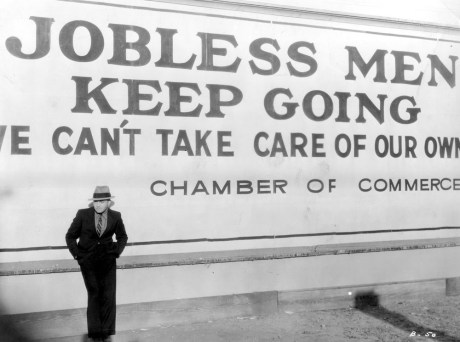
And I’ll let you be the judge whether her description fits the current ‘state of the nation’.
Anywhere on the planet, not only in the US.
“and thus the whole country was moving forward and profiting, not suffering, every step of the way.”


 When traveling on water, I was issued a ‘life-jacket’ – no picture, you all know what one looks like.

 nicichiarasa