Archives for category: fail better

5eg5cq4_llox-4hqq6q6r-cwzhlmn9igl6ermaorfgy

For the last 3500 years humankind has been busy writing Laws.

Which can be grouped in two main categories.
Natural laws and man made (normative) laws.
According to this classification while all laws have been written by Man those belonging to the first category are active regardless of Man being aware of their existence and those who belong to the latter come to life only as long as Man chooses to enforce them.

Another classification could be ‘phusical’ laws – ‘phusis’ being an ancient Greek term for ‘grown naturally’, all things that came to be in a ‘natural’ manner – ‘statistical’ laws and, again, ‘normative’ laws.

Both these classifications depend on how much influence Man has over how the laws work, besides the obvious fact that the wording, in all cases, belong to Him. To Man, of course.

The difference between them being that while the first sees Man as an individual making decisions by himself the second takes into consideration the fact that Man cannot function properly outside of a community.

Before going back to discuss some more about both classifications I have to note that laws are important mainly because they define areas of opportunity.
People are, from a functionalist point of view, self aware decision makers. But since none of them has an infinite amount of knowledge at his disposal nor an infinite capacity to process what ever information he has on a subject, people find it very useful to have the reality around them partitioned into ‘safe’ and ‘enter at your own risk’ areas.
In this respect it doesn’t matter whether the law itself belongs to either of the 5 categories. The consequences of the law are the same. Those who are aware of its existence have a lot easier job at discerning the safe from the potentially dangerous places than the ignorant ones. What each of them does after finding that out is another matter.

Coming back to the first classification, ‘natural’ versus ‘normative’ laws, let me elaborate a little about what ‘natural’ means in this situation.
It is obvious that the law of gravity, the one formulated by Isaac Newton, belongs here.
It started to produce consequences as soon as ‘mass’ came into existence – regardless of who, if anyone, made the necessary ‘arrangements’ and regardless of anyone being aware of its very existence or not.
But how about the law against killing another human being?
Animals belonging to the same species occasionally do kill each-other so this doesn’t seem to be an all encompassing natural law.

On the other hand history has compellingly taught us that communities where individuals are treated fairly by their peers fare a lot better than communities where some of the members kill (some of) the others. In a Darwinian sense the communities who do protect the lives of their members have an evolutionary advantage over those who don’t.
In this sense the ‘do not kill’ law becomes ‘phusical’. It is both ‘man made’, hence ‘normative’, and acts regardless of people being aware of its existence.

And no, this is not the same thing as ‘ignorance of the law offers no excuse‘.
As I said before, the first classification, ‘natural’ versus ‘normative’ considers Man mainly as an individual – who cannot hide himself under the cloak of ignorance and who has to bear the consequences of his acts, if apprehended – while the second classification, ‘phusical’, ‘statistical’ and ‘normative’, considers Man as an individual member who both depends heavily on his community and contributes decisively to the well being of the place where he lives.

In this respect ‘do not kill’ becomes a ‘statistical’ law. If enough individuals refrain from killing other people and if the community successfully puts in place and operates a protection mechanism  to guard the lives of its members, without otherwise stifling the ingenuity of its people, that community will fare better than those who either fail to protect their members or protect them so jealously that transform them into hapless puppets unable to fend for themselves. Those who are interested to find out more about the equilibrium between protection and freedom of expression might want to check Crime and Deviance, Functionalist Perspective.

By now you must have noticed that ‘statistical’ laws are both ‘objective’ – in the sense that they will produce consequences even if people are not aware of/do not care about their existence, and ‘normative’ – in the sense that those consequences do depend, heavily, on how people act.

So. Does this make me a staunch defender of ‘normative’ laws?

Not at all. Just as Durkheim noticed long ago telling people what to do will only stifle their ability to adapt. To cope with change.

That’s why I strongly feel that ‘normative’ laws, the few that are really necessary, must be written in a ‘negative’ way. Do not kill, do not rape, do not discriminate, do not steal are quite different from ‘all of us have to be maintained alive’, ‘we must assign an armed guard to every nubile woman’, ‘we must write millions of pages of rules to cover every possible act of discrimination’, ‘we must arm ourselves to the teeth in order be able to defend our property against all odds’.
 

Yesterday I read an article which stated that ‘when it comes to violin there are a lot of things that are more important than talent‘.

I must confess that I was taken aback.
Not as much by the call itself but by the very fact that someone would actually make a call like that.
Compare apples and oranges, that is.

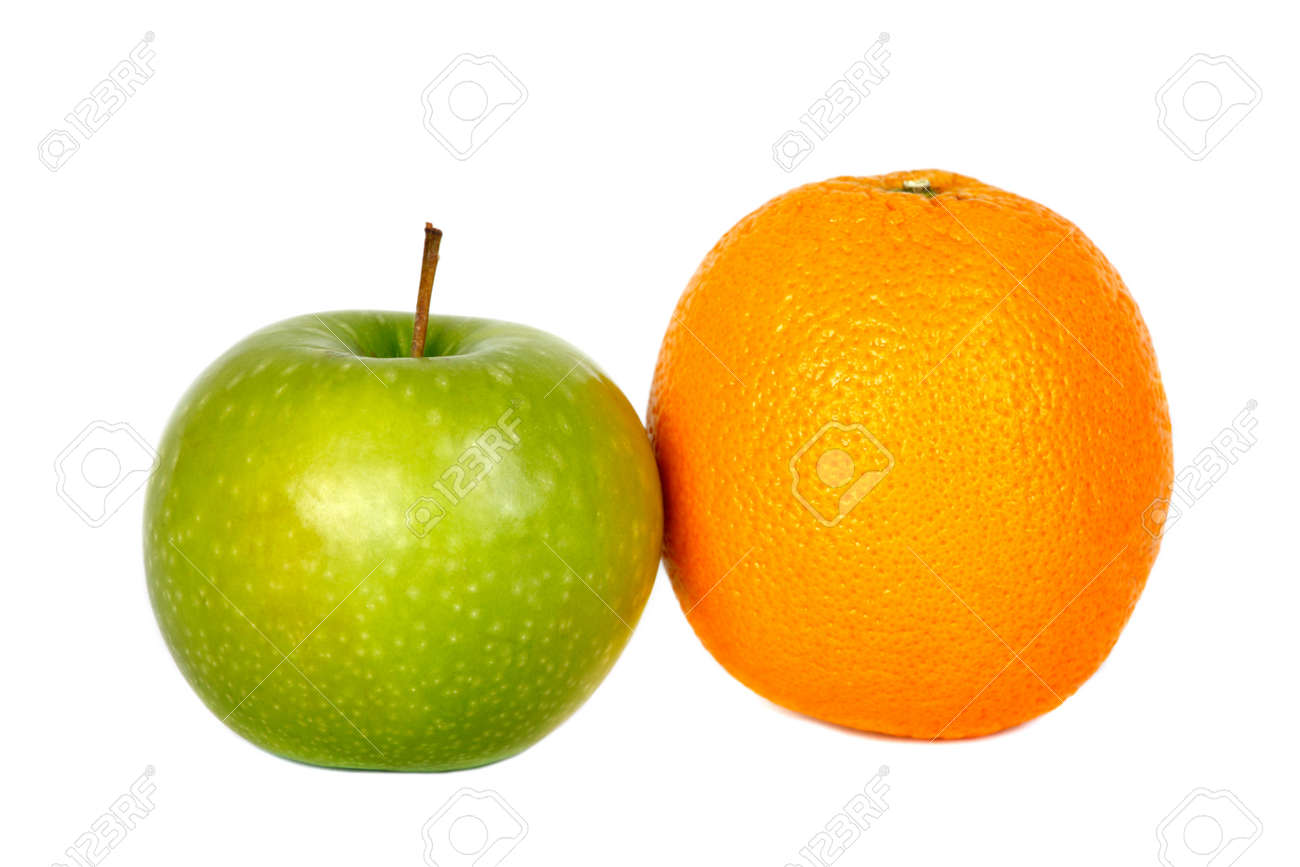
OK, both these two can be found in the same department of the grocery store and are somewhat similarly shaped so…

The whole thing made me wonder ‘how is it that we compare things’?

Simply. We choose a standard and then measure the things we want to compare against that standard.
According to our interest in the matter, of course.

That’s why a comparison is not only easier but also less contestable when that standard is actually measurable.
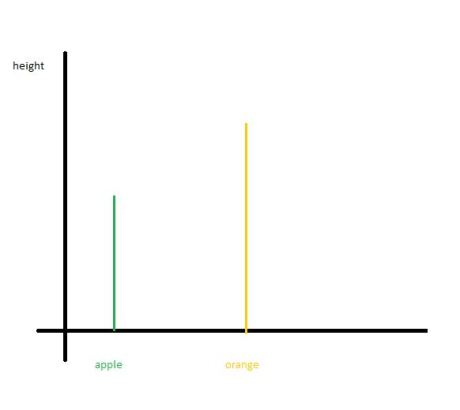
A dimension, for instance. Nobody in his right mind will ever contest a proposition like ‘this orange is larger than this apple’.
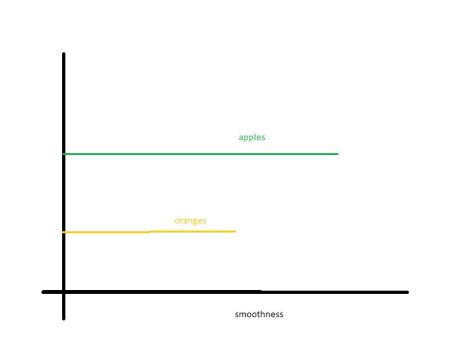
Or an evident feature shared by the items being compared. ‘Apples are usually smoother than oranges’.

5989177-comparing-apples-to-oranges-isolated-on-white-stock-photo

In these cases, when the items are easily comparable – sometimes even against the current mantra, we can say that the characteristics used to compare them are ‘parallel’ to each other.

parralel

Here we can, easily and undoubtedly, determine that one is ‘taller’ than the other.

parralel 2

Or we can make that call by measuring the intensity with which a characteristic shared by both categories manifests itself: “Apples are usually smoother than oranges”.

But what if the things we are trying to compare are defined by characteristics which are perpendicular to each other?

Like length and width, for instance.
In fact this particular case is relatively simple. Here we can determine whether one is longer than the other, wider than the other or if the area covered by one is bigger than that covered by the other.
And, for each case, it would be relatively simple to determine which of the two characteristics is more important. According to each individual situation and to our interest in the matter.
After all it doesn’t make much sense to buy a very long and narrow strip of fabric if you want to make a shirt nor to buy a square shaped cloth  if you need some ribbon.

Things are more delicate though if the characteristics are ‘perpendicular’ only in a figurative manner of speaking. For instance talent and dedication. Or opportunity and diligence. In both these situations it’s extremely hard  to make a call as to which member of the pair is the more important. Simply because without any of them the other is utterly useless. Despite our moral biases. Like ‘dedication is more important than talent’. Or ‘Lady Luck will never fail to smile to the really diligent’.

I’m not implying here that preparing yourself for life, like learning and training, is useless. Quite the contrary.
I’m simply saying that you need first to determine what you are really good at.
It doesn’t make much sense to put a lot of effort into something simply because someone tells you that you’ll become better at it if you work really hard.

Yes, the harder you work at something the better you’ll become at it. But what about spending the same amount of effort at something you are talented for?

So go find out what you are really good at.
If you are diligent enough in your search you’ll eventually find out something that you enjoy doing and others find useful.

And that, my friend, is the real happiness.

Or, in Csikszentmihalyi‘s terms, it would mean that you’d have reached the state of ‘Flow‘.


Mencken, democracy perfected

Just stumbled upon this meme.

It gave me the creeps.

If such an influential personality like H.L. Mencken had such a warped understanding of the democratic process what can we ask from the proverbial ‘regular guy’?

One question haunts me.
How come so many otherwise bright people fail to grasp the obvious fact that ‘democracy’ is what happens before the voting process?

Voting itself is nothing but logistics, arithmetic and honesty. A process more or less akin to a social survey, one through which the electoral commission determines ‘the will of the people’ at a certain moment. A ‘mechanical’ process that has nothing to do with the living thing encapsulated in the concept of democracy.

…’living thing encapsulated in the concept of democracy’…

Do you think I’m exaggerating?

Then let’s go back to the Agora (the meeting place where the ancient Greeks congregated to discuss the public matters at hand) and watch carefully what happened there before each issue was decided upon.

Everybody who wanted to say something about a subject of interest had the opportunity to make his voice heard.

Yes, that’s the real essence of the democratic process! That’s why the Founding Fathers insisted so much about ‘The Freedom of Expression’. That’s why ‘the right to speak up’ comes First, before all others!

You see, the right to vote has no real meaning if the voters are kept in the dark, if they didn’t had access to all the information available prior to the deciding moment.

People will make a choice regardless of how much information they have, at a given moment, about something, precisely because they think they know everything that is to be known about that something.

That’s why people privy to more information than the ‘general public’ have come to reach the conclusion that the ‘ordinary voter’ is stupid.

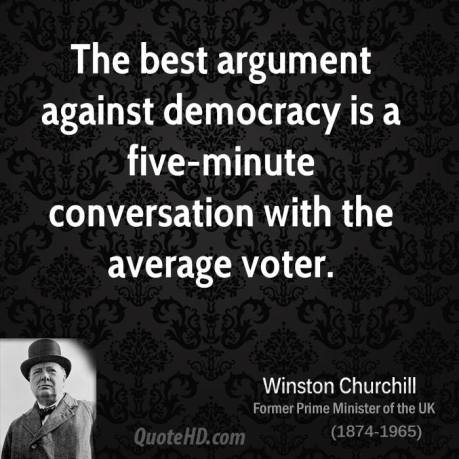
winston-churchill-government-quotes-the-best-argument-against

Because instead of putting everything on the table and letting ‘the people’ decide in earnest, for some time now some of the ‘pundits’ have been playing a dangerous game of  ‘hide and seek’.
One which has resulted in the profound distrust felt by ‘the people’ about the ‘political establishment’. And in the barely masked contempt displayed by the ‘political elite’ towards the rest of the society.

So, instead of having an open discussion about issues and an atmosphere of trust between the various segments  of the social organism we have to pry bits and pieces of information from those who guard it dearly and such mutual distrust that, if we’ll look around carefully, we’ll notice that we’ve been living, for some time now, way inside ‘paranoia land’.

Can we still pretend that our societies are governed in a democratic manner? That each of us tries to shed some light over his area of expertise and by doing so contributes to all of us avoiding as many of the ‘potholes’ as possible?

‘Cause this is the real essence of democracy.
Not finding the best possible solution to every problem but avoiding the known/foreseeable potholes.

No matter how many of us will study a problem we’ll never find the best solution. After five minutes some fresh information will come about and the erstwhile ‘best’ becomes ‘obsolete’.

Compare this situation to somebody stumbling in a pitfall waiting for all of us, coming  back to warn the rest and not one of us heeding to his cries…

1x59cvjb_mojtouxmkbihsq

“When we’re trying to recreate an intellectual milieu, even one that’s relatively recent, we invariably discover that the vast majority of the sources we need to do such a thing have been swallowed up by oblivion and lost forever. Sometimes those that remain—e.g., Plato’s dialogues—remain because they were the best of the best, works of great importance. But this isn’t always (or even usually) the case. Sources often survive for largely accidental reasons. Regardless, the temptation to exaggerate the significance of what we have has proven irresistible for generations of intellectual historians. As the philosopher Aaron Haspel puts it in Everything (2015): “The parable of the drunk looking for his keys under the street lamp, where the light is better, explains vast swaths of intellectual history.” (John Faithful Hamer, Touch They’re Real in his blog Committing Sociology)

As always things are not as simple as they seem at the first glance – otherwise we wouldn’t have had a parable to start with, would we?

Basically the drunkard is doing the only reasonable thing available to him. Searching in the lightless park would be completely pointless but what if somebody else had lost a wallet in the lighted area?

Aaron Haspel is also right. Our intellectual history consists indeed of whatever cultural artifacts have been lucky enough to survive. Considered important enough by a sufficient number of people so they helped preserve it to the present day.
Or, evidently, both!

I’d like to direct your attention to ‘Considered important enough by a sufficient number of people’.
You see, the drunkard was looking under the street lamp because ‘This is where the light is’. He was reacting rather sensibly to a real situation.

But what if the reality of something is not so easily ascertainable? What if it’s a ‘second degree’ reality, one that is constantly (re)created by human intercourse? Like people choosing which book to keep and which one to throw into a bonfire?

fahrenheit451

Or even a ‘third degree’ reality? One that is imagined by someone who tries to assess the wishes of somebody else?

“Politicians are fooled into thinking corporate welfare is important to voters because politicians spend an inordinate amount of time with the powerful people to whom corporate welfare is vitally important. That’s why every candidate who has tried to win Iowa has prostrated him or herself before ethanol.”

You certainly guessed it. This paragraph will be about the ‘fourth degree’ reality. The one we, the voters, bring upon ourselves at the ballot box. After having carefully considered each candidate and his or her programme. Or having voted with ‘that particular one’ just because  …

The point I’m trying to make here being that this ‘fourth degree reality’ is not at all ‘virtual’, in the manner the second and the third ones are. In fact this ‘fourth degree’ reality is exactly the one where we have to live. Where we are faced with the consequences of the choices we, ourselves, have made while bringing it about.

The current spate of dissent on this subject has been spurred by this guy, Angus Deaton, being presented with The Sveriges Riksbank Prize in Economic Sciences in Memory of Alfred Nobel

“A Nobel prize in economics implies that the human world operates much like the physical world: that it can be described and understood in neutral terms, and that it lends itself to modelling, like chemical reactions or the movement of the stars. It creates the impression that economists are not in the business of constructing inherently imperfect theories, but of discovering timeless truths.”

I’m afraid that the author had been so disgusted by the obvious mistakes that have been committed by so many of the supposedly reputable economists of this world that he has become amenable to throwing out the baby along with the bath water.

First of all we must remember that “Science is wrong. By definition.” All theories are imperfect and there is no such thing as ‘timeless truths’.
Ever since Karl Popper introduced the idea of ‘falsifiability’ as the litmus test for determining if any piece of information has any scientific value and Berger & Luckmann noticed “The Social Construction of Reality” it had become apparent both that science is being updated constantly – hence always ‘wrong’, or at least incomplete – and that people are ‘doing science’ on purpose – hence any discussion about reality being ‘described and understood in neutral terms’ is unrealistic, to say the least.

Coming back to Popper, Hermann Bondi had declared that ‘There is no more to science than its method, and there is no more to its method than Popper has said.’
True enough but as any ‘scientific declaration’ this is highly ‘updatable’.

In fact Science is, above all, a human enterprise. It’s a human that picks up – or devises – which method to use in a certain situation when he wants to find out something about a certain subject. Furthermore that method is applied by human individuals, not by robots. The same as those who had chosen it or by others, doesn’t make much difference. And, at the end of the cycle, some other people will evaluate – and sometimes try to replicate – the results.

So the mere fact that a certain set of results could not have been replicated by a certain team of evaluators doesn’t mean that much, by itself. This has been silently acknowledged by Andrew C. Chang and Philip Li in a paper published by the Federal Reserve in 2015: “Is Economics Research Replicable? Sixty Published Papers from Thirteen Journals Say ”Usually Not””. The couple admitted they needed some help from the original authors to replicate the results in a few instances and in some-others they didn’t have access to the same computer software as the first publishers.

But the most interesting fact is that in no instance the authors have been able to positively determine that the results published in any of the analyzed papers are inconsistent with the data presented by the original authors and/with the method invoked. In all instances when they failed to replicate the original results that happened because the original authors didn’t present at all the initial sets of data, they were incomplete or the method/sofware used to  process that data was incomplete, altogether missing or proprietary. And all this despite in some cases the papers being published by journals specifically requesting that all data/methods/software being made available at the moment of publication.

In this situation I find the conclusion reached as being both correct and highly objectionable. And above all lacking any scientific value.
“Because we successfully replicate less than half of the papers in our sample even with assistance from the authors, we conclude that economics research is usually not replicable.”

Yes, it seems that too many papers published by presumably reputable journals are not replicable. But that is due exclusively to the journals themselves not observing their own rules or by some of the authors acting less than ‘over the table’. This phenomenon has nothing to do with ‘economics’ being less of a science than, say, physics and everything to do with humans being… well… human!

Let me go back to where I started, to Joris Luyendijk claim that “Don’t let the Nobel prize fool you. Economics is not a science.”
The author ‘illustrates’ his claim by remembering the infamous LTCM – a hedge fund set up by, among others, a couple of economists who had received a … you guessed it… a ‘Nobel prize for economics’ less than a year before the hedge fund went bust. Kind of ironic, isn’t it?
But the problem remains. The fact that LTCM went bust doesn’t prove anything except the fact that its management was completely inadequate.
The point is that trying to assert that ‘economics’ is not a science only because some guys used a couple of economic theories and failed, abysmally, is akin to claiming that physics is not a proper science because no weather bulletin is 100 percent accurate. Or that biology is not a full blown science because medicine has not yet found a cure for cancer. Or to claim that chemistry is bogus simply because Big Pharma is ripping us off.

At the end of their paper Chang and Li offer some very pertinent advice about how things could be vastly improved. Their main idea being that everything must be ‘above the table’ – both the raw data and the method/software used to process it must be made available for whomever wants to replicate the results. In fact this exactly what science, real science, is about. People have to be able to check thoroughly whatever the proponents of a theory are trying to ‘peddle’. This is the only way for a theory to be proved true or false. Or incomplete so further research might be declared necessary.

Similarly, at the end of his article Joris Luyendijk points his finger at the real culprit.
In reality economics, as a space where people try to gather information, is different from, say physics, only because we, the people, approach them with different attitudes.
Time has taught us, repeatedly, that every-time we’ve tried to deny the obvious we ended up with a bloody nose. The problem is that not all of us are, yet, able to recognize the obvious.
No one in his right mind will pretend, nowadays, that the Earth is flat. Meanwhile some people still pretend that vaccines may induce autism. They don’t. But some of the ‘anti-Vaxxers’ continue to pretend this even after a study partly funded by themselves demonstrated that there is no link between the two.

As suggested by Luyendijk and demonstrated by these examples the real culprit for what is going on, not only in the economic field, is our arrogance.
Arrogance that has led to the survival of what is known as ‘tehnocratic thinking’ despite more and more people learning of the role ideology plays in our decision making.

After all what can be more arrogant than pretending that you have ‘scientific reasons’ for what you do, despite the obvious fact that every one of us acts according to his own ideology?

I’m not going to pretend now that there are good and bad ideologies. I obviously think they can be classified but I cannot pretend that my classification is the correct one.
But I can pretend, and you should too, along with Joris Luyendijk, Andrew C Chang and Philip Li, that each of us should honestly state its point of view along with his opinion when ever discussing something.

After all each of us having an ideology is a reality while pretending that any of us can act as if it doesn’t is a rather pathetic lie.

To conclude I’ll have to keep the promise I’ve made at the beginning of all this and ‘update’ Bondi’s statement about Popper:
‘There is no more to science than its method and there is no more to its method than Popper has said’ but we should always bear in mind that science is exclusively ‘performed’ by human individuals.


“A top GOP pollster tried to find out why people love Donald Trump – and left with his legs ‘shaking’ “.

His conclusion? Republican Leadership “need to wake up. They don’t realize how the grassroots have abandoned them. Donald Trump is punishment to a Republican elite that wasn’t listening to their grassroots.”

I can agree with that but this is only the tip of the iceberg. According to Lowell Weicker, former Republican Senator and independent Governor, there is a “total disconnect…between reality and Republican Party”.
Most civilized people believe that democracy is ‘good for you’ but only a few of them are able to differentiate between bona fide democracy – a political space where all things are discussed openly and which is dominated by a hefty dose of mutual respect among those involved – and ‘mob rule’ – where a portion of the electorate is manipulated into voting for one party/candidate or another.
Mob rule sucks. It divides the society into barricaded compounds that hardly exchange any information. Business slowly grinds to a halt because of mutual distrust and the nation dissolves itself into a collection of individuals too concerned about their private interests to notice what is going on around them.
Real democracy works. Not because more brains think better than one  – that is not necessarily true – but because all ‘brains’ make mistakes. And if the brain at the top goes around unchallenged those mistakes might have huge repercussions for the entire society. During the negotiation phase of a democratic process (otherwise known as the electoral campaign) there are huge chances that most of the potential mistakes will be pointed out and eventually purged. But that happens only if the process is really free. If not, if the public discourse is hijacked by special interests or if the public itself suffers from (temporary?) blindness  things do not go as smoothly as they are supposed to happen.
And here comes Donald Trump.
It’s very hard to say on which side of the things he really is.
Until recently he was saying that he funds his campaign with his own money so that nobody will be able to ask anything from him ‘afterwards’. Now he says he’ll accept donations, big and small.
OK, people can have second thoughts. I have no problem with that. Not even when somebody flips a lot.
I have a big problem though with the con artists who say what the people want to hear instead of honestly speaking up their minds.
In this sense both Lowell Weicker and Frank Luntz, the GOP pollster, are right. The Republican elite has primed their grass roots so hard against the ‘liberals’ that no dialogue seems possible between the two sides. And when dialogue dies out, misunderstanding promptly catches up from behind.
I’m afraid that people who are happy that Trump voices, very loudly, some topics that have either been neglected and/or mismanaged, don’t understand that he doesn’t do it with the intention of solving any of them but because he knows that this is the sure way of mesmerizing the public.
Maybe all this is for the better. The neglected subjects are out in the open and must now be addressed.
Just as important, the pundits, on both sides of the political divide, should have understood by now that it’s high time for them to clean up their act.
Or get replaced by the Trumps of this world.

That was how an old friend of mine – thanks Oache – was treating anyone who complained too much.
And there were plenty reasons to complain about during Ceausescu’s communist rule over Romania.

Five minutes ago I found this in my inbox:

A  young couple moves into a new  neighborhood.
The next morning while they are  eating breakfast,
The young woman sees her  neighbor hanging the wash  outside.
“That  laundry is not very clean,” she said.
“She  doesn’t know how to wash correctly.
Perhaps  she needs better laundry  soap.”
Her  husband looked on, but remained  silent.

Every time her neighbor would  hang her wash to dry,
The young woman would  make the same comments.

About one month  later, the woman was surprised to see a
Nice  clean wash on the line and said to her  husband:
“Look, she has learned how to  wash correctly.
I wonder who taught her  this.”
The husband said, “I got up early  this morning and
Cleaned our  windows.”

And so it is with life.   What we see when watching others
Depends on  the purity of the window through which we  look.
 

I’d go even further than that.
The way we perceive what’s going on around us depends heavily on the ‘filter’ each of us chooses to use when trying to make some sense of this world.
Catalin Zamfir, a Romanian sociologist with a keen interest in the decision making process, has studied how individuals try to assuage the feeling of acute/constant uncertainty experienced by each of them during the constant (social) encounters that constitute ‘daily life’. In one of his early books, unfortunately not yet translated in English, he explains that ‘ideology’ is not only a blue print for future action but also, and maybe even more important, the lens/filter through which we perceive what is going on around us. An interface that translates ‘reality’ into ideas that make sense for each of us.
The interesting thing about ‘ideology’ is that it isn’t fixed. Each of us can choose from whatever is available in his time or even ‘write’ his own.
Granted, the process of selection/rewriting incurs costs/risks. Some obvious, like adopting a contrarian stance, and others very well hidden in plain view, like the dangers that arise from indiscriminately following a herd.
And this is exactly why we should strive to keep our windows/ideological eyes as clean as possible.

“Hope is a mistake. If you can’t fix what’s broken, you’ll go insane.” This muddled piece of dialogue grunted out by Max (Tom Hardy) is a pretty spot on summation of my thoughts on Mad Max: Furious Road. The fact that this film has somehow slipped into the consciousness of the masses, winning the heart of critics and blowing the minds of audiences, is an anomaly to me. With a staggering 98% approval rating on Rotten Tomatoes, I’m still questioning if I happened to miss something or not. I had hoped this would be the heart-thumping action film that others promised. I wanted to bawl over in joy becoming lost in a ridiculous, yet intelligent world created by director George Miller and his fellow screenwriters Brendan McCarthy and Nico Lathouris. But alas, Max was right. Hope is a mistake.” (The Cinephiliac)

OK, so is there anything to be gleaned out from here?

Firstly, hope is a mistake only if not followed through.
Yes, people might get mad if not able to fix what’s broken.
But there are alternatives.
Like next time fail better.
This way even if you don’t succeed at least you end up trying. Way better than locked up in a loony bin, specially so if the cell itself is of your own making.

Secondly, the 98% approval rate on Rotten Tomatoes bears a very clear message.
The audience is fed up. Basically with everything.

I just hope people will find a way to vent their grievances before they flare up and that the powers that be pay attention before the things go too far down the Fury Road.