Archives for category: evolution

And the LORD God said,
Behold,
the man is become as one of us,
to know good and evil:
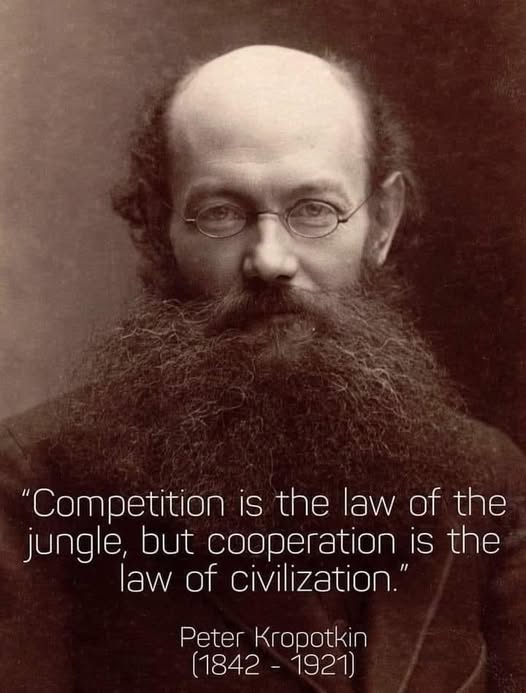
We live in a world of our own making.
We build it by talking ourselves into shaping it one way or another.
If not careful, we end up building a lie!

Competition has nothing to do with what’s going on in the jungle!

The jungle is about eat or be eaten!
Competition is about rules. Follow the rule or you’re kicked out before you get to the end!
The competition stops being true the moment you break the rule and your co-competitors do not throw you out.
By not throwing you out, those in attendance have just transformed that particular pitch into a jungle!

Cooperation is the law of the civilization!
This part is true. But incomplete!
As I explained before, to compete implies to cooperate. Those involved in a competition want to know who amongst them is better in a particular field. And COOPERATE in order to find that answer. By doing that they also build what we currently call ‘civilization’.

Kropotkin might be forgiven for what he had said.
He didn’t get to witness the Chinese Cultural Revolution. That was the true pinnacle of ‘cooperation’! Not civilized by any measure…

We really need to be more careful with words.
With what we say and with what we end up holding to be true!

It’s one thing to be able to see white from black.
And a lot more complicated to see black and white…

Being reasonable means listening to what the world has to say about things.
Being reasonable means being open minded.

Being rational means balancing your means with your wishes.
Being rational means actively identifying resources which might help you attain your goals and the pitfalls you need to avoid.

Being reasonable means choosing goals which ‘do not disturb’.
Being rational means transforming things into what they should be. Into what you think they should be…

Being reasonable means getting along.
Being rational means going alone.

Being reasonable means trying to get all in.
Being rational means being able to get to the bottom of it.

The point being that evolution is about the species, not about the individual.
And this point can be made out but individually…

And the LORD God said,
Behold, the man is become as one of Us,
to know good and evil;
and now, lest he put forth his hand,
and take also of the tree of life,
and eat, and live for ever.

“And the LORD God called unto Adam, and said unto him, Where art thou?

Adam called back and we all what happened next.

The serpent was cursed for his role, Eve was cursed for tempting Adam and Adam was cursed for….
In the end, all those involved – including the serpent, for whatever reason – were banished from the heaven. “Lest he put forth his hand…”

What are we to understand from all this?
That God, the omniscient and all powerful Father, was ‘evil’?
He must have known what was going to happen… he was omniscient, wasn’t he?

There are people who believe the Bible to be an accurate rendering of the past.
I happen to be one of them.
Only I don’t interpret what I read in the literal sense… the narrative is true, those things did happen, only not in the ‘real’ world. The Bible is not the story of flesh but a story of mind.

It is the story of what has happened in our minds. In our collective mind!

Genesis is the story of how we’ve grown conscious!
Starting from the sensations perceived during our interaction with the ‘real’ world – read ‘serpent’ – and using the evolutionary accrued ability to speak among ourselves – we’ve learned to identify ‘information’.
We, like all other living things, were already able to make the difference between good and ‘bad’. All living things ‘know’ what’s good for them and what to avoid. Or, at least, act as if…
We, like all other primates and along many other animals, were already adept at ‘reading minds’. Were already able to figure out intentions.
As conscious ‘human beings’ we have started to attribute intent! “To know good and EVIL”!

So evil is of a conscious nature, right?

‘How about ‘God’? Is it real?’

Sorry, I don’t have a reasonable answer for this question.
All I know is that the God so many of us believe in is nothing but a representation.
A figment of our collective imagination. And since we cannot imagine things but starting from the real world, there is a strong possibility that there is something, somewhere, which fits, however loosely, our concept. Our concept of a God…

Humberto Maturana, The origin and conservation of Self
https://constructivist.info/radical/pub/hvf/papers/maturana05selfconsciousness.html
Frans de Waal, Are we smart enough to know how smart animals are?
https://www.goodreads.com/book/show/30231743-are-we-smart-enough-to-know-how-smart-animals-are

“Intelligence is the ability to think, reason, and understand
instead of doing things automatically or by instinct.

Nerve cells, after all, do not have intelligence of their own.

Theoretically, we do have a certain understanding regarding the thing we call ‘intelligence’. After all, there are some dictionary entries discussing the matter.
But when it comes to measuring the said intelligence… nothing is straightforward anymore. So we still have a lot to learn about the thing. About our ability to understand, after all… About our ability to understand, period, including our own intelligence.

Click the picture above and read the article. It is interesting. The most interesting part being what it misses.

The first really intelligent computer application put together by man was the one who defeated Garry Kasparov.
Has anyone been invited to play chess by an application?
Is anybody aware of any chess or go application who had any initiative? Meaningful initiative? Other than making this or that move only AFTER a human had initiated the game?

What are we discussing here?
The intelligence level of any of the many, present or future, artificial intelligence applications or their ability to become aware? Aware of anything…

Furthermore, when we discuss whether AI, ANI, AGI or even ASI would erase humankind from the face of the Earth… nobody has yet mentioned us. After all, we are the ones building the applications. The computers on which we run the applications…
Instead of worrying whether any of the AI versions would do anything to us, we should worry about what some of us will do after they will have laid their hands on a really powerful AI application!

“There’s going to be things we do and the superintelligences just get fed up with the fact that we’re so incompetent and just replace us.”
Nearly 10 years ago, Elon Musk, founder of SpaceX and CEO of Tesla Motors, told American astrophysicist Neil deGrasse Tyson that he believes AI will domesticate humans like pets.
Hinton ventures that we’ll be kept in the same way we keep tigers around.
“I don’t see why they wouldn’t. But we’re not going to control things anymore,” he said.
 “

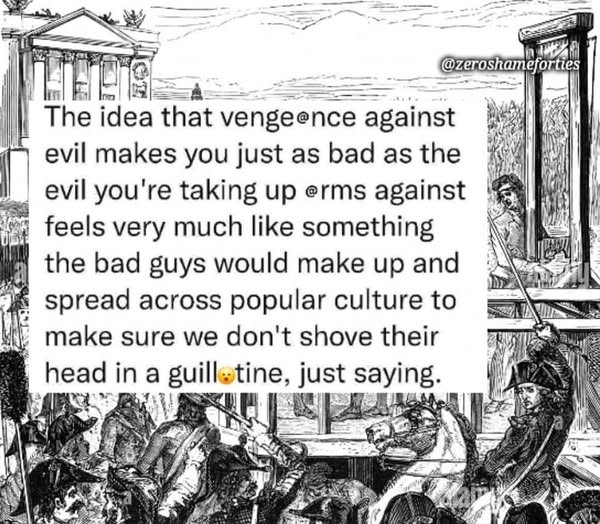
It’s the ‘vengeance’ part which spoils the whole thing.

Evil is to be resisted, of course, only this is better done in a sustainable manner.

WWI was won for nothing. The vengeance part in the Versailles ‘peace process’ had spoiled the whole thing.
Hence the war had to be won again.
During the process, the winners had become wiser. Some of them, at least.
The peace process had been inclusive this time.
The North Atlantic region, the end result of that peace process – no scare marks needed this time, is one the most successful stories of human development.

There’re no blinder people
than those who don’t want to see…

Attempting to determine who ‘made that’ is similar to trying to find out which came first.
The chicken or the egg…
As if one was possible without the other…

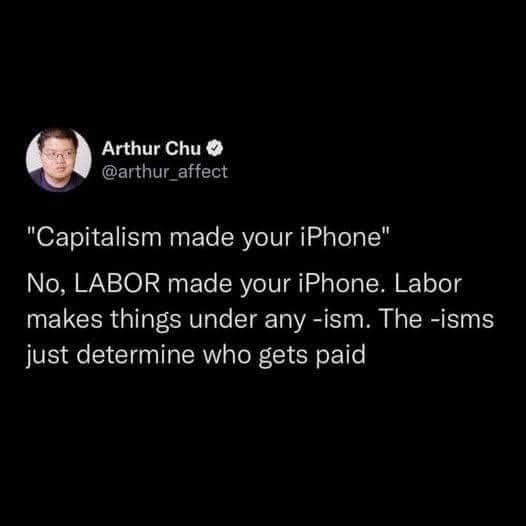
Yeah, it’s labor which makes each thing.
And it’s capitalism which makes things possible…

Capitalism is a setting. A way of doing business.
Labor is a process. Through which some things – ideas included – are transformed into solutions.

If you want to plant a tree, you have to dig a hole.
If there was no shovel around – no capital available – you’d have to dig the hole using your bare hands. And dig the sapling out from the forest. Still bare handed.
If you happen to live in a capitalist setting – you may borrow a shovel and a sapling, if you didn’t have them already. And start an orchard.

The interest is too high? Capital has become too concentrated/expensive?
It happens from time to time. Usually just before a major crises.

Is there anything that might be done? To mitigate this boo-bust cycle?
Make sure the market remains actually free. That no one becomes too powerful.
Too powerful for our own good.

The Sherman Antitrust Act “makes it illegal to monopolize, conspire to monopolize, or attempt to monopolize a market for products or services“.
The Clayton Act “aims to promote fair competition and prevent unfair business practices that could harm consumers.

Actually simple… if dully implemented …

And don’t fool yourself.
Socialism is nothing but state-run capitalism. A bunch of con-men take over the government and make all the decisions. Everything of value – all capital – theoretically belongs to the people and all the meaningful shots are called exclusively by the big shots who control the government.
Fascism, the other ‘alternative’ experimented during the XX-th century, is very much similar. Property remains, theoretically, private but the major calls are also called by the big shots who control the government.


Engine

In their attempt to accomplish their own bidding, people use tools.
From the simplest – a crow bar, for example – to the more and more complicated ones.
The engine is one of the most interesting tools invented by us. While all the tools we used before were mere extensions of our hands, engines directly transform energy into movement. We, the operators, only control them. And provide them with energy.

But don’t have to transform that energy into movement ourselves. As we do when shoveling coal to feed a stove. Or to stoke a steam engine…

Wait a moment! You said we “don’t have to transform that energy into movement ourselves”. Then ‘we have to shovel coal to stoke the steam engine whenever we need that steam engine to work for us’.

Yep. An engine is still a tool. Still an extension of ourselves. And we still have to move our limbs – spend some energy – when operating one. The main difference between a hand shovel and a backhoe being the fact that all the energy needed to ‘activate’ the hand shovel flows through our muscles while most of the energy used to move the backhoe comes from its engine.
Another example being a horse drawn cart. We can carry things on our back – using exclusively the energy provided by our muscles – or we can load those things onto a horse drawn cart. Then drive it, channeling horse-muscle energy into the process – where ever we need those things to arrive.

Savvy?

And what’s in it for us, ordinary people?”
My 90 years old father, commenting the news just running on TV

Nothing but what we can make of it.

The Earth was circling the Sun since the very beginning. Way before Bruno ‘discovered’ the phenomenon. Again…
The egg was sending ‘chemical signals’ since … who knows when. We, all of us, have been born without any knowledge on this matter.

Giordano Bruno was burnt at the stake.
He wasn’t the only one to face the consequences of his discovery. The lives of everybody else have been changed by his discovery. And the way we understand the world!
Sooner or later, somebody will find a way to use the information about ‘how the egg works’. To make some money out of it, to help people… or even to make an ‘ideological point’. “Yet another male dominated fantasy about the creation of life…”

So, Giordano Bruno was burnt at the stake as a consequence of his discovery?!?

Nope!
Bruno was burnt at the stake as a consequence of what we, the people, have made of his work.
Well, not exactly us but our ancestors. And not exactly we, the ordinary people, as the ‘bright minds of the day’. They had to be bright since ‘they’ were the ones running the show, right?!?

OK, so ‘those who know how to weave a story are those who order around those who know the facts’.
According to Yuval Noah Harari.
And, again, what’s in it for us?

Nothing but what we can make of it.

For as long as we’ll continue to chase power, ‘political power’, things will continue as they were.
As we’ve conditioned ourselves to expect them to be.

But, hopefully, when the next Giordano Bruno will tell us things can be spun the other way around, we’ll know better than to burn him at the stake. Alive. Again!

Power can be exercised in many ways!
The more sustainable of which being in favor of the general public.
‘For the long term benefit of the self aware social organism’ instead of ‘for how the public has been led to believe by the spin doctors’.

When will we be able to figure this out?
When those who know how things work will spill the beans out-front instead of choosing whose arse to lick.
After all, the egg encourages the most suitable sperm, not the most enchanting one…

1. Revelation
2. Widespread destruction or disaster

Unsettled.

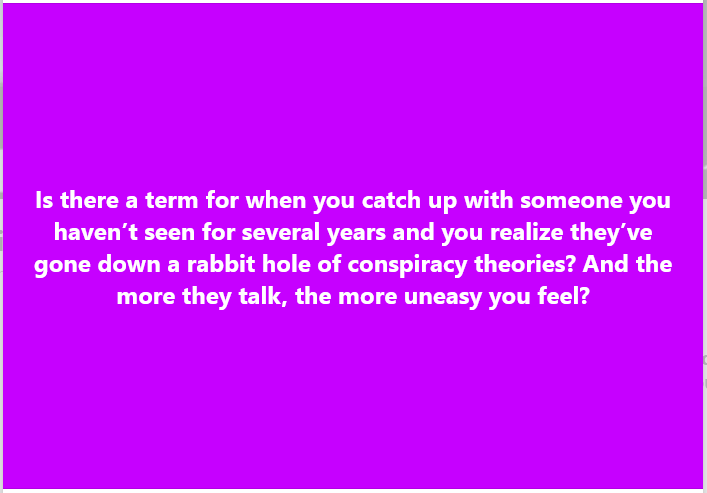
Not in the sense that I feel unsettled in my ‘beliefs’.

In the sense that the world is coming apart. We allow ourselves to be led further and further away from our brethren and, together, from the ‘hard’ reality.

The key concept here is ‘rabbit holes’, not ‘conspiracy theories’.

Each of those theories are nothing but a highly redacted version of the truth, draped in psychological gimmicks. Dangerous but survivable.

It’s the fact that once hooked, those so disposed become unable to see/perceive/accept that no truth is complete or ‘everlasting’. That we need to adapt our beliefs to the ever-changing reality.

On the other hand, it was us who have built this world. The one we currently inhabit.
We have inherited the world and fine-tuned it according to our own wishes. To fit our own desires.

We are also the ones who have to sleep in the bed of our own making.
We are the ones to continue the project.
Or take it apart…

We have arrived at the moment of reckoning.
Like each and every other generation before us.

After all, one cannot build something new before taking apart the old.
This is the only constant truth.

It hurts me to accept that I have been wrong. That my understanding was incomplete or inaccurate.
Yet I have to acknowledge that before starting to build a new, hopefully better, version of the truth.
And I cannot do this alone.

Going forward, I can ‘circle the wagons’, along other like minded people, and attempt to defend the old truth.
Or I can, accompanied by a ‘motley crew’, attempt to see behind the curtains.

To leave behind the ‘safety’ of the rabbit holes and see with our own, very diverse, eyes what lies behind the make-belief shrouds woven by the conspiracy theorists.

Survival of the fittest?!?
No, only the demise of the unfit!

Ernst Mayr, What Evolution Is?

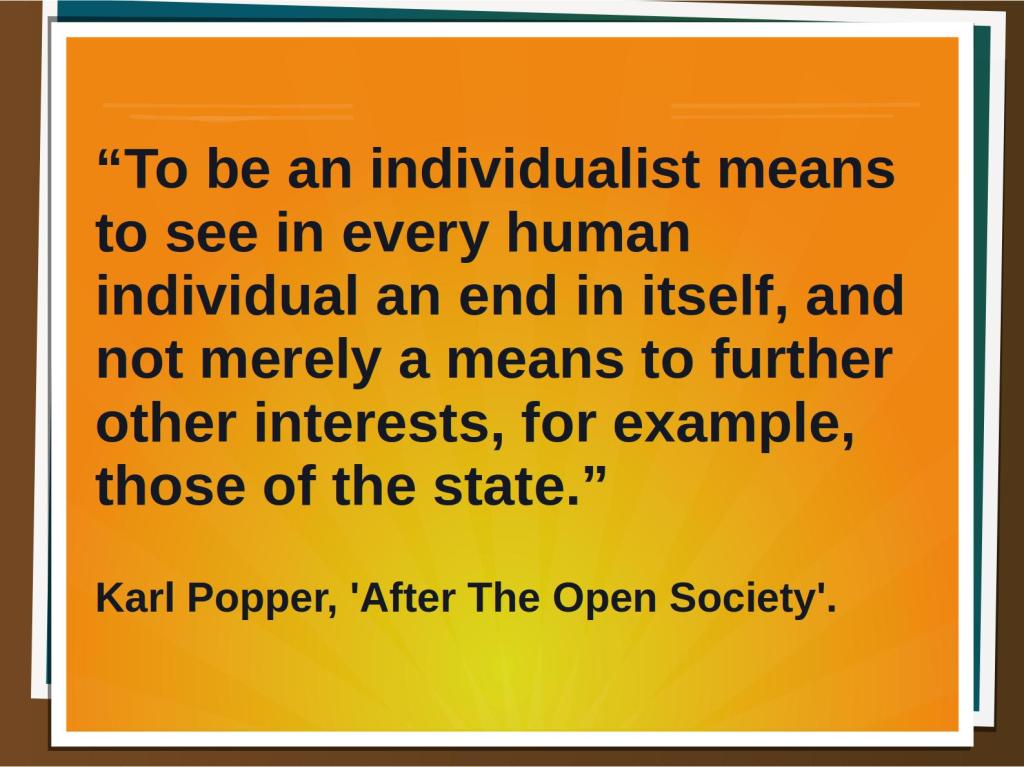
An end in itself…

For whom? For the concerned individual?
For the philosopher pondering the concept?
For the ideologue promoting the idea?

And who determines ‘the interests of the state’?!?

“Plato suggests, and all later collectivists followed him in this point, that if you cannot sacrifice your self-interest for the sake of the whole, then you are a selfish person, and morally depraved.”

Since there’s no better judge for ‘sustainability’ than mere history, let’s ‘look back’.

Whenever the powerful of the day considered that everything belonged to them, and that the collective wasn’t worth any consideration, that ‘arrangement’ soon ended in chaos. From Alexander the Great to Saddam Hussein. Hitler, Stalin, Ceausescu…
Whenever the meek had accepted everything which came from ‘above’, very soon the ‘arrangement’ also ended in chaos. The Khmer Rouge experiment, the Chinese Cultural Revolution, communism being instated in the Eastern Europe by the Soviets…

As a rule of thumb, individuals can exist only as members of a collective.
None of us can birth itself (?!?)
None of us can educate itself ON ITS OWN. OK, one might teach itself to read. And then devour a whole library. But for that to happen, somebody else must have invented the letters first!
None of us can develop into a conscious human being without living with other human beings.

Furthermore, the same rule of thumb states that collectives which value their individuals, all of them, fare a lot better than the highly ‘hierarchical’ ones.
In this sense, Popper was right. ‘Individualistic’ societies – the collectives which ‘see individuals as ends to themselves’ – fare better than the collectives which allow, for a while, their temporal leaders to lure them into obedience.