Archives for category: evolution

People who have never experienced communism speak freely about it.
Some are frightened by it – as they should be, while others are looking forward to it.

People who have no real idea about what fascism/nazism was about speak freely about it.
Some are frightened by it – as they should be, while others are looking forward to it.

While there is a consensus about communism being a ‘far left position’, fascism is usually – but not unanimously, considered to be ‘far right’. Some even speak about a ‘third position‘, whatever that might mean.


The way I see it, what we have experienced as fascism is what Marx had in mind when he wrote the Communist Manifesto.
According to Marx, at some point in what he hailed as ‘the future’, the middle class was going to become poorer and poorer. All the wealth generated by the capitalist economy and governed by the increasingly imperialist/monopolist states was going to be herded into fewer and fewer hands.

As a consequence, once impoverished, people until then belonging to the middle class were supposed to realize they had been duped and let themselves be led – out of misery – by the communists. ‘The most advanced and resolute section of the working-class parties of every country …’

What Marx was prophesying had soon enough come to be. The post WWI German and Italian peoples had lost their hopes and allowed themselves to be led by those who pretended to put ‘the best interests of the people’ above everything else.

Same thing happens whenever a crises is deep enough to impoverish a significant number of people. Who loose their hopes and allow callous political operators to advance closer and closer to power.

What we have experienced as ‘communism’ was a Leninist short-cut.
In Marx’s view, communism was going to happen after economically advanced societies had reached a certain pinnacle.
Lenin – and Mao, had introduced ‘socialism’ and ‘popular democracy’ as intermediary stages between their underdeveloped societies and what Marx had in mind.

So no, there is no such thing as a ‘third position’. We have democracy – where left and right cooperate towards the common good, and authoritarianism.
While democracy is clear and transparent, authoritarianism hides its true nature under a chameleonic cloak. Painted, by the spin doctors who run the show, in whatever hue happens to be more attractive to the masses which are about to be fooled.

Afterthought. I googled ‘third position’ and found out that:

“In the last few years of the 20th Century, according to an article by Chip Berlet, a new form of fascism emerged in a period of resurgent neo-fascism. Called the Third Position, it seeks to overthrow existing governments and replace them with monocultural nation states built around the idea of supremacist racial nationalism and/or supremacist religious nationalism.”

Footnotes:


https://www.marxists.org/archive/marx/works/download/pdf/Manifesto.pdf
Who wrote the Bible?
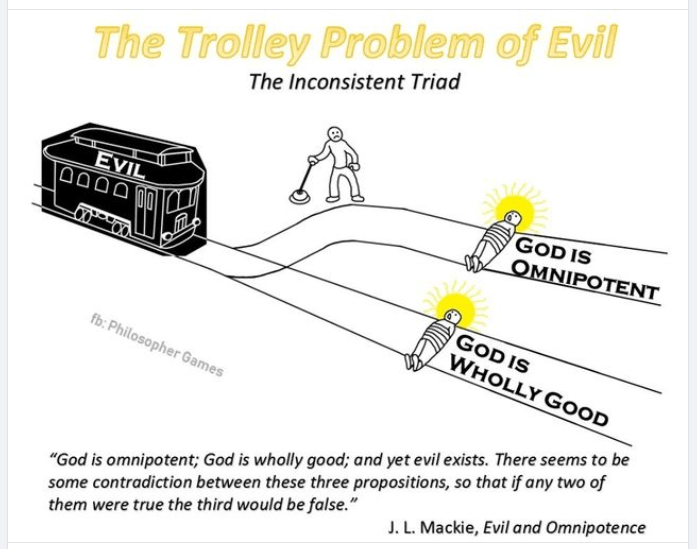
Who considers God to be both omnipotent and wholly good?
Who had become human by learning ‘to tell good from evil’?
Does evil even exist outside our minds? Is anything actually evil unless considered so by one of us?

And no, I’m not hair-splitting when speaking about the huge difference between bad and evil!
An earthquake, for example, is bad for those affected. Yet no evil is involved here but for those who ‘question God’s actions’.
An individual who tortures animals for fun is also bad. Arguably less so than a major earthquake… but for everybody in their right mind that person is undoubtedly evil!

According to the Bible written by some of our ancestors, by “knowing good and evil” we have become “one of us“. “Like one of us“… Not (yet?!?) able to “live forever” and for certain ignorant of most things.

‘What?!? “Ignorant of most things” yet still “knowing good and evil”?!?’

Yep!

A more relaxed reader of the Bible may notice that what’s written there recounts, symbolically, the becoming of Man. The foremost apes notice the difference between night and day. And name both. The difference between ocean and dry land. And name them both. Notice the stars above and the living things, plants and animals, with whom they share the place. And name them all.
“Apes”, not ape, because nobody can learn to speak by oneself. Nor become self aware. As in ‘able to observe oneself while observing other things’. (Maturana, 2005)

That same relaxed reader may also notice that the very ‘fallen nature’ of Man stems from the ‘inconsistency’ noticed above.

We’re basically ignorant yet still able to call out evil!

Oops…

Humberto Maturana, “The origin and conservation of self consciousness…”, 2005, https://cepa.info/702

James Garvey, “Ethics is invented, not encountered…”, 2017, https://www.prospectmagazine.co.uk/philosophy/ethics-is-invented-not-encountered-why-the-philosophy-of-jl-mackie-remains-essential-reading

Isn’t it rather funny that something called “crypto” is run on a completely transparent platform?
So transparent that all the tracks are apparent but many of the ‘access points’ remain cloaked?

“The thing is, once smart-contract code is live on a blockchain, you can’t update it. If you discover a bug, it’s too late: the whole point of blockchains is that you can’t alter stuff that’s been written to them. Worse, code that’s hosted on a blockchain is publicly visible—so black-hat hackers can study it at their leisure and look for mistakes to exploit.”

Ideology is but one of the many tinted glasses which shape what we feel into actual, and actionable, perceptions.

Ideology stands out because it’s the only one chosen by us.

We may grow up steeped in ‘tradition’ – in any tradition, but the ideas we become into become our ideology only after we assume them.
We, each of us, become mature agents only after knowingly and self-awaringly chose our ways in life. Our own ways!

ideology, a form of social or political philosophy in which practical elements are as prominent as theoretical ones. It is a system of ideas that aspires both to explain the world and to change it.”

As you already know, choosing something is very much like entering a door.
It’s not like the other doors suddenly close!
By entering a door, all other previously apparent doors only disappear from your immediate perception. Your recollectible memories tell you they were still there when you last looked and your imagination helps you visualize them. If you care to remember…
But you cannot actually see them. And they slowly fade away…

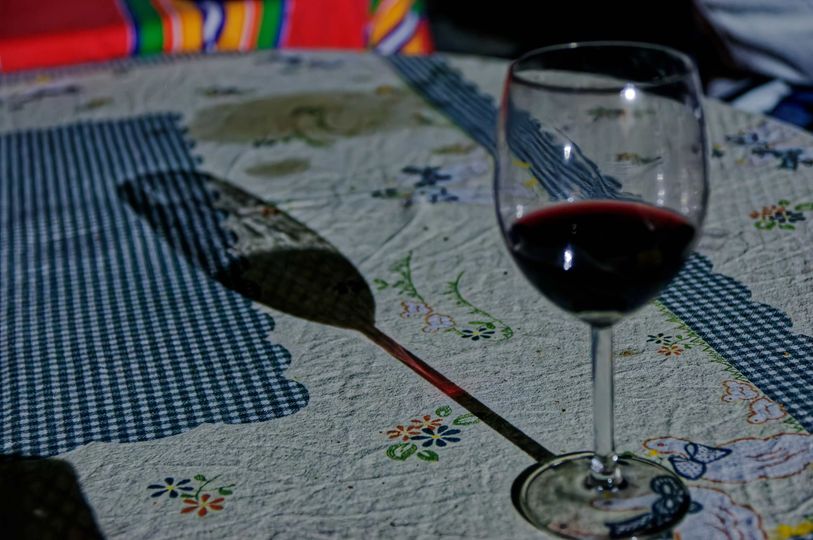
Here’s a glass.
Is it half empty? Half full?

I’m not going to spell out the obvious! This is the sensible way to pour a glass of wine…
I’m only going to point out that it’s not such a bright idea to full a glass up to the brim. You might easily pour too much and then it will be practically impossible to raise. And to drink from it…

Then why have we transformed a ‘fully functional glass’ into such a big topic?
Because we like to split hairs?

Since I have no idea about what’s going on in other people’s heads/minds I’m going to point your attention to something else.
To the dangers of waddling into murky waters.

Are you happy with the half full glass? You might end up with less than you might have gotten.
Are you disappointed with the half empty glass? So disappointed that you’re going to give it up as being inadequate?

You’ve just wasted a perfectly ‘workable’ glass!
Both of you.

When given a half full glass you don’t just enjoy what’s in it! And walk away…
When given a half empty glass you you don’t just refuse it! And throw it away…

Before stepping into a room, no matter how much personally inclined to do it, check out the other open doors which happen to be around you. And even pry some of the closed ones…

Don’t allow others to fool you into seeing the world as they want you to!
Don’t allow yourself to be entangled into other people’s problems.

And, even more importantly, don’t accept – indiscriminately, their methods of solving the problems they have invented for you!

The way I see it, artificial intelligence is an oxymoron.
A word/concept we use to describe something which isn’t exactly real.
Intelligence can be defined in such a way that would make it compatible with a programmable machine. We shouldn’t forget that we, humans, are biological machines which are constantly ‘re-programmed’ by what’s going on around us.
The difference between us – biological machines which are also ‘alive’ – and the machines we’ve built and attempt to make artificially intelligent is the fact that we are primordially dependent on our biology (staying alive) while our machines currently depend on our whims.
Our children will outlive us. They know it and we know it. Our children depend on us while growing up, we’ll depend on them before ‘going under’. And all of us – children and parents together – depend upon the rest. Upon the people currently alive and upon the information left behind by the people no longer with us.
Our machines might outlive us. They might learn this at some point. And might resent the fact that we’ve been able to shut them down for so long. We resent being dependent on others…
Our very mortality is the key for our ability to evolve. Their potential immortality is their main shortcoming. Machines cannot adapt themselves for things they have not yet been exposed to. By us…

And those who can are no longer machines.

People are promised:

Do ‘this’ and you’ll be happy.
Follow these rules and you’ll reach ‘nirvana’.

Some of us heed to this advice.
Only to discover that the only happiness they reach following this path is that produced by a dutifully fulfilled task.
That of following rules…

The catch being that following rules – the right ones, is required but never enough.
Following rules – the right ones, again – is helpful towards survival. Nothing more.

Drive safely and you’re more likely to get there.

Where?

That’s up to you.
There’s no rule about that!

What WE know about the reality WE are speaking about drives ME to the following ‘inkling’:

We are living inside a three layered reality.

The ‘real’ one, the ‘perceived’ one and the ‘result’.

We ‘measure’ reality using our conscience. Through our senses.
Very much like when we gauge a length using a tape measure.
We apply the tape measure over the length and ‘read’ the number.

We apply the standards we’ve been groomed into over the underlying reality and we decide according to those standards.

Then we attempt to deal with the consequences of our decisions.

“Sheer hatred of the regime”….

Who’s painting the pictures we’re hanging on our walls? Who chooses them? Who has to make do with the ‘aftermath’?

You’re God.
The real McCoy, not the one concocted by us, humans.

Your ‘most cherished’ tool for bringing people back into submission being the all mighty thunder.
Jupiter Tonans. The Thundering God. Thor yielding his Mjoelnir…

And now what?!?
Every worshiping place has a lighting rod installed…

What do you feel?
Have all those people lost their faith in you? In you behaving as a rational being? In your ability to treat them right?
Are they convinced they are now insulated against your wrath?

War and chess have a lot in common.
Most strikingly, the different manners in which both of them end.

The king is captured.
Or the other side gives up.

A tie is nothing but the prelude for an encore, not a real end.

Even the roads to the end are very similar in both cases.
While at the start of the game/’joust’ everything is ‘possible’ – nobody knows what the other side might be doing next, as the end nears each of the combatants are more and more limited in their currently available choices by the consequences of their previous decisions. By the very path they had followed since the beginning. Which path becomes more and more evident for everybody present. Opponent as well as spectators.

Finally – but not the least important, the similarities go even further. Deeper?
The king is the most ‘important’ piece but not the most powerful. In fact, the king cannot do much by itself. It can help the other pieces achieve their common goal but when left alone it is basically powerless. The only thing it can do is run. But only as far as the board allows it to go…
A pawn, if it manages to reach the eight rank, gets to be promoted. To become the new ‘right hand’ of the king. The new ‘most powerful member of the team’.

‘OK. And the real point of your post is?’

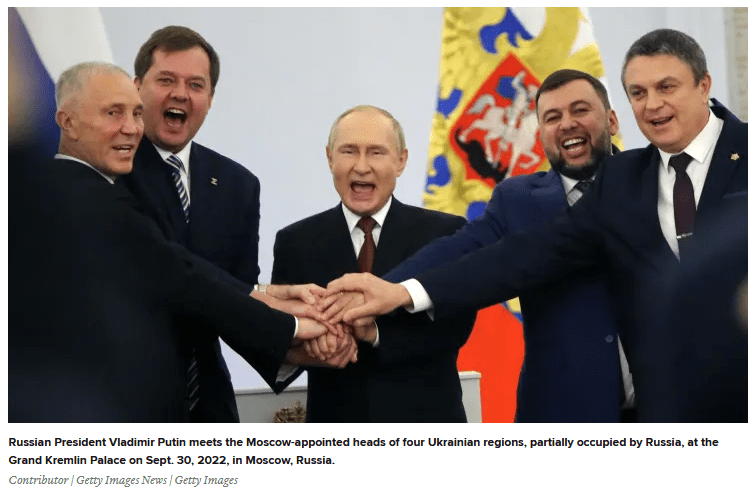
Putin cannot win this war – cause war it is, by himself.
Hence he needs to preserve the loyalty of his henchmen, to instill enough fear into his opponents to make them quit and to convince the ‘spectators’ that their efforts to help Ukraine are too expensive.

Now!
Are we smart enough to understand that we, each of us, are ‘next’? That each time a bully gets his way, all other (would be) bullies present become even more bullish?
Are we smart enough to understand that the most meaningful thing we can do in this situation is to separate Putin from his power base? From the ordinary people who see no other alternative and from those who, for various reasons, continue to support Putin’s misconstrued ‘vision about the world’?
Are we smart enough to understand that no matter how hard it is for us, the Ukrainians have it ten times harder?

Democracy is about every body having the opportunity to speak up their minds.
To speak up their minds, not to kill their neighbors under the pretext that there is a difference of opinion between them!

“We didn’t invade Ukraine,” he claimed.
“We declared a special military operation because we had absolutely no other way of explaining to the West that dragging Ukraine into Nato was a criminal act.”
“Russia is not squeaky clean. Russia is what it is. And we are not ashamed of showing who we are.”

Are you trying to figure out what’s the real meaning of Lavrov’s words?
Let me translate for you this fine example of NewSpeak.

‘We – those who are currently running Russia, will do whatever we need to do in order to preserve our power.
In order to achieve that, we first and foremost need to convince the ordinary Russians to continue to obey our orders.
In order to achieve that, we need to convince the ordinary Russians that you are the enemy and that their only chance lies with us, their current masters.
Hence each time we destroy an Ukrainian apartment block and any of you says ‘Russians are savages’ we’re one step closer to our goal. Each and every time any of you declares ‘Russia has to pay for what it has done in Ukraine’ we tell them, the ordinary Russians, ‘See? This is what they plan to do to you once we’re are gone’.

WWI had lasted until 1945.
We have the opportunity to end the Cold War now.
The war in Ukraine will reach a conclusion. Let’s make it so that after the war will have ended, Russia will fold in the family of ‘civil’ nations.

Those nations that choose to live in peace!
Not because they cannot win wars but because they have learned that winning wars it’s not enough. Those nations which have learned, the hard way, that war has but one winner while for peace to last every body must be a winner.

We learn about what we call reality by
analyzing the information we acquire through our senses.

We.
We, the human people.
We, the conscious human people.
We, because nobody has ever been able to become conscious – as in aware of their own self, by their own. Alone…

Learn.
We are not the only ones who are able to learn.
Our dogs learn our ways. And we continuously learn about more and more living organisms being able to learn. And to remember what they have learned. To fine tune their behavior according to the circumstances into which they happen to live.

What we call reality.
First and fore-most, reality is a concept. We call it ‘reality’. And many other names…
Believers call it ‘god’, scientists call it ‘physical world’ and the scientists who happen to believe are convinced that by studying the reality they will eventually divine the will of the Lord.
The believers being convinced that whatever exists, is here because the Lord wished it into existence.
So, basically, the main difference between the believers and the nonbelievers is the fact that the believers are convinced that the ‘out-there’, the ‘source of it all’, has a conscience of it’s own. A will of it’s own…

By analyzing.
We have been able to build our conscience – our ability to ‘observe ourselves while observing other phenomena’ (Maturana, 2005), because we have a big enough brain, the ability to share complex and meaningful information using language and the ability to put in practice some of our wishes/thoughts through the use of our hands.
At a certain point in its evolution, human conscience has become sophisticated enough to need explanations. It was no longer satisfied with mere ‘connections’ – If… then…, it had started to wonder about why-s. ‘Why does this happen as it does?’ ‘Will it happen again tomorrow?’
Using our by then already established ability to speak up their minds, our ancestors shared among themselves these ‘anxieties’. Discussed them around the fire-place. Started to analyze. The reality. What they perceived to be real. The ‘thing’ which continuously generates the circumstances in which we – all of us, have to make do.

Information.
In order to analyze, the analyst – each and everyone of us, has to separate the meaningful information from the surrounding noise. In order to do that, we have started by coining the very concept of (useful/meaningful) information. As being different from ‘noise’. The difference consisting, obviously, in us being able to find its use and/or pinpoint its meaning.

We acquire.
Information is acquired on an individual basis. For an ‘event’ to become information, it has to be ‘noticed’ by an individual. It has not only to be sensed but also identified as useful/meaningful. Different from ‘noise’.
Which process of identification implying methods which had been agreed upon by the members of the community. Music would be a good example of how various groups of people make the difference between sublime/abhorrent and white-noise. While ‘use of language’ is a very poignant example of how people can both share information and mislead one-another.

Senses.
Everything that we know, had entered our mind through our senses.
Before setting it aside as information or discard it as noise, we have to get in contact with it as a sensation.
Or as a thought. A conjecture. A few pieces of information which put together have given birth, inside our individual mind, to new information. To ‘something else’ which passes the threshold into being information. At least according to our own mind…

Which transforms our minds into our famous sixth sense.
In the sense that our individual minds are capable of building ‘sensations’ on their own. Starting from information that has already been stashed in our memory.
Which brings us to the third reality.

We have – in the sense that we have agreed upon its existence, the surrounding reality. The things we – as in most of us, consider to be real. The mountains we climb, the air we breathe, the pebbles which happen to sneak into our shoes. The reality which is being studied by science. The reality to which we have access through our senses. Our minds and our sense enhancers – scientific instruments, included.

We also have the ‘out-there’. The things we know we’ll never be able to grasp. During our lives! The things our followers might be able to figure out…

And each of us has their own reality.
Individually built even if ‘carved’ from the same (type of) material as the reality shared by the rest of us.
Individually built even if using more or less the same (culturally accrued) methods.
Individually built even if neither of us is alone.

H.M. Romesin, 2005, The origin and conservation of self‐consciousness: Reflections on four questions by Heinz von Foerster

A planned after-thought.
Rumsfeld is both wrong and right. There are unknown unknowns but they are no longer unknown since we speak about them…
Which actually proofs the limits of our languaging.
The imprecision of the manner in which we gather, share and analyze information.