Archives for category: effective communication

I also believe that people – well, some of them – are able to change their minds if presented with the right arguments at the right time, in the appropriate manner and in auspicious circumstances.

People are not robots. And, for certain, not rational!

We are rationalizers. We use rational arguments to fortify our already held conclusions. And the more we love those conclusions, the further we go in our quest to find the ‘right’ arguments in our favor.
But given enough time and if the arguments which contradict our convictions are presented in an un-injurious way, we might be persuaded.

And here’s the catch.

For quite a while now, some of those familiar with how rationalization works have used their knowledge about the innards of our minds to further their own goals.
Nothing wrong with that?

Are you familiar with ‘divide et impera’?
That’s the strategy used by every would be dictator to breed trouble in the population they planed to take over.
Divide and conquer. Make your followers despise everybody else. To the tune of transforming ‘the others’ into sub-humans.
Make your followers believe they are ‘special’ while the others, all of them, are nothing but vermin.

‘And what’s wrong with believing yourself to be rational?!?’

It’s not wrong. Only delusional.

Making your mind up only after carefully considering all of the available ‘arguments’ means having a scientific attitude.
You know? Science, the fad currently popular among many of us…

The problem with the scientific attitude being the fact that this attitude has been developed in the context of hard facts. The scientific attitude has been ‘minted’ by those studying physics, chemistry, biology… fields where every minute transgression becomes evident in real time! Where people could not ‘fall in love’ with their own conclusions. For the simple reason that those conclusions had to be changed along with the new facts continuously discovered in the process of learning.

The concept of rationality had been minted late in the development of human thought.
Sometimes during the XVIII-th and the XIX-th centuries. When philosophers had started to concern themselves with ‘how we think’ on top of ‘what we should be thinking’.
When philosophers – and lately psychologists – have started to understand how we reach/build meaning.

Some of those philosophers have reached rather strange conclusions.

Nietzsche posited that ‘God is dead’ while Marx rationally convinced himself, and others, that there was a way – and only one way, his – to make everybody happy.
Nietzsche opened the gate and Marx led us through.

And now, that we’re dwelling in no-God’s land, everything is up for grabs.

Including reason…
What is here to prevent us from using our knowledge of how mind works in order to further our own, personal, goals?

Goethe did warn us.
The Sorcerer Apprentice made the very same mistake. Overconfidence in his own ability to ‘play the rules’. To fidget with reality.
The difference between Goethe’s poem and what we’re currently doing is the fact that Goethe’s was a work of fiction while we’re playing with our own future.

I’ll wrap up highlighting the extreme perversity of the message.
‘I have a mental illness…’
Loosely translated, this means that everybody who doesn’t follow those arguments to the same conclusion where I have arrived myself must be (also) mentally ill.
And now, that we’ve reached the conclusion that at least one of us is ‘crazy’, it no longer matters who is on the ‘wrong’ side of the fence!

We both are!
We no longer see eye to eye. Each of us is convinced that the other is sick.
Unworthy!

We’re both ready to be taken over.

The only way out is to start listening, respectfully, to what the other has to say.
‘Respectfully’ means, first and fore-most, ‘don’t mess with GIGO‘!

Observe the abnormal.
The out of ordinary.
That’s how you might figure out the regular…

Psychology 101

We live on faith.

Without faith, one cannot even raise from their bed in the morning…
‘What’s the use?’

Animals start looking for food whenever hungry.
Human beings, for as long as they remain conscious, check whether there’s any chance of finding food before attempting to find it.

Faith in what?

Living organisms are made of matter.
Atoms and molecules stacked in a certain order and interacting according to certain rules. Rules being preserved, managed and passed over from generation to generation as ‘genes’.
Individual organisms have very little influence about the whole process, except for some ‘checks and balances’. Which checks and balances work according to some rules also contained in the genes.
Species, generations and generations of individual organisms, evolve. The genetic information passed over from generation to generation becomes slightly altered as evolution forces it to fit the changes in the environment.
According to Ernst Mayr, evolution is about the demise of the unfit. Individuals need to be able to survive in the environment where they happen to have been born. If the genetic information inherited from the parents is suitable for that environment, the individual has a fighting chance. To live and to pass over the genetic information which made survival possible.
The nature of life – the existence of successive generations and the mechanisms which pass genetic information from one generation to the next one – makes it so that genetic information may be slightly altered when copied into the new organism. The alterations appear haphazardly and ‘survive’ only if they don’t jeopardize the existence of the individual organism harboring them. If the organism survives for long enough, the alteration is passed over to the new generation. If the alteration happens to be beneficial for the organism in the context of circumstances where it needs to survive, that alteration has increased the chances of survival for the organism. And its own chances to be passed over to the next generation. Please note that no agency is involved in this process. Nobody and nothing but happenstance has anything to do with what’s going on here!

Conscious organisms are made of animals plus conscience.
You need a living organism in order to have a functional conscience.
Which conscience is nothing but a set of rules learned from the other members of the ‘species’ to which the individual belongs. In fact, conscience – individually speaking, is nothing but a set of ‘cultural’ genes.
Lumps of information passed on from generation to generation which allow us to actively interact amongst us, people, and between us and the environment where we happen to live.
Each individual conscience is like a ‘cultural’ organism riding on top of a biological one.

The difference between the cultural organism and the biological one being the fact that the cultural organism is aware of itself.
Of its mortal nature!

Being an organism, conscience has only one job. To survive for as long as it can and to pass over the information it has gathered to the next generation.
Just as a biological organism is driven by a ‘vital force’ – named ‘survival instinct’ by those trying to make sense of this whole thing – conscience is driven by hope.

Biological organisms have a symbiotic relationship with their environment. They ingest substances and excrete the consequences of their metabolism. They also notice information and react to it. Individually as well as collectively.
As a consequence, the world we currently live in is the ‘byproduct’ of 3 billion years of countless biological organisms having already lived on this planet. Without this teeming life we wouldn’t be here and the planet would be barren.

Cultural organisms have deepened and accelerated the process.
Not only they have physically transformed the planet but they have also built meaning.

As I mentioned before, consciences need hope in order to survive.
In order to have hope, you need meaning.
Things have to make sense.
Out of sheer necessity, we’ve built explanatory scenarios for what’s going on around us.

Congress shall make no law respecting an establishment of religion,
or prohibiting the free exercise thereof;
or abridging the freedom of speech, or of the press;
or the right of the people peaceably to assemble,
and to petition the Government for a redress of grievances.

Doesn’t make much sense?
Mentioning ‘God’ on money is the first step towards the establishment of an officially sanctioned religion?

Well…

In my previous post I posited that property, the concept, is the stepping stone for social order.
I’ll add to that a simple observation. Whenever too much property gets hoarded by a too small number of people, the community which had allowed that to happen is in great danger.

Same thing here.
We have religion – a social phenomenon – and religions.

We have a certain understanding of the world, shared by the members of a community – which allows the community, as a whole, to behave in a coherent manner. Not that much different from what happens when people use a common language. They can communicate. Same thing happens with people partaking in a religion. They ‘see’ things in a coherent manner. Hence can coordinate their efforts.

And we have religions…
To reach the ‘certain understanding of the world’ I mentioned before, each community had traveled a road. A particular road through the particular circumstances in which each cultural community – currently known as ‘nation’ – had had to build their culture. Their identity.
Some communities had put together certain scenarios to accompany them along this road. To help them make sense of what was happening to them.
Some communities have used more than one scenario during that journey while others use more scenarios simultaneously.

Sociologically speaking, all that matters is social coherence.
All is well as long as the community conserves its ability to function. To survive.
As long as the individuals who compose that community continue to have a common enough understanding of the world in which they live.

For the simple reason that they, we, live in the same world!
And if we, individually or in small ‘gangs’, start behaving as if the world is different for each of us…

The Founding Fathers had a common understanding of the world. They belonged to the same (functional) religion despite belonging to different ‘denominations’. For them, the First Amendment was about reigning in the powers of the Government. They had realized that a Government able to impose a certain religion – a certain scenario – upon the entire community would eventually bring destitution.
The Founding Fathers could not foresee a situation in which a few of us would deny the practical daily realities of this world. Invoking their particular scenario as an argument… As the supreme argument for refusing to see the reality.

The reality as it is.
And as it is seen by a majority of us.

I mentioned earlier that some communities have changed their scenario along their history.
They did it when they have found new meanings. They have seen new things about the reality and they have integrated those new things into their newer scenario.
By changing the scenario they have actually built a new reality.
Societies which have clung to their scenario to the bitter end… are no longer with us.
Societies which have somehow found it in their collective minds to adapt their scenarios to the reality changed by their own efforts continue to survive. To thrive, even.

“Hoarded by a too small number of people” means controlled by a handful of people.
Sometimes coordinated.
As it happens in any dictatorial regime. It doesn’t matter who formally ‘owns’ something if the use of that something is tightly controlled by somebody else.
Furthermore, a certain ideology may end up having a lot of clout without being imposed by an authority. Nevertheless, the fact that an ideology dominates, for a while, makes it so that the community which allows this to happen to experience a dictatorial regime.
For whatever reason, some people were convinced that witches were real. And burned them at the stake.
For whatever reason, a lot of people continue to believe that communism might be a good thing.
For whatever reason, some people continue to believe that they are entitled to determine whether a woman may or may not abort a fetus.

What is the difference between an ideology and a scenario?
The manner in which people relate to it.

Having been told that they were the children of the same God made it possible for the believers to stick together. To act like brothers. To respect each-other. To invent and implement capitalism and democracy. Both relying on trust. On mutual trust and on the freedom of the market. Both the market where goods and services are traded and the public forum. Where ideas are traded…

Being told that only one particular understanding of a certain text/idea/concept is correct some people remove themselves from the ‘general population’. Which ‘general population’ becomes ‘the others’.

‘The others with whom we don’t have anything in common’.

Quite an untenable situation, given the fact that the world is becoming smaller and smaller.

The Polish state broadcaster on Saturday suspended
a television journalist who, during the Olympic Games opening ceremony,
reacted to a performance of John Lennon’s “Imagine” by saying it was a “vision of communism.”

And now I wonder…

What kind of communism had Przemyslaw Babiarz, the Polish journalist, experienced?
And where, since the Polish people did not enjoy what had been dished to them by the communist rulers?!?

What a waste of energy….
John Lennon had invited us to dream!
The communists, the real ones, had acted worse than the worst robber barons.
What I had experienced under communist rule, in Romania, had nothing to do with what Lennon had invited us to dream about.
Comparing Lennon’s dreams with the crimes committed by the communists is narrow minded to say the least.
Firing a guy for airing a ‘less than inspired’ statement and pretending to do it in the name of “Mutual understanding, tolerance, reconciliation” is nothing short of idiocy!
For it gives ammunition, and plenty of it, to those who wish to torpedo any mutual understanding and tolerance that still survives.

Each of us expects the others to behave rationally.
While each of us rationalizes their own biases.
And considers this to be normal!

Not so long ago – evolutionary speaking, things were free. As in ‘up for grabs’.
Our not so distant forefathers fed and clothed themselves by picking ‘things’ from nature.

By talking to each other they had become conscious human beings.
Then came up with the notion of property.

‘If I/we have this thing, you cannot have it too’.

Using this notion, they introduced some order unto the social stage.
Some things, albeit fewer and fewer, remained free/up for grabs while the rest – specially ‘the things of interest’ had become private.

Entertaining the notion of property means that individuals are able to link an object to its owner.
This link is a piece of information.
Discussing and remembering who owns what, our forefathers realized that information is important. Not only the information regarding the link between owners and their property but also information in general. Whatever ‘useful’ things had been learned, remembered and passed around.
Thus information became ‘a thing’.

The order created by the communities using the concept of property and by actively circulating information among the members had become the premise for those communities to thrive.

Somewhat naturally, the members of those communities had reached the conviction that:
Property is good. And that more property is better.
Old people are precious. For the simple reason that they deposit what had happened. By sharing their memories, old people make it so that the younger ones don’t need to learn again and again.

Since property and remembered information were good for the community, the communities using them developed faster and had a way better survival rate than those who didn’t. For whatever reasons.

Since in reality people rationalize rather than think rationally, they have reached the conclusion that the rich and old people were the ultimate cause for the well being of the community.
The individuals, not the modus operandi of the community.

“The early details that have emerged about Thomas Matthew Crooks, who was shot dead by law enforcement, show a young man working an entry-level job near his hometown in Pennsylvania, where he graduated from high school in 2022 with a reputation as a bright but quiet classmate. His high school counselor described him as “respectful” and said he never knew Crooks to be political.”

“Two years ago, Crooks graduated from the local high school, where he showed no particular interest in politics, according to one classmate who asked not to be identified. Crooks’ interests centered on building computers and playing games, the classmate said in an interview.
“He was super smart. That’s what really kind of threw me off was, this was, like, a really, really smart kid, like he excelled,” the classmate said. “Nothing crazy ever came up in any conversation.””

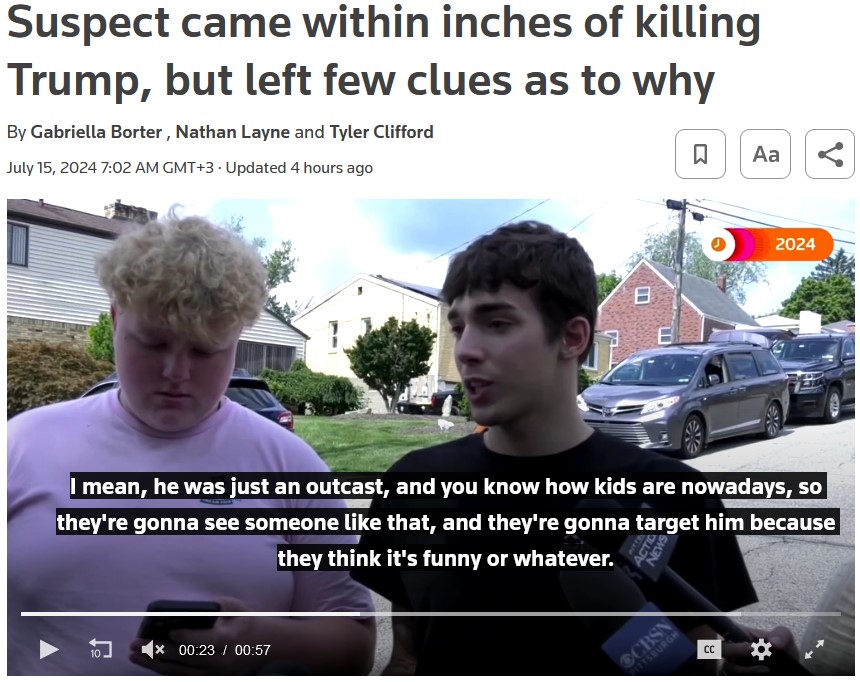
At least one of his classmates perceived him as ‘an outcast’ while another – and his high-school counselor – perceived him as being ‘bright’. Neither ‘saw it coming’.

So why would a very young adult attempt to assassinate a very well known, and very well guarded, public figure?

“Jameson Myers, a former member of the Bethel Park High School varsity rifle team who graduated alongside Crooks in 2022, told CBS that he did not make the team.
“He did not even make the junior varsity team after trying out,” Mr Myers added. “He never returned to try-outs for the remainder of high school.”

Let me rephrase the question. Why would a 20 years old male with a steady job, who had graduated from high school two years ago “with a $500 prize for maths and science“, attempt to shoot somebody out, from a distance, given the fact that he wasn’t trained for it. Nor exactly talented in this domain…

Are we sure this was Crooks’ main target? To assassinate a former, and possibly future, President of the USA?
Or was he trying to end it all? Once and for all?

What were the odds for him to get away with it?
To survive after shooting the first bullet?
He was unanimously described as being ‘smart’…

What drove Thomas Mathew Crooks to the conclusion that his life was no longer worth living?

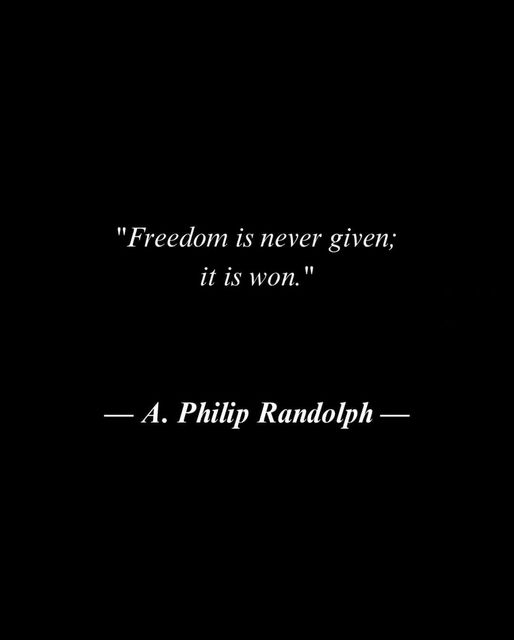
With Chandler Owen, A. Philip Randolph founded and became co-editor of The Messenger,
an African American socialist magazine, in 1917.
In 1925, Randolph established the first predominantly black labor union,
the Brotherhood of Sleeping Car Porters, to improve working conditions
for the nearly 10,000 black railroad employees.
The Brotherhood would enjoy longstanding prominence in the labor and civil rights movements.

According to the English lore, “there’s more than one way to skin a cat”.
According to the cat, ‘who cares about how I lose my coat? I’ll end up dead anyway!’
According to the fur tanners, ‘the manner of skinning the pelt is of utmost importance for the end-result of the operation’.

Whom to believe? Specially since all of them seem to be right…

Well, truth has a marked tendency for being complicated.
Hard to comprehend in its entirety and even harder to express in a concise manner.
Meanwhile we, conscious human beings, have a marked tendency to notice only what we’re interested in. To notice only what we care about…

In fact, the manner in which we notice things speaks volumes about who we are. About how we relate to what we call ‘reality’.

The white colonists inhabiting a certain area in Northern America had become ‘Free Americans’ after fighting the British. Only after they had freed themselves through battle!
A. Philip Randoph had fought for his freedom. And for human rights.

All this fighting leads to a bout of pondering.
Are we free together? As in ‘all of us’ and ‘once and for all’?
Or our freedom is defined against other people? Who might try to steal our liberty from us?

What is freedom, after all?
A zero sum game? Where liberty is up for grabs but in limited supply?
Or a ‘grace’ we impart with and upon our fellow human beings?
Something to be jealously guarded or something to be collectively and cooperatively maintained and enhanced?

And one final question.
Why would anyone attempt to steal other people’s freedom?
When history gives us plenty of evidence that whenever freedom was out to be shared people were happy while whenever freedom was in short supply the entire society eventually crumbled under it’s own weight…

What is going now in China – and in Russia, for that matter –
has nothing to do with the ‘left’.
With what is understood as “left” in Europe…
Instead, it has many similarities with fascism.
‘Corporatist’ states imbued with revindicative nationalism.

Nassim Nicholas Taleb has introduced the concept of “Skin in the Game“.
In short, it is about the fact that the decisions made by people who do not directly and immediately ‘enjoy’ the consequences of their choices have a high probability of being bad. A phenomenon that is accentuated as bad decisions are not immediately sanctioned by those who suffer.

Taleb’s observation only confirms the fact that all dictatorships/authoritarian regimes have collapsed.
Without exception!
Alternatively, it is very easy to see that democracies ONLY last as for long as they manage to maintain their ‘functionality’. That is, for as long as people can – and undertake – to voice their grievances. And for as long as people listen to each other. Respectfully! In vain, some shout about being ‘hungry’ if nobody listens/cares ..

Returning to the idea of ​​’leadership’, yes, countries are led. By some who consider themselves/are considered to be ‘elite’. ‘Led’ only from the operational point of view, however…
Countries are living things, ‘natural selection’ still has the last word!
Ernst Mayr, a biologist, said that ‘evolution is not about the survival of the fittest, but about the disappearance of those who cannot find their ‘right’ place. The misfits. ‘. That’s right, countries have big problems if/when they don’t manage to take down the ‘misfits’ who happen to have clambered into power.
Why countries don’t succeed to do this in a timely manner? How did they clambered there in the first place…
Everything starts when the popular dissatisfaction reaches a critical level. Which dissatisfaction is engendered when the members of that country no longer care for each-other. When mutual respect has disappeared.

I will conclude by returning to the major difference between communism and fascism.
Both of them appeared in situations when enough dissatisfied people were ‘wandering aimlessly’ while looked down by the rest of the society.
Some low-life profiteers seized the occasion and ‘grabbed the helm’. Profiteers who have been able to operationalize the dissatisfaction festering in the society. And the lack of vision of those who hated the others. I repeat myself, both communism and fascism had appeared when various sections of the society despised, and sometimes hated, the ‘others’.
The minor difference consists in the fact that the proto-communist dissatisfied looked up without having any chance to get there, while the proto-fascist ones wanted to return to where they had once been. The Russian muzhiks dying during WWI versus the unemployed German workers who had just lost WWI.

This being where the difference appears.
The difference which makes it hard to recognize what’s going on now in Russia/China as being a form of fascism.
Both the Russians and the Chinese have a lot better lives now than they had under communist rule. Statistically and from the material point of view! Psychologically speaking…
Those who live in well-established democracies – people who respect each other – have a greater tolerance for ‘insecurity’. Each of them knows they can rely on the others. In that environment, failure is temporary. People try as many times as they need to succeed. Or that’s how it used to be…
In communism, we had learned – the hard way, that one was not allowed to make mistakes.
When Russia and China switched to ‘capitalism’ and people saw what could happen to them – to make mistakes while trying – they had become frightened!
And, at least some of them, chose to return – especially psychologically, in the past. Where they felt safe…

“An effective way to undermining something of authentic substance
is by producing versions that closely resemble the real thing
but lack genuine substance.
The skill is in knowing the difference.”

On the other hand, we must keep in mind that fakes are also facts. They exist, don’t they?
Even more so, fake facts do engender consequences!
In fact, it’s these very consequences which impart fact-hood to ‘successful’ fakes.

Also, it is high time for us to understand that this undermining might occur ‘naturally’. Due to our attention being distracted rather than ‘intentionally misguided’.

“Your Liberty To Swing Your Fist Ends
Just Where My Nose Begins
“

Now, what would you have done if this guy had started to swing his fists? In the very proximity of your precious nose?
“Stood your ground” or gave him enough ‘space to exercise’?

You’re not exactly comfortable with the current meaning of ‘stand your ground’?

Then maybe it’s high time for us to understand that ‘stand your ground’ is the direct consequence of ‘your liberty ends where my nose begins’.

Not comfortable with the current situation?

Then maybe it’s high time for us to come up with another definition for liberty.
One which brings forward the cooperative effort which made liberty possible in the first place.
Instead of the confrontational one currently in use. Which serves perfectly the interests of those powerful enough to define evolution as “survival of the fittest”.
Which serves perfectly the interests of those powerful enough to be convinced that only those able to defend their liberty are worthy to be free.

The key word here being “their”, not “liberty”!
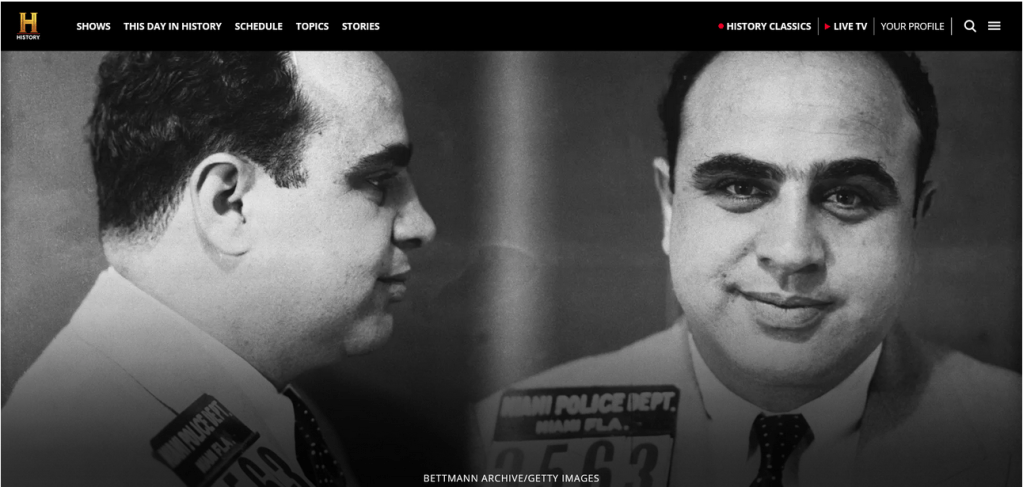
For this kind of people, for the Capones of this world, freedom – their freedom – is something to be appropriated rather than shared.

Think about it!
Do you remember the argument ‘the west has provoked the current situation’?

“Mr Farage said he had been arguing since the 1990s that “the ever eastward expansion” of the Nato military alliance and the EU was giving President Putin “a reason to [give to] his Russian people to say they’re coming for us again and to go to war”.
He added: “We provoked this war. Of course, it’s [President Putin’s] fault.””

What kind of freedom do we want?
For us and for our children?
The kind that must be constantly wrenched from the likes of Putin or one shared freely among all those present?
Built cooperatively or defended against all others?

Shaking willing hands or swinging fists?