Archives for category: Economy

two sided coin

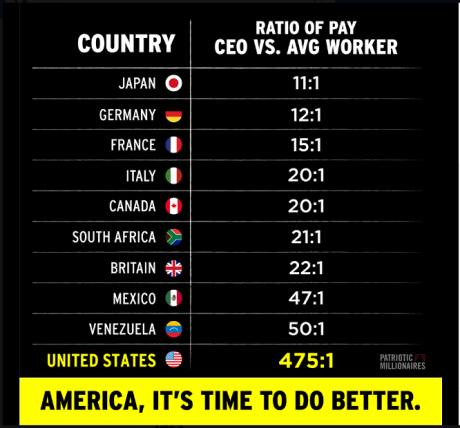
So, Japan and Germany have huge trade surpluses. Despite their workers being the best paid in the whole world. In both absolute and relative terms. Among the major economies, anyway.
Meanwhile, the US has a humongous trade deficit. Yet the American CEO-s are ‘compensated’ as if they were the best in the world…

Interesting, right?

More ideas about the same subject here:

Why is Japan Economy (surplus of over $100 Billion) a considered Weak Economy? & Why is USA Economy (deficit of over $400 Billion) Strong Economy?


Survival of the fittest“.

Evolution is not about survival of the fittest but about the demise of those unable to adapt. Even if the difference seems trivial this approach has vast consequences. As Ernst Mayr explains it What evolution is, (Basic Books, New York, 2002) one can never know what “best” may mean, in any situation. First of all because (Werner Heisenberg, Herbert Simon, Dan Ariely) you can never have a complete picture of anything and secondly because in the real world ‘situations’ are changing constantly – Panta Rhei.
So the only relevant test is survival, being able to cope with whatever comes along and not the brilliance with which one might be able to solve a very particular problem, at a particular moment in time.

Division of labor

After understanding ‘survival’, it’s a lot easier to figure why social strategy functions better than sheer individualism: by creating the right environment for its members to become specialists a complex team will cope better when confronted with  different complex situations than a mob composed of identically qualified members.
With the caveat that this arrangement works only as long as every member of the team realizes that it’s better for him to belong than to get out and only as long as all the members of the said team act consistently as if ‘one for all and all for one’. Otherwise put, complex teams where each has it’s own more or less indispensable role work properly only as long as most of the members continue to be ‘socially intelligent‘.

For those who feel there is an apparent contradiction here please note there are two levels of analysis/interaction.
Individually, each of us has to take care of him/herself (and his/hers immediate family).
Socially, each of us has the duty to evaluate the other members of the group and to exchange information with them about the well being of the whole group.

This can be taken even further. Whenever a subgroup becomes too ‘specialized’ –  as is in ‘becoming so preoccupied with it’s own well being as to stop caring about the rest’, its own survival is in danger. Time and time again, history shows us that those who become estranged from the rest of the society end up badly. Creating problems for the entire society, true, but ultimately their behavior amounts to a form of suicide. Callous royals end up on the chopping block, seemingly indestructible dictators end up at the hands of angry mobs… Erstwhile top of the feeding chain (too big to fail?!?) companies end up broke or bailed out by the government…

Politics versus Economics

I’m constantly amazed by the fact that politics and economy have grown so apart from each other and each of them so disconnected from reality.
Politics has become a constant struggle for administrative power while economy has ‘metastasized’ into a battle field where the foot soldiers struggle to survive while the big brass  gorge themselves with ‘money’.

Nowadays, too many politicians have forgotten that their job is to figure out, in close cooperation with the rest of the society, how to solve the various problems which  challenge us on a daily basis. Too many of them do nothing but fight among themselves, each of them attempting to impose their particular vision on all of us.
In the same time, the economic mechanism is no longer geared towards ‘making the ends meet’ – the original meaning of the Greek word oikonomia.
Our not so distanced ancestors have invented a self governing mechanism which very efficiently allocated the available resources to those who were able to put them to good use. Adam Smith described this mechanism as ‘the free market’.
Presently, we’ve corrupted this previously self leveling mechanism into a collective MMA arena where the heavier knock the wind out of the weaker in the name of ‘king profit’.

All this because we mistakenly believe free market capitalism to be an ideology when it is nothing but a mechanism for allocating resources.
The best to date, admittedly, but only as long as we’re wise enough to preserve the freedom of the market.
And as soon as we’ve mistakenly ‘anointed’ profit as the most important goal of any economic venture… the market had ceased to be free!  You see, profit is the best measure for efficiency – which, in its turn, is the best indicator for economic survivability, yet efficiency itself is pointless if the needs of the market are not met. Smith’s famous characters – the baker, the brewer and the butcher, went to the market to meet the needs of their customers. They became comfortably well off because they were successful in meeting those needs in an efficient manner, not because they were successful in cornering the market… as some of the present day tycoons are teaching us

Why do I maintain that a ‘profit obsessed’ market is no longer free?
Well, simply because the participants to such a market are just as free as those addicted to heroin. Both kind of addicts think of nothing but the object of their addiction and are oblivious to everything else. As in blind to everything else!
And I’m sure you all agree with me that being blind is detrimental to being able to stay alive. Specially so for those unaware of their blindness!
Or unaware of their addiction…


“Between 1970 and 2010, the number of administrators in health care grew more than 3000%, while the number of physicians grew about 200%, according to the Bureau of Labor Statistics. During that same 40 years, U.S. health-care spending rose 2300%. Doctors’ fees account for only 8 cents of the health care dollar. Where do you think the other 92 cents are going?”  (Marni Jameson Carey, Focus on Health Coverage Misses the Point, Forbes.com, Oct 24, 2017)

A few years ago I was arguing that profit was overrated.
It seems that Forbes, a magazine which cannot be accused of any socialist tendencies, has reached a somewhat similar conclusion.

Even more interesting is the solution proposed by Forbes to the health care problem.

A return to the free market!

Free from what? Who says the American health care market is not free?
Well, click on the quote above and see what Forbes has to say about this…

But what happened? How did we get here?

Well, the free market described by Adam Smith was an environment where people used to fulfill their needs by selling their wares.
The butcher sold meat and bought everything else he needed, the brewer sold beer and bought everything else he needed, the baker… and so on!
OK, there  was a certain kind of competition which kept the things in check. The butchers competed against other butchers, the brewers…
And because of this competition, all traders – those who wanted to survive, anyway – streamlined their operations and became more and more efficient. Hence profitable.

I mentioned the link between the survival of a commercial enterprise and its ability to generate profit.
Apparently, it doesn’t make much sense to elaborate on this. Bear with me, please.

The whole point of the free market is the division of labor. Besides its freedom, of course.
Each of us does what he knows better and then we trade our respective wares. This way all of us fare better than if each of us would have had to produce everything each of us needs to survive.
In this scenario, competition – between ‘bakers’, for example – is actually a tool which makes it so that the market, as a whole, doesn’t waste resources. When the less efficient bakers are ‘encouraged’ to find something else to do, the entire market is better off. And so on.
In this sense, profit is only one indicator – and a very good one – of how able to survive is a certain commercial venture. But not the only goal of the entrepreneur who started/runs the enterprise. What he wants is to make an as good as possible living by doing what he knows best, in close collaboration with the other participants to the free market.

Adam Smith had written his books some two and a half centuries ago.
And the free market had served us well, for a while.
Just look at what we’ve accomplished in these two and a half centuries.

But, just as Forbes points out, things are no longer going in the right direction.

Why?

Simply because the market is no longer free!

Not only because some of the participants have become ‘heavy’ enough to crush all competition. This is only the lesser part of the problem.
The really big one, and so well hidden that it’s almost invisible, is that too many of us have become obsessed with the same thing. Money!

Life-of-modern-people

Profit has become THE absolute goal of everything we do. Too many of those who participate in the free market no longer want to collaborate with the others but simply want to get rich. By any (legal) means.

Some say this is a good thing.
They invoke Adam Smith’s words as a justification for their beliefs.

I beg to differ.

The simple existence of our current obsession has profoundly altered the very nature of the market. Which is no longer free.

Because WE are no longer free. When too many of us are obsessively concentrated on the same thing, they will necessarily disregard all other options. And the rest have no other option but to follow.

This is not freedom!

Mesmerized people can not be described, by outside observers, as being free.
Regardless of how they consider themselves.


I’ve reached the conclusion that thinking and digesting have very much in common.

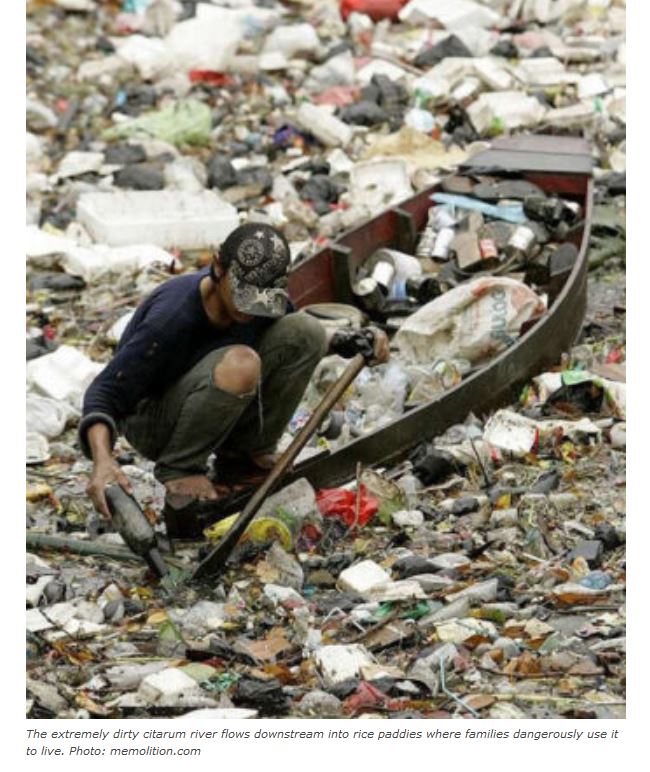
Citarum 2

We can’t do it by our own. Those of us who don’t cooperate/speak with those around them, don’t have what to eat or what to think about.

Both processes imply three stages. Identification, absorption, use.
We use cultural models to identify both our food and the important issues.
Absorption – through our gut/conscience, is both highly specific to each individual and governed by our common DNA/shared cultural traditions.
The ‘products’ of the digesting/thinking process are, again, used both in public as well as in private. Part of the energy we get from our food is consumed ‘cooperatively’ with our ‘coworkers’ while most of our thoughts end up either verbally expressed or put in practice.

Both processes, digesting as well as thinking, increasingly change the environment where we, and others, live.

Citarum 1

Until not so long ago it was possible to buy unlimited coverage against the risks that scared you.
After things became too complicated and fraud a too widespread occurrence even the Lloyd’s gave up and started to introduce caps on insurance policies.
In fact Lloyd’s of London was the only place – that I knew of – where risk was understood, at least in part, in a ‘functionalist’ manner.
Risk is something that can be seen in two ways.
As yet another opportunity for making profit or something that has to be mitigated for the profit of the entire community.
Let me deal with the latter ‘option’ first.
Somehow I don’t buy it that Bismarck was primarily motivated by the well-being of the workers.
But what the German industrial barons of the day needed in order to catch up with the British ones – the Albion was the industrial power house of that time, o tempora…- was more and more people willing to leave the relative safety of the country-side and come to the city to work in the newly built factories.
In order to appreciate the huge difference between these two situations we must remember that in those times families were a lot larger than they are now and that their members used to help each other in times of need. But this could happen only if the members of the same family remained in close vicinity and worked on very flexible schedules – agriculture or family owned shops. You cannot go help your ailing mother if you work in shifts and live two hundred miles away from her.
So, in order to ‘lure’ more and more people out of the fields, and in a very short time, Bismarck had to offer them a ‘safety net’.
OK, let’s accept the idea that, maybe, there are some risks that the society, as a whole, should concern itself with.
But how to fulfill this ‘social need’?
How to identify which risks should be dealt with in a collective manner and which should be left alone. Then how to manage the whole process?
‘State-wide’ or through privately owned/operated initiatives?
Does it really matter?
I don’t think there is a universally valid recipe here.
The Bismarck’s social insurance system worked in Germany.
Lloyd’s has functioned almost seamlessly for 3 centuries. In England.
Both systems, one centered mostly on profit and the other on the safety of those who took part in it, worked because they spread out both the risks and the profits.
Current systems, where only the risks are being mutualized while the benefits tend to become more and more centralized – by ‘design‘, by corruption or both – are no longer functioning properly.
Take ‘Obama Care’, for instance. Most people, including Donald Trump, agree that something has to be done about ‘public health’ but the whole thing isn’t yet working properly.
Instead of fighting among ourselves on whether the state/government should have anything to do with risk management how about considering for a moment where our current infatuation with ‘profit‘ has brought us?

It depends on the meanings we attach to these two concepts.

Yanis Varoufakis, Greece’s ex finance minister, is convinced that ‘Capitalism will eat democracy – unless we speak up.

Since he has some experience in this matter I’ll follow his line of thinking – for a while.

His point being that you can have successful capitalism in undemocratic societies – like Singapore and China – and that effective power has slowly shifted from the political sphere of the society to the economic one – which is undemocratic by definition.

Can’t say he’s entirely wrong, can we?

But we can say he’s somewhat confused…
So, he mentions Lee Kuan Yew’s Singapore and China as capitalistic success stories and then says that  the political sphere is gradually falling  under the yoke of the economic one… Well, last time I looked, in China the state was still in full control of everything that moved and the state was firmly in the hands of the politicians. Same thing was happenning during Yew’s tenure as Singapore’s good willed dictator.

Unfortunately there is some truth in his words when we look at what’s going on on the both sides of the Atlantic and that’s why I’m going to examine whether we have the same kind of capitalism in both situations.

By Google-ing the word I got two definitions for the concept.

The first definition that was offered by the search engine came from Oxford Dictionaries, “An economic and political system in which a country’s trade and industry are controlled by private owners for profit, rather than by the state” and the second one came from Merriam Webster: capitalism is “an economic system characterized by private or corporate ownership of capital goods, by investments that are determined by private decision, and by prices, production, and the distribution of goods that are determined mainly by competition in a free market“.

Putting them together we have private ownership, private decision, free market and profit as a goal.

Are these enough to describe a reasonably well functioning economic system?
I’m afraid not.

Let me give you some examples.
The French state has a controlling interest in Renault and the land of Bavaria quite a sizeable one in VW. Renault is in good shape and VW was too, until very recently. So private ownership is not an absolute necessity.
In the US we had quite an interesting situation. Two out of the three big car manufacturers  had to be bailed out by the state. All three were privately owned so we must look somewhere else: the Ford family still has a powerful word in the management of the single one which didn’t had to be bailed out. In Europe the best run auto company seems to be BMW – again controlled by a single family, the Quandt’s. It seems that it helps a lot if those who call the shots have a long time interest in the well being of the company versus the situation in which the top management has (short time) profit as the single/obsessive target.
Coming back to Renault and VW, they can be compared to Singapore, China and, maybe, Spain. Singapore was able to develop a ‘capitalistic’ economy despite it being an authoritarian society simply because Lee Kuan Yew was a very special kind of ‘dictator’ – one that not only cared sincerely for the greater good of his people but also didn’t loose his head during his long stage at the helm. A similar thing happened in Spain – Franco was the sole dictator who had made preparations for a democratic evolution after his demise, while China had to wait for another good-willed dictator to grab the power – Deng Xiao Ping – before it could steer towards the present course. No other authoritarian regimes but these two have ever managed to replicate this feat – we still have to wait a little before pronouncing Vietnam as the third, and very few other publicly owned companies fare so good as Renault does.

So, we have rather strong evidence suggesting that ‘skin in the game‘ trumps blind insistence on short time profit and that a free, democratic, society offers greater chances for economic development than a authoritarian one. In fact the politicians that need periodic confirmation from the people they govern do have some skin in the game while the authoritarians are in a position that is somehow equivalent to that of the CEO’s of the huge corporations whose stock owners are so disspersed that practically don’t count much – the members of the board practically slap each-other on the back and are able to do practically what they want with the companies. Look what happened at GM, Chrysler and, for example, ENRON.

But how free should be that society in order for capitalism to thrive?

Could it be so free that a guy could come from the street and claim your house as being his own? No?

So we need a free but orderly society. One where private property changes hands only when its owner says so – or has previously entered into a contract which stipulates that in certain conditions that transfer has to take place.

Meaning that in order to have a functioning capitalist society we need not only private ownership but also private owners who have enough trust in each other to start making business together.

You see, the feudal lords of the Dark Ages did have a lot of private property but capitalism couldn’t take hold in earnest as long as the (absolute) monarch could strip a man of his property and give it to somebody else. They couldn’t enter into (longish time) contracts because the era was dominated by huge uncertainties regarding various aspects of the social and economic life.

In fact it is exactly this well tempered freedom that is the crux of functional capitalism. Enough freedom so that everybody could feel confident that he is his own master but tempered by rules enforced in a pwerfully enough manner to give everybody sufficient trust that most contracts will be executed faithfully.

In this sense for capitalism to work properly we need to have a market that is free in more dimensions that one.

It has to be free from political intrusion in the sense that the government should leave it alone as a rule of thumb but also that the same government should keep it free from becoming cornered by a single group of interests.
In fact there is no difference from a market that is run by a governmental agency or by a monopolistic corporation – no matter if the latter is private. As soon as decision making becomes concentrated in too few hands mistakes starts happening. And their effect accumulate until the system finally collapse. Or is dismantled by some ‘exasperated’ more powerful agency – as Standard Oil and  ‘Ma Bell’ were dismantled by the US government. Which, by doing so, created the premises for  the huge development of those two respective markets – oil and communications.

Only this freedom of the markets can seldom be preserved by an authoritarian regime. Yew’s Singapore and contemporary China are exceptions, not the rule. Most authoritarian regimes cannot resist temptation and start meddling in the economic life of their countries. By doing so, they introduce a lot of ‘noise’ into the system. Eventually, this noise drowns the useful signals and ‘blinds’ the decision makers.

Same thing happens – and here Varoufakis has a valid point – when economic agents become so powerful that they can dominate the policy makers. The politicians can no longer preserve a balanced stance towards the economy and give in to ‘special interests’. This way the markets loose their freedom, with all the malign consequences that come with this situation. Among them, the lack of trust that slowly creeps in the souls of those who have to do business in the no longer free markets. Which lack of trust is very bad for all those involved.

And another thing about which Varoufakis is absolutely right. A lot of money are not being moved through the ‘front doors’. Not that they are not invested at all but because they are kept somewhat hidden they do not contribute as much to the well being of the world economy as they could/should.

2.1 $ trillion have been accumulated, as of  October 2015, in off shore accounts by the top 500 American companies in order to avoid taxes and
Between $21 an $32 trillion have been hiding in 2012 in various offshore jurisdictions.

Why is that? Simply because those who are called to decide about these money do not ‘trust’ that by bringing these money home and by investing them there, after paying the taxes, will be able to generate profits equivalent to those produced by leaving them off shore?

So what should we do? Tell them ‘democratically’, by electing somebody who is crazy enough to implement such a measure, to bring them home? Or even  confiscate them, one way or another?

I’m afraid that here I part again ways with Mr. Varoufakis. And with Aristotle: the way I see it democracy is not ‘the constitution in which the free and the poor, being in majority, control government‘. That would be ‘mob rule’.
A truly democratic process starts before the vote. When every stakeholder can make its point known to those who are going to cast a ballot so they’ll be able to do that having a reasonably clear understanding about what’s going on.

Frankly I’d rather rephrase Varoufakis’ message. ‘Corporatism has a tendency to disembowel democracy and transform it into ‘mob rule’ – the situation where the poor are no longer that free simply because they are convinced through ‘unholy’ methods to vote one way or another.

What can be done? Explain, loud and clear, that if jobs disappear the same thing will happen with the aggregate demand?
Explain that by giving their workers as little money as they can in reality the results are way worse than if the wages were as high as the companies could afford?
Ford didn’t give his workers more money because he loved them but simply because he had understood that in the long run he would be better off himself by doing this, you know!

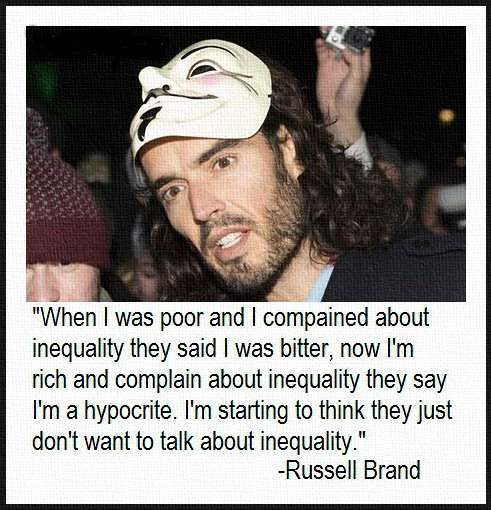
I recently shared this meme on my FB wall:

when_i_was_poor_and_i_complained_about_inequality_they_said_i_was_bitter_2014-07-23

This is what happened next:
No two people are the same.“”That’s why I prefer equal opportunities instead of equality.
No two opportunities are the same. What you might consider an opportunity I might pass up. It’s a very diverse world we live in, a wide one in which hopefully everyone can be accommodated.

‘Can be’ or ‘will be’?

And who is the real looser here?

Let’s see what the broad picture looks like:

The world’s super-rich have taken advantage of lax tax rules to siphon off at least $21 trillion, and possibly as much as $32tn, from their home countries and hide it abroad – a sum larger than the entire American economy.”

Meanwhile

education debt

And what’s wrong with that?!?
Everyone has the right to do what ever he wants with his money and why should anyone expect to be educated for free?!?

OK, let me put it differently.

Every society is like a big community, even if its members do not share an intimate knowledge of each-other.
At least theoretically an overwhelming majority of any nation share the same set of values and the same goal – the long term survival of both the population and the afore mentioned set of values.

Now please consider which society would be better at the game of survival:

One which would make it easier for as many of its members to develop as much of their individual potential as possible or one that would make it easier for a small number of its members to spirit away so much wealth that the rest would remain crippled?

One which would use the very concept of a ‘free market’ as broadly as possible – make sure that as many as possible of its members enjoy the widest possible autonomy – or one that would allow the ‘never as free as advertised’ market to degenerate into the ‘winner takes it all‘ situation we are bound to reach if we continue on our present course?

How could enough people afford to ‘wander around’ for long enough to find the opportunities that would fit them if they are saddled at birth with a huge burden – the ever burgeoning national debt?
Would enough people risk to take on any additional debt (in order to prepare themselves to make better use of the opportunities they might find) if too many of those opportunities, even if met diligently, do not pay enough to ‘eat’ AND pay back the debt?

How is a society going to survive, let alone thrive, if a lot of ‘opportunities’ (social needs) end up being ‘plugged’ by unfitting/under-skilled/’less than enthusiastic’ individuals? Or not at all?

On the ‘supply side’, what do you think of those who choose to dodge paying taxes?
On the ‘demand side’, what do you think of those who squander public money as if there is no tomorrow?

So what should we be talking about? Equality or Equal Breadth of Opportunity?
About the Bed of Procrustes or about a ‘Free Market’ where all participants are simultaneously autonomous and fully aware of their responsibility for their children’s future?

The current spate of dissent on this subject has been spurred by this guy, Angus Deaton, being presented with The Sveriges Riksbank Prize in Economic Sciences in Memory of Alfred Nobel

“A Nobel prize in economics implies that the human world operates much like the physical world: that it can be described and understood in neutral terms, and that it lends itself to modelling, like chemical reactions or the movement of the stars. It creates the impression that economists are not in the business of constructing inherently imperfect theories, but of discovering timeless truths.”

I’m afraid that the author had been so disgusted by the obvious mistakes that have been committed by so many of the supposedly reputable economists of this world that he has become amenable to throwing out the baby along with the bath water.

First of all we must remember that “Science is wrong. By definition.” All theories are imperfect and there is no such thing as ‘timeless truths’.
Ever since Karl Popper introduced the idea of ‘falsifiability’ as the litmus test for determining if any piece of information has any scientific value and Berger & Luckmann noticed “The Social Construction of Reality” it had become apparent both that science is being updated constantly – hence always ‘wrong’, or at least incomplete – and that people are ‘doing science’ on purpose – hence any discussion about reality being ‘described and understood in neutral terms’ is unrealistic, to say the least.

Coming back to Popper, Hermann Bondi had declared that ‘There is no more to science than its method, and there is no more to its method than Popper has said.’
True enough but as any ‘scientific declaration’ this is highly ‘updatable’.

In fact Science is, above all, a human enterprise. It’s a human that picks up – or devises – which method to use in a certain situation when he wants to find out something about a certain subject. Furthermore that method is applied by human individuals, not by robots. The same as those who had chosen it or by others, doesn’t make much difference. And, at the end of the cycle, some other people will evaluate – and sometimes try to replicate – the results.

So the mere fact that a certain set of results could not have been replicated by a certain team of evaluators doesn’t mean that much, by itself. This has been silently acknowledged by Andrew C. Chang and Philip Li in a paper published by the Federal Reserve in 2015: “Is Economics Research Replicable? Sixty Published Papers from Thirteen Journals Say ”Usually Not””. The couple admitted they needed some help from the original authors to replicate the results in a few instances and in some-others they didn’t have access to the same computer software as the first publishers.

But the most interesting fact is that in no instance the authors have been able to positively determine that the results published in any of the analyzed papers are inconsistent with the data presented by the original authors and/with the method invoked. In all instances when they failed to replicate the original results that happened because the original authors didn’t present at all the initial sets of data, they were incomplete or the method/sofware used to  process that data was incomplete, altogether missing or proprietary. And all this despite in some cases the papers being published by journals specifically requesting that all data/methods/software being made available at the moment of publication.

In this situation I find the conclusion reached as being both correct and highly objectionable. And above all lacking any scientific value.
“Because we successfully replicate less than half of the papers in our sample even with assistance from the authors, we conclude that economics research is usually not replicable.”

Yes, it seems that too many papers published by presumably reputable journals are not replicable. But that is due exclusively to the journals themselves not observing their own rules or by some of the authors acting less than ‘over the table’. This phenomenon has nothing to do with ‘economics’ being less of a science than, say, physics and everything to do with humans being… well… human!

Let me go back to where I started, to Joris Luyendijk claim that “Don’t let the Nobel prize fool you. Economics is not a science.”
The author ‘illustrates’ his claim by remembering the infamous LTCM – a hedge fund set up by, among others, a couple of economists who had received a … you guessed it… a ‘Nobel prize for economics’ less than a year before the hedge fund went bust. Kind of ironic, isn’t it?
But the problem remains. The fact that LTCM went bust doesn’t prove anything except the fact that its management was completely inadequate.
The point is that trying to assert that ‘economics’ is not a science only because some guys used a couple of economic theories and failed, abysmally, is akin to claiming that physics is not a proper science because no weather bulletin is 100 percent accurate. Or that biology is not a full blown science because medicine has not yet found a cure for cancer. Or to claim that chemistry is bogus simply because Big Pharma is ripping us off.

At the end of their paper Chang and Li offer some very pertinent advice about how things could be vastly improved. Their main idea being that everything must be ‘above the table’ – both the raw data and the method/software used to process it must be made available for whomever wants to replicate the results. In fact this exactly what science, real science, is about. People have to be able to check thoroughly whatever the proponents of a theory are trying to ‘peddle’. This is the only way for a theory to be proved true or false. Or incomplete so further research might be declared necessary.

Similarly, at the end of his article Joris Luyendijk points his finger at the real culprit.
In reality economics, as a space where people try to gather information, is different from, say physics, only because we, the people, approach them with different attitudes.
Time has taught us, repeatedly, that every-time we’ve tried to deny the obvious we ended up with a bloody nose. The problem is that not all of us are, yet, able to recognize the obvious.
No one in his right mind will pretend, nowadays, that the Earth is flat. Meanwhile some people still pretend that vaccines may induce autism. They don’t. But some of the ‘anti-Vaxxers’ continue to pretend this even after a study partly funded by themselves demonstrated that there is no link between the two.

As suggested by Luyendijk and demonstrated by these examples the real culprit for what is going on, not only in the economic field, is our arrogance.
Arrogance that has led to the survival of what is known as ‘tehnocratic thinking’ despite more and more people learning of the role ideology plays in our decision making.

After all what can be more arrogant than pretending that you have ‘scientific reasons’ for what you do, despite the obvious fact that every one of us acts according to his own ideology?

I’m not going to pretend now that there are good and bad ideologies. I obviously think they can be classified but I cannot pretend that my classification is the correct one.
But I can pretend, and you should too, along with Joris Luyendijk, Andrew C Chang and Philip Li, that each of us should honestly state its point of view along with his opinion when ever discussing something.

After all each of us having an ideology is a reality while pretending that any of us can act as if it doesn’t is a rather pathetic lie.

To conclude I’ll have to keep the promise I’ve made at the beginning of all this and ‘update’ Bondi’s statement about Popper:
‘There is no more to science than its method and there is no more to its method than Popper has said’ but we should always bear in mind that science is exclusively ‘performed’ by human individuals.


Taking the mic. Varoufakis. Yves Herman/Reuters Varoufakis in conversation with leading academics as Syriza splinters and election beckons in Greece

The strangest thing of all that happened in Greece is not that ‘the emperor has been naked for sometime already’ but the fact that this has been public knowledge.
Yet everybody still pretends everything is OK.

Click on the picture and read the article in The Conversation.
You can also check my previous post on this subject here.

“Why should the European taxpayers bail out the profligate Greeks?”

That’s the mantra I’ve been hearing for some time now, even though a way bigger, and darker, cloud slowly builds up on the other side of the world.

As almost all mantras there is a small nugget of truth in here, even if things are not at all as some want us to believe. wrote this almost prophetic article for Reuters, more than two years ago.

So?

First of all I’d like to quote the definition proposed by Investopedia.com for ‘moral hazard’:

“The risk that a party to a transaction has not entered into the contract in good faith, has provided misleading information about its assets, liabilities or credit capacity, or has an incentive to take unusual risks in a desperate attempt to earn a profit before the contract settles.
Moral hazard can be present any time two parties come into agreement with one another. Each party in a contract may have the opportunity to gain from acting contrary to the principles laid out by the agreement…..
.
.
.
Moral hazard can be somewhat reduced by the placing of responsibilities on both parties of a contract….”

The way I understand this definition is that it is the job of both parties who enter into a contract to perform every diligence they see fit before committing to that contract  and to assume the responsibility afterwards.
Let’s see if this definition sheds any light on today’s subject.
The Western World tends to act as if all countries were functioning as communities. If we don’t like what Putin does in Ukraine we impose sanctions that hurt the entire Russia in the hope that people will do something about the situation. That tactic works very rarely – see what happens in N. Korea and in Iran. Even more, sometimes it even backfires. Look at how popular Putin has become after the sanctions have been put in place.
Coming back to Greece we have become fed up with the shenanigans of the Greek politicians – right, left and middle – and now we insist on harsh ‘austerity measures’ in the hope that the Greek voters will somehow find among themselves an honest knight in a shinning armor that will appear from somewhere and teach them to pay their taxes – and by doing so they’ll dully repay the entire debt that has accrued over the time.
After all it’s their responsibility, isn’t it?
It was them, the Greek voters, that have elected the corrupt politicians in the first place. It was them, the Greek voters, that didn’t do anything when they noticed that their Government was corrupt. Even more, some of the ordinary Greeks must have helped the corrupt politicians – nobody can be corrupt by it’s own, somebody must be at the other side of the deal. On top of that dodging taxes was, and still is, a national sport in Greece – well, that’s actually a rational thing to do: ‘who in it’s right mind would willingly pay his taxes, knowing that most of the money would be squandered away’?
Does that mean that the Greeks should be made to reimburse, in integrum, what their creditors demand of them?
OK, lets forget for one moment that this not possible and that if Greece defaults not only the Greek people will have to endure harsh conditions for a while but also the creditors will loose a considerable amount of what they are due.
Let’s presume that a completely different Tsipras somehow convinces the Greek people to accept pension cuts, tax hikes and, lo and behold, to pay their taxes in an honest way.

Then we’ll still have a fine example of ‘moral hazard’.
We have just established that in a democracy the voters have the final responsibility for the actions of those elected/hired into meaningful positions.
And what did the elected officials, from Brussels as well as those from the rest of the EU capitals? Turned a blind eye when Greek politicians ‘cooked the books’ before Greece was admitted into the EU and, after that, into the Euro zone? Then, when the private banks that had unwisely extended credit to the profligate Greeks had troubles recouping their money, the same elected officials said nothing while Jean Claude Trichet, the then president of the ECB, helped transfer the entire burden – mind you, no ‘haircuts’, unto the ‘wider’ shoulders of the European tax-payer? Who said absolutely nothing!
Only now some of the elected politicians, afraid that their constituents might finally protest, have started to notice the irresponsible attitude of Greece, to demand harsh austerity measures and to refuse even the idea of any debt relief.
So how come we can speak of moral hazard when we describe what the Greeks (governments, tax dodgers and general public) did but never mention in this context the lack of financial responsibility displayed by the investment bankers that helped the Greek governments cover up their shenanigans, the European officials who turned a blind eye to what was going on and the wide European public who didn’t care about what was done with their money by those hired to take good care of the European finances?
What is going to happen from now on?
Before trying to gouge that we need to understand what sets Greece apart from the countries that have dragged themselves out of the worst phases of the latest crises – Ireland, Spain and Portugal: Greece is a country deeply divided by rampart corruption.
In most of Europe corruption is a cancer that reaches across the entire social organism, in Greece it divides the population in two almost equal parts: those who work for or do business with the Government and all the rest.
The situation is made worse by the fact that Greece has become independent rather lately, specially compared with the Western Europe. Furthermore, the process was a lengthy one, it started in 1821 and ended right after WWI, only to recommence during WWII. Add to that the long list of authoritarian leaders and you’ll understand the deep mistrust between the people and the Government – which is not at all ‘their’, despite Greece calling itself a democracy. I have a distinct impression that even those who work for or do business with the Government doesn’t really trust it – they know too much about what is going on there. Small wonder, in these conditions, that dodging taxes is a national sport…
What we have now is, on one side, some European leaders who were elected on a conservative/popular ticked and who have already introduced some austerity at home and, on the other side, a leader who has promised to end austerity.
For these people to reach an agreement both sides have to admit failure: the European leaders must accept the past errors and take responsibility for them and Tsipras must convince his constituents that they need to change their attitude. Completely.
Does any of this have any chance to come true?