Archives for category: cooperation

truck-nice

When facing an uncertain future, people are hard wired to search their past.
Some look for things that have gone well and hope that reenacting them will bring back a measure of order in their lives.
Some others look for clues pointing to things that went bad, hoping that making them right will change their prospects.

In this respect I remember how fascinated I was when I first heard about Malraux’s “The XXI-st Century will be religious or will not be at all“.
When trying to understand what Malraux wanted to convey we must remember that he started as a left wing intellectual who, at some point, felt an admiration for Stalin. Later, after he found out what Stalin was really up to, Malraux had given up on Stalinism but never on his atheism. So?

Looking even further back in time we arrive at Emile Durkheim’s Suicide.

Written at the end of the XIX-ht century the book teaches us that while suicide remains a profoundly individual decision those who consider it are deeply influenced, when making the call – one way or another, by the strength and nature of the social ties that connect him to the community to which each of them belongs.
Further into the book Durkheim also discusses the fate of the communities themselves, arguing that a society needs to keep a dynamic balance between social control – that keeps a community together – and a healthy dose of deviance – which might pull at the seams of a society but simultaneously allows it to change when it has to do that in order to survive.

OK, all these are very nice but will you come back to our present? You promised us something about the future and you are leading us further and further into the past. Into a ‘mythological’ past, no less…

One of the most pressing issues that we must face today is the advent of ‘lone wolf’ terrorism. The kind that not only scares us the most but also the one that is hardest to prevent.
Some even try to make us accept the idea that we’ll have to learn to live with it.
“No revelations come from the massacre in Nice. There is nothing to be learned. This is what we live with, what we are getting used to living with. None of it is surprising—that’s the most frightening thing of all.” (George Packer, The Tragic and Unsurprising News from Nice, the New Yorker, July 15 2016)

Well, I strongly disagree with this line of thinking.

What happened in Nice, where a lunatic drove a truck through people gathered to watch fire-works celebrating Bastille Day and killed 86 of them, is proving that both Malraux and Durkheim were spot on. Each in his own right.

In the last twenty or so years, terrorist acts have doubled as suicides. Some perpetrated by ‘simple minded’ youngsters driven to desperation by perceived socio-economic inequities and primed by callous so called religious leaders while others were carefully planned and cold-bloodedly executed by apparently sophisticated members of the middle class.

If we interpret these acts according to Durkheim’s theories we might reach the conclusion that the communities that harbor the terrorists do not function properly. Either the individuals feel so constraint by the existing rules that they cannot find enough breathing space – and snap – or that they cannot find enough social support – and go out ‘with a bang’.

Or both, at the same time.

Let’s remember that those who comited most recent terrorist acts, in Europe and in the Middle East – if we count those who joined ISIS coming from the Western Europe, are second generation Muslim immigrants or new Islamic converts.
I’ll deal with these two categories separately.
The second generation immigrants had a very frustrating experience.
Their parents came from abject poverty, worked hard and, most of the time, fared a lot better in their new countries than any of them even dreamed of on arrival – specially when comparing to the situation in their countries of origin. The youngsters went to school alongside the natives, watched the same television programs and read the same books and magazines. And grew to have the same expectations. But had a lot more difficulties when tried to fulfill them. Because of their skin color, religion, etc., etc. Add to that the nefarious propaganda coming from the Wahhabi preachers and you have an already primed keg of gun-powder waiting for a spark.
But let’s not forget that these people live in otherwise closely knit communities.
And that preparations for terrorist acts do take some time and effort.
How come these preparations go unnoticed and, even more important, unreported?

Can we conclude that whole communities have went past the ‘I don’t care anymore’ point?

A situation for which Durkheim used the term ‘Anomie‘?

Could we consider that not only the immigrant Islamic communities are in an anomic state but also the larger, host ones? For letting the whole situation degrade to such an extent? Not only at home but also at the door steps of Europe?
And please remember the new converts to Islam. What happened to those youngsters – most of them are young people –  that they became so estranged to their native society that emigrated to a totally different realm, not to a different country? A few of them might be explained away by individual ‘deviance’ but such a large number becomes a social phenomenon that begs a different explanation.

Should we accept the situation – and the degradation that would inevitably follow if nothing is done – or should we heed to Malraux’s advice and do our best to find new, and more efficient, communication channels so that we’ll be able to built some much needed trust amongst us? Based on mutual respect, not on MAD force?

Recep Tayyip Erdogan saved his political ass last week-end by urging his “supporters to take to streets in protest of coup

gettyimages-576527614

Supporters of Turkish President Recep Tayyip Erdogan react to a Turkish military tank in front of the Turkish Parliament July 15, 2016 in Istanbul, Turkey.

Which they did and the coup eventually failed.

Leading some observers to salute the maturity of the Turkish democracy:
“The most valuable outcome of last night’s events is that many people who are not AKP supporters stood up for democratic values despite the recent crackdowns on the opposition, and despite the tension and the polarization of the country.” (Erol Önderoglu, Turkey’s Reporters Without Borders representative who is currently on trial on terrorist propaganda charges after participating in a solidarity campaign with a pro-Kurdish newspaper.)

“These people do not support Erdoğan, but they oppose the idea of a military coup. Turkey has a history of very painful, traumatic military interventions, so I was not surprised to see such united opposition to this attempt.” (an academic who wished to remain anonymous)

But ‘not everybody is happy in paradise’.
“Everyone spoke out against the coup last night and that gave me hope” … watching events unfold today this hope has shrunk quickly. Last night there was the possibility that the government would use this to return to a more unifying language, to return to the peace talks, to unite the country. But today it looks like they will use [the coup attempt] simply to consolidate power.” (the same anonymous academic)

What’s going on there? Is Turkey a real democracy?
Or, if we dare to look from the other side, ‘what’s wrong with contemporary democracy’?

Is it enough for elections to be held regularly and the votes duly counted for a country to be called ‘democratic’?

I’m afraid not.
Communist Romania did have regular elections, where a huge proportion of the people rubber-stamped the party line.
Putin is currently serving a third mandate as Russian president, after paying lip service to the Russian constitution and letting Dmitry Medvedev fill in between 2008 and 2012.
No major irregularities were noted at the time of the voting in Russia when Putin was reelected but somehow I cannot consider the process fully democratic.

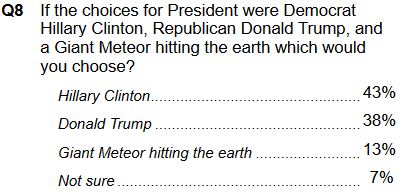
Even in the United States things are no longer what they used to be. Both major parties have put forth candidates that are seen unfavorably by a majority of the people. So unfavorably in fact that 13 % of the registered voters would rather see the Earth being hit by a giant meteor than any of the two as President.

unfavorable trump clinton

Clinton trump unfavorable

clinton meteor

Public Policy  Polling, June, 13, 2016, Raleigh


So, again, what’s going on here?

I’m afraid that what has been known as ‘democracy’ is being slowly eroded to ‘mob-rule’.

You see, in a really democratic situation you get the ‘real deal’ with ‘all the trimmings’ while when having to deal with ‘mob rule’ all you get is some ‘window dressing’.
Or, as the Romanian saying goes, on the outside you are greeted by a white picket fence but once inside you’ll have to deal with a white fanged tiger.

Let me explain myself.
Theoretically democracy is a situation where everybody has some, even if minute, influence over the fate of the community to which he is a part.Practically it means “government by the people; especially :  rule of the majority”.

I’m almost sure that by now most of you have already figured out what I’m driving at.

‘Rule of majority’ can be more dangerous than a regular dictatorship if that majority has been improperly led into voting the way they did.
A ‘dictator’ might be wise enough to know that if he drives the situation way beyond the plausible something will eventually snap but someone callous enough to lie to an entire society doesn’t have such qualms. In fact this is the explanation for why not all authoritarian regimes end up in complete failures.

On the other hand most of them do exactly that while no democracy has failed yet, as long as it maintained its democratic character.

Why? Simple.

Running a complex system – and a country is a very complex system, is a matter of setting goals and avoiding making mistakes.

And while setting goals is important, avoiding mistakes – specially catastrophic ones, is paramount.

If goals are chosen improperly – not bold enough, for instance, or even misguided, that society will experience a ‘hiccup’ but if that society is led into a dead-end then it might never recover. The ‘funny’ thing here being that in many instances the authoritarian leaders were quite good at setting goals but almost always sooner or later ended up in a ditch because they were very poor at avoiding potholes.

But how come democracies are better at avoiding grave mistakes than centralized administrations?
‘Four eyes see more than two’, specially if they look in different directions.
Every authoritarian regime follows the cue of the authoritarian leader and tends to down-play, or even ignore, the rest of the problems. This tendency is accentuated by the fact that those positioned higher on the roster tend to be better insulated from the immediate effects of their decisions. So relatively small mistakes keep piling one atop the other until the heap cannot be balanced any longer.
On the contrary, in a functional democracy – where everybody has a real chance to bring his concerns to the attention of others, mistakes are not only easier to spot but also easier to avoid.
Only this cannot happen as advertised unless the members of a society have a healthy dose of mutual respect. Nobody is going to pay any attention to what is being said by a ‘pariah’. No matter how interesting, or important, that might be.

And this is exactly what happens in a ‘mob-rule’ environment. Nobody listens anymore to what ‘the other’ has to say. People allow themselves to be driven into separate herds and, once there, pay no attention to anybody else but their ‘own’ cattle-driver. Who not only that doesn’t have any respect for ‘his’ herd but usually doesn’t care for anything else but their votes. Reason would ask that he should pay close attention to the well being of his herd but since he is convinced that he can always attract new followers he will usually go for the ‘cheapest’ alternative – taking good care of a flock being more ‘expensive’ than luring some new ‘green horns’.

That’s how people become estranged from one another and end up with their eyes glued to the whip of the cattle driver. That’s how democracy becomes an empty concept.

That’s why an honest count of the ballots doesn’t mean much if the public discussion which preceded the voting wasn’t both free and meaningful.
That’s why reducing democracy to ‘rule of the majority’ is akin to putting the cart before the horse.

The real scope of the whole process being to openly examine as much information as humanly possible before starting to make decisions (vote), not to (artificially) build majorities around (charismatic?!?) political figures. Or should I rather call them by their rightful name? Con men?

nlm_o2_graphic10


“When one body exerts a force on a second body, the second body simultaneously exerts a force equal in magnitude and opposite in direction on the first body.” (Newton’s third law of motion)

For me, the most interesting side of this phenomenon being that the ‘reaction’ is innate in the nature of things. None of the two objects that interact need to do anything in order for Newton’s law to be obeyed.

paramecium-diagram

Google Paramoecium – the unicelular organism depicted here, and you’ll get a lot of pictures resembling this one. None of them even mentions ‘membrane’. That’s an eloquent enough proof about the fact that membranes are, unreasonably, taken for granted.

The next level of this is the ‘membrane’. That thing that separates the ‘inside’ of an living organism from its ‘outside’ and which not only distinguishes between these two spaces but also controls whatever enters and exists the organism – as long as all goes in a regular manner. If something irregular happens to that particular organism its membrane might be overpowered and the organism dies.
At this level also things happen according to some innate laws, without outside intervention and without any need for deliberation on the part of the organism itself. Even when we speak of evolved animals and even with us, humans, most of the inner workings that take place inside our bodies happen ‘under the radar’.

And it seems that what we call ‘deliberation’ isn’t that important after all. Newton’s laws have organized the Universe ever since mass has been around while membranes have made life possible on Earth for the last billion years or so.

The third level, what we call human conscience, has started to develop some 200,000 years ago. Approximately, of course. Humberto Maturana has proposed a very interesting explanation about how it came to be and you can read about it here. For what I have in mind, it is enough for me to mention that Maturana says that we are not only conscious but also aware of our consciousness.

And it is this awareness that has the most important consequences.

I started this post by quoting Newton’s third law of motion. I’ll go back to him and remind you of the first two:
“An object either remains at rest or continues to move at a constant velocity, unless acted upon by a net force” Meaning that things have a tendency to keep doing whatever they are doing at any given moment until something from outside messes with them and
The vector sum of the forces F on an object is equal to the mass m of that object multiplied by the acceleration vector a of the object: F = m Meaning that the end result of an interaction is not commensurate only with the amount of energy spent during that interaction but also with the manner in which that interaction has taken place. The ensuing ‘vector sum of the forces on an object’ depends essentially on two things. How big are the individual forces at play and in which direction are each of them pulling at the object.

I’ve been speaking about ‘three levels’.
At the first two levels the amount of force that was messing with our objects and its orientation relative to the objects (Vector sum) depends only on ‘chance’. The objects themselves – who have no say on the matter, the interactions following blindly some innate rules – can not influence in any way the outcome of the interaction. The results have already been settled at the moment when ‘chance’ had met with the individual characteristics of each object involved in the interaction.

The third level, though, has a very interesting characteristic. At least one of the objects involved – the human individual – is, at least somewhat, aware of its own existence and of its ability to interfere in the development of the interaction. To influence the outcome of  interactions that take place within his reach.

This very awareness, how ever partial, explains why most individuals do their best to survive: they are aware of their mortal nature so they do everything in their power to stay alive, in fact to respect Newton’s first law.
Also it is the same awareness that is responsible for our ‘rational’ behaviour. We have discovered that the results depend heavily not only on the amount of effort spent on the occasion but also on how that effort was applied to the task. Hence the conscientious manner in which we try to get as much bang for our buck.

And the same awareness makes me wonder how come so few people understand the difference between ‘reactive’ and ‘constructive’.
Why so many people, when confronted by a new situation, tend not only to fall back on the ‘tried and trusted’ but also to defend them as ‘the only valid option’. Not taking into account that it is the very novelty of the entire situation that is the most challenging aspect of the whole thing.

So instead of putting all the cards on the table in an attempt to find out a mutually acceptable solution for all – or at least for as many as possible – participants in a given interaction tend to jealously keep their cards close to their chests, negating any chance of cooperation.


rocket1

The Opposable Mind by Roger Martin, 2007  A good lesson about how to overcome this tendency.


5eg5cq4_llox-4hqq6q6r-cwzhlmn9igl6ermaorfgy

For the last 3500 years humankind has been busy writing Laws.

Which can be grouped in two main categories.
Natural laws and man made (normative) laws.
According to this classification while all laws have been written by Man those belonging to the first category are active regardless of Man being aware of their existence and those who belong to the latter come to life only as long as Man chooses to enforce them.

Another classification could be ‘phusical’ laws – ‘phusis’ being an ancient Greek term for ‘grown naturally’, all things that came to be in a ‘natural’ manner – ‘statistical’ laws and, again, ‘normative’ laws.

Both these classifications depend on how much influence Man has over how the laws work, besides the obvious fact that the wording, in all cases, belong to Him. To Man, of course.

The difference between them being that while the first sees Man as an individual making decisions by himself the second takes into consideration the fact that Man cannot function properly outside of a community.

Before going back to discuss some more about both classifications I have to note that laws are important mainly because they define areas of opportunity.
People are, from a functionalist point of view, self aware decision makers. But since none of them has an infinite amount of knowledge at his disposal nor an infinite capacity to process what ever information he has on a subject, people find it very useful to have the reality around them partitioned into ‘safe’ and ‘enter at your own risk’ areas.
In this respect it doesn’t matter whether the law itself belongs to either of the 5 categories. The consequences of the law are the same. Those who are aware of its existence have a lot easier job at discerning the safe from the potentially dangerous places than the ignorant ones. What each of them does after finding that out is another matter.

Coming back to the first classification, ‘natural’ versus ‘normative’ laws, let me elaborate a little about what ‘natural’ means in this situation.
It is obvious that the law of gravity, the one formulated by Isaac Newton, belongs here.
It started to produce consequences as soon as ‘mass’ came into existence – regardless of who, if anyone, made the necessary ‘arrangements’ and regardless of anyone being aware of its very existence or not.
But how about the law against killing another human being?
Animals belonging to the same species occasionally do kill each-other so this doesn’t seem to be an all encompassing natural law.

On the other hand history has compellingly taught us that communities where individuals are treated fairly by their peers fare a lot better than communities where some of the members kill (some of) the others. In a Darwinian sense the communities who do protect the lives of their members have an evolutionary advantage over those who don’t.
In this sense the ‘do not kill’ law becomes ‘phusical’. It is both ‘man made’, hence ‘normative’, and acts regardless of people being aware of its existence.

And no, this is not the same thing as ‘ignorance of the law offers no excuse‘.
As I said before, the first classification, ‘natural’ versus ‘normative’ considers Man mainly as an individual – who cannot hide himself under the cloak of ignorance and who has to bear the consequences of his acts, if apprehended – while the second classification, ‘phusical’, ‘statistical’ and ‘normative’, considers Man as an individual member who both depends heavily on his community and contributes decisively to the well being of the place where he lives.

In this respect ‘do not kill’ becomes a ‘statistical’ law. If enough individuals refrain from killing other people and if the community successfully puts in place and operates a protection mechanism  to guard the lives of its members, without otherwise stifling the ingenuity of its people, that community will fare better than those who either fail to protect their members or protect them so jealously that transform them into hapless puppets unable to fend for themselves. Those who are interested to find out more about the equilibrium between protection and freedom of expression might want to check Crime and Deviance, Functionalist Perspective.

By now you must have noticed that ‘statistical’ laws are both ‘objective’ – in the sense that they will produce consequences even if people are not aware of/do not care about their existence, and ‘normative’ – in the sense that those consequences do depend, heavily, on how people act.

So. Does this make me a staunch defender of ‘normative’ laws?

Not at all. Just as Durkheim noticed long ago telling people what to do will only stifle their ability to adapt. To cope with change.

That’s why I strongly feel that ‘normative’ laws, the few that are really necessary, must be written in a ‘negative’ way. Do not kill, do not rape, do not discriminate, do not steal are quite different from ‘all of us have to be maintained alive’, ‘we must assign an armed guard to every nubile woman’, ‘we must write millions of pages of rules to cover every possible act of discrimination’, ‘we must arm ourselves to the teeth in order be able to defend our property against all odds’.


I recently read an excellent article about how the ever-growing lack of trust in public institutions, governments and experts included, is generating aberrations like Donald Trump becoming the darling of a sizable proportion of the American Republicans.

collapse of trust in institutions

I’m afraid that all of us have contributed to this.

People who get elected to power use it to fulfill  their own goals yet continue to get elected despite the fact that many of those goals do not add anything to – and too many times even subtract from – the general well being.
People who, for various reasons, vote for those mentioned above.
Media pundits who fill the airtime with their versions of the reality, purposefully crafted to fit their own goals instead of honestly trying to present to the public what they have seen/understood of what had happened.

What’s bothering me most is that all of them are behaving in an absolutely ‘rational’ manner.
In the sense that all of them are convinced they are following the current mantra.
“Make the best of the opportunities at hand”

Given the current ethos – that only the pussies do not grab everything within their reach – each of those in places where they might be given things would act foolishly not to accept those ‘gifts’. If they might find a ‘legal’ way to do it.
And the Supreme Court of the US concurs.

In a unanimous decision, the U.S. Supreme Court threw out the corruption conviction of former Virginia Gov. Bob McDonnell.

“There is no doubt that this case is distasteful; it may be worse than that,” Chief Justice John Roberts wrote for the court. “But our concern is not with tawdry tales of Ferraris, Rolexes, and ball gowns. It is instead with the broader legal implications of the Government’s boundless interpretation of the federal bribery statute.””

What happened was that former Gov. Bob Mc Donnell had accepted various gifts from a certain business man called Williams and then (because of them?) ‘set up meetings, hosted parties and called Virginia officials to discuss  a series of meetings to discuss aspects   related to William’s businesses.

Now, is this an example of corrupt behavior or not?

According to the Government and to the lower courts that have sat on this matter, it is.
According to the Supreme Court, it is ‘distasteful and even possibly more than that’ but not yet corruption. Or, at least, not in the way the Government has presented its case.

“But conscientious public officials arrange meetings for constituents, contact other officials on their behalf, and include them in events all the time. The basic compact underlying representative government assumes that public officials will hear from their constituents and act appropriately on their concerns — whether it is the union official worried about a plant closing or the homeowners who wonder why it took five days to restore power to their neighborhood after a storm. The Government’s position could cast a pall of potential prosecution over these relationships if the union had given a campaign contribution in the past or the homeowners invited the official to join them on their annual outing to the ballgame. Officials might wonder whether they could respond to even the most commonplace requests for assistance, and citizens with legitimate concerns might shrink from participating in democratic discourse.” Chief Justice John Roberts writing on behalf of the court.

The way I see it this is nothing but ‘hiding behind technicalities’.
From a formal point of view the Supreme Court’s decision is absolutely correct.
On the other hand almost everybody speaks out, some very vehemently, against ‘pork barrel politics’.

Yet nobody does anything when occasion arises. Forgetting that this is exactly what we, humans, are supposed to do. Make decisions and assume responsibility for them. Otherwise, if we only look out for pretexts to do nothing when those around us keep making ‘good’ use of whatever opportunities they identify, the whole world will soon become, again, encased in the kind of straight jacket Hitler and Stalin were trying to put on us.

Here’s another example.

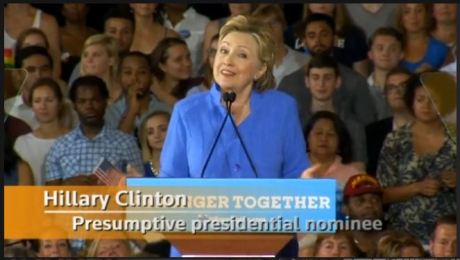
Less than a fortnight from now the Republican and the Democratic conventions will likely nominate Trump and Clinton as their respective presidential candidates. Each passionately defended by their followers and viciously attacked by their adversaries.
Yet both almost equally disdained by the general public.

“More time on the campaign trail isn’t improving the image of either major-party presidential candidate, Hillary Clinton or Donald Trump, a new Wall Street Journal/NBC News poll finds.
Some 60% of registered voters held a negative view of Mr. Trump, the presumptive GOP nominee, compared with 58% in May. Some 29% viewed Mr. Trump positively this month.
Mrs. Clinton, the former secretary of state and presumed Democratic nominee, fared somewhat better, with 55% viewing her in a negative light, compared with 54% in May. One-third of registered voters held a positive view of her.” (Peter Nicholas in Wall Street Journal, June 27 2016)

What’s going on here?
Why has any of them been picked up as candidate in the first place?

And why none of their detractors mentions the trait of character that both of them have in common?

The complete disrespect both of them have for ‘comme il faut’.
You see, ‘properly’ doesn’t necessarily mean ‘being a stickler for the word of the law’ but certainly means following the ‘spirit of the law’.
You’d expect as much from the two contenders for the Oval Office, don’t you?

Yet Donald Trump has a history of trying to use the law in order to drive an old woman out of her house so that he could have build a parking lot for one of his casinos while Clinton is being currently investigated for the highly irregular manner in which she used to manage  her e-mails when she served as Secretary of State.

To me this is a pertinent enough explanation for why a majority of the people do not trust that any of them would have ‘the better interests of the country’ in mind if and when any of them will be elected to office.

Making a step further people might soon develop a distrust for the whole concept of democracy – simply because the system was unable to deliver better candidates/alternatives. Not only in America.

And since the idea of democracy starts with trusting your fellow citizen to be able to make pertinent decisions – even if they happen to be contrary to your own ideas on the matter – it is highly likely that we’ll soon live in a very untruthful world.

tainted vote

“It was a fair vote. They may not like the outcome but nobody’s saying that the vote was tainted. Maybe by the misinformation ahead of it … but the actual voting process…”

If there is something to be learned from the current debacle is that democracy is about way more than honestly counting the votes.

In fact, if we resume ourselves to that, we’ll end up tied down in a cage known as ‘mob rule’. Who ever succeeds to stir up more efficiently the public sentiment will rule the day and ‘apres nous, le deluge‘.

In order for the democratic process to be efficient – actually democratic, that is – the electorate must have at its disposal all the pertinent information that is available at that moment. If the electorate doesn’t really care and doesn’t mind that information… that’s it. But the information has to be readily available.

And there’s the catch.

If those ‘in charge’ use the media to spur up public sentiment instead of honestly informing the people about the  situation at hand then we’ll have a beauty pageant instead of a democratic election. Or referendum.

What we really need to remember, fast, is that for a democracy to maintain its function – weed up the really bad leaders/ideas proposed in the public square – we need to add two things to ‘honestly counting the votes’.

‘Mutual respect’ among all members of a given society and a keen enough interest of a majority of the members of that society in the well being of their community.

‘Democracy’ won’t work properly unless the voters respect each-others, and the government they had, themselves, elected. Simultaneously  the government has to treat ‘the people’ with utmost respect, not as if they were hapless children in dire need of close guidance.

At the same time no democracy ever successfully maintained its character unless the ‘leaders’ were constantly remembered of their ‘mortal’ status.

And the Lord God said, “The man has now become like one of us, knowing good and evil. He must not be allowed to reach out his hand and take also from the tree of life and eat, and live forever.”” Genesis, 3:22

The point being that those who think they can make the difference between good and evil need their feet constantly brought back to the Earth.

In Heaven it was God who did that. Here on Earth God works through the hands of Man. Hence we have to take good care of our own fate.
We won’t be able to do that efficiently unless we start respecting each-others, and each-others’ opinions – because none of us will ever be able to know the entire truth so we’ll be better off collectively if we share our knowledge.
For the very same reason – no one can master all the information that floats around us – all those who try to grab too much power must be treated with ‘extreme caution’. Again, this can be done more efficiently in a collaborative, and respectful, manner.

That’s why I’m convinced that the EU needs to be remodeled, not bulldozed.

under trump's skin

‘I just love how she gets under Donald Trump’s skin.’

Supposedly the democratic process was about presenting your program – as reasonably as you possibly can, so that people would start to trust you – and then letting the electorate decide.

Unfortunately things have become anything but.

People belonging to both sides of the political divides, on both sides of the Atlantic, are acting more like spoiled brats than like the responsible politicians they are supposed to be. Instead of presenting their ideas using a rational discourse they ‘energize’ their followers using all kinds of tricks developed by ‘political marketeers’ until reason is completely numbed.

And the worst thing is that by repeated mutual validation individuals generate social norms. That’s why so many of us don’t find anything odd in the way politicians are currently pandering to their ‘special needs’.

Because of our lassitude and at our own expense.

“The fourth lesson is that voters don’t seem to care about the hypocrisy and inconsistency of the anti-elite politicians. Never mind that Oxbridge-educated politicians were railing against the elites and the EU. Never mind that Trump loves outsourcing and immigrant labor in his struggling businesses, while campaigning against, um, outsourcing businesses and immigrant labor.

The sense of betrayal by and distrust of the elites is so rampant, it doesn’t matter who says it. “I think people in this country have had enough of experts,” said Michael Gove, the Oxford-educated justice secretary, who also compared pro-EU economists to Nazi scientists.”

It was by meeting their ideologically blind ‘hypocrisy and inconsistency’ with despondency that we, ‘the people’, have allowed this to happen.
Pretending that our side is nevertheless better than the other one will only prolong the agony.
We must imperatively ask that both sides mend their ways. Comprehensively.

And for that to happen we must stop pretending that any of the naked emperors have any clothes left on their backs.

they keep telling us.

As if it would always be obvious where ‘up’ and ‘down’ are…

In his efforts to figure up how society works Max Weber has introduced the concept of “ideal type”:

Ideal type, a common mental construct in the social sciences derived from observable reality although not conforming to it in detail because of deliberate simplification and exaggeration. It is not ideal in the sense that it is excellent, nor is it an average; it is, rather, a constructed ideal used to approximate reality by selecting and accentuating certain elements.”

In other words, Weber proposed that in order to better understand social interactions we should first divest everything we consider unimportant from whatever we are studying and then concentrate our attention on what, in our opinion,  ‘makes the world go round’.

Key words here, in my opinion, being “our opinion”.

Common lore, somewhat older than organized ‘science’, used to speak about ‘put yourself in his shoes’.

To me this way of putting it shows two different things.
Commoners are more humble than scientists – none of them pretends to know which are the aspects that have to be taken into account and which are those that should be discarded –  and, maybe even more important, a lot more ‘democratically minded’ – ‘put yourself in his shoes’ plainly states that both opinions, ‘his’ and ‘yours’, have equal value.

In this sense ‘look from above’ seems a rather ‘scientific’ attitude, don’t you think?
By telling somebody that he should search a vantage point and then examine the situation from there actually suggests him to construct one of Weber’s ideal types.

Now, please, don’t get me wrong.
Of course this is exactly how human minds work.
Whenever we look at something – no matter how open minded we believe ourselves to be about it – we do it from a personal point of view. There’s no way that we can reasonably pretend otherwise.

The real problem is what we do next.

When ever we try to put ourselves in somebody else’s shoes we have to make a choice.

We can either try to understand/feel what we would have understood/felt if those things would have happened to us or we can try to imagine what the original owner of the shoes understood/felt then, when things were actually happening to him, in ‘real time’.

I’m sure you all see the difference.

This is why, whenever I’m asked ‘please look at this situation from above and tell me your conclusion’, I always start with ‘all I can do is offer my opinion on this, accompanied by a stern warning: My opinion is just that, an opinion. It can happen to be more accurate than yours but it can also be wrong. If you still want it I’ll gladly put it on the table and let us all discuss it.’

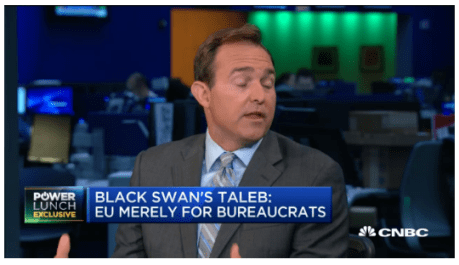
On the practical level Nicholas Nassim Taleb proposes that we should shift our focus from trying to determine which is the best option in a given situation to doing our best to avoid choosing the obviously wrong ones.

‘Obvious’ to those who do not allow themselves to become mesmerized by the illusion that ‘best’ can be identified, o course.

About 8 years ago a girl meets a guy and they get married.

After four months her family intervenes and helps her get out of a dysfunctional relationship.

He starts another one, has a son, and later kills 50 people in a gay bar some time after a gay couple kissed each-other in front of his child.
“They were kissing each other and touching each other and he said, ‘Look at that. In front of my son they are doing that.”

Isn’t this whole thing very descriptive of the situation we are facing now?

Her family noticed something was wrong – he was abusing her – and helped her out.

Eight years later – after having another relationship, after being investigated by the FBI and issued a gun permit – he snaps and kills 50 people.

Where was his family? His friends? His neighbors? His co-workers?

“In other words, Mateen who according to preliminary reports, had been on a terrorist watchlist, and who still managed to obtain weapons thanks to his various licenses and permits just last week, was employed by one of the world’s largest security companies”.

More than 100 years ago, Emile Durkheim, a French sociologist, discovered that suicide, while being a very personal decision, is heavily influenced by the strength and quality of  the social relations that connect the concerned individual to the rest of the society.

I’m not going to argue now that most acts of terrorism, specially the ones perpetrated in the last 20 or 30 years, are of a suicidal nature. They are but this is a somewhat different problem from what I have in mind right now.

What I’m afraid of is that we, in the West, are killing ourselves.

As a society.

We have stopped caring about the guy next door to the tune of no longer being able to notice that he has become crazy and is about to start shooting.

Left and right.

Us.

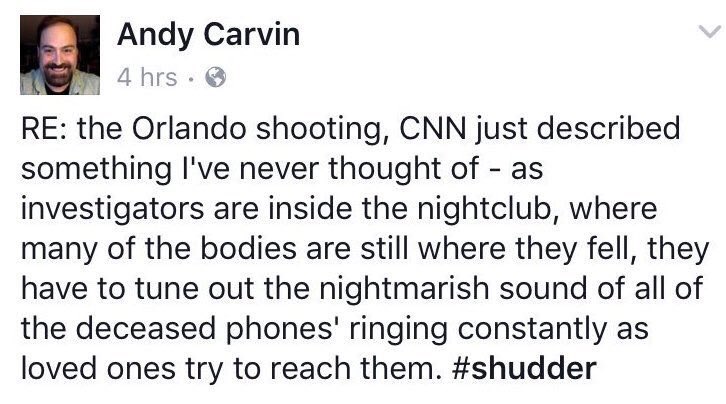
Let’s wake up, before there will be no one left to answer the phones.

phones ringing

8d99cf9b636a698e5bb1d4c6644dcc84

The moment we try to appraise the value of human life, in monetary terms or in any other way, is the threshold to man made hell.
By simply accepting the notion of collateral damage – that the ‘ultimate goal’ might be considered important enough to justify damage suffered by innocents – we enter the realm of ‘fantasy world’.
The place where wishes trump reality and where desires are considered – by those who entertain them, of course – more important than anything else.
In this realm people cannot get along with each-other, simply because they cannot find any common ground. Whenever a group of people accepts the notion that one life can be considered more important than any another – that individual human lives can be ‘filed’ according to their individual values, sooner or later its members will start fighting each others for preeminence.
‘Top dog’ position becomes not only desirable but also the only thing a ‘rational’ individual will ever pursue. Simply because no other position comes even close and because, by agreeing that human life can be appraised, the members of that group have proclaimed that ‘social life’ is more about competition than about cooperation.
The problem with ‘no holds barred’ competitions being that some of the spectators think they are fun to watch while those in the pit discover very quickly that survival is almost impossible but for the briefest lengths of time.